|
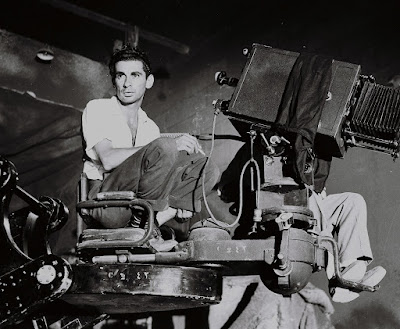
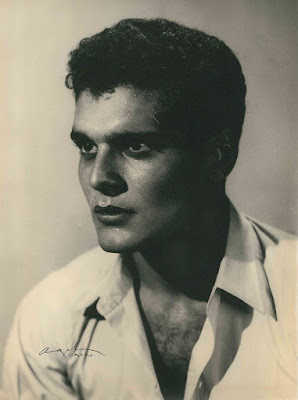
| Director Youssef Chahine |
CAIRO STATION (Bab el Hadid) A- aka: The Iron Gate Egypt (77 mi) 1958 d: Youssef Chahine
This is Cairo Station, the heart of the capital. Every minute one train departs and every minute another one arrives. Thousands of people meet and bid farewell. People from North and South, natives and foreigners, people with and without jobs. —opening narration by Madbouli (Hassan el Baroudi)
Sparking controversy at the time of its release for its bleak portrayal of Egyptian society, exuding hostility, with Chahine claiming in an interview that they spat on his face on opening night (Youssef Chahine in Conversation with Tom Luddy on Notebook), causing such outrage that Egypt banned this film for over twenty years, yet it may be the director’s signature piece, exposing the social injustices in a fringe universe of exploited and impoverished workers who collectively form their own lower-end society among the larger surroundings of Cairo’s central railroad station. The entire film takes place over the course of 24-hours in this claustrophobic setting, an oppressive reality shot by Alvise Orfanelli in striking black and white, sort of a combination of neo-realism and film noir, veering into a horror thriller, where even today it’s a hard film to categorize. Few other films match this same level of bleak intensity, a grim and disturbing film dealing with human alienation, sexual repression, and social violence, where the railroad station becomes a microcosm of Arab society, full of constant motion, with trains simultaneously arriving and departing, accompanied by the everpresent bustle of passengers, from the ultra-chic to the everyday, ordinary, with unlicensed baggage porters frenetically vying against each other in an extremely competitive field, creating noticeable differences in social classes, even among the sub-strata of the poor confined to the station, yet it also has a melodramatic streak and a psycho-sexual turn foreshadowing Hitchcock’s Psycho (1960), finding an even more demented anti-hero fringe character with shattered dreams who resembles the lead, becoming shockingly discomforting at times. Chahine, himself, stars as a crippled, mentally unstable street vendor in one of Egypt’s earliest examples of a neo-realist film, a dramatic powerhouse that abandons the fantasy world of Egyptian studio films, namely the reliance on musical numbers, closed sets, and movie stars, and instead utilizes actual locations, with a brisk economic style that resembles the urgency of the French New Wave, though Chahine hasn’t abandoned the musical number entirely, still featuring a simply amazing comprehension for staging nothing less than an incredible musical sequence right in the middle of the most powerful, dramatic scenes. The introductory narration comes from Madbouli (Hassan el Baroudi), an elderly owner of a kiosk inside the station who takes in Kenawi (Chahine) from a homeless street urchin, giving him a job selling newspapers, and even finding him an abandoned ramshackle shack to live which is also nestled inside the station. Looking after him like a supportive father, Kenawi hops around on one good leg, wearing an old woolen cap, moving around between all the other activity, often an object of ridicule or derision, not ever taken seriously, ignored as an invisible presence unless he gets in somebody’s way, whereupon he’s kicked aside or beaten, as one might expect with a wayward dog on the loose. Caught staring at a married woman, her husband gives him a thorough thrashing, blaming his own wife afterwards for not wearing a hijab headscarf. As we follow him around back to his makeshift home, the walls are lined with magazine pin-up girls, revealing a deep-seeded sexual obsession burrowed under the surface. Groups of women sell cold drinks, carrying ice buckets with them, scurrying around between the trains, often putting themselves in harm’s way to avoid arrest, where Hanouma (Hind Rostom) becomes a central figure, engaged to Abu Siri (Farid Shawqi), a burly porter who is attempting to unionize the workers to get out from under the exploitive and abusive control of Abu Gaber (Abdel Aziz Khalil). Despite having knowledge of their impending marriage, Kenawi obsesses over Hanouma day and night, drawn to her vivacious and openly flirtatious personality, as she is everything he is not, sexually liberated, loud, and outgoing, following her around like a lap dog, as she enjoys the flattery and attention, often joking with him, but never once takes him seriously, and instead ends up laughing in his face following a marriage proposal, played out under the shadow of a Ramses statue, which sends him into emotional despair, his dreams of a better life outside the station completely shattered.
This film marked a radical departure from Chahine’s earlier films, shot on location using a dizzying hand-held camera, relying more upon a meticulous visual design than the use of dialogue, employing crowd scenes and moving trains, where the grand architectural setting of the station tends to dwarf the people who use it every day, featuring people from all walks of life, from youth dancing outrageously to rock ‘n’ roll music to more tightly reserved religious men, from peasants to middle-class train passengers. Those who are well off tend to travel through the station, only lingering temporarily, while for the poor this represents their everyday reality. The groups never come together, as the transience of the station has them all moving in different directions. Kenawi’s destabilized world finds protection in his little tin shack, which is a retreat from reality, observing everything around him, as he is the eyes and ears of the station, yet he is marginalized, ostracized by all social groups, but yearns for a better life outside the confines of the station. What was initially viewed as negative depictions of the Egyptian poor later became a symbol of protest against the economic exploitation of the brutally harsh conditions among the working-class poor. The initial casting against type startled audiences, as the well-known Egyptian movie stars were playing ordinary people who couldn’t be less glamorized. Chahine, whose casting of himself in the film was highly unorthodox, gave himself third billing, though the story revolves around his character, as he had difficulties using other actors to play his on-screen persona, yet his portrayal of a cripple was so convincing that the Berlin Film Festival jury mistook him as a cripple. His deeply sympathetic portrayal of a multi-dimensional character who was not only filthy and repulsive, yet physically deformed and mentally disturbed, with an engaging charm while in the presence of Hanouma, where it’s one of the film’s strongest attributes that he humanizes an outcast character most movie stars would refuse to play. Chahine always viewed himself as an outsider, a bisexual, non-believing Christian in a predominately Muslim society, the child of an immigrant family, born to a Greek mother and a Lebanese father, and a product of the complex cosmopolitan culture of pre-War Alexandria. Yet what is most remarkable is the integration of various movie genres, as it mixes social commentary with lighthearted comedy before delving into psycho-sexual horror. It’s important to note the double standard of the police authorities, who pretty much allow the unlicensed male porters to fend for themselves in a Darwinian dog-eat-dog environment, refusing to intervene, while routinely chasing after the women to arrest them for illegally selling their drinks, earning a mere pittance, completely avoiding Mansour, the food and beverage profiteer who routinely sends the police after them for cutting into his business. This plays into a portrait of an unjust society, accentuated by an ironic scene where a feminist orator from the Association of Women’s Rights with a loudspeaker at the station speaks about the abysmal working conditions for women in rural areas, where her words are largely ignored, as they can’t penetrate the lower-class stratosphere where these women reside. Hanouma, for instance, largely accepts the everyday reality of women struggling to make a living in a man’s world, as they control all the purse strings, but that also leaves her subject to the antiquated patriarchal attitudes about keeping women in line, where they’re not even married yet but Abu Siri still regards her as his possession, giving her a thrashing whenever she disobeys his orders, conditions that seem all too commonplace.
Easily the most audacious scene of the film takes place when a group of young people board a train, a tribute to the burgeoning international youth movement, as they’re carrying musical instruments and start playing rock ‘n’ roll music, played by members of Egypt’s first indigenous rock band, Mike and the Skyrockets, frolicking about, dancing wildly on the train, which draws the curiosity of Hanouma, who initially just stares at the wild gyrations of a female dancer before passing out drinks to everyone, eventually joining into the musical jubilation, with Kenawi’s face plastered to the train window, offering him a drink as well, instantly mimicking her dance movements, though he remains “outside” the train car, never really able to join in. This scene of Western music in a strict Muslim society surely has an edge to it, and may have been viewed as blasphemous, but it adds a sense of elevated bravado to an otherwise downtrodden group, offering them a cinematic sense of liberation, even if short lived. It’s a very forward-thinking decision, looking forward to that day when woman can enthusiastically express themselves with the same uninhibited vitality as men in a male-dominated Muslim society, though half a century later that day has yet to come. Once Abu Siri gets a glimpse of her dancing jubilantly, he chases her into an abandoned warehouse and violently beats her, where she can be heard screaming with remorse, yet then she’s seen provocatively lying in a stack of hay, as if luring him on, changing the entire complexity of the moment with her sexual allure, concluding with a behind-the-scenes sexual union. Abu Siri is established as a sexual predator, yet the scene confusingly blurs the lines between sex and violence. Kenawi witnesses all this, yet we’re unsure how he’s processing it, as he never comes to her defense, with the machinations of his mind still agitated and infuriated from her earlier rejection. There’s another sequence where the women think Hanouma is too full of herself, an exaggerated exhibitionist, so they splash water on her to cool her down, getting a giddy satisfaction out of a good-natured drenching as their own kind of payback, sending Hanouma into an empty train car sopping wet, with the male gaze of the camera finding the outlines of her underwear underneath the snug fit of her clothes against her skin. After peeling off her dress, she stands in her soaking underwear, unaware that Kenawi is hiding nearby, watching her, staring at her exposed body, fixated on what he sees. He is a voyeur, gazing at women who are unaware of his presence, so when she sees him in a mirror, she chases him away, ashamed and humiliated, and more than a little sexually frustrated, as Hanouma’s female friends throw stones at him. Chahine also objectifies the deformed body of Kenawi with close-ups of his face and body, often accentuating the look in his eyes, a pained expression of repressed desires. When Madbouli reads a newspaper article about a ghoulish crime where a knife-wielding serial killer cuts a woman’s body into pieces and places the parts in a suitcase, it sparks his own payback, planning his own devious attack against Hanouma. His inability to possess his own object of desire leads to an urge to prevent anyone else from possessing her. But in his own twisted mind and darkened state of confusion, he mistakenly kills Hanouma’s friend instead, stashing the body inside a crate containing Hanouma’s clothes, which she is transporting by train to the site of her anticipated wedding to Abu Siri. Like Hitchcock’s Psycho, a gruesome stabbing is equated with sexual satisfaction, with Kenawi eventually hauled off in a straightjacket. Another clever narrative device is opening and closing the film with an attractive young woman waiting for her boyfriend at the station, who arrives with a wife and children in tow, so it is an illicit affair, with the film closing with a shot of this same lovelorn woman on the train platform sadly waving goodbye, offering a contrast to the Chahine character, each bordering on the thin line between love and obsession.