 |
Mahalia Jackson with Mayor John Lindsay
|
 |
Mayor John Lindsay
|
 |
Lindsay escorted by Black Panther security
|
 |
Chambers Brothers
|
 |
Abbey Lincoln
|
 |
Rev. Jesse Jackson
|
 |
5th Dimension
|
 |
| Billy
Davis and Marilyn McCoo |
 |
Gladys Knight and the Pips
|
 |
Stevie Wonder
|
 |
B.B. King
|
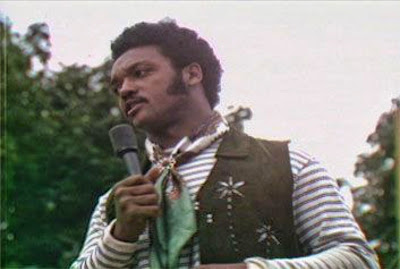 |
Rev. Jesse Jackson
|
 |
Mavis Staples (left) with Sister Mahalia Jackson
|
 |
Hugh Masekela
|
 |
Sly and the Family Stone
|
 |
Nina Simone
|
 |
| Amir “Questlove” Thompson |
 |
Hal Tulchin, 1969
|
SUMMER OF SOUL (…Or, When the Revolution Could Not Be
Televised) B+ USA (118 mi)
2021 d: Amir-Khalib “Questlove” Thompson
Sitting on the shelf for 50-years, this documents the 1969
Harlem Cultural Festival, a series of six consecutive summer Sunday afternoons from
June 29 through August 24, featuring some of the best black musical talent for
free, but overlooked as it took place the same time as Michael Wadleigh’s epic
documentary of a watershed, countercultural music festival, WOODSTOCK (1970),
which took place 100-miles away in upstate New York. Wadleigh’s mostly white film received all the
media attention, winner of Best Documentary at the 1971 Academy Awards, though
some months later the West coast wanted their own version of “Woodstock West,”
holding a free concert at the Altamont Speedway 60-miles East of San Francisco,
which turned into an unmitigated disaster when the Hell’s Angels, supposedly
paid to provide security, murdered a young black man just 20-feet in front of
the stage as the Rolling Stones were playing, captured in Albert and David
Maysles and Charlotte Zwerin’s Gimme
Shelter (1970). While those films
drew attention, this film shot in Harlem floundered, as footage was never
edited, and was eventually forgotten, shot by TV producer Hal Tulchin using 5
cameras at what was then Mount Morris Park (later renamed Marcus Garvey Park),
drawing over 300,000 people, designating the film “Black Woodstock” in order to
garner attention, but no distributors at the time would finance a film, so
50-hours of unedited film sat unused until the project was turned over to Ahmir
(Questlove) Thompson, a drummer, deejay, record producer, and founder of the
Roots, best known as the house band for Jimmy Fallon, who edited the film,
adding several current voices along with a healthy mix of concert footage,
creating a musical stream-of-conscious montage on the developing black
identity, assembling historical footage that provided the backdrop, helping
modern day viewers digest just exactly what transpired that summer. Winner of the Grand Jury Prize for a
Documentary and the Audience Award at the 2021 Sundance Film Festival, this
film joins the 1972 found footage of Aretha Franklin singing gospel in church,
as documented in Sydney Pollack and Alan Eliot’s 2019
Top Ten List #5 Amazing Grace, another film that sat on the shelf for more
than four decades. These revival films,
for lack of a better term, take us back to a different era, providing
commentary on the state of the nation at that time. In the summer of 1969, blacks were still
called Negroes by mainstream media, reeling from the assassinations of
President Kennedy, his brother Robert during his Presidential campaign, the
Reverend Martin Luther King, and black Muslim minister and human rights
activist Malcolm X, each one of which took something out of the spirit of the
60’s, where social movements promised to deliver a more just society, yet this
never happened, instead replaced by the law and order rhetoric that carried
Richard Nixon into the White House in 1968, with Republicans adopting the Southern
strategy of exacerbating black and white racial tension in the South,
taking advantage of white resentment over the Civil Rights and Voting Rights
gains made by blacks, creating a polarizing effect still felt in the region more
than five decades later. A Presidential
Party intentionally excluding racial progress may help explain why the 1969
Harlem Cultural festival was minimized to such an extent and so completely
overlooked, as there were simply no positive stories about blacks at the time, a
community that was largely disillusioned, as instead stories permeated around
the killing of Black Panthers, lost lives in Vietnam where a majority of the
returning dead were blacks sent to the front lines, massive arrests and
incarceration of black people, where even on television blacks were continually
associated with the criminal element, typecast as petty thieves, junkies,
prostitutes, or drug pushers. This may
account for such radically differing views heard at the festival towards the
heralded moon landing that summer, as whites were completely enthralled while
blacks seemed more blasé, believing the money could be better spent feeding
poor people in America.
The film sat in Tulchin’s basement all those years until he
died in 2017, at which point producer Robert Fyvolent found out about it and
bought the rights, hiring Questlove to assemble a film from the massive footage,
tracking down several people who attended the festival, adding a few
commentators, including several of the performers themselves, giving the film a
more personalized glimpse at the historical implications. It’s not really a concert film, as
performances are continually interrupted, which is the film’s biggest flaw, becoming
instead a cinematic essay of historical context, drawing parallels to the
summer of 2020 following the killing of George Floyd and the subsequent Black
Lives Matter social protest movements around the world that arose from that
event. So the opening moments are a bit
jagged with talk as it takes its time finding a musical rhythm, peppered with archival
material about the social injustice of the times, but unless you lived through
it, most people will have little understanding of what the 60’s were like, as
women and minorities were routinely overlooked, still relegated to the margins
of political rhetoric and speeches, not yet obtaining their rightful place at
the table of American democracy, where sexism and racism were still the
norm. So this black music festival, an
oasis of harmony and tranquility, went largely underreported, flying under the
radar, as few whites participated, so it was never part of any mainstream media
which still largely appealed only to whites.
Little coming out of Harlem was ever mentioned on American airwaves, so
this film revives all that was initially missed, providing a modern era
perspective that glorifies the pride and beauty of being black, celebrating black
heritage through the power of music. As
blacks took to the streets after the assassination of Martin Luther King,
creating a succession of infamous burnings in more than 100 cities across
America, much of what was destroyed has still not been rebuilt some 50 years
later, with many New York politicians fearing a recurrence of more uprisings on
the anniversary of King’s death one year later, so there was a train of thought
that these musical offerings in Harlem were specifically designed to prevent
blacks from taking to the streets. The
contrast between the violent lootings and destruction of property with the
overall peace and harmony of this summer music festival couldn’t be more
pronounced, as there isn’t a hint of animosity or discord, instead this is one
of the earliest expressions of black unity and love, a kind of model for what
can exist in the future. Because an open
animosity existed between the black community and the mostly white police force,
the Black Panthers provided the security, an East coast version of the Hell’s
Angels providing security at Altamont, though a small police presence
eventually made its way to the festival.
While sponsored by Maxwell House and the New York City government, without
money for lights, the entire festival took place during the day, where the
stage faced the natural light of the sun, always keeping the performers in the
light. That left the audience out in the
sun as well, with many quickly finding shady spots, but most were left exposed
to the sun, where the relaxed nature of the event was like an outdoor barbeque
with family and friends. The emcee for
the event is Caribbean lounge singer and concert promoter Tony Lawrence, originally
from St. Kitts, an employee of the parks and recreation department of New York
City and a man described as “a hustler, in the best sense,” introducing New
York Mayor John Lindsay, a liberal Republican, who showed up in the right
places, and Stevie Wonder, just age 19 at the time, before he broke from Motown
and became a megastar on his own, singing The Isley Brother’s “It’s Your
Thing,” before breaking into a drum solo, appearing later singing “Shoo-Bee-Doo-Bee-Doo-Da
Day,” where he ended up furiously playing lower register bass notes on the
keyboards until someone came and re-centered his position back to the
middle, The Chambers Brothers follow singing
“Uptown,” also B.B. King playing the blues, Gladys Knight and the Pips singing
“I Heard It Through the Grapevine,” David Ruffin, a soloist breaking away from
The Temptations, sings “My Girl,” with the 5th Dimension singing the medley “Aquarius/Let
the Sunshine In” from the extraordinarily popular Broadway musical Hair, while the married couple Billy
Davis and Marilyn McCoo are seen watching a video of themselves, marveling at
how young they were, but also happy they were finally gaining acceptance by
blacks, as hearing them on the radio many thought they were white. The music is more in the background as Rev.
Al Sharpton and others remind us of the fractious times, with the black
community split between following the non-violence of Dr. King and the more
militant Black Power branch of Stokely Carmichael that wanted a black revolution.
While there are a host of attendees and commentators
offering their own perspective of the festival, where their voices are mixed
into heavily edited footage, the stream of music doesn’t really get rolling
until the gospel section, starting with the Edwin Hawkins Singers with “Oh
Happy Day,” featuring Shirley Miller as the soloist, a moving and extremely
uplifting hit that crossed over into mainstream radio, shooting to number one
in the San Francisco Bay area, where it played regularly, eventually touring
with secular artists, drawing the ire of religious groups that condemned them, yet
they were extremely devout, preaching the gospel through music and spreading
the spirit, finding a new generation of followers. But the true star is none other than Chicago’s
own Mavis Staples, a soulful force who becomes the emotional core of the film, first
appearing with her sisters Cleotha and Cynthia along with the strumming
electric guitar of Pops Staples and the Staple Singers, singing the lead in a
rousing version of “Help Me Jesus,” clapping their hands, rocking the house,
using the call and response style which simply wakes up the audience and fills
them with a joyful spirit, with Mavis providing the commentary, taken aback by
the size of the crowd, all having a good time, so she felt like celebrating
with them. As a popular group, they were
invited to Folk, Jazz, and Blues Festivals, where every kind of music is heard
in their songs. Pops was born in
Mississippi where picking cotton was part of his black heritage, where the songs
they played is what he heard with his family growing up in the Mississippi
Delta. A group of gospel singers follow,
where spirit possession is part of the black religious experience, differing somewhat
from white Christianity (with the possible exception of the Holy Rollers), as
it comes from Africa, with the body erupting with the Holy Spirit seeking
catharsis and a peaceful release. According
to Rev. Al Sharpton, “Gospel was more than religious. Gospel was the therapy for the stress and
pressure of being black in America.”
Psychiatry never made much of a presence in black communities, but they
did have Mahalia Jackson, the most influential gospel singer in history,
selling more than 22 million records during her lifetime. According to journalist Charlayne
Hunter-Gault, one of the first blacks admitted to the University of Georgia,
“Gospel’s part of our DNA. It’s deep in
the recesses of our consciousness…During the Civil Rights Movement, the church
provided sustenance for us, helped us march on, helped generations of people
confront some of the most vicious, violent acts.” She’s speaking from experience, as she
recalls being harassed by white students at the University of Georgia, making
noise and stomping on the floor directly above her, but she drew strength and
comfort from listening to Nina Simone records.
The highlight of the film is the incredibly moving sequence of Mahalia
Jackson singing Dr. King’s favorite gospel song “Precious Lord” along with
Mavis Staples, who idolized Mahalia Jackson, where the opportunity to sing with
her is filled with reverence and supreme admiration, perhaps the only unedited
song heard to its completion in the entire film, with the musical backing of
Ben Branch and the Operation Breadbasket Orchestra and Choir, where Rev. Jesse
Jackson sets the stage, describing the exact moment in Memphis when Dr. King
was shot, claiming he referenced the song in his final words, creating a pall
of silence, with Mavis Staples filling the void, instantly taking command of the
song with that soulful and earthy voice before Mahalia Jackson takes over for
the next verse, setting a moral tone of power and conviction, eventually
releasing it back to Mavis, who describes this as the biggest honor of her
entire life, Mahalia
Jackson in 1969 Summer of Soul - Take My Hand Precious Lord ft. Mavis Staples
YouTube (1:45). A conglomerate of
musical styles are heard, artists that crossed genres, like Cuban percussionist
Mongo Santamaría performing “Watermelon Man,” Puerto Rican percussionist Ray
Barretto performing “Abidjan” and “Together,” the innovative jazz of Abbey
Lincoln and Max Roach, or Hugh Masekela singing an adaptation of a traditional
African folk song built around almost Brazilian percussion before launching
into “Grazing in the Grass.” This is the
prelude to the incomparable Nina Simone, the High Priestess of Soul, who
immediately sets the standard by acknowledging “How can you be an artist and
not reflect the times?” Channeling black
anger into a defiant song of protest, she opens with “Backlash Blues,” a
scathing protest poem by Langston Hughes that Simone set to music, ferociously
pounding on the keyboard, unleashing the indignation and fury of being treated
like a second class citizen, before singing what became a black anthem, “To Be Young,
Gifted and Black,” finally reading a fiery musical recitation of an inspirational
poem of black unity by David Nelson of the Last Poets. The Bay area’s Sly and the Family Stone literally
blew some minds, with his brother Freddie on guitar and sister Rose on piano in
her white mini-dress and white wig dancing and singing backup, a predecessor to
the multiracial and genre-bending Prince, as they had a white drummer and white
saxophonist, something many had never seen before, with a knockout female
trumpet player, Cynthia Robinson, performing the fist-in-the-air song “I Want
to Take you Higher,” exactly as it would be done at Woodstock weeks later, unleashing
a frenzied energy of unabashed freedom, literally dancing up a storm onstage,
instantly elevating the excitement level to a fever pitch, while earlier they
performed “Everyday People,” generating the largely ignored plea for peace and
equality between differing races and social groups, including the global refrain,
“We got to live together.” Largely
forgotten but deeply humanizing, the experience speaks for itself, as the event
lays the groundwork for the formation of a new black identity.
Postscript
In the months that followed, a series of setbacks occurred
with the Black Power Movement in America, as that same summer Stokely
Carmichael fled to Africa to escape harassment and potential arrest by the FBI. Just prior to the festival, 21 New York Black
Panthers had been arrested and charged with planning a bombing campaign across
the city to coincide with the anniversary of Martin Luther King’s death. All were eventually acquitted. Later in December, Chicago Black Panther
Chairman Fred Hampton and fellow Panther Mark Clark were assassinated by the
FBI in cold blood in a pre-dawn raid, with no one from law enforcement ever
held accountable. A year later, Angela
Davis was arrested on gun charges used in the murder of a judge, also acquitted
after a lengthy trial, splintering the movement, as the Black Panther Party and
other black liberation activists were constantly harassed and deeply
infiltrated by FBI informants, leading to a barrage of arrests, while at the
same time they were vilified by the mainstream press, losing public support, causing
infighting and violence while running out of money, bogged down in legal fees
from the multitude of arrests of its members, becoming ever more isolated,
losing public relevance, as membership continued to dwindle over the next
decade. Less than a year after her
appearance in Harlem, Nina Simone left the United States, going first to
Barbados, and then to Liberia, returning only sporadically to perform over the
next several decades, becoming more reclusive in the years that followed. Essentially, the revolution that so many
anticipated, simply never happened, suppressed by a significantly increased police
presence in America, killing or incarcerating the most outspoken radicals, causing
the rest to flee the country or go underground, resurfacing decades later, typically
making plea agreement deals with the government. By 1983, America signed into law a national
holiday honoring Rev. Martin Luther King, observed for the first time in
1986.


