


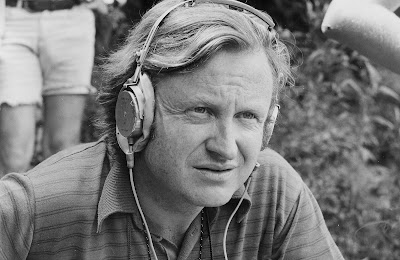
 |
| Director John Boorman |

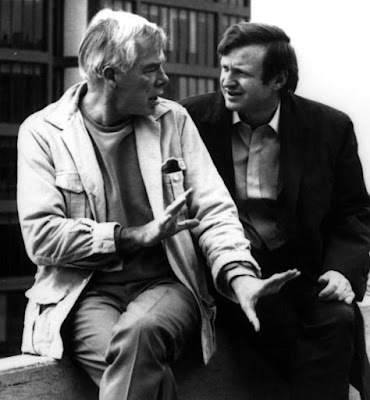 |
| Lee Marvin with the director |
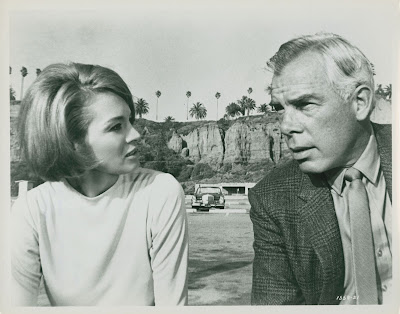 |
| Marvin with Angie Dickinson |
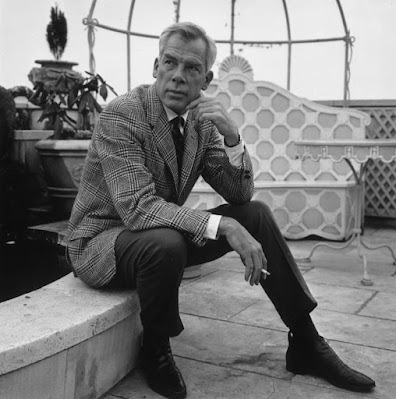 |
| Lee Marvin |
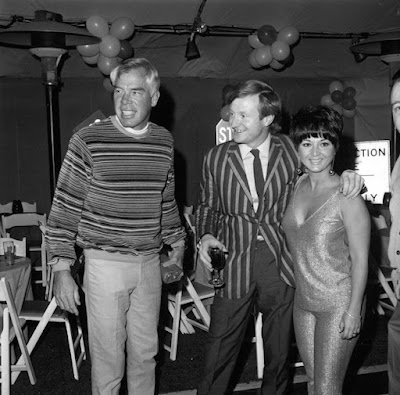 |
| Marvin and his girlfriend, Michelle Triola, with Boorman |
POINT BLANK A USA (92 mi) 1967 ‘Scope d: John Boorman
Lee Marvin got his start playing heavies, routinely cast in the role of villains, soldiers, or hard-as-nails tough guys, perhaps matching that rugged, granite-chiseled face that looks like it’s been around the block a time or two and seen things, a former WWII marine, wounded in action in the Pacific when most in his unit were wiped out, receiving a slew of medals and awards, but midway through his career he started playing rough and tumble good guys, continually growing in popularity, so by the time he made this film he was a bonafide star. With that came surprising autonomy in the granting of certain provisions from the MGM studio heads, where his contract gave him “script approval, cast approval, and approval of the key crew,” deferring unprecedented creative control to young British director John Boorman, who he had met in England while shooting THE DIRTY DOZEN (1967), yet maintained a central role in the film’s development, plot, and staging. What attracted them both to this film is the unstoppable force of the central character of Walker, played by Marvin, a master thief who goes up against the mob, or the Organization, in trying to get money back that was stolen from him after he was left for dead, originating as Parker in this adaptation of the 1962 crime noir pulp novel The Hunter by Donald E. Westlake, writing under the pseudonym of Richard Stark, the first of more than a dozen novels written around that same character. Adapted by screenwriter Alexander Jacobs, reworking what was already written by David and Rafe Newhouse, Boorman and Marvin have transformed what might otherwise be second rate material into a cinema cult classic in this heist gone wrong movie, an absurdist neo-noir crime thriller with links to such classic noir characters as Robert Ryan in On Dangerous Ground (1952) and Robert Mitchum in Out of the Past (1947), and perhaps even his own role in THE KILLERS (1964), yet told with deliberately disjointed scenes and a brightly colorful visual style that alters the look of all the other crime movies which are typically dark and shadowy. Ostensibly a revenge film replete with French New Wave aesthetics, told in a highly subjective yet non-linear style with plenty of flashbacks, jump cuts, slow motion, and a constantly shifting timeline where the present tense remains ever elusive. An unorthodox, avant-garde editing technique also completely transforms a standard-issue, B-movie gangster story into a jagged kaleidoscope of narrative ambiguity, a jigsaw puzzle of disconnected memories reverberating through Walker’s brain, using virtuoso technical bravado to flood the screen with mysterious dreamlike imagery and various pop art color schemes, Walker Coming For You | Point Blank | Warner Archive YouTube (1:38), amplifying the sounds of his footsteps when Walker arrives at the airport, even after the scene ends, building tension while creating a blurred sense of reality, shot by Philip H. Lathrob, a camera operator in Welles’ TOUCH OF EVIL (1958), making impressive use of “Scope compositions, using remarkably little footage, accentuating changing rhythms and off-kilter angles, often stopping in the middle of a shot, making it all but impossible for the studio to re-edit differently (as was their reputation), contrasting long and slow passages with sudden outbursts of violence that continually keep viewers on edge. With Marvin, minimal dialogue suited him best, often resorting to none at all, instead simply lurking in the shadows, or sitting stupefied on a sofa or in a corner, completely exasperated and emotionally spent by the taut intrigue from the accumulating tension of the circumstances, with an expressive face and restless yet contained energy, ideally suited for this offbeat existential thriller that feels timeless, but was not a box-office success when it was released, yet has elicited volumes of critical praise ever since, now considered one of the seminal films of late 1960’s American cinema. The film bears a similarity with the existentialist, avant-garde style of Arthur Penn’s Mickey One (1965), an obscure yet utter revelation in experimental modernism, going even further into the extreme than this film, yet made several years earlier, while Clint Eastwood copied the formula of an avenger returning in a quasi-supernatural form in two of his westerns, High Plains Drifter (1973) and PALE RIDER (1985).
Subject to multiple interpretations, exploring the systematic bureaucracy and depersonalization of crime, a nihilistic sense of despair, while also offering a profound meditation on trauma, the film thrives simply by the force of what appears onscreen, among the most extraordinarily bleak visions of Los Angeles, in particular, rivaling The Long Goodbye (1973), CHINATOWN (1974), Blade Runner (1982), The Limey (1999), which certainly emanates from this film (Point Blank (John Boorman, 1967) and The Limey - Simon's ...), or MULHOLLAND DRIVE (2001), becoming an integral character in the story, relocating much of what in the book took place in New York to Los Angeles, with its vibrant sense of artificiality and empty sterile space. According to Thom Andersen in his illuminating cinematic essay Los Angeles Plays Itself (2003), “People who hate Los Angeles love Point Blank. British director John Boorman managed to make the city look both bland and insidious.” The film is littered with used car dealerships, strip malls, parking garages, and a maze of concrete landscapes, like the concrete pillars beneath the Four Level Interchange and the now demolished Sixth Street Viaduct overlooking the drainage canals of the Los Angeles River, reduced to just a trickle, standing in stark contrast to the glass and concrete of the towering downtown skyscrapers, often shot from oblique angles, with modern architecture contributing to a coldly oppressive atmosphere, providing a brutal backdrop to Walker as a phantom haunting the underworld, wandering around a wasteland as if stuck in purgatory, a netherworld Terminator trying to understand his place in this constantly shifting, labyrinthian environment that devours human souls. Walker is one of those Mephistophelian characters that seems to have made a pact with the devil, as his mere existence is suspect, turning this into a ghost story, an avenging angel demanding retribution for past sins, brutally shot by his treacherous business partner Mal Reese (John Vernon) after ambushing a mob helicopter drop on a deserted Alcatraz Island (the first film to shoot on location there after the prison closed in 1963), with Reese greedily taking his partner’s share of $93,000 in order to pay off the $150,000 he owes in mob debts, crawling his way back into respectability, taking Walker’s wife in the process, Lynne Walker (Sharon Acker), while a bullet-riddled Walker is left for dead in an abandoned prison cell, Point Blank (1967) -- (Movie Clip) Open, How Did I Get Here? YouTube (3:01), where his initial comments of “We blew it” echo a prominent fatalistic theme resonating at the end of Easy Rider (1969). Exhibiting sustained brilliance in the opening sequence, revealed through fractured imagery, like a series of jarring, reassembled memories, with jazzy, melancholic music by Johnny Mandel, Point Blank (1967) -- (Movie Clip) Battle Of Alcatraz - TCM YouTube (3:32), the indestructible Walker rises from the dead, crawls out of his cell, climbs over the high barbed-wire fence, and miraculously swims his way to shore, a Herculean feat rarely, if ever, accomplished even under the best of circumstances. Juxtaposed against this momentous opening sequence is a sight-seeing boat tour of Alcatraz with a fully healthy Walker onboard with Yost (Keenan Wynn), another enigmatic figure, not exactly friends, but together they scour the criminal underworld for unfinished business, with the tour revealing the perilous nature of the freezing water and deadly currents that deter anyone from even trying to swim ashore, with the tour guide suggesting there is no conclusive evidence that anyone has ever made it to the mainland. In reality, there is only one instance of a successful prisoner escape by swimming, John Paul Scott in 1962, yet arrived on the shore so thoroughly exhausted that he was left unconscious, only to be resuscitated by police and immediately rearrested, Escapes from Alcatraz Gallery: Escape No. 14 - SFgenealogy. Curiously, despite stalking a host of mob figures, Walker never kills anyone onscreen, yet people around him die under mysterious circumstances, none with more eerie calm than his ex-wife Lynne, resurfacing in Los Angeles in search of Reese, shooting up the bedroom mattress, only to find he’s not in it, collapsing in a disappointed heap afterwards, where the room furniture has mysteriously disappeared, with his wife narrating the scene in a long, extended monologue without a trace of emotion, as if speaking to herself with a sense of final resignation, committing suicide by sleeping pills in the other room while the unsuspecting Walker broods about what might have been.
Walker is a no-nonsense figure who only asks direct questions while searching for information, going through the ranks of mob figureheads, usually breaking into a room unannounced, taking someone completely by surprise, strong-arming them into confessing what they know, refusing to leave until they spill the beans, yet his often wordless manner completely transforms the figure of a gangster, deriving a certain amount of black humor in his old-fashioned, brutish antics, a lone wolf up against an entire organization, where these mobsters aren’t as much surprised that he was able to breach their security as they are bewildered and positively astonished that anyone would still resort to such reckless daredevil tactics over such a measly sum. Angie Dickinson made three movies with Marvin and has a prominent role as Lynne’s attractive sister Chris, clearly exuding sexuality, owner of a nightclub that was previously run by her husband, the love of her life, wiped out in a disagreement with the mob, yet still runs the place to make a living, making regular payments to the mob as the price of doing business, so there is plenty of instilled resentment that Walker cleverly utilizes to his own advantage, flushing out the whereabouts of Reese, who is protected like Fort Knox in the Penthouse Suite of the Huntley House in Santa Monica, but Walker stealthily finds an opening, Point Blank (1967) -- (Movie Clip) Men Everywhere - TCM YouTube (2:54). Infuriated that he is void of emotion and won’t give up on his robotic quest, Chris furiously beats him on his chest until collapsing from sheer exhaustion, turning on all the modern electrical appliances in the kitchen, voicing her displeasure over an intercom like the voice of the omnipotent, believing it’s only a matter of time before he gets killed, that he’s living like he’s already dead, lee marvin vs. angie dickinson YouTube (4:18). This was the same home rented by the Beatles in 1966, located at 7655 Curson Terrace in Beverly Hills. Blending the past, the present, and the future, the film is an amalgamation of Walker’s troubled memories, constantly referred to as already being dead, repeating the ominous opening shot sequence multiple times lest we forget, yet his obsession with righting past wrongs adds a kind of fantasy, wish-fulfillment twist, where violence is a conditioned reflex that seemingly justifies his overall ruthlessness, lost to himself and all that remains human, having no other recourse, where obliterating all obstacles in seeking justice is the only thing that matters. Walker is a destructively amoral force conjured up to even the playing field, joining the ranks of all the rest of us seeking answers for having been burned or cheated by capitalism running amok, by the standard cutthroat tactics of a ruthlessly corrupt government or big business, which we are powerless to stand up to, overwhelmed by all their contemptible power and monetary advantages that allows them to routinely step on and ignore the little people. Walker is the spirit of retribution, a symbol of our times, constantly questioning his own understanding of reality, finding a glaring contradiction between who we are and who we pretend to be. Throughout the film various mobsters are disguised as respectable members of the community, just a cover for money laundering and nefarious other sleazy business practices that allow them to routinely swindle the public. Keenan Wynn’s Yost may be the most devious surprise, as we’re led to believe he’s a federal agent of some sort with acutely reliable inside information, perhaps in on the scheme to track these mobsters down as there is insufficient evidence to prosecute, yet it turns out he’s also Fairfax, the man who writes the checks, deeply embedded into the hierarchy of the mob’s organizational structure with his own ambitious designs on taking over, using Walker to do the dirty work for him, leaving audiences in a moral quandary, as everything we’ve been led to believe is turned upside down. Under the illusion of free will and the American Dream, we are all trapped under the thumb of doing the bidding for some faceless disreputable force that can only maintain their power through deception, misdirection, and invisibility. No good guys, no bad guys, all in the same boat, where the entire systematic structure is rotten to the core, as organized crime continues to be embedded into the sanctuary of everyday ordinary life. Like INVASION OF THE BODY SNATCHERS (1956), you can’t get rid of them, as they’re literally everywhere living under a carefully protected façade of legitimacy. Self-deception may be our greatest weakness, where the medium is the message, and who among us can see through the all the layers of manufactured illusion and camouflage to get at the truth? And what is the truth? These kinds of unanswered existential questions lie at the heart of this boldly innovative film, asking just who we truly identify with.
'Point Blank': John Boorman's Amalgamation of American ... Koraljka Suton from Cinephilia & Beyond


