THE LONG GOODBYE A
USA (112 mi) 1973
‘Scope d: Robert Altman
The private eye is admittedly
an exaggeration — a fantasy. But at
least he’s an exaggeration of the possible.
—Raymond Chandler
With the opening and closing notes to the
self-congratulatory sound of “Hooray for Hollywood,” Johnny Scat Hollywood Davis -
YouTube (4:53), Altman’s film is a tribute to the Hollywood tradition, but
one that turns that tradition on its ear.
Beautifully balancing the Hollywood mainstream and the world of art
films, Altman chooses to make a genre film, one of about ten films made
portraying private eye Philip Marlowe, a character from the Raymond Chandler
novels, perhaps the greatest purveyor of film noir in the city of Los Angeles. When Chandler wrote his seven novels in the
40’s and 50’s, they were considered minor works, where the detective genre was
considered a dime store novel barely worthy of serious consideration, yet now,
along with fellow detective writers Dashiell Hammett and James M. Cain, they’re
considered a major influence on contemporary American literature. Born in the pulp magazines of the 20’s and
30’s, the private eye theme projected a modern era masculinity, where the myth
of the rugged individualism from the western frontier was brought into an urban
environment, where the private eye, usually working alone, was more independent
than a policeman, usually portrayed as cynical and hard drinking, often making
wise cracks at gangsters and cops on the beat, where they navigated the lurid,
subterranean realms of the city by living on the edge, going places the reader
dared not go, yet somehow remained untouched by the stain of moral squalor
surrounding him. With the introduction
of the film noir era of the 40’s and 50’s, these men became more tarnished by
the depravity that all but engulfed them, where walking in the shadows and
rain-soaked streets or through dark nightclubs and narrow alleyways became a
part of their routine, exhibiting a macho toughness and heroism, while adhering
to no particular moral universe, somehow stuck in their own claustrophobic
world, as their existential wanderings keep them continually outside the
mainstream comforts of society. Robert
Aldrich’s Kiss Me
Deadly (1955) and Orson Welles’ TOUCH OF EVIL (1958) go about as far as the
conventional 40’s noir genre can take them.
Chandler himself reportedly indicated Dick Powell was his favorite
Philip Marlowe portrayal onscreen in Edward Dmytryk’s MURDER, MY SWEET (1944),
an adaptation of his 1940 novel Farewell,
My Lovely, but he’s also quoted in a 1946 letter describing Humphrey Bogart
as Marlowe from Chandler’s first novel in Howard Hawks’ THE BIG SLEEP (1946):
Bogart … is also so much better
than any other tough-guy actor that he makes bums of the Ladds and the Powells.
As we say here, Bogart can be tough without a gun. Also he has a sense of humor that contains
the grating undertone of contempt.
Chandler’s protagonist Philip Marlowe, along with Hammett’s
Sam Spade in John Huston’s THE MALTESE FALCON (1941), are synonymous with film
noir, where in the 40’s Humphrey Bogart is the quintessential private detective
in both films, becoming the archetype against which all subsequent film
detectives were measured, where his tough-guy persona always oozes masculinity
while maintaining a sympathetic appeal, perfectly capturing the particular
flavor of Hammett’s and Chandler's hard-boiled style. Bogart had the perfect face for film noir, a
face filled with character, one that radiates a world-weary complexity, exuding
strength under fire, as if he had survived many battles before, where he was
right at home when seen with a drink in one hand and a cigarette in the other,
where his keen shrewdness reveals a man of principle with his own code of
honor, where his hard corps cynicism often covers up his essential decency
towards women and his own personal integrity.
Chandler was over 60 when he wrote The
Long Goodbye in 1953, written while his wife lay slowly dying, where the
novel is more contemplative than his earlier books, where the author clearly
understands that the era of the private eye is coming to an end, as the mean
streets of the city were rapidly expanding into the comforts and security of
the postwar suburbs, which sounded the death knell for pulp detective
writers. From Altman’s film, Martin
Scorsese’s Mean
Streets (1973) and Taxi
Driver (1976), Arthur Penn’s Night
Moves (1975), also Roman Polanski’s CHINATOWN (1974), filmmakers in the
early 70’s were returning to the film noir genre of the 40’s while re-examining
the dark underside of the modern urban world.
With the exception of Scorsese, who used young street punks along with a
disturbed and deeply alienated war vet, the other films utilize the detective
who has to respond to the changing cultural climate around him. During the Depression, the urbane wit of
William Powell in THE THIN MAN (1934) showed a sophisticated identification
with luxury and refinement, completely at odds with the seamy world he’d have
to enter while working on his cases, where there was little hint of any real
sense of danger. Bogart, on the other
hand, as Marlowe and Sam Spade, was a product of the 1940’s war years, where
he’d been to hell and back, maintaining a certain reserve about venturing into
dangerous waters, yet his sense of assurance in dealing with gangsters and
lowlifes defined his inner resolve and moral strength of character.
Scriptwriter Leigh Brackett, who co-scripted Hawks’s THE BIG
SLEEP with William Faulkner and Jules Furthman, was well liked by Howard Hawks,
as “she wrote like a man,” but when she was shopping around her screenplay of
Chandler’s last completed novel, which had never been made into a movie, both
Hawks and Peter Bogdanovich turned it down, with Bogdanovich recommending
Altman for the picture, but initially he also turned it down, as the studios
were pushing either Lee Marvin or Robert Mitchum for the role of Marlowe. It’s only when Elliot Gould’s name got
mentioned, an actor who hadn’t worked in nearly two years, that Altman
expressed an interest, as Gould is the antithesis of Bogart and the
conventional 40’s portrayal of Marlowe, a reinvention of the character in a
different time setting, where the film tries to recreate the morals of an
earlier time in the Los Angeles landscape of the early 70’s which had a
prevalence of hippies, was caught up in a health food craze, along with yoga
and transcendental meditation, where, according to Altman, “everything is
glazed in a haze of pot smoke,” all new stuff for Marlowe to grasp, where his
chain-smoking is contrasted with the health-conscious southern California world
where no one else in the movie smokes, an example of how out of touch he
remains with his surroundings. Of
interest, Bogart was age 47 when he filmed THE BIG SLEEP, while Robert Mitchum
was 58 when he played the part of Marlowe in FAREWELL, MY LOVELY (1975), while
Gould was only 34 in this picture. While
he remains a character out of step with the times, a private eye still charging
the 40’s rate of $50 dollars a day plus expenses, always seen wearing a dark
suit and tie while casual wear with open shirts is the theme of the day in
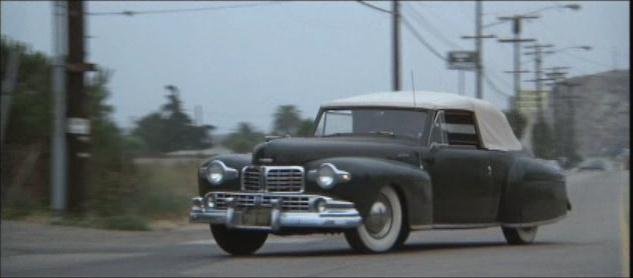
sunny LA, Marlowe drives a classic 1948 Cabriolet Lincoln Continental
Convertible (http://pics.imcdb.org/0ge24/244761-t8.jpg),
which was Elliot Gould’s own car. Gould
is younger, more of a smart aleck, who brings a brash irreverence to the role,
often seen mumbling to himself or completely lost in his own world, where he’s
downright insolent when interrogated by the cops, called a “smartass,” but his
sardonic wit and inspired humor can feel patently absurd, where he’s literally
a walking parody of the profession. Yet
according to Gould, Altman insisted that Marlowe was the only character in the
film with a conscience.
When the film was released, Raymond Chandler fans were
outraged, calling it a con job, as Altman had so completely subverted super
sleuth Philip Marlowe’s black and white film noir world of the 40’s into the
sunny, smug and self-centered, Southern California culture of the 70’s,
employing laser-sharp irony and comic wit, becoming one of the high points of
Altman’s career. Yet when the film was
initially released it was poorly attended and received bad reviews, linked to
misleading ads suggesting a crime fighter with a gun, hyping the tagline
“Nothing says goodbye like a bullet,” so Altman pulled it from the screens and
re-released it 6 months later using a more irreverent marketing campaign. Part of the ultimate success of the film,
besides the music and outstanding production design, is how much Gould seemed
to relish playing Marlowe in such a radically different way. The film was nearly dropped when Altman’s
longtime friend Dan Blocker died, whom Altman had known from their earlier days
of working together on the television show Bonanza
(1959-73). It was a stroke of genius to
replace him with Sterling Hayden, an actor with a reputation for being
difficult to work with, but he offers a towering, larger-than-life performance
as Roger Wade, one of the wonders of Altman’s creations, an alcoholic
Hemingwayesque writer with writer’s block, a supremely tormented soul living in
an idyllic residence with giant floor-to-ceiling glass windows overlooking the
beach in Malibu Colony, which, like his contemporary Cassavetes,
offered Altman the chance to shoot a film in his own house. Of note, Sterling Hayden wrote his own
scenes, taking his character to new levels, where the authenticity of his
eccentric nature helps define the uniqueness of the film. While earlier Chandler films feature plenty
of dialogue and snappy film noir voiceovers that narrate the story of the
novel, as Chandler wrote “with rude wit, a lively sense of the grotesque, a
disgust for sham, and a contempt for pettiness,” here Marlowe offers a
different style of commentary as he largely talks to himself in a kind of
incoherent muttering, where the ad-libbed opening sequence features Marlowe
with a cat (a superb performance by Morris the Cat before he became an
advertising star), in a rambling sequence where he tries to convince the cat to
eat an inferior brand of cat food, which he’s out of, going to great lengths to
convince this cat that he’s giving him what he wants, but the cat is not fooled
and runs away. It’s an interesting
comment on deceit and dishonesty, as the theme of the missing cat continues
throughout the film, but it also establishes that Marlowe is more loyal to his
finicky cat than anyone else around him.
According to Daniel O’Brien from his book, Robert Altman: Hollywood Survivor, THE
LONG GOODBYE has been described as “a study of a moral and decent man cast
adrift in a selfish, self-obsessed society where lives can be thrown away
without a backward glance ... and any notions of friendship and loyalty are
meaningless.” Marlowe lives atop the
Hollywood High Tower apartments, High Tower
Court: Hillside Living with a Private Tower ..., just around the corner
from the Hollywood Bowl, with a delicious overview of the city of Los Angeles,
where ironically just across the walkway is a group of topless or semi-clad
girls who still appear to be living in the Age of Aquarius, usually stoned out
of their minds, as they’re largely immune to the world outside, where they’re
continually seen on the shared balcony practicing yoga exercises or meditation
techniques, always attracting the gawking eyes of the male cops or gangsters that
happen to be paying Marlowe a visit. As
it happens, Marlowe is visited by a childhood friend, Terry Lennox, (Jim
Bouton, former Yankee pitcher, and author of the book Ball Four), who’s gotten himself into a scrape with his wife,
complete with scratches on his face, and needs a ride to the border at Tijuana,
which Marlowe gladly offers even though it’s the middle of the night. Upon returning back home, the police are
waiting for him, throwing him into the slammer when he refuses to cooperate
after questioning him in connection with Lennox’s suspected murder of his wife
Sylvia. He’s inexplicably sprung after a
few days when Terry Lennox’s body is found in Mexico, where his suicide appears
to confirm his guilt, wrapping up the case a bit too neat and clean for
Marlowe’s tastes, who remains suspicious of the police findings. After getting his picture in the papers as
part of a salacious murder exposé, it does instant wonders for his business, as
he’s hired by wealthy socialite Eileen Wade (former singing star Nina van
Pallandt in her first film role) to find her missing husband Roger Wade, a
famous novelist with a history of going on alcoholic benders. Of note, van Pallandt was the mistress to
Clifford Irving, an investigative reporter known for pulling off a hoax
autobiography of Howard Hughes in the early 70’s, allegedly written with the
cooperation of the reclusive billionaire, eventually exposed as a fraud with
the assistance of van Pallandt, who appeared in the Orson Welles film F FOR
FAKE (1973), a woman Altman immediately saw as a “Chandler blonde,” casting her
in three more of his films.
Marlowe’s frequent visits to the Wade residence take him
through the security gates of Malibu Colony, with the affable Ken Samson
playing the guard, where in one of the running jokes, in a community famous for
its movie star inhabitants, he does film impressions of Barbara Stanwyck, Cary
Grant, Jimmy Stewart, and Walter Brennan, adding a classical touch of Hollywood
within an industry genre picture. It
doesn’t take him long to track down Roger Wade, holed up in a local “drunk
farm,” a Burbank sanitarium run by Dr. Verringer, Henry Gibson in perhaps the
most despicable role in his career, playing a slimy psychiatrist who comes
across like an oily, snake-oil salesman, a loathsome quack of a doctor getting
rich off the perceived neuroses of the rich, a diminutive little man always
dressed in a white suit, seen more interested in getting paid than in providing
treatment. When Marlowe brings him home,
there’s obviously a riff between his wild, extroverted behavior and his more
reserved wife, who clings to their Doberman Pinscher dog, though he quickly
takes to Marlowe, calling him “Marlboro, the Duke of Bullshit,” inviting him in
for a drink, telling him, “I wish you’d take that goddamn J.C. Penney tie
off.” Nonetheless, the calm by the beach
with its sunny serenity belies the storm that will follow. Marlow has a run-in with local gangster Marty
Augustine, Mark Rydell, who directed ON GOLDEN POND (1981), who always
surrounds himself with hoods, but he claims Terry Lennox was working for him
and was carrying $350,000 of his money when Marlowe drove him to Mexico. Now that Lennox is dead, he’s come for his
money, smashing a coke bottle over his girlfriend’s face as a sign of the
seriousness of his intent, “Now, that’s someone I love! And you I don’t even like!” Marlowe makes a Mexican trip to visit the
good doctor who signed the death certificate confirming the details of the
death, yet when he returns, there’s a $5000 dollar bill in the mail waiting for
him from Terry Lennox in Mexico, and while the letter is delayed, it suggests
he may still be alive. Marlowe returns
to the Malibu Colony where Eileen Wade is throwing an upscale beach party,
where the drunken outbursts from her husband are interrupted by the little man
in the white suit, Dr. Verringer, who in the epitome of bad taste has come to
collect his bill, causing quite a humiliating commotion as Roger Wade throws
everybody out. Sticking around
afterwards, Marlowe is seen having an evening dinner with Mrs. Wade at the
window overlooking the ocean, where Eileen acknowledges she knew Sylvia Lennox,
who lived down the beach, something of a bombshell for Marlowe, which leads to
the most dramatically impactful sequence in the film. As they are at the window discussing the
latest revelations, Roger Wade can be seen out the window walking to the ocean,
where the camera zooms through the darkness to a close up as he throws himself
into the crashing waves of the ocean, where the thunderous sound elevates the
moment. Marlowe whips off his tie as
they both jump in after him, but it’s too late, with the two of them left in a
heap of exhaustion on the beach, with their frantic dog running back and forth,
jumping into the water to retrieve Roger Wade’s cane, a sure sign that he is
dead.
Eileen tries to suggest to Marlowe that her husband may have
been having an affair with Sylvia Lennox, and could possibly have killed her in
a drunken rage once their affair was exposed, but the police are disinterested,
claiming they already knew, and they’ve already closed the case. Meanwhile Marty Augustine picks up Marlowe,
again asking for his money, where Arnold Schwarzenegger in a non-speaking role
can be seen as one of his bodyguards.
Showcasing the reconstructed face of his girlfriend (apparently
discovered while working as a waitress in a Malibu restaurant, where according
to David Thompson’s book Altman on
Altman, she was at a party four years later with people super high on
drugs, where someone actually bit the nose off her face, in an example of art
imitating life), still hidden under all the bandages, Augustine is about to
reconfigure Marlowe’s body parts, when a package arrives, as Mrs. Wade has
dropped off the cash. Heading for her
Malibu home, Marlowe discovers Eileen Wade has sold the property and left for
parts unknown. When he sees her driving
down the street, he chases after her, yelling her name, but she ignores him, as
he’s eventually hit by another car and taken to the hospital, where a
mysteriously bandaged man in the bed next to him gives him the gift of a tiny
toy harmonica, which figures into the final scene. Convinced he has solved the mystery, he heads
back to Mexico, pays a visit to the good doctor and introduces him to the $5000
dollar bill, unraveling the final details of the story. Altman was so taken by Leigh Brackett’s
ending that he insisted upon contractual language so the studio could not alter
it, and it’s one of the best things about the film, paying homage to the final
scene in THE THIRD MAN (1949). It must
be said that this reinvention of the genre is something of a revelation, as it
obliterates the original model and sets this film in the oppressive light of
sun-bleached Southern California, where Los Angeles is a city of narcissists,
the land of Hollywood and all the broken dreams, a symbol of artifice and
illusion, described by Chandler as “the big money, the sharpshooters… the
grifters and con men and female bandits… the luxury trades, the pansy
decorators, the Lesbian dress designers, the riff-raff of a big hardboiled city
with no more personality than a paper cup,” where the city itself couldn’t be
more bored and indifferent to the concerns of its own citizens, “lost and
beaten and full of emptiness,” where for all it cares, they may as well vanish
and disappear from view.
While this may be a devastating portrait of broken
friendships, Marlowe spends nearly the entire movie trying to protect his
friend, remaining true to the idea of friendship, refusing to believe the
charges against him, and in doing so, believes every sort of lie that comes his
way. Just as emphatically, characters
remain cut off from one another, whether the oblivious girls on the balcony or
the more powerful Malibu characters seen through glass windows, where Wade and
his wife may be seen arguing, but we don’t hear a word, and instead see Marlowe
reflected in the image of the window as he strolls equally as clueless along
the beach. In Altman’s vision of film
noir, rather than a tough guy hero, the detective becomes a patsy, continually
lied to and manipulated by the motives of others, yet he continually goes with
the flow, even as he doesn’t comprehend the circumstances, where his catch
phrase throughout is “It’s OK with me,” a theme that persists in another form
in Nashville
(1975), becoming “It Don’t Worry Me.”
Today this has evolved to the all-to-often used phrase, “No
problem.” This was the third consecutive
Altman film shot by cinematographer Vilmos Zsigmond, beginning with McCabe
& Mrs. Miller (1971), which uses a similar post-flashing technique originated
(at least by Altman) in that film, exposing the original negative to a brief
flash of light, where the film negative, the essential source of the movie, is
permanently altered in the development, which has the effect of softening the
film, creating a more hazy, pastel feel, giving it the look of old postcards
from the 1940’s. It’s also a film where
the camera is never still, but continually moves throughout the film, adding a
depth of space, giving the movie the you-are-there feel of a hand-held camera
or cinéma vérité. In one of the more
improvisatory moments of camera movement, when Marlowe exits a bus in Mexico
and starts walking down the dirt road in town, the camera curiously changes the
focus to two dogs fornicating in the middle of the street. The musical theme, composed by John Williams
and Johnny Mercer, interestingly occurs throughout the film each time using a
different variation, from different singers or groups, including the Dave
Grusin Trio, Jack Sheldon, Clydie King, Jack Riley, the Morgan Ames’ Aluminum
Band, and the Tepoztlan Municipal Band during a funeral procession in Mexico,
but it can also be heard as supermarket muzak, a hippie chant, radio music, a
piano lounge, and even a doorbell plays the theme. It should be mentioned that Raymond Chandler
identified with the characters of this novel, showing autobiographical insight,
using them to comment on his own life, where much like Roger Wade, he became a
celebrity writer who was also a self-hating alcoholic clinging to ideals that time
had already passed by, where the novel detests the self-pity that propels much
of the action, beautifully expressed by Marlowe telling Mrs. Wade, “Your
husband is a guy who can take a long hard look at himself and see what is
there. Most people go through life using
up half their energy trying to protect a dignity they never had.”