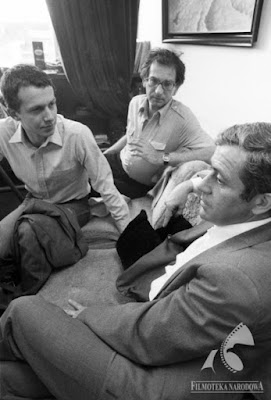
 |
| Director Krzysztof Kieślowski (center) |


BLIND CHANCE (Przypadek) A aka: The Accident Poland (122 mi) 1981 d: Krzysztof Kieślowski
I don’t really know why there wasn’t any true description of Poland in the 1970’s in the other arts. There wasn’t even a proper description of it in literature, and literature is easier to produce than film. It’s not subject to censorship to the same degree although individual writers or individual books might be. Yet films offered the best description of Poland. At the end of 1970’s I realized that this description was limited, that we had reached these limits and that there was no point in describing this world any further. A result is ‘Blind Chance,’ which is no longer a description of the outside world but rather of the inner world. It’s a description of the powers which meddle with our fate, which push us one way or another. —Krzysztof Kieślowski, 11 October* film & talk: Krzysztof Kieślowski – Blind Chance ...
Poland has the unfortunate distinction of having been invaded in 1939 by Nazi Germany from the West while also by Russia days later from the East, becoming the center of the Holocaust during the war, where Auschwitz will forever be linked with one of the worst atrocities in human history. The population experienced horrific oppression by both occupying forces, with the Russians eventually prevailing afterwards, yet the aftermath left a moral void that still reverberates today, though Polish artists today enjoy Western-style freedom. Context is essential with this film, as the director was born into the Poland of WWII, where it took him three tries to gain acceptance into the Łódź Film School, while this film is a product of the political anxiety of its time, going hand-in-hand with the long-exiled Nobel Laureate Czesław Miłosz (the prize awarded a year prior to the making of this film) and his book entitled The Captive Mind, a study of the capitulation of artists to the demands of Stalinism, as Krzysztof Kieślowski is one of the supreme artists in cinema and Polish history, where this revelatory work early in his career beautifully speaks to the malaise of a nation, introducing prevalent themes that are expanded in his later efforts, shot during the Russian communist occupation, yet remains timeless and strikingly modernist. This film illuminates the intersection of fate, coincidence, and choice, suggesting chance rules our lives as much as choice does, examining how a single innocuous event can irrevocably alter our lives forever, offering three distinctly different outcomes in the life of a young medical student as he runs to catch a train in Łódź to Warsaw, none of which lead to a desirable result. In one he joins the communist party, hoping to make an impact, defining himself by his commitment to the cause, yet he inadvertently harms the ones he loves the most, in another he’s arrested and sent to a labor camp where he bands together with associates he meets in an underground movement resisting the communist authority, yet is thoroughly ineffective, while in the third he returns to his life in Łódź and becomes a family man, establishing a successful medical career, yet he’s completely apolitical, refusing to take sides, nonetheless his life is deeply impacted in ways outside his control. In each he establishes a different group of friends (with actors revolving into different roles), a different career, a different love interest, and takes on decidedly different political views, yet none bring him happiness. Influenced by Fassbinder’s THE MARRIAGE OF MARIA BRAUN (1978), yet giving rise to Tom Tykwer’s Run Lola Run (Lolo Rennt) (1998), Kieślowski developed innovative narrative forms and stylistic methods to address pressing existential, moral, and political issues that reflected conditions in Poland at the time, living under the repressive Stalinist machinations of communism, a kind of outdated, old-world relic that transplanted itself to Poland, leaving few options, as individual free will in a totalitarian society is simply steamrolled out of existence, easily crushed under relentless pressure to conform. Kieślowski began his career making short black and white documentaries, yet concluded making sumptuously elegant features, committed early on to the principles of realism, where this film reflects the moral dilemma of life under communism, where there really is no choice at all, as bowing down to the pressures of authority is the only available option, yet each new generation seeks an alternative path, one that doesn’t yet exist, overwhelmed by the absurdities of existence, as totalitarianism dominates every aspect of one’s life, where being suspicious of your neighbors is an everyday reality. Ordinary people’s lives were constantly under pressure, followed and surveilled by the police or their thugs, apartments routinely ransacked searching for seditious activity, arrested and accused of crimes you did not commit, confessing what you know about others to police in hopes of alleviating some of that strain is often the one and only option. Although the movie was made in 1981 on the eve of martial law, whereupon it was immediately banned, it had its premiere in 1987 in a censored form, screening at the Un Certain Regard section at Cannes (initially rejected as the work of a “local artist”), as the delay was caused by state-imposed censorship due to the film’s political content. A recent restoration has returned the film to its original form, with one brief censored section of a police assault missing altogether, yet the sound remains. The collapse of communism in 1989 was a major turning point, as films prior to that were all motivated by the strain of life under communism. While other Polish filmmakers like Andrzej Wajda and Krzysztof Zanussi struggled to find funding and relevant subject material after 1989, Kieślowski’s career, long undervalued outside Poland, flourished, suddenly regarded as the vanguard of Eastern European art cinema, a worthy heir to Tarkovsky, discovering transnational cultural productions, where the worldwide acclaim for his film The Decalogue (Dekalog) (1988) led to international coproductions, with his last four films made largely outside of Poland, and predominantly in French, while broadening the ethical and metaphysical questions of his earlier films.
During the communist period, Polish cinema served as an antidote to the propaganda of state television, never more strongly than the cinema of moral anxiety of the late 70’s, also known as cinema of moral unrest, a grouping of blunt yet stylistically unembellished films that brought attention to the social ills of the nation, where people find themselves isolated and alone in a corrupt and dishonest society, yet the period was short-lived due to the imposition of martial law in 1981. Andrzej Wajda paid homage to Kieślowski, claiming “When we were lost and confused during martial law, he alone knew which path to follow.” His methods, a pronounced existential strain both stylistically and narratively, exposing the uncertainties of life and the impossibility of judging the lives of others, had a profound influence on other European directors, perhaps none more than the austere work of Austrian director Michael Haneke, emotionally spare, fractured in perspective, using long takes to accentuate a heightened realism. After the fall of communism in Eastern Europe and the formation of the European Union, Haneke’s films explored the increasing isolation of the individual in a fragmented Europe, with Kieślowski’s THREE COLORS TRILOGY (1993-94) sharing similar themes with Haneke’s Code Unknown (Code inconnu: Récit incomplet de divers voyages) (2000), both sharing the same French actress Juliette Binoche, with both offering an insightful, modernist perspective of Europe from an informed Central European identity. Like his earlier works, this film has a documentary quality, yet its realization of a cyclical Sisyphus syndrome where the central protagonist is doomed to repeated mistakes succinctly sums up the Cinema of Moral Anxiety era, with its irrationality of existence, where the search for hope and meaning is absurdly thwarted by a morally bankrupt and dehumanizing system, where one lives and dies meaninglessly, no matter the circumstances. Kieślowski places great faith in chance encounters, reminding us of the significance this plays in our lives, in the determination of our character, even in who we meet, and how we meet them, considering all the possible “what if?” variables that might have gone another way, yet each life is a mysterious intersection with the hands of fate, where this film is a reminder that had things gone differently at some point we could be living entirely different lives. A disjointed series of seemingly unrelated incidents start the film in a shockingly well-made opening montage, providing something of an abstract historical backstory connecting the memory of the past to the present, including traumatic childhood incidents (some remembered inaccurately) and a primal scream evoking a terrifying sense of helplessness and despair, though their interconnectedness is not actually realized until the final shot. Given a grim, social realist look by cinematographer Krzysztof Pakulski, his camera is cleverly utilized, more active than previous works, displaying a sensual sensibility, mixing eroticism with a warm humanism, but through it all Witek (Bogusław Linda) remains optimistic in leading a good life, an apparent reference to Voltaire’s Candide, whose sole existence is guided by living the best of all possible worlds. In each of three narratives, he tries to make the best ethical choices, seeking to live meaningfully, where if he cannot change the world, he can at least do his best not to let the world change him, which under a totalitarian regime would be a remarkable achievement, yet the intrusion of reality as an unstoppable force intervenes each time defying his efforts, leaving him disillusioned and heartbroken, casting the entire film under a darkened shadow of negativity. Each segment opens with renewed possibilities full of hopes and promise, where it looks like Witek is in a position to choose his own destiny, as if the future is in his hands, yet he gradually gets caught up in a chain of events, accidents, and misfortunes that leave him exhausted, disappointed, and morally depleted. There is a pronounced element of fatalism, one of the most toxic side-effects of living in a totalitarian system, as it dangerously pollutes the subconscious, perhaps best represented by a scene on the train where Witek follows a prisoner to the restroom, offering him a chance to escape, but the prisoner instead capitulates and willingly returns back to the authorities. Throughout the film, however, this apparent disillusion with humanity is met with an equally mystifying faith in it, a remarkable characteristic from this director.
While Poland is a devoutly Catholic country, Kieślowski was an agnostic, yet according to fellow Polish director Agnieszka Holland, who knew him well, “Krzysztof is somebody who had an incredibly deep need to believe in something transcendental. He did believe, but at the same time he wasn’t really a member of any church, and his relationships toward the religious were less theological than ethical and metaphysical.” Kieślowski reveals in the 1993 book Kieślowski On Kieślowski, a conversation with Danusia Stok, “given the limitation of our knowledge and the imperfection of our intelligence, there’s no way we can gauge the reality or the gravity of sin, the extent of guilt.” What this suggests is that the only way we can escape the Sisyphean futility of utter human despair is to accept, at least hypothetically, the existence of a metaphysical point of view where things make more sense, as otherwise we will never be able to get out of the suffocating framework of “chance.” Interestingly, one of the predominant themes of the film is stated early on from Werner (Tadeusz Łomnicki, a former member of the Party’s Central Committee), an old communist Witek meets on the train, who articulates this notion of the exhaustion of hope:
Every generation has need of light. It needs to know, or to believe that the world can be a better place. This need…is like a drug. Early in life, it brings joy, as light seems near, within reach. At life’s end, it brings bitterness, as the light has grown distant. During those 40 years, I lived through many things, and today I see it more distant than before. […] But…life without this hope, without this bitterness, wouldn’t be worth living.
It’s curious that at the time this film was finally released in Poland in 1987, along with several other previously banned films, Polish film critic Tadeusz Sobolewski described it as “a souvenir of the past,” viewing it as a “pessimistic philosophical parable on human destiny shaped by occurrences beyond individual control,” relatable, supposedly, only to those still behind the Iron Curtain. Yet the film is not some outdated nihilistic relic, actually transcending any notion of time and national boundaries precisely because it could come to represent any point of living under oppression, where according to Dennis Lim’s Criterion essay, Blind Chance: The Conditional Mood, “the failures of the system remain secondary to the human-scale dilemmas of the individuals trapped within it.” Witek in all three segments is basically the same person, a kind of everyman who is morally upright, honest, and virtuous, trying to make the best of his life, where he’s a decent human being irrespective of his politics or life choices. What’s quite astonishing, particularly in comparison with Run Lola Run (Lolo Rennt), is that moral intent matters, and that ethical choices make a profound difference whether advocated by the great Russian novelists Tolstoy and Dostoyevsky or the Romantic Polish tradition of glorifying national martyrs, who are revered for believing in causes greater than themselves. It is inevitable that all choices lead to death, where fate and death are interlinked, yet Kieślowski’s next film NO END (1985) is intrinsically a meditation on death and its haunting presence that continues to linger in our lives. Yet what distinguishes this film is how essential ethical choice becomes in the human experience, elevating not only this film but the overall stature of Kieślowski as a filmmaker, as his films always feature philosophical journeys into the human spirit while demonstrating a concern for the moral and ethical implications of human action. Accordingly, he confirmed his status as a major contemporary director with The Decalogue (Dekalog) (1988), an ambitious series of ten hour-long films funded by Polish television, telling stories loosely based on the Ten Commandments, yet set in the heart of the modern existentialist world. This ambiguous criss-cross narrative surpasses, to a large extent, the formulaic restrictions of the cinema of moral unrest by introducing larger-than-life themes into the equation, becoming a philosophical quest for knowledge, an internal odyssey of changing configurations, where Witek’s life revolves around three women, Czuszka (Bogusława Pawelec), his first love, Werka (Marzena Trybała), the sister of a childhood friend, and finally Olga (Monika Gozdzik), a fellow medical student that he marries. Yet in such an over-controlled authoritative society, making no choice at all is synonymous with the status quo, as it offers no resistance to the continued offenses of the state, where Witek’s success is achieved at the expense of others, with the director highlighting the randomness of choice in an amusing scene showing a Slinky on the stairs, coming to life as it gracefully slithers effortlessly downward step-by-step until it comes to a stop at the bottom where it “looks dead.” A point of emphasis should be made regarding an isolated scene where two jugglers appear in an open courtyard, with Witek watching them in awe, as their skill in generating a neverending back-and-forth stream of balls in the air is simply unfathomable. The significance of this scene may easily be overlooked, as it’s not really part of the overall narrative, but appears to stand on its own in the third segment, yet it has major ramifications. Witek is told “They’ve been practicing for at least ten years…Seems no one in the world can juggle like that.” What they represent is a vision of excellence bordering on perfection, an example of what people can achieve if they truly dedicate themselves, representing a supreme form of inner freedom. Regardless of the political stratum, these two are unaffected, seemingly capable of juggling like that forever, as they are masters of their craft, where nothing breaks their concentration. This may be a moment of enlightenment for Witek, perhaps envisioning himself as the best doctor he can become in his profession, where the pursuit of excellence is its own just reward. In the second segment, Witek makes a religious transformation and asks to be baptized, yet still questions the existence of God. This is arguably the most intensely religious sequence in the entire Kieślowski repertoire, as he breaks out into prayer afterwards, but asks only for God to “be there.” While God may not have shown up yet in his life, this prayer sequence insures that there’s a place waiting for him in the future and he’s warning God to prepare for being present in that moment. Even if only an abstract metaphysical notion, even if non-existent, God still plays a central role in our lives. It’s an extraordinary inner awareness that emerges into the heart of the film, which is an inner dialogue we have with ourselves and those higher powers of our own choosing. It serves as the Bressonian moment of transcendence, a cinematic connection to Au Hasard Balthazar (1966), one of the most unique of religious expressions. While not as polished and as ravishingly beautiful as his later works, this gritty effort is remarkably complex and powerful, showing rare insight into a moment in history while setting the tone for the films that would follow, providing the emotional and dramatic genesis of his career.