


 |
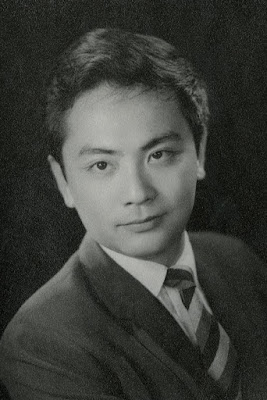
| Director King Hu |
DRAGON INN (Long men kezhan) A- aka: Dragon Gate Inn Taiwan (111 mi) 1967 ‘Scope d: King Hu
It’s a particularly controversial period... there was a much discussed book by Wu Han about Ming politics. It was on the one hand the period when Western influences first reached China; on the other, it was one of the most corrupt periods in Chinese politics. Most of the Ming emperors were bad; some were drug addicts, some were very young indeed when they came to the throne. Power was effectively in the hands of the Court Eunuchs, who created their own secret services, the “Dongshang” or “Eastern Group.” Without exaggeration, you could say that the power of the Dongshang exceeded that of the German Gestapo. They could arrest and execute virtually anyone, including ministers of the Courts, without accountability or, indeed any legal process. Both Dragon Gate Inn and A Touch of Zen deal specifically with the operations of the Dongshang.…At the time I made those movies, the James Bond films were very popular, and I thought it was very wrong to make a hero of a secret service man. My films were kind of a comment on that.
—King Hu
Among the more original filmmakers of the 60’s and 70’s, where his artistry has less to do with narrative story telling than an emphasis on form, making beautifully stylized films with meticulously authentic costumes and set designs, where the dance and musical-like nature of Hu’s work is more painterly and poetic than novelistic or dramatic, and appreciated more intrinsically for its relevance to Chinese opera, painting, literature, and history, with this film setting the standard. Born in Beijing, King Hu (aka Hu Jinquan) moved to Hong Kong at the age of 18 and started work as an illustrator for film advertisements, painting billboards or designing handouts, later becoming a director, graphic artist, set builder, actor, and screenwriter, best known for his Wuxia films that became popular in Hong Kong cinema in the mid 60’s and onwards. It was his proficiency at speaking Mandarin, his native language, that helped him get a start in Hong Kong studios, initially assigned as a set decorator before appearing in 37 films as an actor between 1954 and 1965, joining the Shaw Brothers Studio in 1958, working as a second unit director and screenwriter until finally directing his own film, COME DRINK WITH ME (1966), his first wuxia film, a transitional work as it was still a Shaw Brothers Studio movie, combining fantasy and special effects with elements of realism. Yet the success of the film allowed him to break away from the Shaw Brothers in 1966 and go his own way. Making only fourteen films in his thirty year career, his fame is largely based on six wuxia features. Before him, filmmakers shot fight scenes based on the acrobatic techniques of Beijing opera, often resembling a staged show, but Hu was the first director to use sophisticated cinematic techniques achieved through editing and multiple camera angles while shooting on location, combining Chinese history with religion and philosophy while also expressing military strategy, elevating martial arts action into a sense of cinematic poetry, featuring skilled female combatants to counter male-dominated themes, drawing inspiration from art and literature, never viewing himself as part of the movie industry, but as part of the wider body of the Chinese arts. Hu consulted with historians when writing his movie scripts, choosing the Ming dynasty for most of his movies, known for being one of the most chaotic periods in Chinese history. Hu often gave historical lectures throughout his career, speaking in Paris and at Harvard in the mid-70’s discussing the literary career of Lao She, later conducting a series of lectures in the 80’s on Italian Jesuit priest Matteo Ricci. Traveling to Taiwan to make this film, the Chinese Cultural Revolution particularly inspired its making, specifically the struggle against intellectuals and the disgrace of Ming dynasty historian Wu Han in 1966, who doubled as the deputy mayor of Beijing, targeted for having written a play set in the Ming dynasty where a court attendant chastises an emperor, a thinly veiled reference to an actual occurrence between Mao and one of his top generals during the disastrously managed Great Leap Forward of the late 50’s and early 60’s when famine caused the death of up to 30 to 40 million Chinese, leading Wu to become one of the first victims of Mao Zedong’s persecution. Left to die in jail while an entire generation of young Chinese were taught to denigrate their own culture, some even actively seeking to destroy it, Hu was provoked into making the film as a tribute to Wu’s career, as his work on the imperial secret police, the dongchang (Eastern Depot), had particularly influenced Hu as a young man. For the exiled Taiwanese, ruled by a repressive one-party system that purged its own political and cultural elite (murdering as many as 40,000 victims), while remaining under martial law for almost four decades, they took a personal interest in Hu’s allegorical connection to the Mainland, giving them a taste of a mythical China that blurred into the present, where a heroic fantasy evokes the tragic Chinese experience of endless tyranny, oppression, and exile. Blending Chinese traditions with Hollywood westerns and Japanese samurai movies, Hu created ballet-like fight sequences taking the audience on spiritual journeys that confound expectations, featuring sword-wielding heroines, mistaken identities, secret allegiances, rooftop chases, and showdowns in taverns and bamboo forests, breaking box office records in Taiwan, Korea, and the Philippines on route to becoming a cult classic.
Hu has designed something that quite simply doesn’t exist anymore, often imitated but rarely equaled, creating an exaggerated picture of perpetual exile and nomadic instability, defined by the restless and rootless lives of his characters who thrive in a seemingly endless wasteland, lavishing attention on detail, displaying a rare economy, creating one of the more darkly humorous and deeply entertaining Scope spectacle films of all times. Set during the Ming dynasty, the opening scene exhibits pageantry and is given plenty of colorful Kurosawa costume drama in the vast emptiness of an open plain, resembling Shakespeare’s King Lear, surrounded by his massive armies, reading his decree of how he intends to abdicate power and divide his extensive domain among his three children, Yet here, given similar pomp and circumstance, the emperor’s minister of defense, General Yu, is executed for betrayal and insurrection, framed on trumped up charges by an all-powerful court eunuch, Cao Shao-qin (Bai Ying), a tyrant who controls both the secretive Eastern Agency and Palace Guards, representing the worst excesses of ruthless ambition, where Cao is meant to resemble Mao, surrounded by devoted followers who are meant to resemble Mao’s Red Guards. The Emperor has allowed Wu’s family to live in exile, but Cao has other ideas, dispatching a clan of elite assassins known as the Black Arrow Troop to cut off the bloodline, to hunt down the minister’s escaping, exiled children with a planned ambush taking them to the remote mountainous location of the Dragon Inn, a northern border region where mysterious strangers begin to congregate, each with growing suspicions of the other. In examining the corruption and suppression of intellectuals by the eunuchs, the film is not only meant as an allegory to reflect the chaos occurring on the Chinese Mainland, but also as an attack on the Communist Party regime. In using the wuxia genre as his vehicle, it allowed Hu to criticize without politicizing, while simultaneously illustrating nostalgia for his homeland. There are masterful compositions by cinematographer Hua Huiying featuring breathtaking landscapes, as Hu paid tribute to classical Chinese landscape paintings, yet bloody swordplay battles featuring inexplicable aerial jumps are the highlight and main feature of the film, as each extended scene leads to yet another extended swordfight, turning into a battle royale that borders on dream fantasia. The narrative plot is kept at a minimum, yet every scene feels like a showdown of deception, as there’s a battle of wits taking place in attempting to outmaneuver the other, with neither side willing to reveal their hand, meant to hide their intentions, with the dongchang resorting to poisoned liquor, small darts, flaming arrows, including a battalion of trained assassins to annihilate anyone that gets in their way. Yu’s former subordinates appear, like apparitions, attempting to usher the children to safety, but Cao’s secret police are blocking the way, led by Pi Shao-tang (Miao Tien) and Mao Zong-xian (Han Yingjie). We see the elegance of a female warrior, Miss Zhu (Shangkuan Ling-fung), fending off soldiers with ease, the equal to any man, along with her hot-tempered brother Zhu Ji (Hsieh Han), who arrive at the inn along with a secret traveler that arrives earlier, Xiao Shaozi (Shih Chun), who dazzles with his ability to thwart opposing trickery or sneak attacks, catching darts with his chop sticks, or arrows with his bare hands, simply defying the laws of physics, yet he’s there to meet the innkeeper, Wu Ning (Tsao Chien), who was one of the the executed General’s lieutenants. So without realizing it at first, these four align to counter the full force of the dongchang, who subject the inn to a flamed aerial assault of burning arrows, tricking them into a fight in the dark of night, accompanied by fiery musical excerpts from Mussorgsky’s orchestrated Pictures at an Exhibition, specifically The Hut on Hen’s Legs (Baba Yaga), Mussorgsky Baba-Yaga and The Knight's Gate from "Pictures at an Exhibition" YouTube (9:30).
Fully integrated into the fabric of the narrative, indoor tavern sequences are staged with attention to characterization and a keen sense of atmosphere, demonstrating Hu’s intimacy with the decor and lifestyle of traditional Chinese inns. These “inn films,” aptly named because they are almost wholly set in the tavern, are notable as political allegories, where one side fights for a political or patriotic cause against a side representing the forces of repression and authoritarianism, perhaps mirroring the Cold War conflict between the Communist Party and the Nationalist Party, yet exhibiting a pursuit of righteousness, which has its roots with Chinese opera, with the motivations of the characters onscreen clear from the outset. The inn itself is not much to look at, drab, somewhat rundown, with wooden tables below and rooms upstairs, all under a mud-thatched roof. Not much of a décor, commandeered by a military unit of the dongchang, located in the middle of nowhere, where emerging from the jagged mountain edges are soldiers challenging anyone that passes nearby. Both Xiao Shaozi and Miss Zhu have handled Cao’s minions with ease, where one fights against many, dispatching the bad guys with nonchalance, where each confrontation is a challenge of honor where only one side can prevail. Because of the collection of freedom fighters who display a spirit of rebellion, this breaks down into an ensemble piece, moving from one figure to the next, yet an early extended sequence with an emboldened Xiao Shaozi may be the most exemplary, as it displays humor and daring wit, along with a series of surprises, where the man refuses to reveal his identity or be broken by a series of deadly attacks, handling each confrontation with ease, eventually forcing the dongchang to submit by asking him to join forces, yet he resolutely refuses, as he’s a free spirit. This appears to be the heart and soul of the film, that you can’t kill an idea, that it will somehow thrive and survive, even if under a hidden identity. So much information is given at the opening voiceover narration of the film establishing the historical and narrative parameters that it is almost impossible to digest, yet many heroic characters die at the end after facing seemingly insurmountable odds. While the direction is stunning, this epic film is also an extended choreography of superlative martial arts confrontations that seemingly go on forever, featuring some of the most brilliantly designed sword fights and hand-to-hand combat to ever grace the screen in martial arts films, with an unmatchable mix of rhythm and movement. The stunts and fight scenes were choreographed by Han Yingjie, also one of the principal actors and a Peking Opera performer, creating acrobatic set pieces, introducing ballet-like leaps and jumps into the final sequences, displaying superhuman speed and agility in an inevitable showdown with Cao Shao-qin, often veering into mystical realms of the supernatural, where his action is faster than the eye can see, quite stunning, really, especially considering the time it was made. Sound is as important here as it is in Kurosawa films, very percussive, again drawing a certain musical rhythm and timing from the staged opera, yet adding his own personalized aesthetics, infusing his films with energy and finesse, lavishing attention on set pieces, drawing every shot in advance, supplying the cast and crew with photocopies, studying them from many angles, preoccupied with the visual design even before shooting begins, where the shot is a meticulous reconstruction of an idea. Hu was a talented calligrapher, painting the opening credits himself. Tsai Ming-liang’s GOODBYE DRAGON INN (2003) is a tribute to this film, set during a deluge of rain in a decrepit Taipei movie theater on its final night in business, where the last few mysteriously elusive customers are either drawn to the movie screen playing this film, or are humorously distracted from it. Wong Kar-wai’s ASHES OF TIME (1994) and the significantly improved 2008 REDUX version bears a similar remote setting, also exuding philosophical themes, with both films resembling a Chinese version of the Sergio Leone spaghetti westerns. Ang Lee’s CROUCHING TIGER, HIDDEN DRAGON (2000) and Zhang Yimou’s HOUSE OF FLYING DAGGERS (2004) are both tributes to this film, while Tsui Hark remade it twice, in 1992 and 2011. To celebrate one hundred years of Chinese cinema, the Hong Kong Film Awards released a list of The Best 100 Chinese Motion Pictures, with this listed at #7, Hong Kong Film Awards' List of The Best 100 Chinese Motion.


