Showing posts with label Filippo Scotti. Show all posts

Monday, August 24, 2026

The Last One for the Road (Le città di pianura)


Director Francesco Sossai

Sossai on the set with Sergio Romano


THE LAST ONE FOR THE ROAD (Le città di pianura)                 B                                            Italy  Germany  (100 mi)  2025  d: Francesco Sossai

We’re too old to grow up.                                                                                                               —Doriano (Pierpaolo Capovillo)

Old geezers on parade, a zany road trip featuring the misadventures of two fiftyish small-time Italian crooks, best friends Carlobianci (Sergio Romano) and Doriano (musician and singer-songwriter Pierpaolo Capovillo), who obsessively live for their next drink, stopping at any roadside tavern along the way, bound by their proverbial ritual of always seeking that one final drink, literally spending their lives completely inebriated, where this is their normalized state of mind, kind of like a Charles Bukowski fever dream.  A bizarre, dialogue-heavy character study written by Sossai and Adriano Candiago, it resembles the comic absurdity of Vladimir and Estragon in Waiting for Godot, two colorful characters who are oblivious to the changing times, passing their time in endless existential conversations and philosophical musings, where not much of anything happens.  These unwitting millennials were born during a time of intense economic growth, but entered the workforce during the devastating 2008 Great Recession, the worst downturn since the Great Depression, later facing the Covid pandemic during their prime earning years, and are sometimes called a new “Lost Generation” because these historic economic shocks left them with massive debt, lower wealth accumulation, and delayed major life milestones compared to previous generations, now subsisting on memories, forever recalling their glory days as if it was just yesterday, raising their glass, claiming “it’s still yesterday for us.”  Shot by Massimiliano Kuveiller on Super 16mm and 35mm film stock, with an incredibly raw and crude sounding guitar soundtrack that was composed by local musician Krano, who is seen live onstage at one point, sounding as ragged as anything you could ever imagine.  Premiering at the Un Certain Regard section at Cannes 2025, Francesco Sossai was born in the area depicted in the film, forever changed by globalization, so he understands it intrinsically, making short films at an early age, moving to Rome where he graduated in English and German Literatures before being admitted to the German Television Film Academy in Berlin (DFFB).  Like outtakes from an Aki Kaurismäki hangout movie, with no real story to speak of, portraying a side of Italy that is not often shown, freely exploring the road not taken, this is a raw and seemingly unrehearsed odyssey of aging boozers and ruined romantics, driven to rediscover all their old favorite hangouts to eat and drink, which still linger in their imaginations, yet never seem to live up to their expectations, following their spontaneous journey from bar to bar.

An aimless and meandering film about middle-aged male disillusionment and the time we’ve lost, and the time that has been wasted, literally stumbling from place to place, where the lives of these anti-heroes have been filled with plenty of regrets, as they once had a thriving construction business, building a highway that links Lisbon through Treviso to Budapest, but since 2008 they’ve long since lost their jobs and become black market scam artists, swindlers, and petty thieves, continually coming up with ways to make something out of nothing, yet riding in style, as Carlobianci splurged on a Jaguar S-Type luxury vehicle when they were flush with cash, money that is long gone, yet they continue to cherish those memories as they now face the impending mediocrity of middle age.  In a flash, Carlobianci seems to have unlocked the secret of life, literally beaming with joy, but just as quicky it is instantly forgotten, spending the rest of the film trying to remember as they wander through these massive transformations, both cultural and physical, that the landscape is going through, making it nearly unrecognizable to how we remember it, completely altering our idea of identity.  At one stop along the way in the wee hours of the night, they notice something strange about what they’re drinking, disappointed to discover it is non-alcoholic beer, thinking that doesn’t really count, concocting a plan to pick up their exiled partner in crime Genio at the airport in Venice, returning to Italy after fleeing to Argentina before the 2008 financial crisis, feeling giddy about the idea, driving through the night to get there, LE CITTÀ DI PIANURA by Francesco SOSSAI - Clip 1 YouTube (1:33).  Stopping at a roadside Country & Western bar, our protagonists comment that they may as well be in America as men and women in cowboy hats are doing some line dancing.  A German tourist at the bar mentions that he’s there to see Italy before it’s destroyed, with Carlobianchi uttering, “I think you’re too late.”  Continuing on their trek, the Venetian bar they were pursuing is somehow closed, but opportunity knocks, as they stumble upon a boisterous group of college students loudly celebrating a graduation on the streets, easily joining in the festivities, asking where they can get a drink, and immediately the entire group shifts to a nearby local bar, but before they do, our guys happen to witness a conversation between the shy, reserved, and lovestruck architectural student Giulio (Filippo Scotti, the star of Paolo Sorrentino’s 2021 The Hand of God (È stata la mano di Dio), and the girl of his dreams, Giulia (Giulia Bertasi), claiming he needs to go home as he has a design exam early in the morning, indicating they’ll meet another time, but she declares, “There’s never another time.” 

Seemingly innocuous and harmless, this expression is a key to unlocking the film, with Carlobianci repeating the phrase to him as they drag him to the party.  With that seemingly innocent gesture, the bookish Giulio suddenly becomes the third wheel to our road trip adventure, initially quiet and  standoffish, wondering how he got railroaded into this terrible idea, but he soon forgets his morning appointment and warms to their all-embracing, anything goes style, becoming something of a free for all as they travel across a stretch of land running from Venice to Milan called the Pianura, or the flatlands of Veneto, once the beating heart of the Italian economy, but now fallen on hard times with industry and economic growth abandoning the region, seemingly transformed overnight, as globalization has led to a near-complete uniformity, creating a stifling homogeneity.  Carlobianchi is a man consumed by regrets, feeling as though time has passed him by, haunted by the choices he's made.  Doriano has already come to terms with his past, offering a quiet wisdom that Carlobianchi could only hope for, while the sweetly charming Giulio is just embarking on his own journey of self-discovery, with our heroes continually encouraging him to build up his courage and go after the girl.  Somehow the three of them explore things that matter in their own distinct way, continually wandering off course, finding trivialities and small everyday moments, yet always searching for hidden meaning in their lives.  When they do finally connect with Genio (Andrea Pennacchi), pinning their hopes on cash he buried before the financial crisis, they’re stymied once again, as modernization has constructed a building over the site, leaving them thoroughly demoralized.  Capturing the beauty of the end of an era while mostly drunk or hungover, this is a different kind of movie, recalling Dino Risi’s IL SORPASSO (1962), but less tragic, reviving the Commedia all'italiana style through the Dionysian spirit, filled with unexpected turns and strange realizations, like the sudden shift to Giulio’s point of view on a trip to Treviso for the post-modernist Brion Memorial designed by Carlo Scarpa, with its heavily concrete forms, viewed through the academically informed eyes of Giulio, bonded by their friendship as an emotional anchor, offering a different vision of the future, unfolding in a melancholy road movie that never really leads anywhere, LE CITTÀ DI PIANURA by Francesco SOSSAI - Clip 2 YouTube (1:16).  Through sad and jubilant moments, there is never a sense of the profound, as the journey blends humor with matters of the heart, balancing the light and the heavy in a way that draws the audience deep into the characters’ lives, where it’s not places, or monuments, or things that represent a country, but the people living in it, offering an intimate exploration of human connection, forgiveness, and hope.

Saturday, January 1, 2022

The Hand of God (È stata la mano di Dio)


Director Paulo Sorrentino


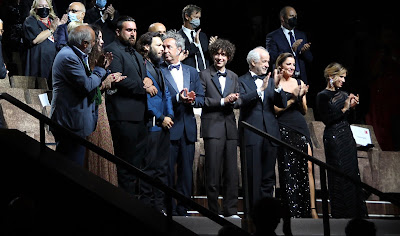
Sorrentino with his ensemble cast

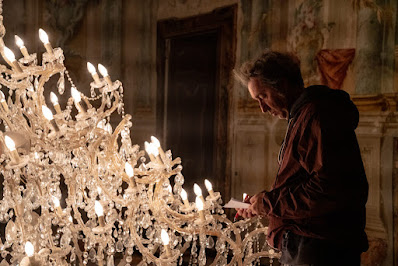
Sorrentino on the set

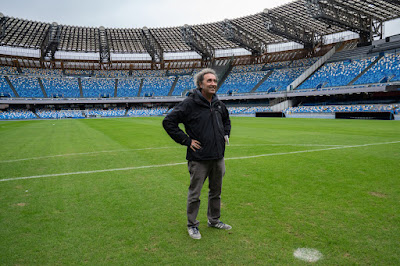
Sorrentino on the soccer field


THE HAND OF GOD (È stata la mano di Dio)                    B-                                               Italy  USA  (130 mi)  2021  ‘Scope  d: Paulo Sorrentino

I did what I could.  I don't think I did it so badly.                                                                          —Diego Maradona, opening epitaph

Winner of the Grand Jury Prize (2nd Place) at the Venice Film Festival, this semi-autobiographical and coming-of-age story takes us back to Naples in the 1980’s, with Fabio (Filippo Scotti), a stand-in for the director, living his awkward teenage years with loving parents, including his father (Toni Servillo) and doting mother (Teresa Saponangelo), who both hold hands and whistle at each other to maintain romantic interest, an older brother Marchino (Marlon Joubert), and a sister Daniela who never seems to come out of the bathroom.  They live in a building owned by an elderly matriarch, the heartlessly dispassionate Baronessa Focale (Betti Pedrazzi), a throwback to an earlier era, as she would have staunchly supported the Fascists, who pounds on the floor whenever she needs anything.  Fabio is something of a friendly ambassador and go-between in his large, extended family, as he helps out with regular visits, extending the friendship his parents themselves have no interest in extending, largely due to damaging rumors, or the flamboyance and idiosyncracies of the family.  While Fabio has no real friends, or a girlfriend, he is well-liked by the women in his family, as he’s kind and gentle, a little dreamy, and always willing to do whatever they ask, but feels especially drawn to his Aunt Patrizia (Luisa Ranieri), who is a bit touched, mentally, as she is childless, yet she is gifted with a sculpted body, which she flaunts, that all teenage boys would adore, holding Fabio on a leash, apparently, as he follows her around like a lap dog.  The Daria D’Antonio cinematography, as always in a Sorrentino film, has touches of magic, none more superb than the opening sequence, an extended aerial shot lasting several minutes swooping over the speedboats in the Gulf of Naples closing in on the town of Naples, then following a vintage limo seemingly from the 40’s down a coastal road before expanding back to a view of the nearby islands of Capri, Ischia, and Procida, while not far away is Stromboli, a volcanic island in the Tyrrhenian Sea.  Water is the life blood of every port city, as it is a means of transport, offering employment opportunities, and connects the city to the outside world, yet it also allows recreational opportunities, like swimming and boating, allowing people to relax, take a dip in the sea, and bask in the sun.  This eye-popping shot is followed by another, where Patrizia, a curvaceous woman with her breasts and nipples clearly outlined under the slim material of her white dress is seen waiting at a crowded stop for a night bus when a mysterious man in that same limo shows up, identifying himself as San Gennaro (Enzo De Caro), the Patron Saint of Naples, who takes her to an immaculate estate to meet the mythic local figure Monaciello, or ‘Little Monk,’ who kisses her on the head (while grabbing her ass) and stuffs money in her purse as a magical guarantee that she will conceive a child.  Yet when she returns home late, claiming she’s experienced a miracle, her husband Franco (Massimiliano Gallo) finds the money and rails against her with a violent rage, calling her a “whore” while slapping her to the floor, causing Fabio’s family to intervene, with Fabio enthralled by an exposed naked breast, yet no one but Fabio believes her story, as she is described as “touched in the head,” yet clearly the line between what’s real and the mythical has been crossed, raising questions about what constitutes the truth.  Nothing in the rest of the film lives up to those introductory shots, as Fabio’s extended family decides to leisurely spend a weekend afternoon on a boat, the entire family is flummoxed to see Patrizia lying completely naked on her back under the sun before the entire family, adults and children, who can’t take their eyes off her, many seeing an exposed woman’s breast for the very first time, until she politely asks Fabio to bring her a towel.  This kind of scene establishes Sorrentino as a breast man, as he is clearly fascinated and obsessed with the female anatomy, where movies offer the chance for young boys like Fabio to leer all they want.  But the afternoon is interrupted by a high seas motorboat chase, as police are chasing some cigarette smugglers, yet the smugglers seem to have the upper hand with superior boat speed and dexterity, eventually losing the police, seen lounging in the harbor afterwards draped across their bow under the sun.  The family al fresco lunch disintegrates into eating watermelon and griping, with people eagerly voicing their complaints, waiting for a plethora of profanity to come from the mouth of a dried-up old shrew, Signora Gentile (Dora Romano), one of the more eccentric female family members, seen eating a hunk of fresh mozzarella while wearing a fur coat on a hot summer’s day.  Sorrentino has re-introduced the Fellini profile of the grotesque, finding chiseled faces who fit his photographic criteria, often mocking them, yet never developing them into fleshed-out characters.   

What 2014 Top Ten List #5 The Great Beauty (La Grande Bellezza) (2013) was to Rome this film is to Naples, inspired by the success of Alfonso Cuarón’s autobiographical Roma (2018), Sorrentino decides to delve into his own haunted past, losing the dramatically flashy editing and exquisite design, and the sheer spectacle of his earlier films, toning it down, where a lack of musical selections, a staple in earlier films, stands out, and where a VHS copy of Sergio Leone’s ONCE UPON A TIME IN AMERICA (1984) sits in a prominent spot on top of the television, unwatched, a reminder of his life in Naples, often overlooked compared to larger Italian cities, as it’s busy, noisy, and sometimes viewed as dirty, where a criminal element is part of the landscape.  Yet the backdrop of the story are the rumors floating around Naples that Argentine soccer magician Diego Maradona, regarded as the world’s best and arguably the greatest ever, is contemplating leaving the Barcelona Football Club to play in Naples, which has the whole town on high alert, where it seems that’s all people can talk about.  The general consensus is spoken aloud, “He’d never leave Barcelona for this shithole.”  Marchino even asks Fabio which he would prefer, having sex with Patrizio or Maradona coming to play for Naples.  Without hesitation he picks Maradona.  But it amps up when Fabio’s father verifies the local bank transferred a sum of £6.9 million to the Barcelona team, all but confirming the transfer, turning the town into a frenzy of unbridled excitement, unable to contain their joy of what they are about to witness.  Fabio’s father buys him a season ticket for his birthday, and Naples is consumed by soccer mania.  Maradona, of course, did not disappoint.  There’s a brief scene of father and son sitting in the stands watching a team practice, with Maradona hitting a series of consecutive penalty shots, each one just above the outreached hands of the goalie elevated high into the near corner just under the bar.  It’s a picture of perfection, wonderfully executed, leading to Naples winning the Italian title of best team.  Italy stops in its tracks during a big soccer match, with deserted city streets, then exploding in a collective elation whenever the local team scores, with a noisy celebration coming out of every balcony and window.  But the best was yet to come, especially in the quarter finals match of the 1986 FIFA World Cup, when Maradona broke a 0-0 score with England in a controversial play, forever known as the Hand of God, as he played the ball off his left wrist scoring a goal, which should have been disallowed, but the goal stood, scoring another goal later in the match where he weaves his way through the entire team, known as the Goal of the Century, ultimately winning 2-1.  An elderly uncle Alfredo (Renato Carpentieri) screams with delight, so despising the imperialist British that he felt they deserved the curse brought upon them, perhaps karmic retribution for the ill-fated Falklands War, a curse that still remains in effect, apparently, as they’ve never won another World Cup since hosting the event in 1966.  Argentina went on to defeat West Germany in the finals, winning the World Cup, with Maradona voted the best player, scoring or assisting on 10 of Argentina’s 14 goals during the tournament.  This all dissolves into one memory, yet for Naples, this felt heaven sent, as not much ever happens in their town, and suddenly it felt like the center of the universe.  But it’s soccer, in particular the wondrous exploits of Diego Maradona, that ultimately saves Fabio’s life, as a random tragedy alters his life at the tender age of 16, an accident he avoided by watching Maradona in a soccer game, a tragedy that would forever mark his life, which could have sent him reeling into a state of depression, giving up on his personal ambitions and dreams, but the beautiful artistry of one man’s genius on the soccer field forever lifted his spirits, where old clips, Diego Maradona Amazing Skills in Training - YouTube (4:13), or Diego Maradona - When Football Becomes Art - YouTube (17:36), give you some idea of what it was like to witness this man in live action. 

An intensely personal film, much of this feels hit or miss, with grievances aired throughout the film, where life’s disappointments are a familiar theme, never really drawing viewers into this 1980’s world, or living up to the magic of Fellini’s AMARCORD (1973) or Tornatore’s CINEMA PARADISO (1988), two autobiographical coming-of-age films that still resonate today, viewing more family relatives than one could count, not really knowing who they are, yet faces, much more than characters, repeatedly show up before the camera, even as we don’t have a clue who they are.  This overly detached and impersonal style of filmmaking is at odds with the style of film this wants to be, revealing a series of kaleidoscopic vignettes in the life of a young man on the verge of manhood, yet too much of this leaves viewers disinterested, never maintaining that emotional pulse to hold everything together.  It’s also a tribute to the glories of Naples, reveling in the coastal beauty, the decaying splendor in architecture, and the panoramic Italian vistas, including a vibrant theater scene, making a blatant sexual reference about Franco Zeffirelli, claiming he “plays for the other team,” where a Fellini audition turns into an absurdist set piece, with Marchino, a handsome, aspiring actor, sitting in a waiting room where everyone is already dressed like a Fellini extra, so he never stands out, with the infamous director telling him he looks ordinary, sending him into a tailspin of depression for losing his one opportunity.  Yet watching a film shoot in the middle of town is recalled as a magical experience, with Fabio growing intrigued, but an accidental tragedy leaves his life significantly altered, suddenly rootless and alone, with no direction.  By chance, he runs into one of the speedboat guys on the run, Armando (Biagio Manna), who quickly befriends him, whisking him off to a midnight run to Capri to go dancing, but the place is deserted, later ending up alone in Stromboli, contemplating his existence, watching the gaseous fumes stream out of the volcano.  Just as suddenly, he visits Armando in prison, wondering whether he’ll get 10 or 15 years, so the transiency of his life at this point feels overwhelming, having no place to really call home.  Even Patrizia is locked up in a mental asylum, watching her life waste away, yet we remain clueless why.  An aunt tells Fabio she has suicidal impulses, claiming she would otherwise take her own life, but we see no evidence of that, so her confinement remains baffling.  He pays a surprising visit to the Baronessa, who despite their age difference, seems to understand the needs of a teenage boy who is just wandering in a state of perpetual indifference.  Much of this takes place in the claustrophobic confines of dark, interior rooms, enveloped in sadness, tending to feel sorry for himself, as if there is no escape from the doldrums of his dreary life.  At a local theater performance, a man in the audience shames an actress off the stage, something Fabio had never seen before, running afterwards to discover it was Antonio Capuano (Ciro Capano), a no-nonsense movie director who happens to be from Naples, yet also a man with a volatile temper, peppering him with questions about his seemingly aimless ambition, which stiffens his resolve, as Fabio has inclinations of becoming a director himself, which sends Capuano into an assault of insults.  “Is it possible this city doesn’t inspire you at all?”  He urges him to steer clear of his comfort zone, but to remain true to himself, suggesting not to go to Rome, where he plans to attend film school, and to instead reclaim the emotional resonance of something with true meaning and value, something that comes from deep within himself, urging him not to fall into the trap of pretension, always the safer road to travel.  This brief back and forth is not exactly friendly, but has a contentious nature about it, as Capuano, for all practical purposes, is dismissing the kid until he proves himself worthy of his attention.  As it happens, Sorrentino co-wrote the screenplay for Capuano’s THE DUST OF NAPLES (1988), one of his earliest screen credits, with the film following him on a train on his way to Rome to discover his future.