Showing posts with label Paul Guilhaume. Show all posts

Friday, August 28, 2026

Two Pianos (Deux Pianos)


Director Arnaud Desplechin


Desplechin with François Civil

Desplechin with Nadia Tereszkiewicz

Civil and Tereszkiewicz


Charlotte Rampling


TWO PIANOS (Deux Pianos)           B+                                                                             France  (115 mi)  2025  ‘Scope  d: Arnaud Desplechin

Desplechin developed a reputation for writing some of the most natural dialogue in the movie industry, starting with MY SEX LIFE…OR HOW I GOT INTO AN ARGUMENT (1996), ESTHER KHAN (2000), KINGS & QUEEN (2004), and A CHRISTMAS TALE (2008), using a revolving stable of actors who moved on to impressive careers, while more recently he’s dabbled in smaller projects, 2015 Top Ten Films #7 My Golden Days (Trois souvenirs de ma jeunesse), a romantic and nostalgic take on memory and first love in this coming-of-age prequel to MY SEX LIFE, and Deception (Tromperie) (2021), an adaptation of a Philip Roth novel, where the lead protagonist, a novelist, describes himself as “a talk fetishist!” in one of the many conversations before, during, and after sex.  Desplechin also directed theatrical playwright August Strindberg’s The Father in 2015 and Tony Kushner’s Angels in America in early 2020, both playing at the esteemed Comédie-Française in Paris, where his innate sense of staging is evident here in an unconventional film featuring characters who are thrown into the middle of chaos.  All his films are intellectually challenging, dramatically compelling, and always curious, demonstrating a remarkable consistency in churning out quality films.  This is unlike anything else he’s ever done, particularly the way the story slowly advances, with frequent use of disorienting jump cuts and plenty of unspoken details, literally defying audience expectations with a non-resolution, growing smaller and smaller in scope, yet continually challenging audiences in unorthodox ways, adding to the magic and the mystery. Falling off the map in terms of accessibility, it’s hard to find Desplechin films anymore, even on streaming platforms, where his previous film is still unavailable in the United States, though they were once a staple of international arthouse films.  Known for his wit and literary inspirations, and for producing quality soul-bearing performances from a mix of known and unknown actors, this feels like the kind of film we used to see on a regular basis, but has disappeared from the landscape, so discovering this small gem is like rediscovering a bit of ourselves, a reminder of why we value cinema so much.  The original story and scenario were conceived by Arnaud Desplechin and Kamen Velkovsky, and then developed into a screenplay alongside Ondine Lauriot dit Prévost with collaboration from novelist Anne Berest.  In some ways it recalls Denis Dercourt’s THE PAGE TURNER (2006), a French psychological thriller revolving around a piano audition gone wrong, or the gritty underworld thriller by Jacques Audiard, The Beat That My Heart Skipped (De battre mon coeu... (2005), where a debt-collecting thug develops an interest in playing classical piano, like Zen therapy, also revolving around a piano audition, where in each case the serene calmness of the classical music world stands in stark contrast to the chaotic violence of the central storyline.  The original music is composed by Grégoire Hetzel in his 9th Desplechin film, but also Denis Villeneuve’s Incendies (2010), where the marvelous AMÉLIE-sounding accordion-led song over the end credits is a reminder that we’re watching a French film, even though it’s Italian, Parole di vento composed by Franco Ghigini YouTube (4:30).

In this case Desplechin mixes together two storylines about impossible love, an homage to Leo McCarey’s AN AFFAIR TO REMEMBER (1957), the tale of a woman whose fate was sealed when she was very young because she had a child, and another story about a pianist who returns to his home country and catches sight of a child who is his exact double, sounding very much like a German fairy tale steeped in mystery, with the filmmaker returning to some of his favorite themes, psychologically charged homecomings and unexpected reunions.  Once a virtuoso child prodigy at the piano, Mathias (François Civil from Larry Abrahamson’s 2014 Top Ten List #10 Frank) returns to his provincial hometown of Lyon after spending eight years abroad teaching and performing in Japan, summoned by his mentor Eléna (Charlotte Rampling in her best role since 2016 in Andrew Haigh’s 45 Years), a celebrated older pianist who plans to retire and hopes he can perform with her in a concert for two pianos and orchestra in what will be her final performance.  Shooting in a city rarely featured in French films, other than Bertrand Tavernier and Lumière’s first studio, Desplechin showcases some iconic locations in Lyon, including the Parc de la Tête d'or, the two rivers running through the city, the cobblestone streets of Vieux Lyon, the city’s oldest district, and the Maurice Ravel Auditorium.  Arriving straight from the airport to a party in Eléna’s honor, still disheveled and disoriented and underdressed, where he is handed a tie at the door to look more formally appropriate, he mingles with her briefly before making a quick exit, but as he leaves he comes face to face with an arriving woman, Claude (Nadia Tereszkiewicz, impressive in Ozon’s The Crime Is Mine (Mon Crime) (2023), causing her to run right back out the door while Mathias faints on the spot.  More than foreshadowing, this sets the tone for the emotional turmoil that follows, as there’s an element of psychological unease lying beneath the surface for the rest of the film, which explores the source of this tension, as there is obvious emotional baggage that Mathias is carrying, like open scars that he cannot escape, as Claude is married to art gallery owner Pierre (Jérémy Lewin), his childhood best friend and rival in love, and the reason he fled to Japan.  The volatile temperament for such a talented artist comes as a surprise, as musicians are usually expressed by strict rigor and discipline, but this guy is all over the place, an artist in conflict with his own art, invariably too wrapped up in his own self-created problems.  Plunging him into bouts of heavy drinking, Mathias gets stinking drunk afterwards, with his benevolent, all-encompassing, father figure agent Max (Hippolyte Girardot) looking out for him, waiting patiently for him to wake up in the jail’s drunk tank, while Pierre dies suddenly in a car accident, leaving Claude stunned and devastated, left to raise her child Simon (Valentin Picard) alone.  While wandering through a park afterwards, Mathias can’t take his eyes off Simon for some reason, perched at the top of the pyramid on the playground, locking eyes just before he falls from a great height, but survives intact, amazingly, where it’s just a scare, but Mathias can’t help but think this child looks just like him at that age, asking his mother to pull out a family photo to confirm his suspicions.

An alluring mystery where music, memory, and identity merge and threaten to overwhelm the tender psyche of a virtuosic pianist, this homecoming does not go as planned, as Mathias is not that invincible force of nature that serious performing artists tend to be, like the touring performance artist Eléna, who reminds him at the party, “I was built for war,” as she chastises him for not touring constantly and sharing his gift to the world.  Her implacable reserve commands respect, protecting herself like a mighty fortress, but this icy demeanor allows her to go anywhere at any time and play without the use of a score, committing it all to memory, like a force of nature.  Mathias, on the other hand, has tragic weaknesses, where both he and Claude share deeply buried passions and unspoken truths that bond them together, yet they can’t be together, as long ago she chose Pierre, leaving him completely devastated.  This has left him more passive and emotionally vulnerable, as he’s still in love with her, which is evident every moment they spend together, as sparks are in the air, with surprising results, as she welcomes that undivided attention, especially in her grief, but she’s also not ready to commit to him, even as he devours her with his eyes.  Channeling his lust for Claude spills over into a brief affair with Pierre’s younger sister and Claude’s best friend, Judith (Alba Gaïa Bellugi).  The acting in this film is superb, brilliantly filmed in ‘Scope by Paul Guilhaume, who recently filmed two of Jacques Audiard’s most impressive looking films, 2021 #6 Film of the Year Paris, 13th District (Les Olympiades, Paris 13e) in black and white and the colorful musical Emilia Pérez (2024).  His constant handheld camera movements create an unbearable suspense, shooting without dollies, without tracking shots, and without a tripod, always countering the classicism of the story they were telling.  Centered around our biggest regrets, music plays a big role in the film, with selected classical pieces by Bartók, Debussy, Chopin, and Bach, lofty giants that performers can find refuge in the complexities of their music, which is the same thing that happens here, with the music expressing underlying emotional layers that can never be expressed verbally.  Mixing old world and new world characters, the film is a kind of fantasy-melodrama, much of it taking place in interior spaces, where the three main multi-lingual performers, Civil, Tereszkiewicz, and Rampling beautifully portray just how profoundly debilitating their respective emotional worlds can be, like pulling the rug out from underneath them, sending them into a dizzying freefall without a clue where they will land.  These are stories of isolated characters who come together for an all-too brief moment and embrace in order to escape the depths of their solitude, weighed down by grief and sorrow, then inevitably return to it, as this solitude is obviously a protective strength for them.  The film is pure poetry, exploring the underlying layers of emotional worlds that is rare to see, not with this degree of assurance, which feels surprising in this day and age, and altogether missing in modern American films, yet it is the essence of cinema in the best possible sense, as beauty is timeless.  While he may not be spoken in the same breath as Rivette, Rohmer, or even Truffaut, Desplechin is a major force in world cinema.

Saturday, January 1, 2022

2021 #6 Film of the Year Paris, 13th District (Les Olympiades, Paris 13e)


Director Jacques Audiard


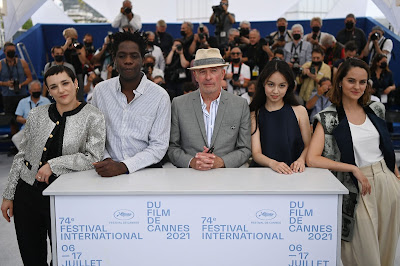
Audiard with his ensemble cast

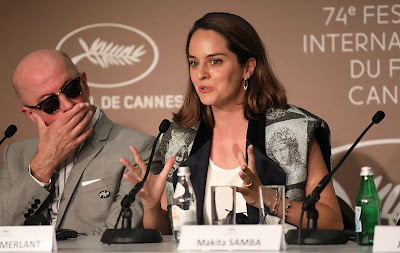
Audiard with Noémie Merlant

Audiard with Lucie Zhang


Paris, 13th District (Les Olympiades, Paris 13e)                    B+                                           France  (105 mi)  2021  d: Jacques Audiard

Probably one of the strangest love stories ever, where the cool, overly detached attitude never seems to be about love, or so we’re led to believe through all the strange detours and plot twists, becoming a moody, self-absorbed experience about living in the computer age where everything is at your fingertips, featuring more nudity than any film seen in years, delving into the hateful and misogynistic aspects of the porn sex industry, yet also introducing a true screen star, Lucie Zhang, whose brash, contemporary attitudes couldn’t be more flamboyantly in-your-face, as free-spirited as any character that has graced the screen in years, while Audiard is an uncompromising director, making this an exhilarating experience, constructing a fascinating exposé on contemporary multicultural attitudes in Paris today.  A bit like Robert Altman’s Short Cuts (1993), where Los Angeles is transported to Paris, given a literary feel, set in the suburban sprawl of contemporary Parisian life, the motif of the film is built around the growing chaos of intermingled lives who all appear shattered by circumstances, featuring broken characters who spend the film trying to heal.  It lacks the subversive humor of Altman, but it owes a lot to that film.  Audiard transfers to France three stories by graphic novelist and New Yorker cartoonist Adrian Tomine, adapted by Léa Mysius, Céline Sciamma, and the director himself, the power of black and white photography from cinematographer Paul Guilhaume is immediately apparent, offering a gorgeous landscape of the sleek, high-rise modern architecture in the 13th arrondissement, situated on the left bank of the River Seine, home to Paris’s principal Asian community, the Quartier Asiatique, located in the southeast of the arrondissement in an area that includes Les Olympiades, a diverse neighborhood of high-rise apartments that evolved out of an Olympic-themed renovation project in the 1970’s built to attract young multi-ethnic professionals, a prominent undercurrent of the film, capturing the intersecting lives of Émilie (Lucie Zhang), a Chinese immigrant from Taiwan, Camille (Makita Samba), an African immigrant, and Nora (Noémie Merlant), fresh off her role in 2019 Top Ten List #2 Portrait of a Lady On Fire (Portrait de la jeune fille en feu), a recent arrival from the Bordeaux region.  Almost immediately, this film offers a wide panorama of love and desire mixed into the everyday survival in a racially, culturally, and sexually diverse contemporary city landscape, taking the abstract documentary film genre of the City-symphony and expanding it into a fictional film about educated but disillusioned young people of today trying to find their way, where the interest is in things happening simultaneously.  Audiard, an ardent social realist who won the Palme d’Or with Dheepan (2015), a film about Tamil refugees in France, finds it troubling that so many French films lack multi-racial representation, acknowledging “In (François) Truffaut’s films, you could see a real estate agent too, or a lover that passes out, but there is no Black person, no Chinese person.”  Premiering at Cannes, in what could easily be one of the best edited and best photographed films of the year, the film won the Cannes Soundtrack Award, featuring a throbbing urban musical design scored by Rone, perfectly synchronized and punctuating the opening shot (and trailer), LES OLYMPIADES Bandes Annonce (2021) Jacques Audiard YouTube (1:43), as the camera peers into high-rise apartment windows where we immediately discover Émilie completely naked singing a French song in Chinese, which is among the more provocative openings, as it certainly grabs the attention and lures viewers into this film.  Émilie is a graduate of the prestigious Sciences Po School, yet works at a call center in some sort of telemarketing campaign, where the floor is a jumbled conglomeration of low-entry temp workers all squeezed into their cramped spaces, yet she walks down the street with an air of casual abandon and nonchalance, totally into herself, representing a new breed of openness.  A knock at her door reveals a prospective roommate, Camille, confusing her at first as she was looking for a girl, yet he persists, a literary postgraduate teacher who has put his academic career on hold, as the conversation immediately turns to sex, another key element of the film, he openly acknowledges that he “channels professional frustration into intense sexual activity,” a revelation she finds immensely appealing, reminding her of an old Chinese proverb, “Fuck first, ask later,” where sex has replaced the idea of getting to know someone first, inverting the social dynamic in relationships, where in no time the two are fuck buddies, developing a steamy relationship, but it all changes when he brings a girlfriend home, as Émilie is not amused, and is more than a little bit ticked off, feeling openly betrayed. 

While both make appealing fresh faces gracing the screen, Émilie’s unabashed freedom to say and do whatever she damn pleases is an utter revelation, cute and sassy, with an acid-sharp tongue, yet she’s shaped by the Asian cultural dynamic, receiving repeated calls from her mother to go visit her grandmother in a retirement home, scolding her for not visiting enough, while also calling her sister whenever she needs help, which exasperates her sister, working in a hospital with more emergent needs, but Émilie is a character living in the here and now.  Camille has surprised her with his declaration of independence, claiming he’s tied to no one and made no promises, yet the presence of new girlfriends in her home is leaving her infuriated, made even worse when she loses her job for being overly outspoken, violating some rule of polite conversation.  Apparently unable to reach a compromise on everchanging rules and agendas, Camille moves out as well, learning Émilie lives there rent-free, as it’s her grandmother’s apartment, making it an easy source of income.  A visit to her grandmother is another shock to the system, a sad sight, rambling incoherently, incapable of recognizing who she is from her worsening dementia, while receiving substandard care at the facility where she is largely ignored.  In finding a new roommate, a young Chinese woman, Émilie amusingly treads new territory, offering rental reduction if she visits her grandmother once a week, as she’s not recognizable anyway, and the experience is just too painful for her to deal with on a regular basis, yet this also reveals the utter selfishness of the character, and the depths of her own apathy.  When she attends a wild and raucous party, she over-indulges in ecstasy, calls her sister in a state of distress, but her sister is tired of her antics and has more pressing matters.  When she accidentally runs into Camille, she feigns indifference, as does he, but it’s clear they have unfinished business between them.  Both engage in a contentious, yet often endearing and sarcastic, love/hate relationship as Émilie struggles with her attraction to Camille, while he does his level-headed best to remain connected yet uncommitted.  A new character is introduced, Nora, a Sorbonne postgraduate seen thrilled at the view from her new apartment with a balcony overlooking the Seine, moving to Paris to attend law school, yet her introduction turns awkward and ugly, as she’s mistaken for a porn star named Amber Alert (Jehnny Beth, from the English rock band Savages), with text messages sent back and forth between students revealing her supposed sexual identity, with guys openly demeaning her with cyber bullying and sexist taunts, while women are more than eager to play along, where in one class session the phones light up like a Christmas tree with instant messaging associating her with salacious sexual promiscuity, where just a flick of her name opens files of porn activity.  She is so humiliated and her reputation so damaged that she flees in dismay, having never heard of this porn star before, but her self-esteem plunges to new depths.  She makes a fresh start and takes a job working for a small real estate company currently run by Camille, who’s filling in for a friend, knowing nothing about the real estate market, so Nora sets him straight, offering warning signs about any unwelcome come-ons, as she’s strictly professional, having worked in real estate in the Bordeaux region.  She turns the business around almost immediately, both seemingly happy, so as it happens they jump into the sack as well, but Nora is among the more deeply confused and overly repressed characters seen in a while, exhibiting signs of trauma that she keeps concealed, so their sexual activity is usually fraught with unanticipated problems, as she’s clearly got issues, but Camille tries to be patient and understanding.  While each of the three main characters have strong personalities, coming from a much more sexually liberated generation, but they also have exposed awkwardness and vulnerabilities, making them easy to relate to, where their crossed paths only heighten the human interest, yet it’s their unique inner dynamic that couldn’t be more fascinating, as the interweaving tapestry of stories highlights the intelligence, cynicism, and relative aimlessness these characters come to represent.    

When we visit Camille’s family, reeling from the recent death of his mother, we discover his 16-year sister Eponine (Camille Léon-Fucien) has designs of being a stand-up comic, yet this discovery is met with mock sarcasm by Camille who belittles the entire comedy profession with a healthy amount of arrogant disdain, suggesting comics only vent their own psychological frustrations, which is enough to send his sister to her room slamming the door in his face, with his father chewing him out for being so arrogantly cocky and unsupportive, claiming it’s hard enough being a teenager.  Later Camille introduces Nora as his girlfriend to Eponine, who can see right away that something’s off.  One stunning revelation is that Nora worked for her uncle in the real estate business, and was married to him as well, which didn’t generate any red flags, but apparently he became overly controlling in their relationship and never wanted her to leave.  There’s a kind of musical chairs of changing plot twists where the characters occasionally intersect, yet among the stranger developments is Nora’s interest in contacting Amber Alert on her porn site, paying the money like any visiting customer, but simply wanting to talk.  This seems to go on a while, with Nora wanting more personal information, the kind of thing never revealed on porn sites, as it could damage your reputation, stunned to realize the naiveté of her own stupidity, as she’s been using her own name when visiting the site.  At the end of one session Amber Alert blurts out that her name is Louise, provides an email address indicating how to hook up on a Zoom conference call, and the two of them become fast friends, spending hours staring at their screens, revealing their innermost secrets, where sex-abuse is never openly discussed, but seems to be a common underlying connection they both share, as it would explain Nora’s sexual reticence, her attempts to fight through it through even more brazen sexuality, but eventually she calls it off with Camille as it obviously isn’t working.  The tell-tale sign that something is up happens when a Taiwanese businessmen is interested in buying property, with Camille bringing in Émilie to translate, where Nora could immediately see sparks between them, demonstrated further at a celebratory party afterwards, which is enough for Nora to call it quits.  Émilie, on the other hand, seems to be flirting with men on dating apps in an attempt to make Camille jealous and test his seriousness, sending him text messages of her dates.  In what is perhaps the most boldly audacious sequence in the film, Émilie is alone playing the piano, as if preparing for a class of young ballerinas, playing Schubert, Schubert: Piano Sonata No.17 in D, D.850 - 2. Con moto YouTube (11:53), which is juxtaposed against another scene where she’s working as a waitress at an upscale restaurant, seen receiving a call, taking a break from work, merging into a sex scene with a random date, continuing in silence and slow motion as she returns to the restaurant gliding through the aisles with exquisite grace in a series of leaping ballet moves to the applause of the customers.  When Émilie’s grandmother dies, she’s racked with guilt for not visiting more, but the entire family is flying in for the funeral.  When Camille asks is he should show up, Émilie insists she doesn’t want him around unless he’s willing to make a lifelong commitment, and walks away.  With her family interested in selling her grandmother’s apartment, Émilie is seen on the morning of the funeral in the empty apartment dressed in her black funeral attire.  When it’s time to leave, the phone rings, receiving a last-minute reprieve from Camille who has arrived to escort her to the funeral.  Considering the amount of baggage on display at the beginning of the film, that’s a long way for the two of them to come before finally reconciling their differences to take the next step.  It’s like an old-fashioned, Hollywood ending.  In yet another scene, Nora arrives to the tranquil setting of a gorgeously landscaped public park, looking around, obviously awaiting someone with great anticipation, as we see Louise emerging from a crowd, with her short cropped hair, happy to finally meet her in person.  Nora faints, dropping to the ground, but a kiss resuscitates a binding love between them.  In each instance, out of nowhere, it’s like a fairy tale ending, like the arrival of Prince Charming, an unlikely possibility anywhere else in the world but here.