Showing posts with label police brutality. Show all posts

Thursday, August 5, 2021

With Drawn Arms


Director Glenn Kaino (left) and Tommie Smith


WITH DRAWN ARMS         C                                                                                                USA  (84 mi)  2020  d: Glenn Kaino and Afshin Shahidi

Like so many other films that get the 60’s wrong, this one is no exception, combining some of the more significant artworks of Los Angeles conceptual artist Glenn Kaino with 1968 Olympic 200 meter sprint Gold Medal winner Tommie Smith, the first to break the twenty second barrier in the race, yet he made history afterwards in the Mexico City medal ceremony when he and Bronze Medal winner John Carlos raised their fists from the podium during the playing of the national anthem, heads bowed, each wearing black gloves, described at the time as a black power salute, yet that iconic image remains a preeminent symbol for defiance, black pride, and solidarity.  In today’s world, it’s an affirming gesture symbolizing victory, where clinched fists or fist pumps are often expressed at the end of a game expressing triumph.  At the time it happened, the filled-to-capacity stands booed them vociferously, showering them with a wrath of open resentment.  If protest is meant to disrupt the status quo, certainly part of the desired goal is making people uncomfortable.  Castigated for their actions, the two were immediately sent home by the U.S. Olympic Committee, denigrated by the press, where eminent sportswriter Brent Musburger described the two black athletes as “a couple of black-skinned storm troopers.”  Paying a price for their actions, both men and their families were subject to abuse and death threats, ostracized by the sporting community, unable to find work afterwards, eventually falling on hard times, with their lives spiraling into emotional chaos and dysfunction.  It’s important to place the event in context, however, as 6-months earlier the Civil Rights Act had been signed, Martin Luther King was assassinated, and the summer was filled with riots and demonstrations, including a tent city of protesters that was erected in Washington, D.C.  The Democratic Convention was held in Chicago that summer, where the downtown parks were flooded by anti-war protesters who had a series of violent confrontations with the police each night captured live on nationwide TV, bloodied by nightsticks and batons and endless rounds of tear gas, chanting “The whole world is watching,” later described by a National Commission as a “police riot.”  The violence and racial unrest of that summer cannot be underestimated, which led black athletes, led by sociologist and civil rights activist Dr. Harry Edwards, to consider boycotting the Olympics, eventually deciding to utilize individual expressions of protest instead, leading to the actions of Smith and Carlos.   Had the film been about their 1968 protest, placing it context with similar protests of today, it might have had more appeal, instead it gets caught up in unfamiliar territory, as it documents the personal downfall of Tommie Smith, leaving out John Carlos altogether, basically narrating the story of his life, but the Tommie Smith of today bears little resemblance to the fiery athlete from San Jose State that broke a world record that stood for more than 40 years.      

Instead, a 76-year old Tommie Smith is the central thread of the film, and while he’s amiable, he’s just not that interesting more than 50-years removed from the incident that defined his life, describing how his life has changed and been indelibly harmed by the aftermath, where his mother was sent feces and dead animals in the mail, believing that was the cause of his mother’s deadly heart attack, where early marriages ended prematurely, as he never really recovered from the emotional weight of the experience, carrying it with him his entire life, and while not mentioned in the film, the path of John Carlos followed a similar trajectory, as his wife committed suicide in 1977, leading him to a lengthy period of depression.  Both reached rock bottom in their lives, yet somehow persevered, even after an unappreciative public largely forgot about them.  It took 50-years before they were re-assessed by history, perhaps jumpstarted by the controversy surrounding the Colin Kaepernick protest of police brutality, disparaged and targeted personally by the President of the United States, openly blackballed by the NFL and kept out of the league, then suddenly a tidal shift happened following a swarm of international protests from the George Floyd murder.  Smith and Carlos were anointed to heroic status, where they are now linked among the 60’s black athlete activists that include Jim Brown, Muhammad Ali, Bill Russell, and Kareem Abdul Jabbar.  At the time it happened, however, the press wrote disparaging, anti-American comments about them, basically slandering them in public, linking the black power salute to the Black Panthers (1968), who were notoriously targeted by the FBI, smeared in public and described at the time as a terrorist organization, yet in that era any outspoken black person was viewed as a national threat, including Dr. Martin Luther King, who the FBI called the “most notorious liar” in the country, harassed and secretly followed under covert operations known as COINTELPRO, trying to expose him as a fraud and link him to the Communist Party, which is what they did in those days under J. Edgar Hoover.  Smith recounted an incident when the FBI followed him into a barber shop, where they obviously had a file on him and viewed him as a potential threat. Smith, himself, is the farthest thing from a radical, soft-spoken and reserved, keeping most of his thoughts to himself, spending most of the lonely journey alone, separated from friends and family, where he might have died early on had his third wife Delois not brought him back to his roots in Lemoore, California, a small agricultural community in the San Joaquin Valley, not far from Fresno, where the quieter lifestyle and more open spaces allowed him time to spiritually heal on his own, finally embracing his own life.  The film, unfortunately, never connects the downward trajectory of Smith’s life to the Olympics, becoming pure speculation, as similar death threats have followed others, like Henry Aaron as he pursued Babe Ruth’s home run record, but his life didn’t fall into turmoil, so the filmmakers expect viewers to take this heavily accentuated storyline on face value. 

The final third of the film reveals the artworks of Glenn Kaino, who revered Tommie Smith growing up, finally getting a chance to meet him, making him the centerpiece of his collection of art, starting with a plaster cast of his arm, painted gold, connecting them to another 150 arms by cables, suspended in the air, entitled “Bridge,” a 100-foot long exhibition that fills up an entire room at the High Museum of Art in Atlanta, the cradle of the Civil Rights movement, giving new meaning to the raised fist, resembling a “Bridge Over Troubled Water,” Bridge Over Troubled Water - John Legend - North Sea Jazz ... YouTube (3:44), sung here by John Legend, one of the producers, singing the song over the end credits.  Another artwork was highlighting a Newsweek cover in 1968 where Smith was labeled “The angry black athlete.”  Kaino did a series of magazine covers each smudging out a different word of that headline, altering the meaning entirely, and by doing so implicating the power of words.  The degree of angered hostility that the protest generated stands in stark contrast to the measured tone set by the athletes themselves, who stood in silence, head bowed, yet offering a profound symbol for the fight for social justice.  Kaepernick’s protest of kneeling during the playing of the anthem was equally measured, hardly an act of provocation, where the controversy comes from the deafening noise of misunderstanding, from those that refuse to believe any association with police brutality or social justice.  It is no accident that blacks themselves, by and large, support these protest incidents, where for them there is no disruption or controversy, while those agitated by it seem to be whites resistant to the idea of social change.  Other spokespersons in the film are Colin Kaepernick, the late Congressman John Lewis, sports analyst Jemele Hill, and soccer star Megan Rapinoe, who herself emulated Kaepernick and kneeled during the anthem, but caught no flak for it, largely because she’s white, so whites feel less threatened by her act of resistance.  Kaino created an Invisible Man sculpture that from the back reveals the raised fist, recognized as a symbol of defiance, promoting change, yet the mirrored front takes on the camouflaged look of the surrounding environment, creating a different message depending on which side you see.  Kaino also developed a T-shirt that says “Unite”, where the letter “i” is Smith’s clenched fist.  Smith was also honored by being placed on the cover of a limited-edition Wheaties box, which felt very cathartic, as what was once viewed as extreme has now become part of the mainstream.  Smith was finally inducted into the U.S. Olympics Hall of Fame in 2019, yet two months later protests were banned at the Olympics, as the International Olympic Committee announced in 2020 that athletes were banned from any sort of “political, religious or racial” demonstration.  Just like they were in 1968, the Olympic Committee remains a picture of an unchanging status quo, becoming the last body on earth to appreciate or understand why any athlete would generate a message of social change. Apparently they’ve had their head in the sand for well over 50 years, so why should we expect them to be any different?  The current U.S. Olympic Committee Leadership board of directors is comprised of 17 members, where all but one are white, while the executive team is comprised of 13 members, all but two are white.  Until their racial configuration matches that of the athletes themselves, they will never be a true representative body, instead aligning their interests with the sponsors, as fundraising remains their primary duty.  For them, the individual humanity of Tommie Smith was never their concern, remaining invisible in their eyes.   

Monday, May 24, 2021

Black Panthers


Stokely Carmichael (left) and Bobby Seale


Kathleen Cleaver


Eldridge Cleaver


Huey P. Newton

bullet-ridden poster

Panther door shot up by police


Huey P. Newton

Director Agnès Varda


BLACK PANTHERS                        B+                                                                                   aka: Huey                                                                                                                                        France  USA  (31 mi)  1968  d: Agnès Varda

A humanistic, conscious-raising film, among the early California films made by Varda, where this is easily her most distinguished, made when she and her husband Jacques Demy came to Hollywood to make his film MODEL SHOP (1969), where both were quickly caught up in the wave of dissent sweeping across the country in the late 1960’s.  Varda was sympathetic to leftist causes, having already contributed to the Chris Marker collaboration of seven directors in FAR FROM VIETNAM (1967), gaining access to the Black Panther Party in ways the American press could not, even obtaining an interview with Huey P. Newton in prison, offering a fairly detached yet sympathetic view of the Party and what they stand for, often siding with the Panthers, borrowing their own slogans or accepted terminology with no real claim to be objective.  Varda retreats to the sidelines in this film, never imposing her own artistic style, creating what may be the definitive portrait of the Panthers at the time, allowing their voices to resonate without imposing a white filter, essentially making a film the Panthers would have approved.  Shot in the summer of 1968, using a borrowed 16mm camera from student activists at Berkeley, the film documents a Black Panther rally with an unidentified Chairman Bobby Seale at the microphone, which was essentially a Free Huey rally, with Seale and Stokely Carmichael (Kwame Ture), a key leader in the Black Power movement, the historic predecessor to Black Lives Matter, seen together making the case that the incarcerated Huey Newton, the Panther Chairman of Defense and co-founder with Bobby Seale of the Oakland Black Panther Party, was a political prisoner who needed to be released immediately, as historically America has “declared war on black people.”  The circumstances for his arrest are shrouded in incendiary rhetoric on both sides, as he’s charged with the murder of a police officer, with another officer wounded while Newton took a bullet to the abdomen in a gunfight that resulted from a police stop while Newton was driving his car, yet no gun is found at the scene of the crime, so there is no physical evidence connecting him to the alleged murder, only the testimony of the wounded police officer.  Nonetheless, he was taken to the hospital by another Panther and awoke surrounded by policemen while handcuffed to the hospital bed.  Coming on the heels of the assassination of Martin Luther King, and just two days after that the police shot Black Panther Treasurer Bobby Hutton, only 17-years old, who was killed under disputed circumstances in another police shoot-out, where the Panthers were surrendering after tear gas flooded their building, including Eldridge Cleaver, Panther Minister of Information, author of Soul On Ice, and Presidential candidate in 1968, who surrendered to police, yet maintains Hutton was shot 17 times with his hands up while attempting to give himself up, with police accounts differing, suggesting he was running away.  While the killing of George Floyd in May 2020 caused a moral public outrage, leading to international Black Lives Matter protests that continued all summer long in the middle of a Covid health pandemic, the chant of “Free Huey” has now been replaced by “I can’t breathe,” where the primary sentiment expressed is that enough is enough.  The Black Panther Party was formed in the Fall of 1966 in Oakland, California based on this same outrage from police targeting and killing innocent black men, claiming then that enough is enough more than a half century ago, yet this practice continues with few police officers ever held accountable.  These organizational rallies to liberate Huey Newton brought the Black Panthers greater strength and wider appeal, as it radicalized the American public, garnering plenty of interest in both the black and white communities.  Working for French television, which are the press credentials Varda used to obtain access to the prison interview, the film was scheduled to be screened in October 1968 for French television, but it was never shown for fear it could incite violence and reignite the riots of May ’68 happening just a few months earlier (May 1968 events in France), with Varda suggesting “We weren’t supposed to reawaken the students’ anger.” 

The narration is uncredited, but the voice may be Berkeley philosophy professor Denise Warren, who narrates the film in a dry, emotionless style, claiming at the outset, “This is no picnic in Oakland,” reiterating many of the Panther’s points of view, which remain unchallenged in this documentary, as the voice-over narration offers the pretext, “Oakland police officers are famous for their brutality; they do not hide their hatred of the Black Panthers.  They seize upon every pretext to harass them, to arrest them, to search them and to enter into their houses without a warrant.” Varda offers no police testimony, no educational or historic analysis, yet it’s the one film that presents the Panthers as themselves, made with the best information available at the time.  In America, they remain one of the most misunderstood liberation movements, promoting militant activism while conducting a sequence of armed police patrols that unnerved the Oakland Police Department, calling them “pigs” while alerting local citizens of their rights under arrest.  Inspired by Black Nationalist and anticolonial traditions, with members routinely seen carrying their Little Red Book, or Quotations from Chairman Mao, while also endorsing Che Guevara and the Cuban revolution as well as the writings of Frantz Fanon, they were discredited as murderously violent criminals by FBI Director J. Edgar Hoover, who viewed the Panthers as “the greatest threat to the internal security of the country,” initiating a massive misinformation campaign through the FBI’s covert counterintelligence operations known as COINTELPRO, COINTELPRO [Counterintelligence Program] (1956-1976) •, which used a Soviet-style propaganda campaign to undermine their reputation in the eyes of the public, as they did with Martin Luther King and Civil Rights leaders who were deemed too activist, using dirty tricks to destroy their credibility and public image, planting stories that vilified them in the press, with more than 30 Panthers murdered by police, another 750 sent to jail, where rising court costs eventually bankrupted the Party.  This information was not known to Varda at the time she made the film, as it did not become public knowledge until an FBI burglary in 1971 by the Citizens' Commission to Investigate the FBI, where classified FBI documents were published in The Washington Post.  The first film to reveal the existence of COINTELPRO was Howard Alk’s The Murder of Fred Hampton (1971) which meticulously documents the police murder of Fred Hampton, rising spokesperson and Chairman of the Chicago Black Panther Party, where an FBI informant (who later committed suicide) provided a blueprint of Hampton’s apartment for the police who made a pre-dawn raid, supposedly justified by the bogus accusation that the Panthers started firing on the police.  To this day, the police have never been held accountable for their own murderous activities, continuing to kill blacks with impunity, citing as their defense the danger of the job, yet notoriously lying to protect their own.  The culture of police abuse was the primary reason for the formation of the Black Panther Party, among the first to celebrate the beauty in being black, setting their own definition of “black is beautiful” separate and apart from white industry terminology that has controlling interests in magazine and fashion products that define beauty, with blacks for years trying to emulate looking white, finally celebrating their own natural beauty.  With an opening shot that reads “Black is Honest and Beautiful,” Varda presents the Party line, with the Communications Secretary Kathleen Cleaver (spouse of Eldridge Cleaver), wearing an Afro, offering her own discourse on Panther women, promoting positive and uplifting images of being black, while also organizing demonstrations, creating pamphlets, designing buttons and posters, holding press conferences, and getting out the message speaking on college campuses, at rallies, and on TV.  

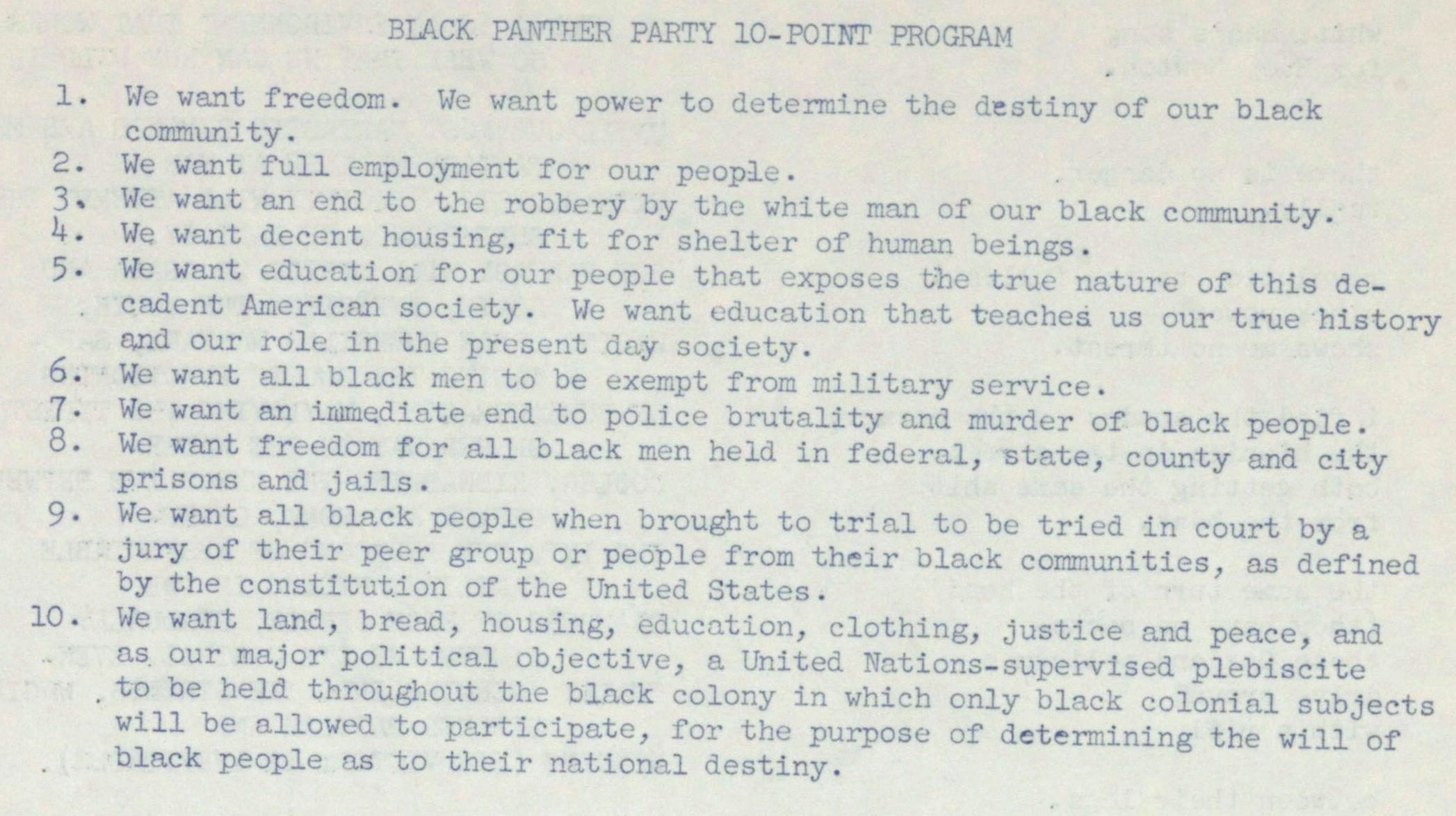
While children and adults alike are interviewed, both male and female, where kids can be seen happily dancing, all offer reeducated and redefined views on what it means to be black, with a young girl acknowledging poor literacy rates in the black community, emphasizing the need for dramatic rhetoric to make an impact, while Party Captain Bill Brent can be seen repeating the founding principles of the Black Panther Party, rattling off (without notes) the ambitious 10-point program.  Coming from him, each point clearly matters and is given a point of emphasis, where these are basically survival tools in a community ravaged by drugs, poverty, and crime, with low educational levels, where police abuse only escalates the existing problems.  The Panther mantra of “Free Huey” is the centerpiece and rallying cry of the film, with Panthers unfurling Panther flags while lined in formation taking their positions on the steps in front of the Alameda County Court House (with police watching intently from the windows), with more marching in formation while demonstrating, shouting slogans, handing out pamphlets and literature, raising money and awareness, creating a daily public presence that becomes associated with Newton’s incarceration, propelling Newton into the forefront of the American 60’s radical movement and transforming the Black Panther Party into one of the most visible political organizations of the era.  All of which is a lead-in to Newton’s prison interview with the filmmaker, which is strikingly honest and unfiltered, where the major bone of contention is how blacks have been abused throughout history, not just American history, identifying with armed struggles of colonized people throughout the world, framing his own situation as a struggle between the white establishment and “colonized black people,” initially captured and brought to this country in chains, leading lives of forced servitude, where historically blacks have been used as bodies for labor while whites have controlled all aspects of the mind.  Central to the Panther political message is the notion of self-representation where blacks are finally taking control of their own minds and speaking for themselves, suggesting this is a break with the past, which is what whites find so intimidating, throwing the weight of the law against them, arresting as many blacks as they can, with Newton claiming 80% of the prisoners inside the prison compound at the Alameda County jail are black, yet they comprise only 32% of the Oakland population.  In his criminal case, though no one, including a second wounded officer, saw Newton holding a weapon, Newton was convicted of voluntary manslaughter by an all-white jury in 1968, a sentence that was overturned two years later.  But the night of his conviction, Oakland police shot up the windows of the Black Panther Party headquarters, making a direct hit on the Huey Newton poster hanging prominently in the center, riddled by bullet holes afterwards, sending a message of their real intent.  In the 1960’s, many black African nations had gained their independence from colonial European powers, where the effects of racial divisiveness from the Algerian War in France, best expressed by Gillo Pontecorvo’s The Battle of Algiers (1965), with Algeria gaining their own independence in 1962, remains a heated hotbox of discontent even half a century later.  Varda was deeply influenced by the Black Panther’s move to determine their own terms of freedom and liberation, awakening her own consciousness in the face of the growing women’s movement rebelling against the dictates and control of a patriarchal society which for generations had defined and determined “a woman’s place,” with Varda adopting a more overtly feminist tone to her work afterwards.