Showing posts with label Ineko Arima. Show all posts

Sunday, October 6, 2024

Zero Focus (Zero no shôten) (1961)


Director Yoshitarô Nomura

author Seichō Matsumoto

screenwriter Shinobu Hashimoto


ZERO FOCUS (Zero no shôten)          B+                                                                                  Japan  (95 mi)  1961  ‘Scope  d: Yoshitarô Nomura

sagging clouds
alone facing
the raging waves
I feel sadness
first trip to Noto

—Seichō Matsumoto poem carved into a stone near the Yase Cliff (Yase no Dangai) on the Noto Peninsula, Matsumoto Seicho's "Zero Focus" and Noto 

Not your ordinary Japanese film, a mix of a slow-burning character study and a tense psychological thriller, this is arguably the most overtly film noir style of all of Nomura’s films, one of eight films the director made adapting the works of Seichō Matsumoto, an Akutagawa Prize-winning author in 1952 and the consummate crime fiction writer in Japan with more than 450 crime stories, where his works tend to focus on the minute details of crimes and the impact they had on society.  Perhaps because Japanese government censors banned detective novels during the war, declaring them unpatriotic, Matsumoto got a late start writing in his early forties, becoming Japan’s highest paid writer, politically left-leaning and popular with Japanese audiences, but his downbeat novels were emblematic of the postwar pessimism in the turbulent years following atomic annihilation, foreign occupation, and waning nationalism.  Taut and tightly constructed, the screen adaptation is co-written by Yōji Yamada, a director in his own right, maker of THE TWILIGHT SAMURAI (2002), and Shinobu Hashimoto, a frequent collaborator with Akira Kurosawa, including RASHOMON (1950), IKIRU (1952), and SEVEN SAMURAI (1954), writing more than 80 screenplays, where this has a distinct literary style with existential voiceovers and duplicitous characters, mixing an underlying Hitchcockian sense of dread with postwar Japanese social commentary, evolving into a multi-layered, convoluted plot taking us down a rabbit hole of intrigue and shocking revelations, each one drawing us into this labyrinthian flashback structure that grows ever more unhinged.  Notable for its use of three women as the lead protagonists, very much ahead of its time in that regard, especially for crime thrillers, probably the most women-centered noir you’ll ever see, described as feminist noir, as it simply was not done at the time, especially in the paternalistic Japanese society.  The son of a silent film director Hōtei Nomura, the still mostly unheralded Nomura may be one of Japanese cinema’s best kept secrets, working as an assistant director for Kurosawa on The Idiot (Hakuchi) (1951) and spending his entire career for the Shochiku film studio.  Japanese noir has a very distinct sensibility, with shifting values of modernism, including the postwar American occupation, skeptical views of progress as well as ambivalent views of the past, existential angst and paranoia, a fatalistic sense of doom, with a reevaluation of social and gender roles for those struggling on the margins.  In this film, prostitution is an underlying theme, but barely touched upon, focusing instead on the psychological ramifications, where there is an effort to transform one’s life from the cruel realities of the past, but reintegration into mainstream society proves more difficult than it seems.  Mizoguchi’s OSAKA ELEGY (1936) was one of the first critiques of gender issues, examining the darker side of sex workers (the director’s older sister was sold into prostitution when he was a child), realistically exploring a young woman’s victimization and descent into prostitution, while Kurosawa’s STRAY DOG (1949) takes noir in a new direction with a police procedural in the ruins of postwar Tokyo, utilizing a near documentary style where the camera moves fluidly through crowded streets, following a detective through Tokyo’s poverty-ridden streets for one entire reel without any dialogue, capturing the physicality of the people, the style, the mood, especially the heat, contrasted against Western influences, the introduction of a gun, baseball, white suits, dancing girls, the blues, jazz, and classical music, with Kurosawa training his eye on Japanese postwar corruption.  This film explores the trauma Japanese women had to endure following the country’s defeat in WWII mixed with revelations of corruption and prostitution during the American occupation, where rampant poverty and limited options forced some into prostitution, having to work very hard to escape that shameful past, which could prove tragic if it becomes known, where a panicked fear eventually leads to murder and suicide.  This gritty black and white noir is the first of two film versions, as a color adaptation was released nearly 50 years later by Isshin Inudo in 2009.

The question of how much we really know about our married partner is a popular device in thriller fiction, bringing comparisons to Hitchcock and his films such as Rebecca (1940) and Suspicion (1941), but this film also draws heavily from Vertigo (1958), accentuating a psychological hysteria that is further exaggerated by the swirling music of Bernard Hermann, while here it is a similarly provocative musical score by Yasushi Akutagawa, known primarily for his films with Kon Ichikawa.  Merging Japanese social realities with the pictorial and symbolic qualities of Japanese landscapes, it’s hard to think of another film that utilizes a steep cliff overlooking a swirling ocean below as well as this one does, described by local police as a beautiful natural vista, but also a popular spot for suicides.  At the center of the story is Teiko, Yoshiko Kuga, who worked with Kurosawa, Mizoguchi, Naruse, Ōshima, and Ozu, a Tokyo woman who is seen at the outset getting happily married to a man ten years older than her, a very successful advertising executive, Kenichi (Kōji Nanbara), supposedly the man of her dreams, though they met through a centuries-old family tradition of Miai, which is more of a suggested rather than arranged marriage, with representatives from his company singing his praises at the wedding, where they appear to have a very happy life ahead of them.  As he’s been promoted to the head office in Tokyo, he takes a short business trip to the offices in coastal Kanazawa to finalize his business dealings there and arrange for his new successor, Zero Focus (1961), directed by Yoshitaro Nomura. #film ... TikTok (2:41), but as the days pass, to her dismay he never returns.  Neither the company nor the police have any idea what has happened to him, but lacking any sense of urgency, she decides to search for him on her own, at first with the help of his employer, but eventually on her own, bringing with her a pair of old photographs she found among his things, but little else to go on, uncovering a series of unexplained deaths and sham suicides as well as a mountain of details that suggest he was living a double life, circumstances not even his co-workers knew about.  Assuming the role of private detective, the more she learns, the less she knows about him, as she searches for clues among a web of lies and deceit that shroud a secret life he was leading, traveling to the western provinces, where it quickly changes to deep snow, which falls relentlessly, but you never know what’s buried underneath, turning even more somber when Kenichi’s brother Sotaro (Kō Nishimura) also intervenes and investigates on his own, but things quickly go awry.  Yet what stands out are the uniqueness of the locations, including a gorgeous seaside route along the railway, with stops at the Hakui Station and the Sanmiyo Station (discontinued in 1972), with breathtaking footage of the coast up to the Noto Peninsula on the rugged north Japan sea coast, which was also featured in Shōhei Imamura’s final film WARM WATER UNDER A RED BRIDGE (2001) and also Hirokazu Kore-eda’s Maborosi (Maboroshi no hikari) (1995), a film that also deals with a missing husband and has many visual parallels.  In what is essentially a whodunit, she is dumbfounded to discover the exact same locations as the photographs, one of which is Kanazawa Castle in the snow, while the other is a small wooden house along a barren, windswept coast in a desolate, economically backward region, with dilapidated houses still built largely out of wood and in many respects unchanged since ancient times, with a high wall of fortified sticks built to keep out both the water and the wind, where the community is sketched out with an almost documentary detail, discovering hidden meanings layered underneath, yet perhaps the most unique aspect is the continued use of voiceovers to express her changing state of mind, filled with unanswered questions, where the mystery only deepens.

This film is like a puzzle box with hidden storage spaces that require intensive brainpower to unlock, as the deeper we get into this moody, atmospheric journey the more difficult it becomes to comprehend, where the real beauty is the secluded location of the windswept Noto Cliff, which frames the dizzying climax, surrounded by an omnipresent dark and dreary, yet tempestuous sea gushing below that recalls Grigori Kozintsev's HAMLET (1964), shot mostly on location in beautifully composed ‘Scope by Takashi Kawamata, where the bleak final act is given a grandiose and surreal stage for such high-wire emotional histrionics, delving into the ever-deepening mystery surrounding Kenichi’s secret life and disappearance.  Adding to this unique theatricality is the dizzyingly exaggerated, Lady Macbethian performance of Sachiko (Hizuru Takachiho), the wife of a wealthy industrial magnate, Mr. Murota (Yoshi Katō), a friend of Kenichi, yet what’s intimated is a much earlier relationship, as in 1950 the missing husband used to be a street cop in Tachikawa near the American occupied airbase when Sachiko was working as a prostitute catering to American soldiers, something she has kept concealed all this time, yet it’s a past that she cannot escape, which is a classic noir theme.  The things that people will do to keep their secrets from being exposed is uncanny, and Sachiko is involved in multiple levels of dirty dealings that the police have erroneously determined were either accidental deaths or suicides.  The degree to which the police are clueless is a bit mindboggling, but the only one savvy enough to actually uncover the interconnectedness and underlying motives behind all these disappearances is Teiko, whose relentless investigation puts her life in danger, as everyone else who came remotely close to unraveling these mysteries ended up dead, so the fact she’s standing precariously close to the edge of a cliff feels more than a little ominous.  Of course the music only amps up the tension, unleashing waves of explosive revelations that grow stranger by the minute.  While we were led to believe that it was Kenichi who was the enigma, Sachiko is a powderkeg of hidden secrets that take this in an entirely different direction, becoming a feminist examination of the postwar predicament for women, many forced into unwanted sexual relationships, as though they were mere objects, denied any feeling of humanity.  This is the essence of the Japanese noir modern woman, an unsettling figure outside the conventions and traditions of marriage and family, existing on the margins of society, expressing individuality and independence by means of a self-imposed isolation, often resorting to and relying upon their exposure to criminality to find their way out of what they perceive as life-threatening situations.  Few films convey a dire sense of desperation like this one, as if a noose has already been placed around Sachiko’s neck, suffocating not only from the choices she’s made but the consequences that come from their exposure, shown in a flurry of flashback sequences that unravel with differing RASHOMON-like interpretations.  Teiko is the lead protagonist, but Sachiko is a mystery woman/femme fatale who becomes an avenging angel of death, while yet another woman from the past surfaces, Hisako (Ineko Arima), a reception girl of the agency’s Kanazawa branch, who turns out to be Kenichi’s common-law wife, and is equally mystified by his strange disappearance, yet she and Sachiko have similar pasts, where the three women are drawn together into the precarious final moments that only grow more melodramatically delirious.  It’s a dense and often confounding film that requires plenty of subtitling, as it’s a whirlwind of rapidly changing events, each with their own deeply unsettling conundrums that have been buried under the surface, finally coming to light.

Monday, April 11, 2022

Tokyo Twilight (Tôkyô Boshoku)


Director Yasujirō Ozu


TOKYO TWILIGHT (Tôkyô Boshoku)                    B                                                             Japan  (141 mi)  1957 d: Yasujirō Ozu

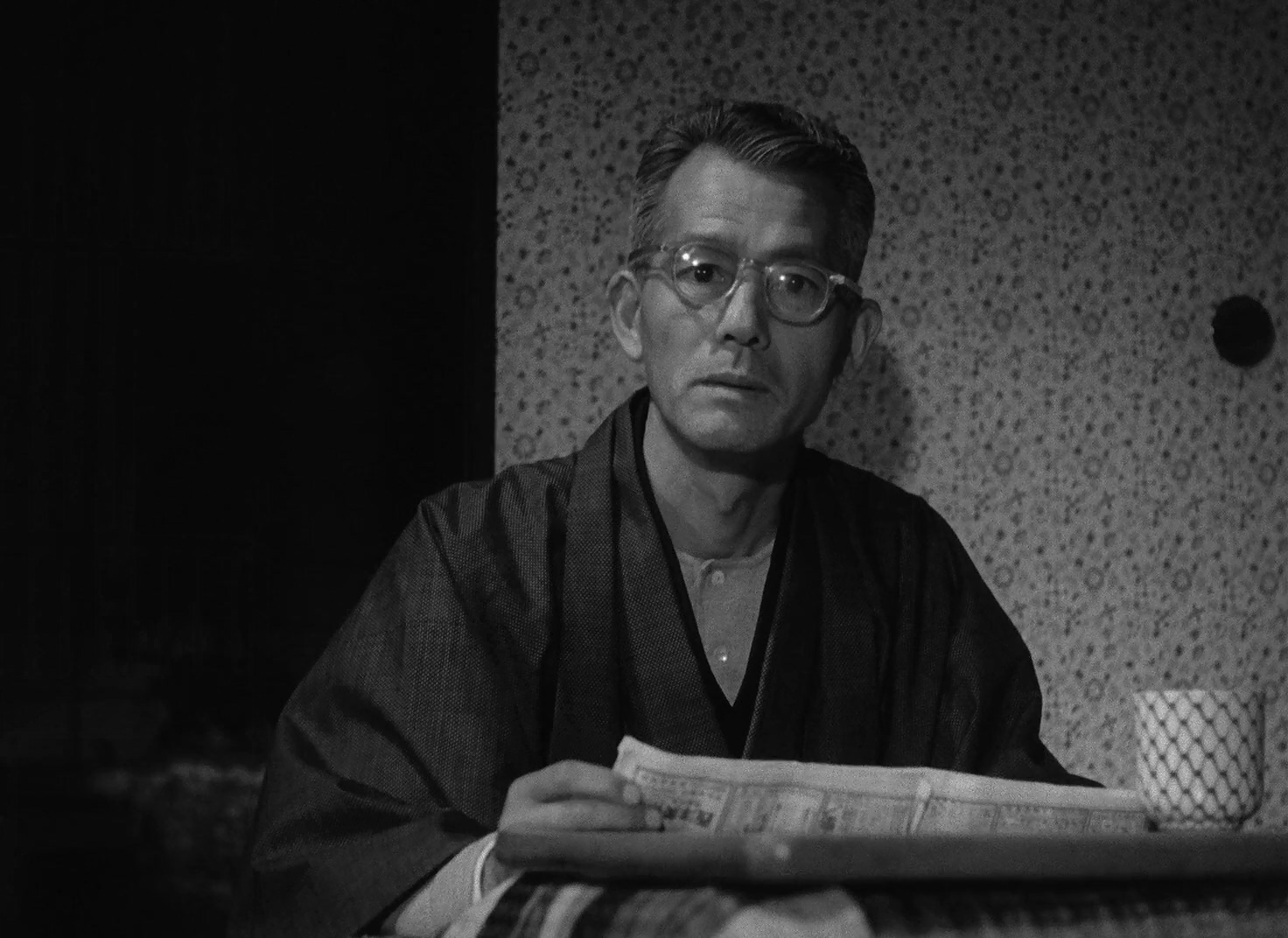
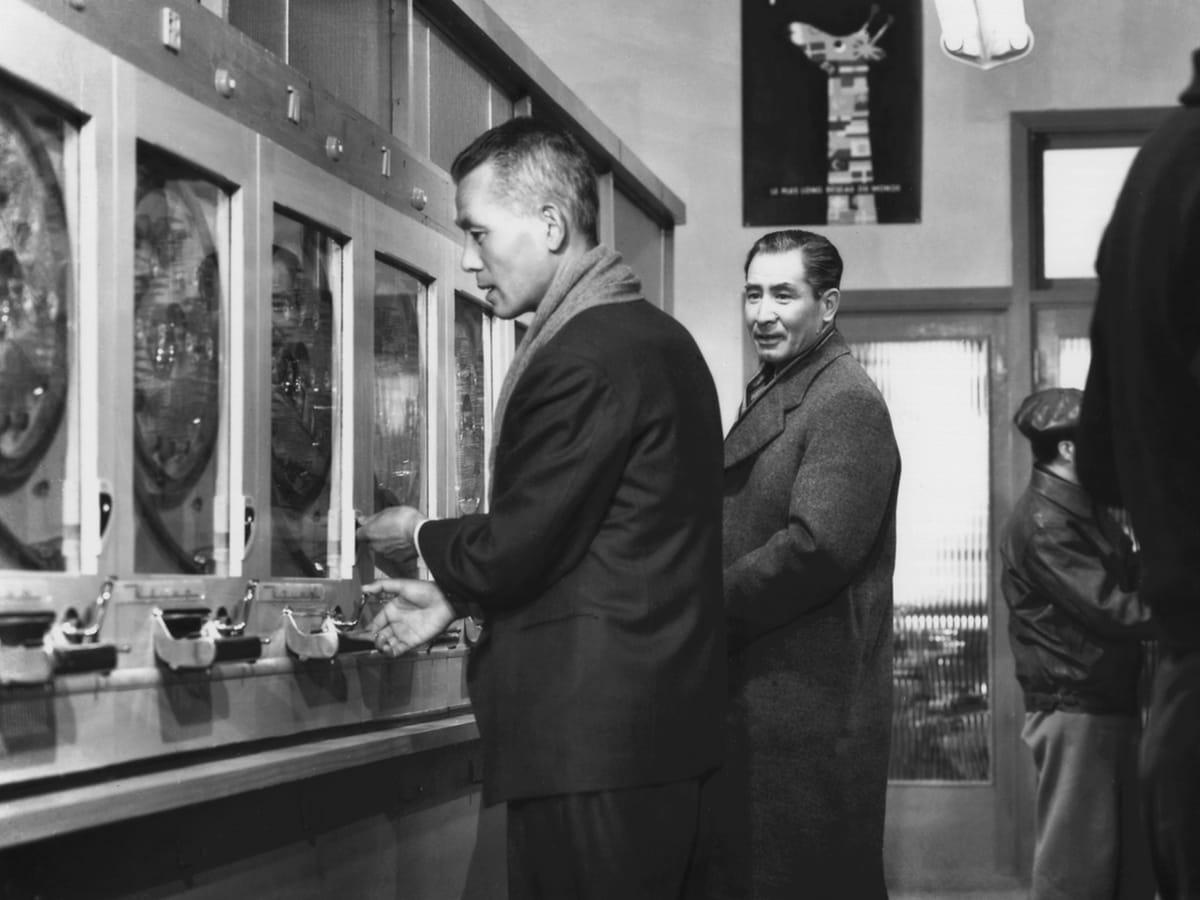
A piercing portrait of family life, easily the most downbeat, melancholic, and melodramatic of Ozu’s films, a noir-influenced family drama that is also Ozu’s bleakest film, given a German Expressionist look, as if shot through a fog, like early Hitchcock films from the 20’s, such as The Lodger (1927), where the cheerfully ironic opening and closing music resembles what you might hear in a Fellini film, also used in a similar capacity during a funeral sequence of EARLY SPRING (1956).  The lurid, somewhat sensational aspect of the material may have grown out of the criticism the director received that his films were out of touch with the youth of today, so a rebellious youth is fully integrated into this movie.  Yet it was not a success, the only Ozu film not to make the top ten of the Kinema Jumbo poll since THE ONLY SON (1936), catching Ozu off-guard, where he and longtime co-screenwriter Kōgo Noda feuded, with Noda apparently unhappy with Ozu’s final screenplay, both viewing this film as a failure.  Slow to accept new technical advances, this is Ozu’s last black and white film, shot by longtime collaborator Yūharu Atsuta under barely lit circumstances, most of it shot after dark, provocatively dealing with issues such as marital discord, rebellious adolescence, premarital sex, abortion, and suicide.  In an era of Covid and the wearing of masks, this film is eerily striking with some prominent characters wearing face masks as protection from the contamination of pollution in the city, with much of this film taking place in seedy Tokyo neighborhoods.  By any measure, this is a different kind of Ozu film, unlike any of his others, his only postwar film taking place in the dead of winter, where the lighting, in particular, accentuates shadowy figures walking late at night down darkly lit spaces, narrow alleyways, and the cramped quarters of small bars, mahjong and pachinko parlors, or noodle houses that dot the landscape, with nearly all the action taking place at night, or in shadowy interiors, offering a grim tone where the protagonists deal with the dissatisfactions in life, shockingly offering a psychologically downbeat subject matter haunted by an implacable shadow of death, where there are shady characters outside the family featuring plenty of drinking and gambling.  There’s even a Robert Mitchum movie poster from the film FOREIGN INTRIGUE (1956) hanging on the wall in one of these dimly lit bars.  It opens, however, in a wintry scene with the always sympathetic Shukichi (Chishū Ryū) taking a seat at a Ginza neighborhood sushi bar ordering a meal with some warm saki, as we see commercial buildings, power lines, and one lonesome street light illuminating the early dusk, with Tokyo viewed as a collection of neighborhoods with interconnected lives and stories, a city still in progress, a place and a people in flux, dislocated and often alone, though Shukichi lives in the more quietly traditional Zoshigaya district of Tokyo with two daughters, one obedient and one disobedient.  His wife left some time ago for a younger man during the build-up to war, abandoning her children, with Shukichi concealing his grief, never burdening the children, sparing them the circumstances, though this film explores the ramifications of that concealment.  The normally angelic Setsuko Hara appears in this film (her fourth Ozu film, the only one where her character is neither single nor widowed) as Takako, the elder daughter of Shukichi, in her most taboo-shattering role as an emotionally dispirited though proud young woman who leaves her abusive and alcoholic husband, bringing her 2-year old daughter with her, moving back into the home of her father, where she is obediently attendant to him, wearing traditional Japanese clothing.  While there was also a brother who died in a mountain climbing accident several years earlier, Takako is unsettled and overly distraught right from the outset.  When her father asks what’s wrong, she can barely say, overwrought with endless turmoil, carrying the weight of the world on her shoulders, never really having a moment’s reprise.  When younger daughter Akiko (Ineko Arima), a college student, arrives home even later, she is sullen and noncommittal, completely rebuffing her father’s attempts to find out where she’s been, verging closer to open defiance and blatant disrespect.  Shukichi is clearly exhausted with Akiko’s disobedient refusal to communicate, apparently unable to get through to her, where her impudence is an issue.  Akiko’s not really in school any more, learning English shorthand instead, hanging out in bars and mahjong parlors late into the night, appearing surly and bad-tempered, never smiling, smoking cigarettes while acting nonchalant, a modern reflection of Western fashions and values, always dressed in a shabby, wrinkled coat, usually seen in search of her boyfriend Kenji (Masami Taura), who has been avoiding her, with people calling her derogatory names behind her back.  By the time she catches up to him, she reveals that she’s pregnant, but he’s completely indifferent, expressing no interest whatsoever, even questioning whether the baby is his, the standard modus operandi for male denial that leaves her in a quandary.  Offering a pitiless view of a Japanese family beset by repressed secrets and lies, there seems to be no end to the damage done, resulting not just in the fracturing of the Japanese family, but even more importantly, how individuals inexplicably blame themselves for the pain it causes.  In no other film does Setsuka Hara look so world-weary and beaten-down as she does here. 

A film that reveals the complex and often corrosive impact of American occupation, which serves as an unseen backdrop for all Ozu’s postwar films, where traditional Japanese ways of life struggled in contrast with the western imposition of modernist, capitalist, and thoroughly American consumer practices.  Postwar Japan was a time when the Japanese identity was reconstructed under the influential gaze of American eyes to serve American interests.  Young people of Japan in the middle of the twentieth century came of age during the rise of television and mass commercialized media, which was complicated and amplified by the leering presence of American military bases nearby, which helped change the face of Japanese society.  This is the larger context underlying this lurid family drama.  Of note, Shukichi tells Takako that he read her husband’s article entitled “Resistance to Freedom,” a rare protest against his country’s failure to question the magnitude of American commercial and political influence.  Shukichi has a comfortable position working as a bank executive, meeting up for lunch with his sister Shigeko (Haruko Sugimura), who gets to work right away in finding marrying options for Akiko, believing this is her best option.  It’s an interesting intersection of the old world meeting the new world, using an old world solution for a modern era problem, with Akiko resembling that 50’s juvenile delinquent so prevalent in American movies, like Nicholas Ray’s Rebel Without a Cause (1955), where teenagers are often viewed as socially maladjusted.  Ozu applies the same principal here, as Akiko struggles with being raised without a mother, who has been presumed dead, but she runs into a woman purely by chance, Kikuko, (Isuzu Yamada, Lady Macbeth in Kurosawa’s THRONE OF BLOOD released earlier that same year), the proprietor of a mahjong parlor in the Gotando neighborhood, known for its unpaved roads and seedy bars, who was asking a lot of questions about her, knowing her entire family history, making her think  this could be her mother.  When they meet, it raises existential questions in her mind about where she came from.  When Takako learns her sister actually rediscovered their mother, she quickly moves to protect her, paying the woman a visit while angrily informing her to never reveal she is actually Akiko’s mother.  Yet when Akiko learns her sister paid a visit to the mahjong parlor, she immediately confronts her, suspecting something is wrong.  Takako is forced to acknowledge their mother abandoned them at an early age to run off with another man, believing they would never see her again, while exhibiting shock that she actually turned up again in Tokyo.  When Shukichi learns his brash younger daughter has been asking for money from relatives, he tries to speak with her, but Akiko is evasive, continually hiding the truth, as the money was for an abortion, something she could never speak about openly (though abortion was legal in Japan since 1948), sharing the truth with her sister, but the shame this would bring her father is a primary reason she could never be honest with him, so she invents excuses and little lies.  That experience, however, leaves her emotionally drained, never fully recovering afterwards.   When Shigeko pays a visit with her marital suggestions, her joyful mood quickly turns sour, as Akiko’s not the least bit interested, literally showing contempt for the idea.  Because of her standoffishness, it is perceived as Western belligerence, seemingly wanting things her own way, where she’s such a disappointment to her father, who wonders how she turned out this way.  Takako is the intermediary, always supporting her sister, identifying with her inability to find acceptance either within her family or in broader society, feeling like an outcast.  Akiko begins doubting herself, questioning where she really came from, actually believing she is an outcast, that Shukichi is not her father, running back to Kikuko, expressing her own hatred for having been abandoned while demanding the truth, but she swears Shukichi is her father, once again leaving Akiko in a quandary, not knowing what to think, but never really feeling close with her father, instead feeling isolated and alone, which is never more apparent than when she is waiting in a bar for Kenji to show up, still waiting well past midnight, revealing a configuration of thick shadows in dark spaces, when a detective in civilian clothes (wearing a mask) picks her up and hauls her down to the police station, with Takako (also wearing a mask) coming in the wee hours to the station to pick her up.  While not breaking any laws other than curfew (the same crime police use to haul James Dean into the police station in Nicholas Ray’s film), she is simply a young girl seen as being in the wrong place at the wrong time.  Nonetheless, her father denounces her, claiming “You’re no child of mine,” while Akiko claims she’s not wanted, responding with “I should never have been born.”      

A film described by critic Robin Wood as “the one nobody wants to talk about,” this is one of the very rare Ozu films in which laundry hung up to dry does not appear, recurring in every Ozu film from A Story of Floating Weeds (Ukigusa Monogatari) (1934), while trains, on the other hand, are still a staple, normally representing the possibility of movement and change, but here with overtones of melancholy or tragedy.  With melodrama as the dominant element, Ozu stages an anxiety-ridden internalized struggle with the darkest realms, accentuated by bleak and somber settings, including a view from Tokyo harbor revealing smokestacks, industry, and the high cost of modernity, similar to Antonioni’s vision in RED DESERT (1964), described by Andrew Sarris as “the architecture of anxiety,” with a psychologically disoriented Monica Vitti suffering extreme alienation.  In these depictions, the high cost of modernization equates to the loss of the human soul, which becomes fractured and less resolute.  Featuring plenty of tearful scenes, this tragedy is juxtaposed against the calm demeanor of Chishū Ryū, a sympathetic figure who is the picture of fair-mindedness, with Setsuka Hara straddling the generational differences.  Ineko Arima may get swept up not only by the unfortunate circumstances, but the massive influence of the major players she’s working with, coming across as abrasively shrill in stark contrast with their more measured restraint, yet Ozu along with Kōgo Noda have written a scenario where she dominates the screen time, accentuating the plight of the youth.  More shaken than ever, Akiko wanders into a noodle house and orders sake, drinking it all down at once, sitting alone and beleaguered, then ordering another one.  Purely by chance, Kenji walks in the door, once again pleading his case, justifying his own behavior, leaving Akiko little choice but to slap him hard in the face several times before walking out the door without uttering a word.  Shortly afterwards a train whistle marks a significant event, with pedestrians running to the scene of a horrific accident, apparently throwing herself in front of an ongoing train.  With her father and sister at her side in the hospital, she can be heard wanting to start over again, with Ozu curiously cutting to a clock and a yawning nurse, disaffected images that comment on the passing of time.  Takako makes the journey to the mahjong parlor in her mourning clothes, informing Kikuko that she’s to blame for the death of Akiko, before leaving in a scene of repressed yet righteous anger.  A cloud of sadness pervades in the aftermath of a needless death, with Takako suggesting her younger sibling missed not having a mother’s love, leaving her feeling abandoned and alone, while Shukichi, in re-evaluating the situation, feels compelled to acknowledge he always paid her more attention, to the point where he felt Takako might feel slighted, and apologized to his daughter for insisting upon the marriage that has caused such grief, depriving her from marrying the one she loved.  After paying a visit to Takako’s husband, Shukichi realizes he’s not the same person, having become more irritable and disconsolate, thinking only of himself, incapable of recognizing the sorrows of others.  Kikuko then pays a visit to Takako, offering flowers as a tribute, announcing she and her husband would be departing by train later that evening to seek a new job in the far regions of Hokkaido.  Takako is stunned, to say the least, wordlessly viewing her with open disdain.  The scene at the train station is one of the better sequences in the film, as Kikuko holds out hope that Takako will see her off, eagerly looking out the train window, yet what stands out is the serenade of a youthful school choir, establishing a localized sentiment, one with roots in the community, sending off the train with high hopes, accentuating the ideals of youth, likely singing about themes of honor, courage, and integrity, perhaps even valor, all traits associated with exemplary behavior and high ideals, none of which can be attributed to her life, as she watches in vain for any sign that her life matters.  Meanwhile, Takako is rooted to her place within her own family, clearly overwhelmed by her sister’s suicide, speaking with her father about giving her marriage another chance, as her daughter deserves having the love of two devoted parents.  Fully aware that she’d be leaving her father all alone, openly concerned for his welfare, he puts all that aside, reassuring her that he’d be just fine before kneeling to pray at the altar of his deceased daughter.  As he does in so many Ozu films, there is a long, final scene of this stoic, solitary father figure alone on the floor of his finally empty home, calmly staring out in the distance, fully aware of his own solitude, accepting it with a quiet resignation.