Showing posts with label Howard Alk. Show all posts

Wednesday, February 5, 2025

Don't Look Back


Marianne Faithfull in the corner


manager Albert Grossman


Donovan


Director D. A. Pennebaker

Pennebaker with Dylan

Pennebaker holding the camera

Dylan with Howard Alk on the left

Dylan with Alk


DON’T LOOK BACK           A                                                                                               USA  (96 mi)  1967  d: D.A. Pennebaker

I ain’t lookin’ to compete with you,
Beat or cheat or mistreat you,
Simplify you, classify you,
Deny, defy or crucify you...

—Bob Dylan - All I Really Want To Do (Live in Liverpool - 1965 ... outtake footage filmed by Pennebaker, YouTube (3:40)

Made during Dylan’s 1965 solo tour of England, but released in 1967, this is the definitive portrait of the artist at an early stage of his career, a time when he was still only 23, yet it’s the height of his worldwide success, where the film has become an iconic rock document, an anthem for 60’s youth culture.  Pennebaker and Chicago filmmaker Howard Alk, one of the cinematographers on the film who would later direct The Murder of Fred Hampton (1971), had unprecedented access, and a brief temporal window behind the scenes that allows viewers to just hang out with the artist for a while as he’s on the verge of becoming internationally famous, with Dylan captured onscreen as he never would be again, offering a rare emotional intimacy that no subsequent documentary has achieved.  This is a film about the 60’s as seen through the dizzying life of one of the standard-bearers of that tumultuous decade, where he is to the 60’s what Jack Kerouac and Allen Ginsberg were to the 50’s.  His Ginsberg-like stream-of-conscious words are an aggressive assault to the senses, where the meaning remains highly ambiguous, while his style is constantly changing, and his notorious avoidance of publicity borders on the obsessive, yet he remains the influential voice of the era.  One sequence that stands out, as if pulled out of time from a different era, is Ed Emshwiller footage of Dylan singing outdoors to farmhands two years earlier during a voter registration drive in the cotton fields of Greenwood, Mississippi, Dont Look Back (1967) -- (Movie Clip) Only A Pawn In Their ... YouTube (3:20), where he transitions from a younger version of himself to a live performance on this tour, mirroring the shift from folk traditions to a new terrain of rock.  Filmed during a three week concert tour in the spring of 1965, it’s not so much a documentary as it is a window into a private side of one of our more revered artists, a look behind the curtain, where his sneering intellectual arrogance on display and his disdain for others marks his turf as an insufferable egotist, yet there are throngs of admirers waiting to see him perform, where every concert is sold out.  It’s relaxed and informal, with no set format or criteria, perhaps only visualized in the editing room, which happened very quickly in a matter of weeks, displaying a remarkable gift for weaving music into the visuals so that each seemed to become indistinguishable from the other, reflective of the volcanic social and political transformations taking place during the 60’s, creating not only a revolutionary cinéma vérité approach to a road tour, but a new form of social commentary, bringing it to the mainstream, offering one of the most intimate glimpses possible of the perpetually elusive Bob Dylan.  An artist receiving the Presidential Medal of Freedom from President Obama in 2012 and who would be awarded the Nobel Prize in Literature in 2016 for his “new poetic expressions within the great American song tradition,” with literary allusions to a wide swath of notable poets and writers from Homer to Shakespeare to William Blake, Arthur Rimbaud, James Joyce, T.S. Eliot, Allen Ginsberg, and Jack Kerouac, but in the early years no one really knew what to make of him, and this gritty exposé of the good, the bad and the ugly reflects that mysterious confusion, containing a wide variety of mixed emotions.  A frustrating, puzzling, illuminating, and fleeting portrait of the artist as a young man, originally shot in black and white on handheld 16mm, with blurred grainy images of fast monochrome film, where cigarette smoke permeates every frame, much of the film takes place in a cramped hotel room at the Savoy in London, where the tight quarters only accentuate an atmosphere of intimacy, wandering around backstage, conducting interviews, meeting with fans, taking limo rides, creating a feeling of actually being there.  There is no narrative, and there are no talking heads, with no attempts to define or explain who he is, so it’s such an individualized, interior, free-associating experience that may play out differently for each individual viewer, offering an unflinching gaze into the darker corners of Dylan’s persona.  According to Pennebaker, “Dylan is an interesting person to watch because he is constantly creating himself, and then standing back and trying to witness it,” while according to Dylan, “What happened, [in the sixties] happened so fast, that people are still trying to figure it out.”  You may be able to recognize Joan Baez, Marianne Faithfull, Donovan, former Animals organist Alan Price just after he left the group, that’s him on The Animals - House of the Rising Sun (1964) + clip comp. 60 ... YouTube (4:32), Dylan’s relentlessly aggressive, über manager Albert Grossman (the film is actually his idea), and Beat poet Allen Ginsberg by sight, where there is nothing to identify them otherwise, as they simply appear onscreen, part of the mosaic of intermingling personalities that comprise this film.   

This remarkable film was added to the National Film Registry in 1998, while in 2021 Rolling Stone magazine listed this as the #1 music documentary of all time, 70 Greatest Music Documentaries of All Time, described as an “obvious cultural reference point” and a “permanent blueprint for the public’s image of mid-Sixties rock & roll.”  It bears some resemblance to the weirdly scripted comedy of Richard Lester’s A HARD DAY’S NIGHT (1964), shot during the height of Beatlemania and coinciding with a world tour, where fans besieged their hotels, stole various items for souvenirs, and chased them around London.  Here wildly enthusiastic fangirls are waving to Dylan outside his hotel, hopelessly trying to get his attention, screaming with delight at any sign of him.  What distinguishes this film from other musical documentaries is that this is not a concert film, as none of the songs play out in full, which is actually the film’s biggest criticism, but it’s not that kind of film, where it’s more about the intangible moments in between the songs, with Dylan interacting with the press, hotel personnel, or other friends and musicians paying him a visit, occasionally breaking out in song.  One thing that stands out is that he is defiantly contrarian, not willingly agreeing with anyone, continually finding an antagonistic point of view, yet what’s fascinating is how he sees himself during this momentous period of his life, regarding it all suspiciously, where we literally watch him reading articles written about him, and then reacts as only Bob Dylan can, as he obviously gets a kick out of seeing himself in the news.  When Dylan reads an article that describes him as “puffing heavily on his cigarette, he smokes eighty a day,” he hilariously responds, “God, I’m glad I’m not me.”  Not just a songwriter and musician, but Dylan is also a poet, who attracted the interest of other poets, including fellow musician/poet Patti Smith, who has talked about the impact both Dylan and the film had on her as a young, struggling artist in New York, as she “related to everything he did, his magnetism and sexual energy.  He was nobody’s patsy,” something she describes as “the hubris of youth,” Patti Smith on Bob Dylan and DONT LOOK BACK YouTube (14:01).  This would be Dylan’s final acoustic tour, coming just after he released Bringing It All Back Home, as he began to move away from the folk movement from which he’d emerged, where the first side is all electric, while the second side is all acoustic, becoming his first album to incorporate electric instrumentation.  When he returned to England in 1966 it was for the electric tour that caused one outraged fan who felt so betrayed he shouted out “Judas,” a legendary moment of instantaneous frustration that pretty much defines his career evolution, as he continually evolves into new musical forms, never repeating any song the same way twice.  Curiously, according to photographer Daniel Kramer, who was sent to photograph him, finding him completely uncooperative, he rarely even plays the guitar except when performing.  The film hasn’t aged a bit, and feels as modern and timeless today as it was when it was released, offering a compelling critique of an intrusive media that can completely misunderstand its subjects through their own bias, yet still print distortions and inaccuracies anyway.  Pennebaker’s restless camerawork is perfectly suited for Dylan’s chameleon-like persona, never really answering any of the interviewers questions, typically turning the questions back around on them, often seen hiding behind his everpresent dark sunglasses that he strangely wears indoors, where you may not like him, but he’s very human, as openly flawed as the rest of us.  The title comes from Satchel Paige, the ageless Negro League baseball pitcher who famously remarked, “Don’t look back.  Someone might be gaining on you,” with Dylan offering his own retort, “He not busy being born is busy dying,” and since he so thoroughly carries the film, the focal point of every single second, he describes the film as Pennebaker by Dylan.  The opening two-and-a-half minutes is an improvisational music video (with some calling it the first) promotion for Dylan’s first Billboard-landing single and electric rock anthem, Subterranean Homesick Blues, Bob Dylan - Subterranean Homesick Blues (Official HD Video) YouTube (2:15), with Dylan fumbling through a series of cue cards that he drops to the ground after the words are sung, a shorthand for his momentous lyrics, which sets the tone for what follows, with an unidentified Allen Ginsberg in the background, where he and Kerouac used to refer to themselves as “subterraneans,” the title of a 1958 book by Kerouac, where there is an audio recording of him reading a passage from the book, Jack Kerouac Reads From 'The Subterraneans' (1958) YouTube (3:14).

Dylan’s snarly and petulant attitude, particularly with clueless reporters, may have simply been a defense mechanism against the overexposure in newspapers and magazines, where his music was as overplayed on the radio as the Beatles, because commercial radio loves repetition, elevating him to a Godlike status, which he shied away from, so his automatic impulses shut down those questions while making fun of just how ridiculous the situation was that he found himself in, literally jousting with reporters, viewing them as comic relief, Dont Look Back (1967) -- (Movie Clip) Lies And Rubbish YouTube (3:45), where people were asking him everything imaginable, no matter how personal or inappropriate, and then writing whatever the hell they pleased, often using broad, encompassing labels to describe him.  So there are moments when he’s being spectacularly obnoxious towards others, a real jerk, as if he couldn’t care less about them, using acerbic sarcasm as a weapon, yet he also has some indescribable endearing quality, where he seems genuinely authentic and quite comfortable just being himself.  Mixed altogether in a musical collage, we’re privy to a constantly changing mindset that offers an exemplary view of all the contradictions he was constantly dealing with, where it’s impressive that a document like this even exists, as we rarely get behind the façade of great artists, but this one really expresses all the adrenaline-laced, sped-up confusion wrapped up in the meticulously documented, jagged edges of the experience, with Dylan acutely aware that a camera is always on him, where every moment is a performance, yet this may also be who he really is, making things up as he goes along, like looking in a mirror at yourself while real life is happening, where you have to wonder at times if that guy you’re looking at is even you.  In a bewildering moment that comes out of nowhere, all hell breaks loose when Dylan throws an angry tantrum after learning someone threw a glass bottle out the window, causing all sorts of pandemonium mixed with an air of late night drunken revelry, Bob Dylan hotel argument about throwing glass in the street YouTube (2:59).  Lost among the barrage of Dylan clips is an extremely raw and revealing moment with Alan Price, coming at a particularly vulnerable time for an extremely talented artist, having left The Animals under questionable circumstances, where alcohol may have played a role, and while he’s barely onscreen except for a few moments, they are tinged with giddiness turning to heartbreak, where the instantly changing mood becomes something of a subplot for the film.  Dylan’s unidentified right hand man and friendly soulmate is his road manager Bob Neuwirth, a partner in crime with a long and influential association with Dylan, who is with him throughout this film, often acting as a sounding board, both cracking up over the enthusiastic press coverage of Donovan, described by the press as “England’s answer to Bob Dylan,” which becomes a running joke in the film, where his press clippings adorn the hotel mirrors and a concert poster appears in the hotel room draped across a couch, but they’re generally on the same wavelength, Bob Dylan and Bobby Neuwirth YouTube (47 seconds).  Joan Baez makes an early appearance and then disappears, something she has described as “the most demoralizing experience of my life,” apparently having enough of this self-obsessed Dylan guy, but she sings a beautiful song, Dont Look Back (1967) -- (Movie Clip) Percy's Song, Etc. YouTube (3:57), while Dylan completely ignores her, back turned, typing away on his reportedly amphetamine-fueled experimental novel Tarantula, released several years later, which baffled his critics and left his fans scratching their heads, while in this same sequence Marianne Faithfull can be seen tucked away in a corner, never saying a word.  Donovan actually appears in the hotel room and sings a nice, conventional folk song, Donovan - To Sing for You, Bob Dylan - It's All Over Now Baby ... YouTube (4:05), with Dylan watching nervously until Donovan asks if he’d give an impromptu performance of It’s All Over Now, Baby Blue, which is endearing and seems especially personalized, yet the coup de grâce may actually be an unused outtake from one of Dylan’s most sublimely gorgeous love songs, filled with symbolist wordplay, Bob Dylan - Love Minus Zero/No Limit (Live at Savoy Hotel 1965) [HD FOOTAGE] YouTube (3:42), a snippet of which played in concert closes the film.  It’s fair to say Donovan was one-upped here, and was likely overwhelmed by Dylan in a take no prisoners mode, where there was simply no one else like him in the entire universe.  Not an easy man to get along with, yet this film graces the screen with rare moments of down time, when he had time to kill, preparing for the actual moments when he would take the stage, as this entire film is a lead-in to that combustible moment when Dylan set the world on fire.

Sunday, January 3, 2016

The Black Panthers: Vanguard of the Revolution


Panthers on parade at Free Huey rally in Defermery Park (named by the Panthers Bobby Hutton Park) in West Oakland


Ericka Huggins


Angela Davis


Kathleen Cleaver


Kathleen and Eldridge Cleaver


Eldridge Cleaver


Huey P. Newton, Chairman of Defense


Huey P. Newton holds a Bob Dylan album at home after he was released from jail


Chairman Bobby Seale speaks at Free Huey rally in Defermery Park in West Oakland. Bill Brandt, who later defected to Cuba, is at left


Chairman Bobby Seale


Bobby Seale in jail


Eldridge Cleaver gathering petitions for his Presidential run in 1968

Top left to right: Elbert "Big Man" Howard; Huey P. Newton (Defense Minister), Sherman Forte, Bobby Seale (Chairman). Bottom: Reggie Forte and Little Bobby Hutton (Treasurer), November 1966


Huey P. Newton at a Black Panther rally


Bobby Seale (left) and Huey P. Newton


Chairman Bobby Seale


Director Stanley Nelson


Many of the photos are attributed to Stephen Shames from the Steven Kasher Gallery, Black Panther Party—Stephen Shame


THE BLACK PANTHERS:  VANGUARD OF THE REVOLUTION            B   
USA  (113 mi)  2015  d:  Stanley Nelson                   Official site


The purpose of this new counterintelligence endeavor is to expose, disrupt, misdirect, discredit, or otherwise neutralize the activities of black nationalist, hate-type organizations and groupings, their leadership, spokesmen, membership, and supporters, and to counter their propensity for violence and civil disorder.  The activities of all such groups of intelligence interest to this Bureau must be followed on a continuous basis so we will be in a position to promptly take advantage of all opportunities for counterintelligence and to inspire action in instances where circumstances warrant.  The pernicious background of such groups, their duplicity, and devious maneuvers must be exposed to public scrutiny where such publicity will have a neutralizing effect. 
—J. Edgar Hoover, Director of the FBI, Cointelpro memo from August, 1967 declaring the Black Panther Party a Black Nationalist hate group

The Black Panther Party is one of the most misunderstood elements of the late 1960’s political and social movements in the United States due to government disinformation, harassment, and racial misperceptions that were magnified by an FBI campaign not only to discredit the organization, wipe out any future leaders, but also to destroy it by taking every available opportunity to either arrest or kill any surviving members, where what was once believed to be fiction is now fact.   This film doesn’t really get into the history of the FBI COINTELPRO program, a covert counterintelligence operation that officially started in August, 1956 to target and discredit activities of the Communist Party of the 50’s, but was expanded in the 60’s to include a number of domestic groups defined as hate groups, among which included peaceful Civil Rights organizations like Martin Luther King Jr. and the Southern Christian Leadership Conference (SCLC), National Association for the Advancement of Colored People (NAACP), and Congress of Racial Equality (CORE), claiming the organizations were infiltrated by communists, but also individuals associated with the women’s rights and anti-war movements, also the Ku Klux Klan, the Socialist Workers Party, American Indian Movement, Students for a Democratic Society (SDS), the Weathermen, and the Black Panther Party.  Identifying the motivations of these groups as subversive, the FBI investigated and undermined virtually every prominent black leader in the country for 15 years, including a veritable Who's Who of iconic historical figures, ranging from Malcolm X and his wife Betty Shabazz, from their marriage in 1958 through 1970, continuing even 5 years after her husband’s murder, while also hounding Fannie Lou Hamer, Jackie Robinson, and Martin Luther and Coretta Scott King, planting listening devices in their home and various hotel rooms, tapping their phones, writing fake letters and initiating false allegations, undermining their marriage, even sending a “suicide letter” to Dr. King in a crude and disgraceful attempt to convince him to commit suicide rather than accept the Nobel Peace Prize. 


FBI undercover agents spied on leaders, federal informants were planted inside organizations, disinformation was deliberately spread with the intention of exacerbating internal dissension within the ranks, spreading discord and strife between leaders, organizations, and their families. To this day, huge volumes of the COINTELPRO documents remain redacted and off limits, fueling speculation on just what they may still be hiding more than 40 years later, as the program officially ended in 1971 after it was exposed in open court deliberations and later criticized by Congress and the American people for violating first amendment rights and making inappropriate use of American tax dollars.  Through the Freedom of Information Act, the department was forced to release official documents that exposed to the public revelations of police abuse, humiliation, misinformation, outright lies, coercion, informants, plants, and more.  Any documentary or historical exposé of the Black Panther Party must also include the extreme degree to which individuals and the organization were intentionally discredited by the FBI, using anonymous letters encouraging violence between the Panthers and street gangs, working with local police departments to harass local members of the Black Panther Party through raids and routine vehicle stops, even providing the strategical logistics of those pre-dawn raids, providing maps and floor plans to the police, while the newspaper and television version of unfolding news events followed the police-fed reports nearly verbatim, making the police department version the one that was officially used with the public to describe the Panther Party and their activities.  That bias continues to this day, where no one has officially corrected or updated the record, and as a result this period of history, and in particular the Black Panther Party, remains clouded in ambiguity.  

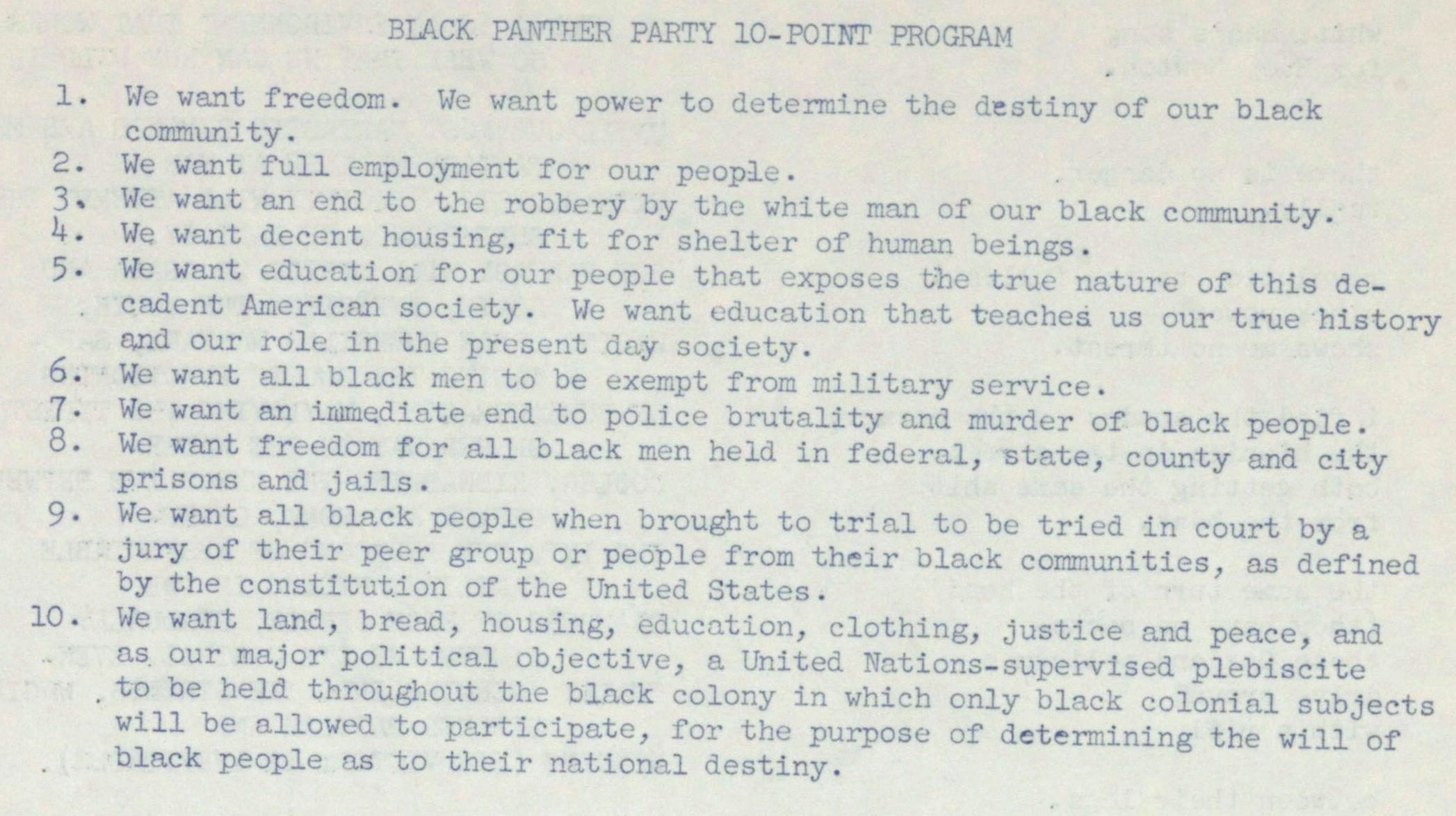
The film opens to the innocent sounds of Chicago’s own Chi-Lites, Chi Lites For God Sake Give More Power To The People 1971 B1 YouTube (2:44), eliciting the familiar refrains of social change in the air, where the non-violent protests led by Martin Luther King were inextricably linked to the Civil Rights era, yet increasing numbers of young people, both black and white, were appalled by repeated scenes of blacks being brutalized by heavily armed white police, not just in Selma, Alabama but in urban cities across the country.  While there were more militant spokespersons, Malcolm X was assassinated in 1965 at the age of 39, leaving behind a power vacuum in the black movement.  The Black Panther Party, formed in Oakland, California in October of 1966, attempted to fill that void, founded by 24-year old Huey Newton and 29-year old Bobby Seale, both with Southern roots (one from Louisiana and the other from Texas) who met and grew politically active at Oakland City College, gravitating towards the militancy of Malcolm X rather than the more passive tactics of Martin Luther King, where initially it was Newton’s idea to go on armed patrol with other members to monitor police behavior and bear witness to police brutality, providing an extra set of eyes and ears to the actions of police on the street, hoping to minimize the potential harm done to minority citizens that were routinely stopped and harassed by police.  Standing off to the side, perhaps ten feet away, so they would not be accused of interfering, their mere presence altered the playing field so cops couldn’t just gang up on innocent blacks.  As citizens of California at that time had the legal right to carry arms openly, they formed a quasi-military organization whose initial aim was to defend the black community from the excessive harassment of the city’s predominantly white police force.  Drawing up an ambitious 10-point program, their aims were influenced by Marxist and Maoist ideology, including the writings of Malcolm X, Chairman Mao, and Franz Fanon, where they fought to establish revolutionary socialism through militant self-defense, mass organizing, and community-based programs, like setting up medical clinics and free breakfast programs in the neighborhoods where they lived, but they were quickly labeled “extremists.”  They drew national attention on May 2, 1967, with local press and TV cameras alerted, when 30 armed Black Panthers carrying rifles, including Bobby Seale and Eldridge Cleaver, drove to the state Capitol in Sacramento to protest a bill being discussed that would prohibit anyone from carrying loaded firearms in California other than the police, army, and hired security guards, where at one point they were no more than 10-feet away from Governor Ronald Reagan who was admittedly appalled at what he saw. 

Dressed in black leather jackets, berets, sunglasses, and armed with shotguns, the image of Black Panthers became legendary overnight, anointed the darlings of the political left, including the white liberal Hollywood faithful who flocked to rub elbows with “real” revolutionaries and organized fundraisers on their behalf, labeled “Radical Chic” by author Tom Wolfe who mocked and satirized this practice in his 1970 book, Radical Chic & Mau-Mauing the Flak Catchers.  Nonetheless, it was their practice of defiance in the face of rampant police racism that people found so captivating, as this was such a stark contrast to the meek horrors on display witnessed in other more notable Civil Rights activities led by Martin Luther King.  Their methods certainly caught the eye of FBI head J. Edgar Hoover who called the Panthers “the greatest threat to the internal security of the country.”  Invariably, when looked back from this distance, it resembles a good and evil campaign, where noble intentions are countered by the dark machinations of the state, as the FBI resorted to a dirty tricks campaign targeted against the Panthers, even resorting to murder, as depicted in Howard Alk’s The Murder of Fred Hampton (1971), where information from an FBI informer led to a police raid that literally assassinated the Chicago Chairman of the Black Panther Party, Fred Hampton.  Once more, the police invent a fictitious scenario of facing a flurry of bullets from the Panthers to justify their use of force, but the evidence proves otherwise, as there were 99 incoming bullets and only 1 outgoing bullet, which was itself an accident, as the Panther guarding the door, Mark Clark, dropped his gun during the initial pre-dawn police assault where he was killed instantly, his gun firing when landing on the floor.   Any attempt to portray the Panthers in a socially progressive light, however, is met with equally valid criticism that many of its members were illiterate and lacked education, had extensive criminal records, where their stubborn insistence to remain an armed group in the face of continued military assaults organized by the much more extensively armed and better funded police force defies reason.  While there’s little doubt that the FBI campaign against the Panthers was viciously excessive, it’s also important to remember that blacks only comprise about 12% of the population, where the overwhelming majority of whites continue to believe the police version of events, where Panthers are not only perceived as militants, but terrorists.  As a result, even forty years after the fact, it’s hard to distinguish between the idealized goals of the organization, some of which have eventually come to light, and the gun-toting activism that provokes a kind of retaliatory violence the public abhors.  While people may be drawn to mythological outlaw figures like Bonnie and Clyde (1967), no one disputes that they were notorious criminals, who used guns to rob banks during the Depression, and killed a few people along the way.  While that film ends in a hailstorm of bullets, viewed as excessively violent at the time, there are always going to be some that claim they only got what they deserved, as the nature of their criminality is what led the police to track them down.  By re-electing Richard Nixon as President in 1972, the American public overwhelmingly rejected the aims and tactics of the Panthers and voted for the strongest law and order candidate on the ballot.  

While the film doesn’t get into it, it’s important to consider the circumstances surrounding the Angola 3, where two of three black prisoners accused of killing a prison guard were confined to solitary confinement in a Louisiana penitentiary for over forty years due to their affiliation with the Blank Panthers, still viewed by the warden as belonging to a “terrorist” organization, as depicted in Jean Vadim’s documentary film In the Land of the Free...  (2009).  While all three vehemently deny the charges, the cases have been dismissed by a judge, with convictions overturned as many as 3 times, yet new charges persist that remain clouded in racist turmoil.  One (Robert King) was released from prison in 2001 when his conviction was overturned after 29 years in solitary, another (Herman Wallace) was released in 2013 just before he died after 41 years in solitary, while a third (Albert Woodfox) is still being held in prison, going on his 43rd year in solitary confinement while awaiting his third trial. Though no longer convicted of murder, Louisiana officials still refuse to release Albert from solitary, with the warden Burl Cain claiming “there’s been no rehabilitation…(from their) Black Panther revolutionary acts.”  While watching this film, it’s impossible not to think about how the credibility of institutions has been shattered in recent decades, where a new, as yet undeveloped moral standard is taking shape, but only after DNA evidence has exonerated convicted murderers the penal system has placed on Death Row, cigarette executives lied to the American public for decades about the dangers inherent with their product, NFL executives have been doing the same with concussion information, the Catholic Church lied that they weren’t aware of the sex abuse behavior in priests, Nixon lied about Watergate and the Vietnam War, Bush lied about weapons of mass destruction, while police departments have literally lied for decades about shootings, where Rodney King style videos are changing our perception of institutional police credibility.  While this film is a start, attempting to demystify a dark period of our pasts, it doesn’t go nearly far enough and instead becomes a relatively safe and conventional portrait that resembles a PBS documentary, leaving out massive elements of Panther history. 

While the film attempts to at least demythologize the history behind the Blank Panthers by providing a fairly objective view of their historical importance, what it doesn’t try to do, or even infer, is make the direct line between the secretive FBI COINTELPRO tactics of the late 60’s and the current and standard practice used by police departments across the nation when it comes to discrediting the voices from minority communities, especially when it comes to police shootings, where the official police version doesn’t match the actions captured on video footage, suggesting police have a pattern of abuse, brutality, and outright lies when it comes to twisting the facts in order to bolster their version of resorting to justifiable force.  As recently as Ferguson, Missouri, and the unrest that followed the Shooting of Michael Brown by a white police officer, similar police and government tactics were implemented to intimidate, criminalize, humiliate, and undermine activists from day one, using the same kinds of bullying tactics.  Mirroring the civil rights era, angry police dogs were brought to the scene of the crime in an attempt to intimidate the public, the St. Louis police chief holds a press conference and provides erroneous details, later bringing in military-grade weapons and equipment, justified by another police fabrication that protesters were using pipe bombs, though no evidence of pipe bombs was ever discovered.  While the St. Louis County medical examiner decided not to release its autopsy report, it “did” choose to reveal that the deceased had traces of marijuana in his system, as if this somehow justifies the use of lethal force.  The local St. Louis paper claimed “more than a dozen” different witnesses corroborated the police version of events, which is just another example of the police feeding information to the press, which is then reported as fact, though the information turns out to be dubious at best, with dozens of peaceful protesters arrested, including members of the clergy, along with Dr. Cornel West, a former Harvard and Princeton professor who is charged with assault, while a Muslim photojournalist covering the events is held in jail longer than anyone, threatened with trumped up additional charges if he didn’t release the names of protesters he was filming.  These actions assert an intentional police distortion of events when it comes to explaining what amounts to systematic shootings of unarmed black victims and are at the root of understanding why the Black Panther Party was formed in the first place, to combat police brutality and the use of excessive force.  Add to that the distorted and massively incendiary false statistics tweeted by Republican Presidential candidate Donald Trump on November 22, 2015 (Trump's Pants on Fire tweet that blacks killed 81% of white ...), alleging 81% of white homicide victims are killed by blacks (incredibly using statistics from a fictitious Crime Statistics Bureau that doesn’t even exist), a number that is actually closer to 15%, according to the FBI, reminding us once again that what was happening then is still happening now.