Showing posts with label Stanley Nelson. Show all posts

Monday, March 1, 2021

Miles Davis: Birth of the Cool


Miles with Charlie Parker in 1947


Miles with Frances Taylor


Miles with Gil Evans


Miles with John Coltrane


Bill Evans (left to right), Miles, Cannonball Adderley, and Coltrane


Miles with Cicely Tyson


Director Stanley Nelson


MILES DAVIS:  BIRTH OF THE COOL – made for TV               B                                         USA  (114 mi)  2020  d:  Stanley Nelson

Listen.  The greatest feeling I ever had in my life — with my clothes on — was when I first heard Diz and Bird together in St. Louis, Missouri, back in 1944.  I’ve come close to matching the feeling of that night, but I’ve never quite got there.  I’m always looking for it, trying to always feel it in and through the music I play.                                                                       —Miles Davis, opening line from The Autobiography of Miles Davis, with help from Quincy Troupe, 1989

Documentary filmmaker Stanley Nelson makes another PBS American Masters film, moving from one radical piece of black history, The Black Panthers: Vanguard of the Revolution (2015), to another, this time documenting the life of jazz great Miles Davis, one of the most innovative and influential jazz musicians of the twentieth century.  Using much of the narration taken directly from The Autobiography of Miles Davis (421 pages), published in 1989 with help from Quincy Troupe, spoken by longtime TV actor Carl Lumbly in a raspy voice meant to sound like that of Miles, it’s a fairly straightforward documentary style that mainstreams an unconventional artist into a conventional format, easy to digest, wall-to-wall music playing in the background, plenty of vintage photographs, never really delving under the surface, instead standardizing his legacy.  Since the story is told by the artist himself, it has a ring of authenticity, but what’s lacking is material that refutes his greatness or offers any divulging opinions, as it’s basically a puff piece celebrating his status of jazz royalty.  While that was never in dispute, there were quite a few musicians who had their run-ins with Miles, Charles Mingus among them, finding him too egotistic and wrapped up in himself, making too many demands of others, where he refused to play with him after some early sessions, finding his irascible personality too easily provoked, as there was always tension in the room.  Jazz music, on the other hand, usually took the tension out of the air, so at least as a young artist there was an enigma associated with his name (An open letter to miles davis — CHARLES MINGUS).  Yet you won’t find any comments from Mingus in this film, or Monk, who Miles harassed and tried to change or alter his peculiar playing style, wanting the piano to accompany his trumpet in a supporting role, a vision not shared by Monk, to his credit.  So none of the abrasive moments butting heads with other jazz musicians are mentioned here.  Instead it appears that his career was all smooth sailing, where a child prodigy simply took the celebratory Mozartian road to success, where everything he touched was beloved by the public.  Only Stanley Crouch, a black cultural critic known for his jazz criticism, takes issue with the music he’s playing late in his career, wondering out loud why people are drawn to it, as at least in his mind there’s nothing about it that feels the least bit interesting.  And this touches on what’s not mentioned in the film, how jazz as a commercial form was largely directed towards white audiences, as they’re the ones buying the records, while jazz as an art form is a uniquely black cultural expression.  Late in his career, Miles wanted to be a rock star, doing live shows, like Hendrix or the Rolling Stones, selling out venues that appealed to mostly white audiences.  Certainly some purists in the jazz industry would call that selling out to make a buck, yet because he’s Miles Davis, legendary jazz artist, no one questions his motives.  The almighty dollar certainly plays into this as a driving motivation, yet so is success and popularity.  Miles wanted to be as popular as Michael Jackson or Prince.  In that vein, the difference between the unembellished portrayal of Monk in Charlotte Zwerin’s Thelonious Monk: Straight, No Chaser (1988) and Miles in this film couldn’t be more profound, as Monk was never searching for the money or accolades associated with winning over white audiences. 

Something of a contrast to Don Cheadle’s Miles Ahead (2015), showing Davis in one of his dark periods, which veered into the ridiculous and surreal, Nelson’s film may lack flair or originality, but it does provide much of the music that Miles is known for, even if it’s presented in a greatest hits manner.  Davis was born in Alton, Illinois, but soon moved to East St. Louis where his father set up a dental practice, owning 200 acres of land in Arkansas, while his grandfather owned acres of nearby farmland as well, spending his summers there, so he didn’t grow up poor, as his family was among the wealthiest black families in the region, but he witnessed his father physically abuse his mother, a trait he inherited in his own relationships with women, repeating the same mistakes, becoming a major flaw in his character that was often overlooked.  He was gifted a trumpet by his father at age 13, playing in the high school marching band, while also playing in local bands.  While still in high school, he filled a seat on a band called Eddie Randle’s Rhumboogie Orchestra, becoming the musical director, but the most significant event after high school was sitting in on the Billy Eckstine Band on tour in St. Louis, featuring both Charlie Parker and Dizzy Gillespie, where the three of them comprise the future of modern jazz, Groovin High - Charlie Parker, Dizzy Gillespie (5:14).  This gave Miles the musical inspiration he needed, knowing his future would lead him to 52nd Street in New York, known as the Mecca of Jazz clubs, with various establishments lining both sides of the street.  His father urged him to attend Juilliard School, learning music theory, but he hit the clubs in the evenings, eventually dropping out to join a bebop quintet with Charlie Parker, who struggled with mental health issues and heroin addiction problems, gaining plenty of weight, going on alcohol binges, where his physical condition just deteriorated.  So he worked with a collection of LA artists, including Gil Evans, who specialized in small orchestra arrangements, both seemingly bringing out the best in one another, giving birth to his first legendary recording session in 1949-50 with Birth of the Cool, but it was a trio of later albums that helped separate Miles from the field, Miles Ahead (1957), Porgy and Bess (1958), and Sketches of Spain (1960), all examples of re-inventing the limits of jazz parameters using non-jazz music, deeply introspective, master of the muted sound, with each showcasing a more lyrical, mournful anguish rarely heard in jazz.  Often overlooked in Miles’ career is the success he had in Europe in the mid 50’s, which embraced American jazz music after the war as a sign of freedom, where black musicians were more appreciated in Europe for their artistry, as opposed to the continued legacy of racism in America, with Miles Davis greeted alongside the likes of Picasso and Jean-Paul Sartre, all celebrated for expanding the realms of consciousness.  During a brief Parisian tour in 1958, film director Louis Malle asked Miles to improvise a musical score for his latest film, Elevator to the Gallows (Ascenseur pour l'échafaud) (1958), an existential film noir starring Jeanne Moreau about distanced lovers who never meet, with Miles improvising on the spot by watching the completed film footage in the recording studio, where his music plays as Moreau wanders the streets endlessly at night, perfectly capturing her loneliness and growing sorrowful detachment, Miles Davis - Générique - YouTube (2:49). 

Among his greatest collaborations is working with John Coltrane in Kind of Blue (1959) prior to Coltrane’s own break-out ascendancy to becoming a legendary star, but also Julian “Cannonball” Adderley and the compositional genius of Bill Evans before they formed their own bands, where the intimate setting allowed each musician their own space, with Miles providing a spare outline of a melody, becoming what is regarded as the greatest jazz album ever recorded and still the best-selling jazz album of all time (Kind of Blue: how Miles Davis made the greatest jazz album in ...), largely due to its accessibility, appealing to audiences that aren’t necessarily jazz devotees, as it perfectly captures the spontaneity of the moment, Miles Davis - So What (Official Video) - YouTube (9:06).  Let’s not forget the recent Barry Jenkins film based on a James Baldwin novel, If Beale Street Could Talk (2018), which prominently features the achingly sad Blue in Green by. Miles Davis - YouTube (5:37) in one of the more harrowing scenes.  As Coltrane demanded his own independence, however, wanting his own spotlight, Miles had to re-invent himself once more in the mid 60’s, creating a quintet with relatively unknown talent, adding Wayne Shorter and Herbie Hancock to the mix, and a 17-year old drummer extraordinaire in Tony Williams, priding themselves on rehearsing in performance, as they wanted to capture the explosive freshness each time, “Footprints” - The Miles Davis Quintet Live In ... - YouTube (9:08).  And when jazz lost its popularity to the cultural fascination of rock music, Miles re-invented himself again going totally electric in one of his most neglected albums in 1969, In a Silent Way, which is never mentioned, yet rivals his best work, introducing jazz fusion.  The film gushes over one of his more demonstrative phases, using echo and reverberation effects in crafting an experimental new sound, Miles Davis - Bitches Brew (Live In Copenhagen ... - YouTube (15:34).  Miles experienced his own Rodney King-like beating at the hands of the New York Police Department, standing in front of a club where he was the headliner, smoking a cigarette, but was ordered by cops to move along, which he refused to do, leaving his suit splattered with his own blood while his head was battered by nightsticks.  He suffered his own battles with drug dependency, especially in dealing with the constant pain from hip surgery gone wrong, but he had several episodes with drug addiction, which was a contributing factor in ending his marriage to dancer Frances Taylor, who may be the most welcome presence here, where they were the talk of the town, a chic and sophisticated New York City couple, both extremely fashion conscientious and both extremely talented, where her face appears on an album cover for Someday My Prince Will Come.  But drugs and alcohol, a toxic mix, only accentuated his jealousy, not wanting anyone else to show any extra affection to his wife, showing up in rehearsals for West Side Story and taking her home, refusing to allow her to have her own career, then belting her to the floor when she happened to mention she thought Quincy Jones was cute, the first of several instances, eventually walking out the door for good.  Plenty of faces offer commentary throughout, none offering any definitive historical view, so in equal measure they all weigh in during certain stages of his life, including his son Erin Davis and nephew Vince Wilburn, former girlfriends French singer/actor Juliette Gréco, Marguerite Cantú (mother of Erin), and painter Jo Gelbard, with brief appearances from Betty Mabry and Cicely Tyson, but also childhood friends and musical collaborators Gil Evans, Jimmy Heath, Jimmy Cobb, Wayne Shorter, Herbie Hancock, and Ron Carter, but also Marcus Miller and Lenny White.  Quincy Jones makes an appearance and Clive Davis, manager Mark Rothbaum, also concert organizer George Wein, who recalls how influential it was for Miles to play at the Newport Jazz Festival, which was like a trial run for signing with Columbia records.  Perhaps most surprising is the adoration expressed by Carlos Santana, but also reflections offered from scholars Farah Jasmine Griffin and Tammy L. Kernodle, which reveal surprisingly little.  However his own dire reflections carry over through the end credits, revealing what could amount to a fitting epitaph, “When God punished you, it’s not that you don’t get what you want.  You get everything you want and there’s no time left.”

Sunday, January 3, 2016

The Black Panthers: Vanguard of the Revolution


Panthers on parade at Free Huey rally in Defermery Park (named by the Panthers Bobby Hutton Park) in West Oakland


Ericka Huggins


Angela Davis


Kathleen Cleaver


Kathleen and Eldridge Cleaver


Eldridge Cleaver


Huey P. Newton, Chairman of Defense


Huey P. Newton holds a Bob Dylan album at home after he was released from jail


Chairman Bobby Seale speaks at Free Huey rally in Defermery Park in West Oakland. Bill Brandt, who later defected to Cuba, is at left


Chairman Bobby Seale


Bobby Seale in jail


Eldridge Cleaver gathering petitions for his Presidential run in 1968

Top left to right: Elbert "Big Man" Howard; Huey P. Newton (Defense Minister), Sherman Forte, Bobby Seale (Chairman). Bottom: Reggie Forte and Little Bobby Hutton (Treasurer), November 1966


Huey P. Newton at a Black Panther rally


Bobby Seale (left) and Huey P. Newton


Chairman Bobby Seale


Director Stanley Nelson


Many of the photos are attributed to Stephen Shames from the Steven Kasher Gallery, Black Panther Party—Stephen Shame


THE BLACK PANTHERS:  VANGUARD OF THE REVOLUTION            B   
USA  (113 mi)  2015  d:  Stanley Nelson                   Official site


The purpose of this new counterintelligence endeavor is to expose, disrupt, misdirect, discredit, or otherwise neutralize the activities of black nationalist, hate-type organizations and groupings, their leadership, spokesmen, membership, and supporters, and to counter their propensity for violence and civil disorder.  The activities of all such groups of intelligence interest to this Bureau must be followed on a continuous basis so we will be in a position to promptly take advantage of all opportunities for counterintelligence and to inspire action in instances where circumstances warrant.  The pernicious background of such groups, their duplicity, and devious maneuvers must be exposed to public scrutiny where such publicity will have a neutralizing effect. 
—J. Edgar Hoover, Director of the FBI, Cointelpro memo from August, 1967 declaring the Black Panther Party a Black Nationalist hate group

The Black Panther Party is one of the most misunderstood elements of the late 1960’s political and social movements in the United States due to government disinformation, harassment, and racial misperceptions that were magnified by an FBI campaign not only to discredit the organization, wipe out any future leaders, but also to destroy it by taking every available opportunity to either arrest or kill any surviving members, where what was once believed to be fiction is now fact.   This film doesn’t really get into the history of the FBI COINTELPRO program, a covert counterintelligence operation that officially started in August, 1956 to target and discredit activities of the Communist Party of the 50’s, but was expanded in the 60’s to include a number of domestic groups defined as hate groups, among which included peaceful Civil Rights organizations like Martin Luther King Jr. and the Southern Christian Leadership Conference (SCLC), National Association for the Advancement of Colored People (NAACP), and Congress of Racial Equality (CORE), claiming the organizations were infiltrated by communists, but also individuals associated with the women’s rights and anti-war movements, also the Ku Klux Klan, the Socialist Workers Party, American Indian Movement, Students for a Democratic Society (SDS), the Weathermen, and the Black Panther Party.  Identifying the motivations of these groups as subversive, the FBI investigated and undermined virtually every prominent black leader in the country for 15 years, including a veritable Who's Who of iconic historical figures, ranging from Malcolm X and his wife Betty Shabazz, from their marriage in 1958 through 1970, continuing even 5 years after her husband’s murder, while also hounding Fannie Lou Hamer, Jackie Robinson, and Martin Luther and Coretta Scott King, planting listening devices in their home and various hotel rooms, tapping their phones, writing fake letters and initiating false allegations, undermining their marriage, even sending a “suicide letter” to Dr. King in a crude and disgraceful attempt to convince him to commit suicide rather than accept the Nobel Peace Prize. 


FBI undercover agents spied on leaders, federal informants were planted inside organizations, disinformation was deliberately spread with the intention of exacerbating internal dissension within the ranks, spreading discord and strife between leaders, organizations, and their families. To this day, huge volumes of the COINTELPRO documents remain redacted and off limits, fueling speculation on just what they may still be hiding more than 40 years later, as the program officially ended in 1971 after it was exposed in open court deliberations and later criticized by Congress and the American people for violating first amendment rights and making inappropriate use of American tax dollars.  Through the Freedom of Information Act, the department was forced to release official documents that exposed to the public revelations of police abuse, humiliation, misinformation, outright lies, coercion, informants, plants, and more.  Any documentary or historical exposé of the Black Panther Party must also include the extreme degree to which individuals and the organization were intentionally discredited by the FBI, using anonymous letters encouraging violence between the Panthers and street gangs, working with local police departments to harass local members of the Black Panther Party through raids and routine vehicle stops, even providing the strategical logistics of those pre-dawn raids, providing maps and floor plans to the police, while the newspaper and television version of unfolding news events followed the police-fed reports nearly verbatim, making the police department version the one that was officially used with the public to describe the Panther Party and their activities.  That bias continues to this day, where no one has officially corrected or updated the record, and as a result this period of history, and in particular the Black Panther Party, remains clouded in ambiguity.  

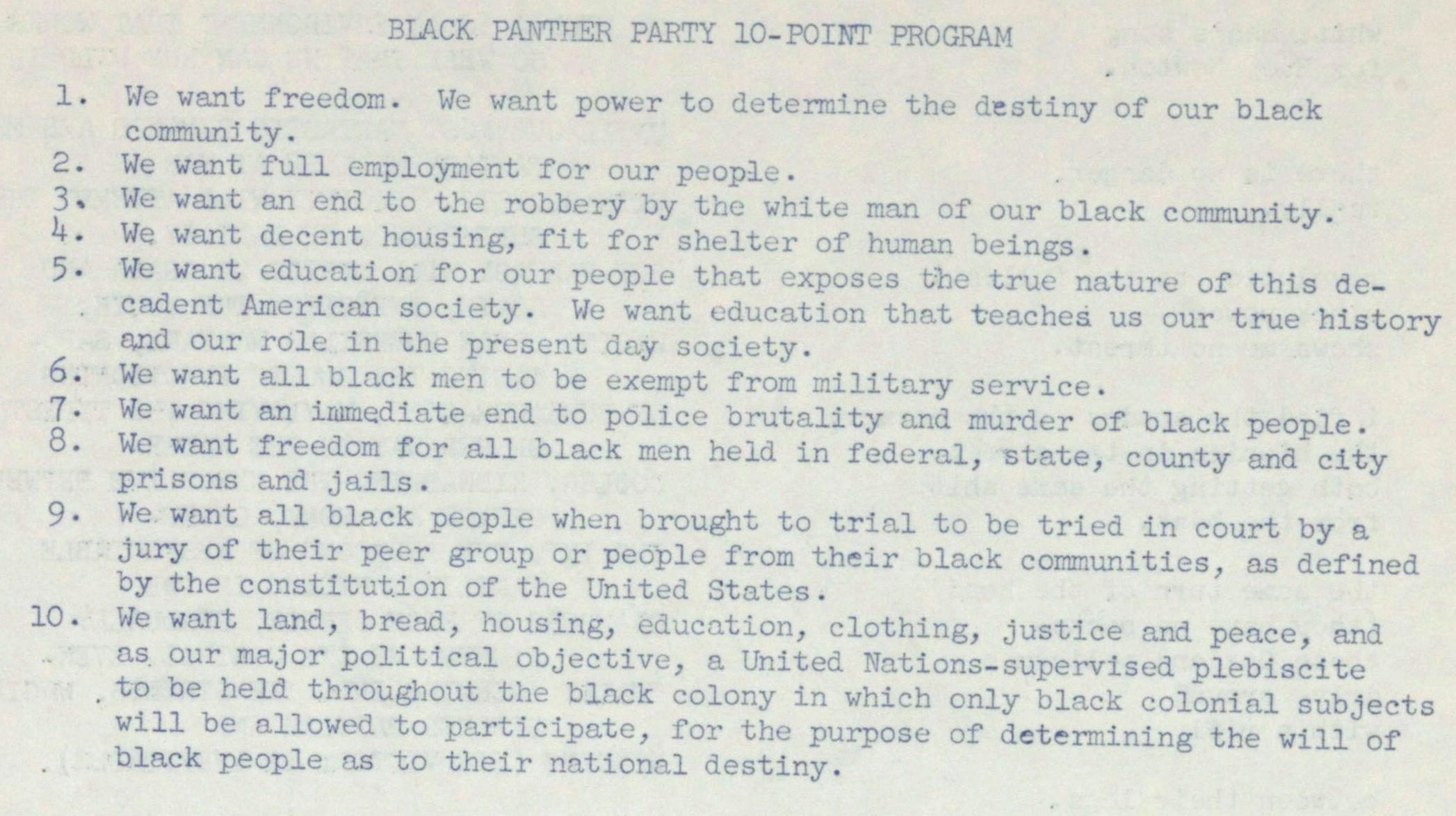
The film opens to the innocent sounds of Chicago’s own Chi-Lites, Chi Lites For God Sake Give More Power To The People 1971 B1 YouTube (2:44), eliciting the familiar refrains of social change in the air, where the non-violent protests led by Martin Luther King were inextricably linked to the Civil Rights era, yet increasing numbers of young people, both black and white, were appalled by repeated scenes of blacks being brutalized by heavily armed white police, not just in Selma, Alabama but in urban cities across the country.  While there were more militant spokespersons, Malcolm X was assassinated in 1965 at the age of 39, leaving behind a power vacuum in the black movement.  The Black Panther Party, formed in Oakland, California in October of 1966, attempted to fill that void, founded by 24-year old Huey Newton and 29-year old Bobby Seale, both with Southern roots (one from Louisiana and the other from Texas) who met and grew politically active at Oakland City College, gravitating towards the militancy of Malcolm X rather than the more passive tactics of Martin Luther King, where initially it was Newton’s idea to go on armed patrol with other members to monitor police behavior and bear witness to police brutality, providing an extra set of eyes and ears to the actions of police on the street, hoping to minimize the potential harm done to minority citizens that were routinely stopped and harassed by police.  Standing off to the side, perhaps ten feet away, so they would not be accused of interfering, their mere presence altered the playing field so cops couldn’t just gang up on innocent blacks.  As citizens of California at that time had the legal right to carry arms openly, they formed a quasi-military organization whose initial aim was to defend the black community from the excessive harassment of the city’s predominantly white police force.  Drawing up an ambitious 10-point program, their aims were influenced by Marxist and Maoist ideology, including the writings of Malcolm X, Chairman Mao, and Franz Fanon, where they fought to establish revolutionary socialism through militant self-defense, mass organizing, and community-based programs, like setting up medical clinics and free breakfast programs in the neighborhoods where they lived, but they were quickly labeled “extremists.”  They drew national attention on May 2, 1967, with local press and TV cameras alerted, when 30 armed Black Panthers carrying rifles, including Bobby Seale and Eldridge Cleaver, drove to the state Capitol in Sacramento to protest a bill being discussed that would prohibit anyone from carrying loaded firearms in California other than the police, army, and hired security guards, where at one point they were no more than 10-feet away from Governor Ronald Reagan who was admittedly appalled at what he saw. 

Dressed in black leather jackets, berets, sunglasses, and armed with shotguns, the image of Black Panthers became legendary overnight, anointed the darlings of the political left, including the white liberal Hollywood faithful who flocked to rub elbows with “real” revolutionaries and organized fundraisers on their behalf, labeled “Radical Chic” by author Tom Wolfe who mocked and satirized this practice in his 1970 book, Radical Chic & Mau-Mauing the Flak Catchers.  Nonetheless, it was their practice of defiance in the face of rampant police racism that people found so captivating, as this was such a stark contrast to the meek horrors on display witnessed in other more notable Civil Rights activities led by Martin Luther King.  Their methods certainly caught the eye of FBI head J. Edgar Hoover who called the Panthers “the greatest threat to the internal security of the country.”  Invariably, when looked back from this distance, it resembles a good and evil campaign, where noble intentions are countered by the dark machinations of the state, as the FBI resorted to a dirty tricks campaign targeted against the Panthers, even resorting to murder, as depicted in Howard Alk’s The Murder of Fred Hampton (1971), where information from an FBI informer led to a police raid that literally assassinated the Chicago Chairman of the Black Panther Party, Fred Hampton.  Once more, the police invent a fictitious scenario of facing a flurry of bullets from the Panthers to justify their use of force, but the evidence proves otherwise, as there were 99 incoming bullets and only 1 outgoing bullet, which was itself an accident, as the Panther guarding the door, Mark Clark, dropped his gun during the initial pre-dawn police assault where he was killed instantly, his gun firing when landing on the floor.   Any attempt to portray the Panthers in a socially progressive light, however, is met with equally valid criticism that many of its members were illiterate and lacked education, had extensive criminal records, where their stubborn insistence to remain an armed group in the face of continued military assaults organized by the much more extensively armed and better funded police force defies reason.  While there’s little doubt that the FBI campaign against the Panthers was viciously excessive, it’s also important to remember that blacks only comprise about 12% of the population, where the overwhelming majority of whites continue to believe the police version of events, where Panthers are not only perceived as militants, but terrorists.  As a result, even forty years after the fact, it’s hard to distinguish between the idealized goals of the organization, some of which have eventually come to light, and the gun-toting activism that provokes a kind of retaliatory violence the public abhors.  While people may be drawn to mythological outlaw figures like Bonnie and Clyde (1967), no one disputes that they were notorious criminals, who used guns to rob banks during the Depression, and killed a few people along the way.  While that film ends in a hailstorm of bullets, viewed as excessively violent at the time, there are always going to be some that claim they only got what they deserved, as the nature of their criminality is what led the police to track them down.  By re-electing Richard Nixon as President in 1972, the American public overwhelmingly rejected the aims and tactics of the Panthers and voted for the strongest law and order candidate on the ballot.  

While the film doesn’t get into it, it’s important to consider the circumstances surrounding the Angola 3, where two of three black prisoners accused of killing a prison guard were confined to solitary confinement in a Louisiana penitentiary for over forty years due to their affiliation with the Blank Panthers, still viewed by the warden as belonging to a “terrorist” organization, as depicted in Jean Vadim’s documentary film In the Land of the Free...  (2009).  While all three vehemently deny the charges, the cases have been dismissed by a judge, with convictions overturned as many as 3 times, yet new charges persist that remain clouded in racist turmoil.  One (Robert King) was released from prison in 2001 when his conviction was overturned after 29 years in solitary, another (Herman Wallace) was released in 2013 just before he died after 41 years in solitary, while a third (Albert Woodfox) is still being held in prison, going on his 43rd year in solitary confinement while awaiting his third trial. Though no longer convicted of murder, Louisiana officials still refuse to release Albert from solitary, with the warden Burl Cain claiming “there’s been no rehabilitation…(from their) Black Panther revolutionary acts.”  While watching this film, it’s impossible not to think about how the credibility of institutions has been shattered in recent decades, where a new, as yet undeveloped moral standard is taking shape, but only after DNA evidence has exonerated convicted murderers the penal system has placed on Death Row, cigarette executives lied to the American public for decades about the dangers inherent with their product, NFL executives have been doing the same with concussion information, the Catholic Church lied that they weren’t aware of the sex abuse behavior in priests, Nixon lied about Watergate and the Vietnam War, Bush lied about weapons of mass destruction, while police departments have literally lied for decades about shootings, where Rodney King style videos are changing our perception of institutional police credibility.  While this film is a start, attempting to demystify a dark period of our pasts, it doesn’t go nearly far enough and instead becomes a relatively safe and conventional portrait that resembles a PBS documentary, leaving out massive elements of Panther history. 

While the film attempts to at least demythologize the history behind the Blank Panthers by providing a fairly objective view of their historical importance, what it doesn’t try to do, or even infer, is make the direct line between the secretive FBI COINTELPRO tactics of the late 60’s and the current and standard practice used by police departments across the nation when it comes to discrediting the voices from minority communities, especially when it comes to police shootings, where the official police version doesn’t match the actions captured on video footage, suggesting police have a pattern of abuse, brutality, and outright lies when it comes to twisting the facts in order to bolster their version of resorting to justifiable force.  As recently as Ferguson, Missouri, and the unrest that followed the Shooting of Michael Brown by a white police officer, similar police and government tactics were implemented to intimidate, criminalize, humiliate, and undermine activists from day one, using the same kinds of bullying tactics.  Mirroring the civil rights era, angry police dogs were brought to the scene of the crime in an attempt to intimidate the public, the St. Louis police chief holds a press conference and provides erroneous details, later bringing in military-grade weapons and equipment, justified by another police fabrication that protesters were using pipe bombs, though no evidence of pipe bombs was ever discovered.  While the St. Louis County medical examiner decided not to release its autopsy report, it “did” choose to reveal that the deceased had traces of marijuana in his system, as if this somehow justifies the use of lethal force.  The local St. Louis paper claimed “more than a dozen” different witnesses corroborated the police version of events, which is just another example of the police feeding information to the press, which is then reported as fact, though the information turns out to be dubious at best, with dozens of peaceful protesters arrested, including members of the clergy, along with Dr. Cornel West, a former Harvard and Princeton professor who is charged with assault, while a Muslim photojournalist covering the events is held in jail longer than anyone, threatened with trumped up additional charges if he didn’t release the names of protesters he was filming.  These actions assert an intentional police distortion of events when it comes to explaining what amounts to systematic shootings of unarmed black victims and are at the root of understanding why the Black Panther Party was formed in the first place, to combat police brutality and the use of excessive force.  Add to that the distorted and massively incendiary false statistics tweeted by Republican Presidential candidate Donald Trump on November 22, 2015 (Trump's Pants on Fire tweet that blacks killed 81% of white ...), alleging 81% of white homicide victims are killed by blacks (incredibly using statistics from a fictitious Crime Statistics Bureau that doesn’t even exist), a number that is actually closer to 15%, according to the FBI, reminding us once again that what was happening then is still happening now.