Showing posts with label Greek tragedy. Show all posts

Thursday, March 16, 2023

Athena


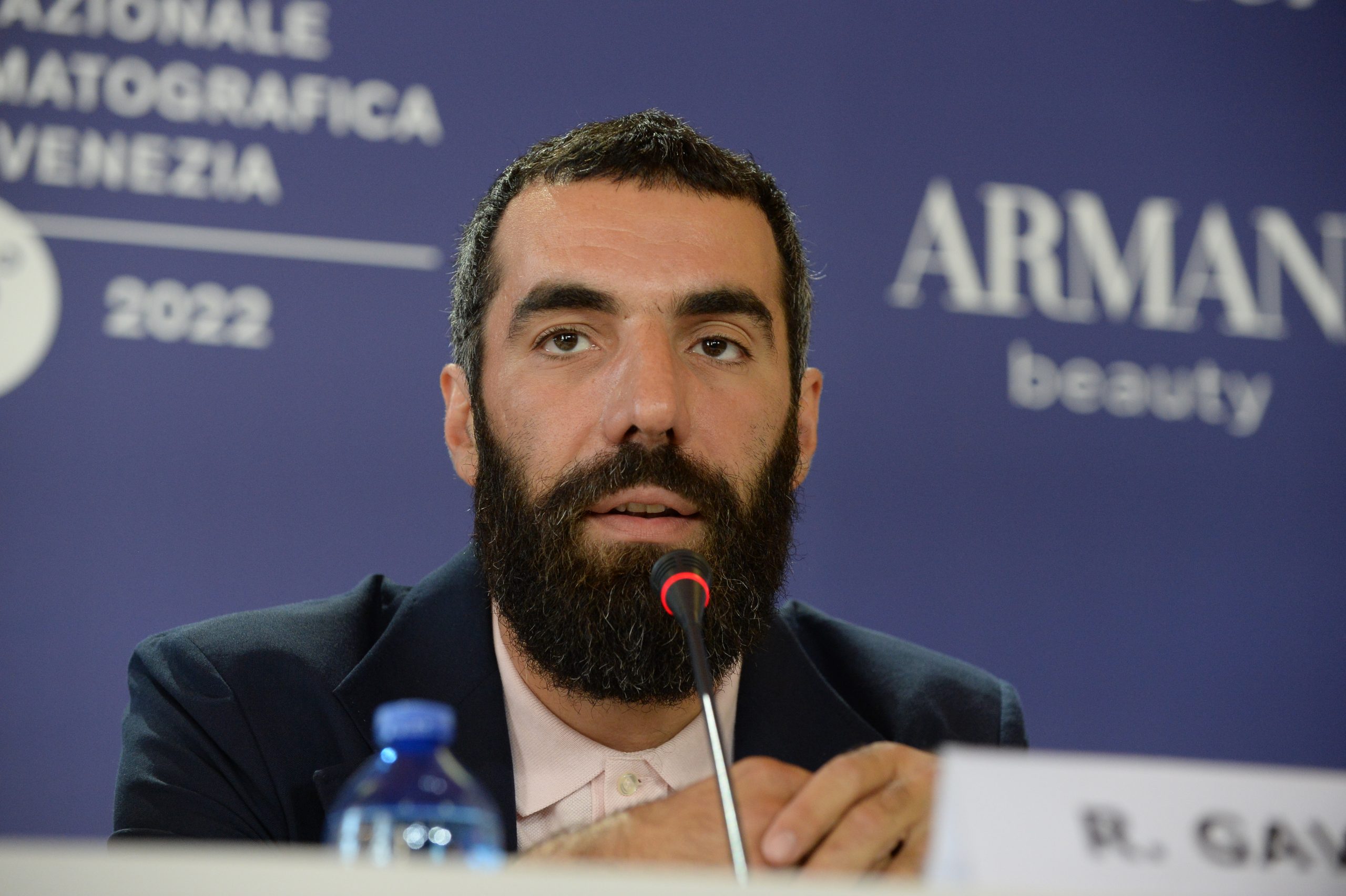
Director Romain Gavras


Ouassini Embarek on the set


cinematographer Matias Boucard


ATHENA       B                                                                                                                            France  (99 mi)  2022  ‘Scope  d: Romain Gavras

The true hero, the true subject, the center of the Iliad is force.  Force employed by man, force that enslaves man, force before which man’s flesh shrinks away.  In this work, at all times, the human spirit is shown as modified by its relations with force, as swept away, blinded, by the very force it imagined it could handle, as deformed by the weight of the force it submits to.  For those dreamers who considered that force, thanks to progress, would soon be a thing of the past, the Iliad could appear as an historical document; for others, whose powers of recognition are more acute and who perceive force, today as yesterday, at the very center of human history, the Iliad is the purest and the loveliest of mirrors.                                                                  —Simone Weil opening paragraph from her essay The Iliad, or The Poem of Force, 1945, The Iliad, or The Poem of Force | The Anarchist Library

Gavras is the youngest son of renowned Greek-French film director Konstantin Costa-Gavras, whose political thriller Z (1969) was ripped from the headlines, shot like a documentary, and listed by Time magazine as one of "The 15 Best Political Films of All Time: The Votes Are In".  Like father like son, this is another blisteringly intense experience recalling the French suburban riots of October 2005 that originated in the mostly North African immigrant banlieue region of Clichy-sous-Bois, an eastern suburb of Paris, after the death of two young boys who had been escaping the police, eventually spreading to 274 cities and towns nationwide, triggering the worst rioting in France for 40 years, lasting over three entire weeks, forcing the government to declare a state of emergency, resulting in the burning of nearly 9,000 vehicles and the arrests of 2888 individuals, as dozens of public buildings and businesses were set on fire.  The French courts eventually cleared the police (French court clears police over Paris deaths that triggered ...), while the conditions that fueled the uprisings in the banlieues remain largely unchanged, ('Nothing's changed': 10 years after French riots, banlieues ...), as the same bleak hopelessness prevails, and the promise to provide racial and economic equity has abysmally failed, with poor education, rampant youth unemployment, and violent confrontations continuing from a heavy-handed police presence, often involving tear gas brigades, with French Prime Minister Manuel Valls saying in Le Monde that there was a “territorial, social, and ethnic apartheid” in France.  Unlike the widely heralded Kerner Commission following urban riots in the United States during the 60’s that revealed “Two societies, one black, one white—separate and unequal” (The 1968 Kerner Commission Got It Right, But Nobody Listened), or the Scarman Report in Great Britain following the Brixton Riots of 1981, which identified “complex political, social, and economic factors” that created a “disposition towards violent protest,” but did not explicitly condemn police racism and denied that “institutional racism” even existed, with the recommendations ignored by the Thatcher government, there has been no official national debate on the crisis in France, as no commission of experts and legislators was convened to analyze the riots, resulting in a massive failure to address ongoing racial and religious discrimination.  Making matters worse, newspaper and television reports often depict these rioters as “violent” or “thugs,” though artists are often at the forefront of the protests, yet somehow they fail to address the circumstances that ignited these outbreaks.  What we’re left with, then, to fill the political void, is the arts community providing their own challenging vision, with Gavras using cinema as a theater of provocation, hoping to advance public arguments and discussions on the separate and unequal disparities in the the banlieues, where hopelessness and civil unrest continue to plague the nation.  Shot south of Paris in Évry-Courcouronnes, in the Parc aux Lièvres housing project (aka “the Rabbit Park”), where around 80% was shot with an IMAX camera, the last one available when shooting started (there are only around 50 in the world), this follows in the footsteps of the Mathieu Kassovitz film LA HAINE (1995), Jean-François Richet’s MA 6-T VA CRACK-ER (1997), Jacques Audiard’s Dheepan (2015), and more recently Ladj Ly’s Les Misérables (2019), all films shot in the suburban banlieue projects, where trust with authorities has never been lower, as residents are routinely stigmatized as criminals, where racial tensions with police are continually on high alert, using raw language and an ultra-realistic cinéma vérité shooting style to convey the immediacy of each moment, as these are tinderboxes continually on the verge of erupting into a firestorm of violence.

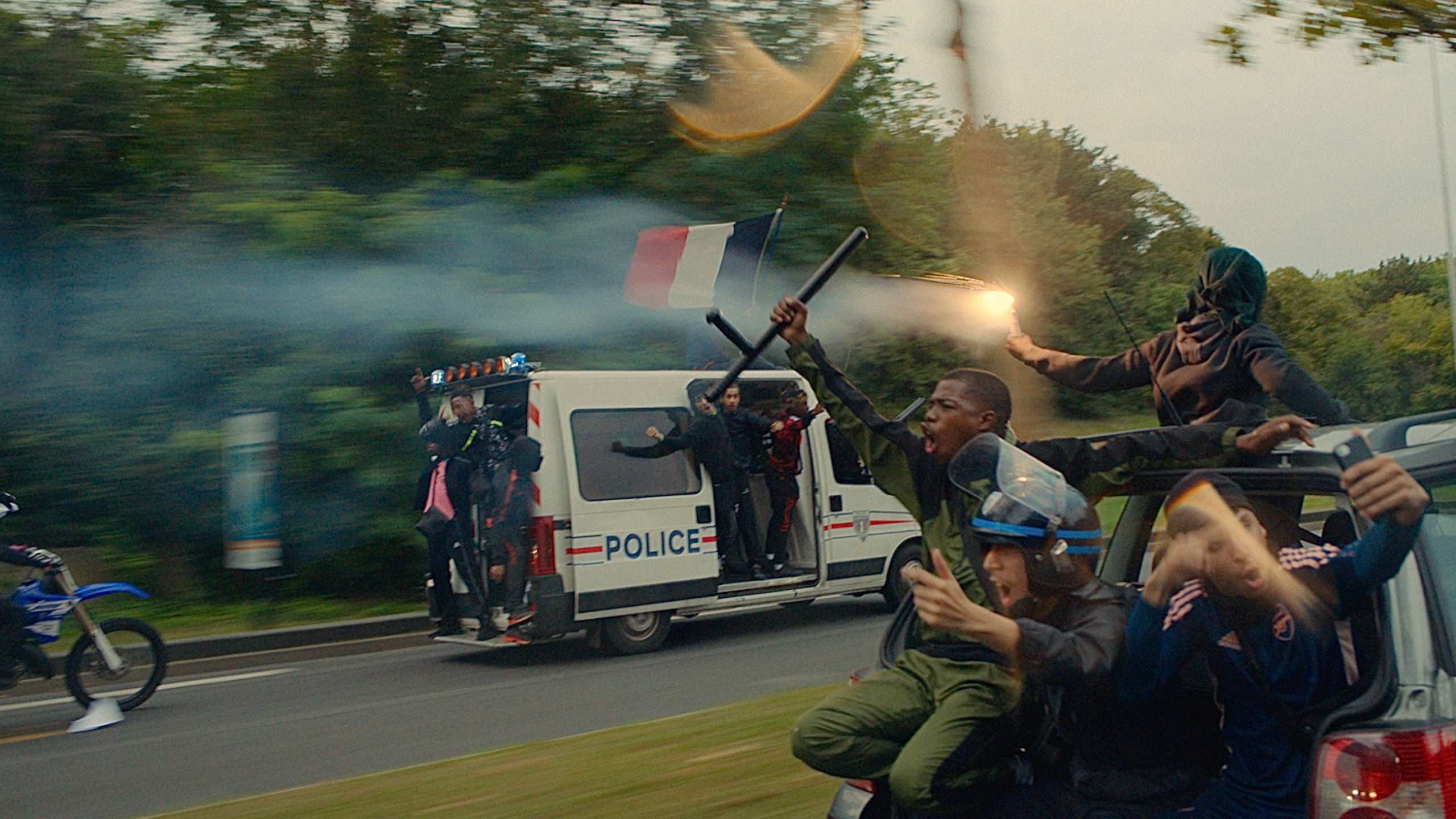
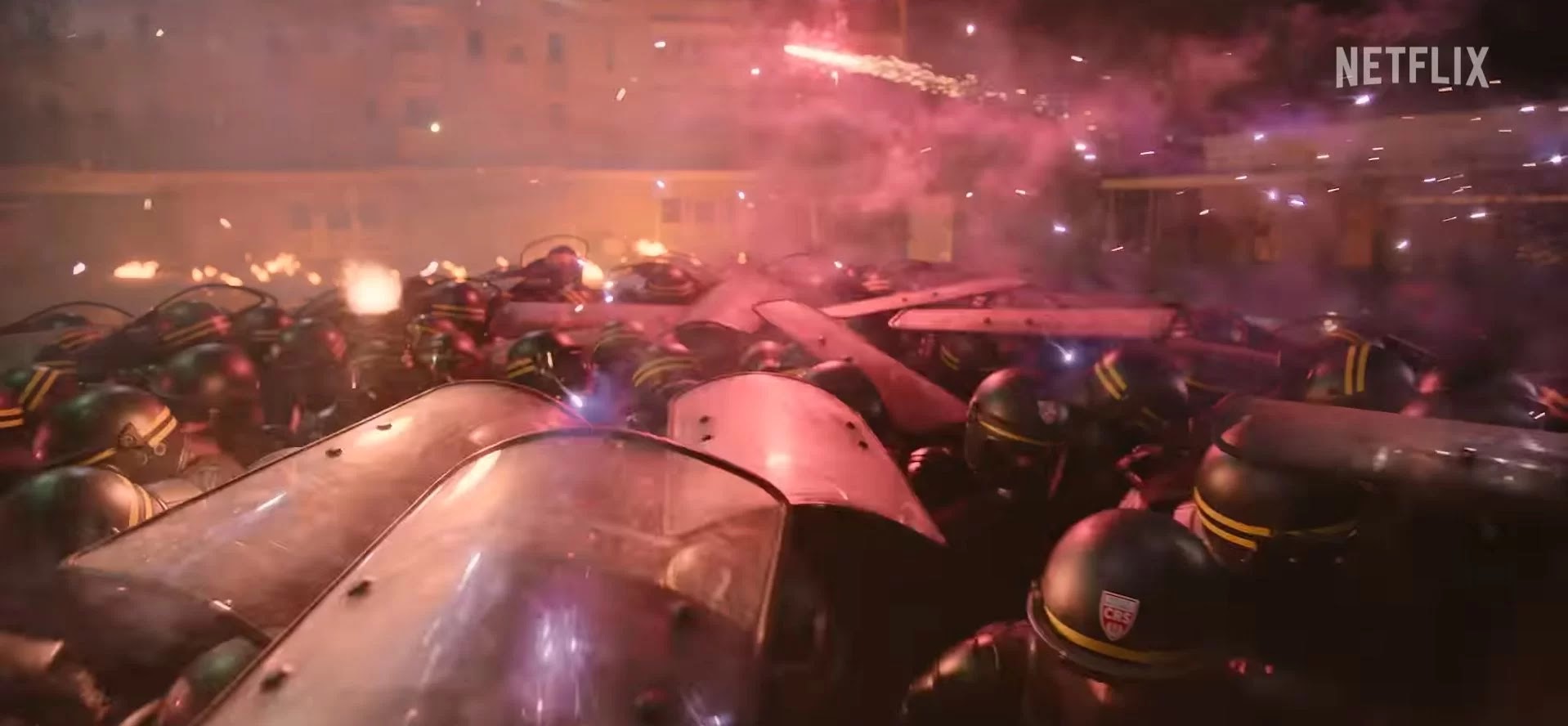
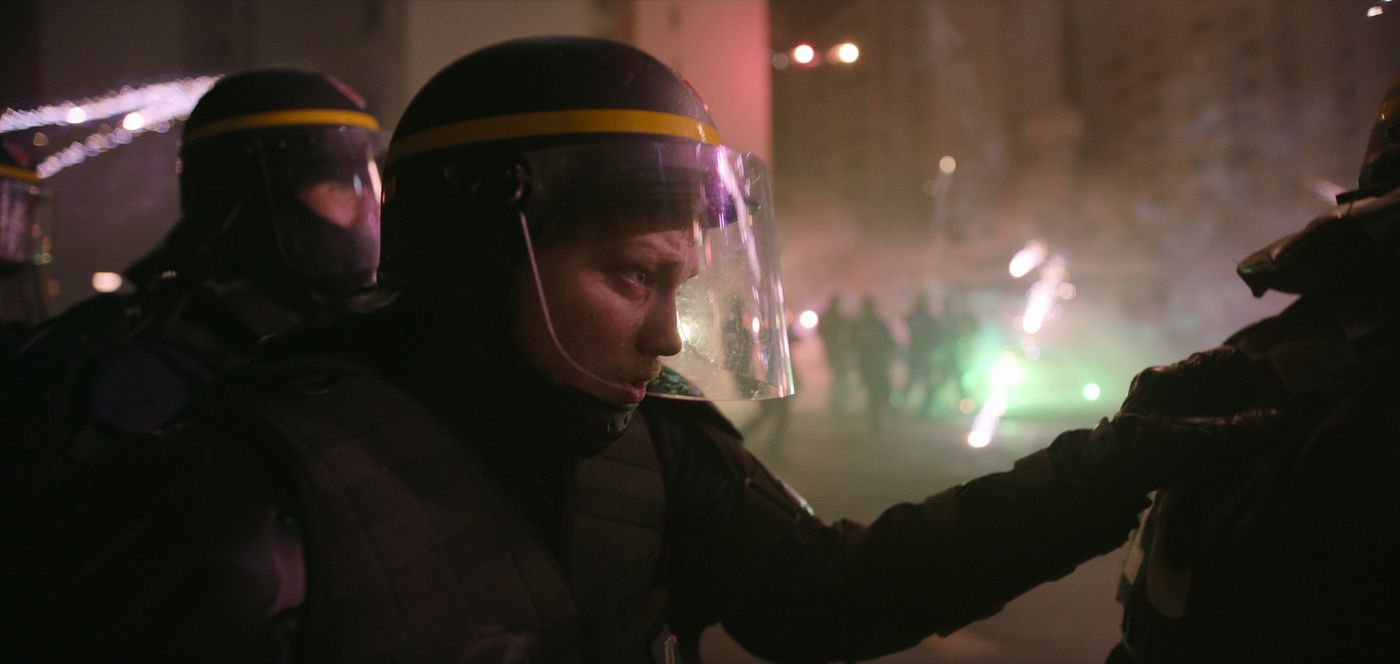
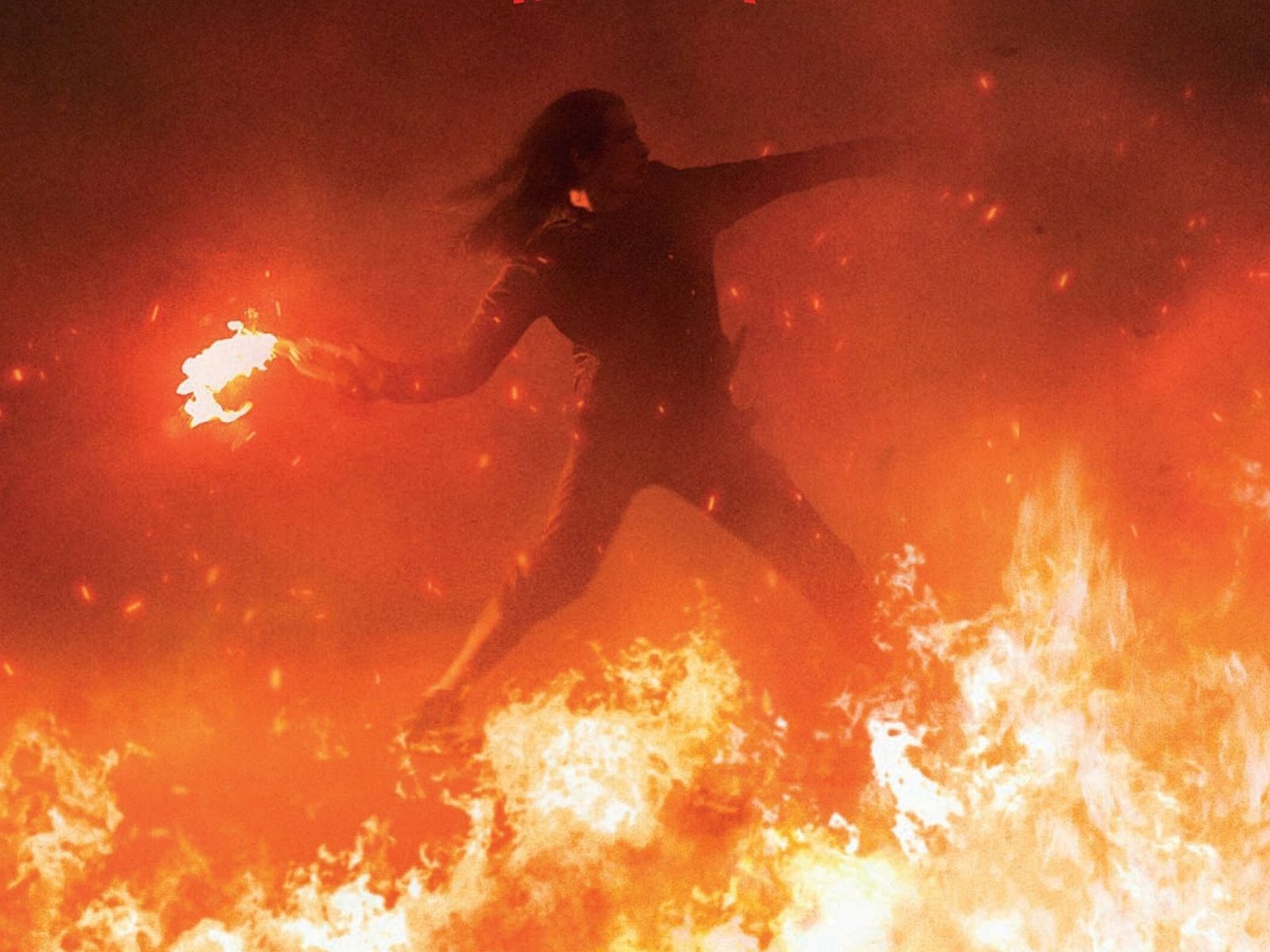
Gavras got his start making advertisements and directing music videos, and this is largely a choreographed movie, much like storyboards in movies of old, where sequences were carefully constructed ahead of time and rehearsed for months before shooting began.  Matias Boucard’s cinematography is the star of the show, easily the biggest single takeaway from the film, and not just the harmonious synchronicity of the tracking shots, which are utterly spectacular, but the sheer realism in capturing the impassioned outrage from the collective anger in the projects.  Reminiscent of Emmanuel Lubezki’s camera kinetics and complicated long takes in Alfonso Cuarón’s Children of Men (2006), the opening shot is a doozy, an electrifying 11-minute tracking shot that swivels on a dime from following a solemn police press conference, quickly turning into John Carpenter’s ASSAULT ON PRECINCT 13 (1976), as all hell breaks loose with a sudden mob insurgency when they ransack the police station stealing weapons, gear, and a police van before making an electrifying escape back into the protected walls of the Athena projects (named, appropriately enough, after the goddess of war), with armed residents standing guard atop the towering fortress awaiting the inevitable police response.  Written by Gavras, Ladj Ly, and Elias Belkeddar, it’s a Greek tragedy along the lines of The Iliad, an alliance of Greek cities that eventually prevail in sacking Troy, with a SWAT team of police in riot gear representing the massive force of the Greeks against the besieged banlieue fortress of the protected city of Troy, viewed as a nightmarish Armageddon vision of intensely staged combat where in the end all humanity feels lost, as there is no reconciliation, only blind hatred. This gritty thriller follows three brothers of French-Algerian descent whose lives are thrown into chaos following the brutal beating of their youngest 13-year old brother who was left for dead, with video footage pointing to the police, where the outraged community is a powder keg of unleashed fury ready to explode.  Abdel (Dali Benssalah) is a decorated French soldier who fought in Iraq and in the former African colony of Mali, now collaborating with the police, whose calm demeanor is in stark contrast to the incendiary emotions of Karim (Sami Slimane), the charismatic youth leader who aggressively starts a campaign of guerilla warfare against the police, while the oldest is Moktar (Ouassini Embarek), a drug dealer more concerned with hiding his stash of drugs and weapons from the impending police raids than assisting either of his brothers.  Karim despises the fact that Abdel refuses to take up arms and fight the police, angrily raging “You’re a military whore for France,” while Moktar constantly urges Abdel to protect his own skin above anything else.  These existential, post-imperialist choices reflect the dilemma of Arab and African French immigrants who are urged to assimilate, yet find opportunities glaringly limited by poverty, powerlessness, and racial divisions, where justice is something they never see, with absolutely no trust in the police or governmental authorities, where a lingering sentiment refuses to accept them as being French, instead associating them with criminal or terrorist behavior, where they are literally viewed as the scourge of the earth. 

The knock on this film is that it accentuates the stereotypes, with zero female presence, making little effort to establish any interior character development while also failing to provide social context, though much like the United States, police killings of civilians have dominated headlines in France for years, with the film addressing a prevalent lack of hope in the post-modern world, motivating Gavras to present a collapsing world that seems to revel in an unfolding civil war which sends shock waves across the nation, with television reports of mosques burning and right-wing attacks across the country.  Driven by the visceral allure of Pontecorvo’s revolutionary The Battle of Algiers (1965) and George Miller’s sensationalized Mad Max: Fury Road (2015), the aesthetic is an adrenaline rush on overdrive, using drones and swooping crane shots with no pauses or moments to breathe, as it’s simply a non-stop assault to the senses, an all-consuming experience in real time that continually immerses viewers into the center of the action, accentuated by the reverberating music of Benoit Heitz, aka GENER8ION, ATHENA - Netflix Soundtrack - GENER8ION YouTube (35:46), like a Greek chorus commenting on the action, with the camera jumping back and forth in expressing points of view, where the bloodthirsty allure of revolution becomes an apocalyptic day of reckoning of Biblical proportions.  As the various attacks unfold, it also includes a tormented family melodrama, with brother turning against brother, elevated to a mythical scale as they barricade themselves into the bowels of this concrete monstrosity, where much of it is shot in darkened corridors where it was hard to tell what was happening, resembling the chaos of a war zone, entangled in a perplexing labyrinth where there are no good options, each seemingly a dead end, while also mysteriously sheltered inside is a wanted sociopathic terrorist, Sébastien (Alexis Manenti), who has gone into hiding.  At some point in the ensuing chaos a young police officer named Jérôme (Anthony Bajon) is separated from his unit and captured, immediately turned into a hostage used for negotiations, demanding the names of the three policemen involved, with Karim refusing to believe the police report that the killers may not have been police officers, but far-right extremists posing as the police in a deliberate attempt to incite a race riot.  The same nation that gave us liberté, égalité, and fraternité is also the nation of Le Pen, the hijab ban, and horrific atrocities in Algeria, where the colonial fallout is still being felt.  While Gavras explores themes of racism, violence, and social injustice on a grand scale, he combines all facets of photography, editing, and the musical score with a potency that is perfectly synchronized, culminating in an adrenaline-charged tragedy of operatic dimensions, where a nihilistic fatalism devalues everything that exists, as freedom is a lost cause, recalling the finale sequence of Peckinpah’s The Wild Bunch (1995), where this is simply a blitzkrieg of annihilation, leaving no room for empathy or reflection.  The reveal in the final postscript may be the most divisive aspect of the film, a flashback to what sparked the outrage, yet it’s handled with a deft precision, adding a sense of foreboding for the future, as cataclysmic divisions in France are only exacerbated by increasing political power of the far-right National Rally, whose nationalist, anti-immigration policies repeatedly connect immigration to Islamic terrorism, making any potential racial reconciliation impossible.  This deserves to be seen on the biggest screen possible, with the best sound systems, as much of the visual style was designed for the big screen, much like Hollywood action movies, but unfortunately it spent little time in theaters and was immediately streamed on Netflix, which is disheartening, as you can’t help wondering how that happened, as it seems like a huge mistake.  The film is dedicated to DJ Mehdi, a French hip hop and house music producer, and the memory of Bernard Moussa Gomis. 

Friday, January 1, 2021

2020 Top Ten List #2 There Is No Evil (Sheytan vojud nadarad)


Director Mohammad Rasoulof


Baran Rasoulof accepting the Golden Bear for her father


THERE IS NO EVIL (Sheytan vojud nadarad)                    A-                                                     Iran  Germany  Czech Republic  (150 mi)  2020 ‘Scope  d:  Mohammad Rasoulof

A disturbing yet meditative essay on the death penalty in Iran, where in the year 2017 the nation of Iran carried out half of the world’s total executions while continuing to execute a higher number per capita than anywhere else in the world (just last year Iran executed 225 people, compared to 22 in the USA), a frightful example of a repressive authoritative state running amok, with the director stringing together four Kafkaesque morality tales, all tragically interconnected, emphasizing freedom of choice and the power of saying “no” in an autocratic society, each commenting differently on the subject, examining in many ways the consequences of one’s actions.  Despite working with a miniscule budget, this is a full-blown art film of the highest standards, where the acting is superb, while the writing offers enough variation to keep viewers on edge, maintaining suspense throughout, named the winner of the Golden Bear for Best Film at the Berlin Festival.  Rasoulof has a long and protracted history with the Iranian government, beginning with his dispute of the 2009 Iranian presidential election of President Ahmadinejad, calling it rigged and a fraud, describing Iran as a dictatorship where artists may no longer speak freely and are routinely arrested and tortured under interrogation, as he was the following year along with filmmaker Jafar Panahi, both sentenced to six years in prison for “conspiring against national security and spreading propaganda against the Islamic government.”  Furthermore, both were banned from making films, writing scripts, giving interviews, or traveling abroad for 20 years, each stripped of their passports, a blatant attempt by the Shiite fundamentalist regime of President Mahmoud Ahmadinejad to silence two internationally acclaimed directors and politically intimidate any other artistic critics of the regime.  The sentence was later reduced to one year in prison.  Shortly after winning his Golden Bear, he was given the summons to serve the one-year jail sentence that the Iranian Revolutionary Court imposed on him (along with a two-year ban on travel), but he has not complied due to the outbreak of the coronavirus.  Earlier this year, 55,000 Iranian prisoners were released due to concerns about the spread of Covid.  Undeterred, and despite continued harassment and repeated arrests, Rasoulof continues to make films (which are banned in his own country), actually shot by his assistants, where he directs remotely, providing very precise shot lisitings, though his name is never mentioned on the crew lists and production schedules, receiving critical accolades at both the Cannes and Berlin Film Festivals.  In the tradition of Kieslowski’s A SHORT FILM ABOUT KILLING (1988), an expanded sequence on the death penalty from his masterful The Decalogue (Dekalog) (1988), or more recently Boo Jungfeng’s Apprentice (2016), examining execution practices in Singapore, which in the late 90’s led the world in per capita executions, we are reminded of German-born American philosopher Hannah Arendt, who introduced the phrase “the banality of evil,” believing no human is born evil and that people are victims of the systems in which they live.  In covering the trial of Adolf Eichmann, one of the architects of Hitler’s Final Solution who helped identify and coordinate the transportation of millions of Jews from occupied Europe to Nazi death camps, carrying out his duty with a horrible efficiency, yet after examining 3,600 pages of police interrogations, Arendt did not see a monster or psychopath in him but considered him to be a mid-level bureaucrat who would do anything for a promotion.  That is Rasoulof’s assessment as well, where the following incident may have prompted the making of the film, with the director revealing:

Last year, I spotted one of my interrogators coming out of the bank as I was crossing a street in Tehran. Suddenly, I experienced an indescribable feeling. Without his knowledge, I followed him for a while. After ten years, he had aged a bit. I wanted to take a picture of him on my cellphone, I wanted to run towards him, reveal myself to him, and angrily scream at him all of my questions. But when I looked at him closely, and observed his mannerisms with my own eyes, I could not see an evil monster.

How do autocratic rulers metamorphose people into becoming mere components of their autocratic machines? In authoritarian states, the sole purpose of the law is the preservation of the state, and not the facilitation and regulation of people’s relations. I come from such a state.

And driven by such personal experiences, I wanted to tell stories that asked: as responsible citizens, do we have a choice when enforcing the inhumane orders of despots? As human beings, to what extent are we to be held responsible for our fulfillment of those orders? Confronted by this machine of autocracy, when it comes to human emotions, where does the duality of love and moral responsibility leaves us?

While Rasoulof has examined this subject before in Manuscripts Don't Burn (Dast-neveshtehaa nemisoosand) (2013), that film becomes bogged down in the weight of its own subject, yet this is more profoundly lyrical, offering some of the most exquisite locations to ever grace the screen, simply stunning in their beauty, much like an earlier film, The White Meadows (Keshtzar haye sepid) (2010), becoming an allegorical narrative combining four different stories, each shot independently, like film shorts, with a shifting style and genre element, all stunning in their traumatic impact, with each setting growing farther and farther remote.  The opening segment is entitled “There Is No Evil,” a family drama set in the rush of Tehran big city life centered around Heshmat (Ehsan Mirhosseini), a heavy-set man with a beard caught up in a daily routine, performing the mundane ordeals in the everyday life of a typical middle-class family in Iran, calmly enduring the nagging presence of his constantly complaining wife, while trying to appease an overdemanding, spoiled young daughter as well.  As he fights his way through city traffic, with blaring noise and reckless vehicles constantly darting in and out directly in front of him, it’s a relief to finally get home and enjoy some quiet moments.  Taking a nap that extends to the middle of the night, an alarm awakens him at 3 am, when he takes a shower, gets dressed, and is off to work in the wee hours of the morning, parking in a massive garage, finding his way to a non-descript room where he sits and waits.  When a series of green lights appear on a screen, he presses a button that produces a truly shocking surprise, an astounding moment that takes one’s breath away, superbly prefaced by the banality of such ordinary events.  The second episode, “She said, you can do it,” is an equally oppressive setting, with young men jailed in tight prison quarters, yet they wear official uniforms.  Using military conscripts instead of trained professional staff, part of the basic training in fulfilling the 2-year military service forces them to participate in executions of fellow citizens, becoming complicit in the government’s killing apparatus, yet Pouya (Kaveh Ahangar) can’t imagine killing another man.  However, with an honorable discharge, he can apply for a passport and realize his dream of leaving Iran to live abroad with his girlfriend.  Openly tearful, on a cellphone with his girlfriend, he pleads for help finding a way out of this predicament.  The other men chime in, offering their own comments on his moral dilemma, suggesting he’s no better than the rest of them, mostly suggesting soldiers follow orders, as if you don’t they make things very difficult afterwards, increasing your required years of service while refusing passport and driver’s license requests, finding it hard to ever work again.  While the setting is drab and dreary, no windows, all color washed away, it’s a peculiar arrangement to find them imprisoned, as none are accused of committing a crime.  At the bewitching hour when his name is called, Pouya is reluctantly released, with another guard ordering him to get the prisoner, handcuffing himself to that prisoner as they walk down a long, empty corridor, falling occasionally, whimpering with dreaded anticipation, with the guard pulling him up, barking encouragement at him, as the roles are reversed, as the convicted prisoner is perfectly calm while the accompanying military guard is behaving like it’s his own life on the line.  In a split second, however, Pouya grabs the guard’s automatic weapon and locks the two of them up as he makes his escape, a harrowing journey accompanied by pulsating music, suddenly turning into a suspenseful prison escape thriller with an uncertain outcome, brilliantly culminating with an Italian anti-fascist song of resistance, Milva - Bella Ciao - YouTube (2:42).

If the first two segment feature oppressive settings, the next two are mesmerizingly beautiful, capturing the natural world like few films do, magnified even further by being shot in ‘Scope by Ashkan Ashkani, with the third segment entitled “Birthday.”  Opening with magnificent shots of distant mountains, Javad (Mohammad Valizadegan), a young soldier on a three-day pass is crossing the vast openness of the country by train until he arrives at a remote location in a dense forest near the Caspian Sea.  Cleansing himself off in the river, he heads for an isolated home in search of his fiancée, Nana (Mahtab Servati), bringing a ring, asking her father’s permission to propose on her birthday.  But the situation is dour as they’ve just learned of the death of a close family friend, a teacher who was viewed as a son by her father, beloved by all who knew him, yet Nana never mentioned him before, so this revelation comes as an unexpected surprise.  With mixed emotions, the family plans for a funeral service, hiring musicians and holding a personal family ceremony for the recently deceased, including candles lit alongside a giant photograph.  Once Javad takes a look at the photo, his heart sinks, immediately growing ill, throwing himself into the river, as if washing away his sins, drawing the attention of Nana, providing him a dry set of clothes, with Javad realizing his own dark connection to the deceased, having participated in his execution as an enemy subversive, creating a situation where the political becomes personal.  Afterwards they hold an engagement celebration, revealing nothing to the family, yet both appear like zombies or the walking dead, void of all emotion, where the hours pass like years.  When it’s time to return, his fiancée simply walks away without uttering a word.  The final segment is entitled “Kiss Me,” featuring the director’s daughter Baran Rasoulof as Darya, a college student receiving her education as a medical student in Germany, visiting her aunt Zaman (Zhila Shahi) and uncle Bahram (Mohammad Seddighimehr) in what has to be the most remote region in Iran, a hilly yet desolate outpost where they raise bees.  With miles and miles as far as you can see of utter isolation, it soon becomes clear they are living lives of self-imposed exile, visiting with her father’s approval, as Bahram appears near death, having serious episodes coughing up blood, tenderly cared for by his wife, with Darya looking on, wondering why her uncle received a medical degree just like her father, educated at the same school, but then threw it all away to live out in the wilderness tending to bees.  Their story is inexorably connected to earlier episodes, resembling a classic tragedy, morphing into the ethical dilemma of Antigone, depicting what happens when an individual insists upon their moral beliefs and challenges the authority of the state, in this case altering the equilibrium, uprooting their families, exchanging children for their own safety, then living with the consequences of remaining hidden away in secrecy, ultimately leading to questions years later of altered parentage.  Enraged and hurt by the revelation, Darya feels little sympathy, believing it was a selfish decision, yet Bahram calmly stands behind his actions.  With so many transplanted families due to the European migration of refugees, you’d think this is a relatively common practice, yet few films actually touch on this issue.  The final shot resembles one of those magnificently extended final shots from Kiarostami’s Koker Trilogy (1987 – 1994), a perfectly composed shot that poetically expresses the emotional paralysis that sets in, unable to truly comprehend the extent of the personal sacrifice, literally laying it all on the line for one’s beliefs, yet her blazing anger reveals the cost.