DARK WATERS (Siraa Fil-Mina) B aka: Struggle On the Pier, or Battle at the Port Egypt (120 mi) 1956 d: Youssef Chahine
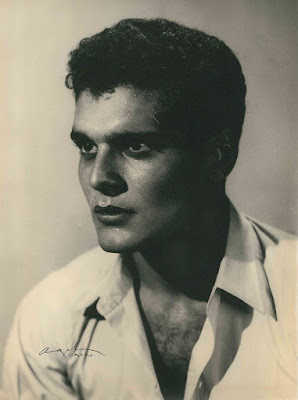
Following a largely unseen Omar Sharif costume drama entitled DEVIL OF THE SAHARA (1954), this is the third and final collaboration with Sharif and this director, combining social realist settings with a modern day romance that gets undercut by the labor strife of dock workers in the port city of Alexandria, generated by underhanded dealings behind the scenes from a sleazy character who attempts to exploit them by eradicating their existing contracts so he can take over, kind of an Egyptian version of Elia Kazan’s On the Waterfront (1956), with Sharif starring in the Brando role. Sharif is Ragab, a sailor who has been at sea for three years, seen in the opening shots shirtless and enthusiastically excited that he will finally be returning to his home town of Alexandria, where his arrival is met with appreciative greetings upon his return, like the return of a prodigal son, where he appears to be universally liked and respected, handing over his well-earned savings to his mother (Ferdoos Mohammed), who hugs him with tears of joy. Yet his real interest appears to be Hamedah (Faten Hamamah, the first lady of Arab cinema), an orphan girl that grew up in his home as his cousin, now finally grown up, and while she has street instincts and the ability to take care of herself, there are obviously lingering feelings between them with great expectations. Yet his first big surprise is how disappointed he is to realize their home on the harbor is small and congested, where in his mind after a few years it had somehow grown in size and proportion, where Ragab goes on a “Woe is me” Hamlet-style soliloquy to his mother about their impoverished circumstances that no matter how hard he works never seem to change. Simultaneous to his arrival, and completely unknown by Ragab, Ezzat (Tawfik El Deken), a corrupt employee of the powerful shipping tycoon Fadel (Husain Reyadh), secretly plots to have all the existing dock workers fired, while he replaces them with his own company, putting Fadel’s existing company out of business. Ezzat plans to use the playboy laziness of Fadel’s son, Mamdouh (Ahmed Ramzy), as his foil, as he is a manager in name only, completely lacking in business acumen, and hasn’t a clue how to keep his workers in solidarity, so he is an easy scapegoat when Ezzat riles up all the workers with false rumors and disinformation, suggesting Mamdouh intends to pull the rug out from underneath them and form his own company, betraying not only his father but all the existing dock workers. Ezzat, and his lackey Monem, one of the dock workers, utilize the maliciously evil tactics of Shakespeare’s most heinous villain Iago in Othello by whispering in everyone’s ear spreading false rumors. In many ways, this story resembles Chahine’s earlier film The Blazing Sun (Siraa Fil-Wadi) (1954), with the rich class betraying the poor, manipulating and exploiting the gullibility of the workers to line their own pockets, intentionally preying on the misfortunes of others, regardless of the consequences, suggesting the rich have no conscience at all and will sell out the working class at their first opportunity. The wild card here is Faten Hamamah as Hamedah, as instead of a naïve, yet sophisticated modern woman in BLAZING SUN, she plays a street urchin with guile, exhibiting more street smarts and feisty independence than any of the men involved, who are easily duped (including Sharif), becoming the real star of the film, and a shining example for women in the Arab world.
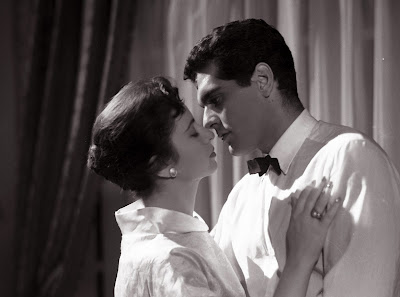
While much of this plays out like a B-movie, where the screen chemistry of Sharif and his then wife Hamamah is especially dynamic, complete with detours and convoluted plot twists, along with near hysteric, melodramatic revelations that subvert the social order in the manner of Douglas Sirk, yet what stands out is the steady hand of direction behind this increasingly tense and gripping seaside thriller, always on the verge of spinning out of control, yet is evenly paced and always entertaining, centered around well-constructed characters who are strong and largely flawed, yet human. Beautifully filmed in black and white by Ahmed Khorshed, the harbor life is portrayed as a world of its own, with boats of all sizes lining the pier, where the sea is an outlet for all their yearnings and dreams as well as their frustrations, where the title aptly illustrates the emotional turbulence and ominous nature of the evolving story, which grows disturbing in many ways, showing an ugly side of male patriarchy. There’s also a wonderfully sensuous scene of Ragab and Hamedah riding a ferry boat, with musicians breaking out into a percussive rhythm, where she euphorically gets up to dance, an exhilarating moment, exhibiting the heated feeling between them, yet he cruelly pulls her away, as if it’s a sin for women to dance in public, berating her for what appears to be a cultural taboo, showing signs of the religious extremism that would eventually prevail throughout the Islamic regions of North Africa and the Middle East. The backstory is that Ragab and Mamdouh are boyhood friends, both from different social classes, where Ragab was exiled and forced to sail the seas to earn a living while the more privileged Mamdouh flaunts his wealth by sailing his boat whenever he pleases, having never worked a day in his life, as everything has been given to him by his extravagantly wealthy father. When Ezzat attempts to pit the workers against Fadel and his untrustworthy son Mamdouh, he places Ragab in the center of it all, planting the seed that his friend is betraying him, trying to steal his girl while he’s been away, and that he and the dock workers are blind to Mamdouh’s real intentions, so why are they slaving away and continuing to load cargo onto ships, suggesting they should stand up for themselves, for a change. This puts a pall in his heart, not knowing what to think, so when Mamdouh disappears out to sea with Hamedah, his jealous rage only escalates as he fumes in solitary waiting for them to return, growing ever more furious, suggesting he will kill Mamdouh on sight, drinking himself into a frustrated stupor with the other dock workers who have shifted their allegiance away from Mamdouh and his father, all believing they are being betrayed. While this anger festers, Fadel is having a lavish party at his home, like Nero fiddling while Rome burns, and Mamdouh is out at sea with his own personal intentions, offering Hamedah gifts, claiming she is the woman of his dreams, making all attempts to romance her at sea. Yet when they return in the dark of night, Ragab slaps around Hamedah for her blatant disobedience, attacking her with a fury, revealing an ugly side of his nature, where his physical abuse borders on rape and is reflective of male ownership, exposing the patriarchal aspects of Arabic culture, where women are expected to be subservient to men. Yet what spews out of his mouth is equally reprehensible, clearly appalling and misogynistic, yet representative of the times, which is a chilling aspect of the film, and the legacy of Omar Sharif. This emotional vitriol, however, generates much of the action, as Ragab eventually turns his attention to Mamdouh, starting with a bar fight, but extends well beyond any initial confrontation, as the animosity persists.
Filmed in the same year that Nasser nationalized the Suez Canal while denouncing British imperialism, which had controlled the Canal’s profits, claiming the Egyptian people had a right to sovereignty over the waterway, especially since “120,000 Egyptians had died building it.” This speech made in Alexandria proved to be extremely popular with Egyptians, with Nasser claiming the profits could fund the Aswan Dam project, instead of the international funding that was initially requested, though the Soviet Union eventually provided needed money and technology to build the dam, which took more than 15 years. Nevertheless, this helped create a nationalistic fervor, where Nasser’s reputation in the Arab world skyrocketed, with calls for pan-Arab unity. This communal spirit is very well depicted in the film, where the streets are literally bustling with people and activity, standing in stark contrast with Ragab being forced into exile in order to pay for his wedding (which is only assumed and never announced), as the dock culture has its own organic movements and rhythms, all emulating the ebbs and flows of the sea, creating its own unique character, which can work in harmony and unison, like loading and unloading ships, which has its own elaborate choreography, or turn on a dime into an ugly lynch mob mentality, an uncontrolled rampage capable of ruthless violence, even murder. While Ragab himself is overcome by the lynch mob mentality, guided by ill-conceived motives of hatred and revenge, the women, in this case Hamedah and Ragab’s mother, act as a counterpoint to the male rage, hoping to offset anger with a voice of reason and clarity, each pursuing their own path of mediation in attempting to tone down the rhetoric. Yet an inflammatory murder of the dock foreman sets things off, with Monem as Ezzat’s hired assassin, yet only Mamdouh, in pursuit of the killer, is identified at the crime scene, triggering a chain reaction, with Mamdouh and Ragab getting into an epic battle together on the pier, emulating the differences in the class divide, but also sparked by the love of the same woman, where Ragab’s rage knows no bounds. As the angry mob arrives with news of what they’ve seen, Hamedah sneaks Mamdouh out of harm’s way on a small rowboat out to sea, yet Monem, the real killer, blames Mamdouh for the murder, sending an incensed mob scurrying to their boats in a mad dash across the sea after them, like a cavalry charge of sailboats, creating a dazzling cinematic spectacle. Yet once Ragab learns the truth from Fadel (in more ways than one) that it’s really Ezzat behind all the agitation and turmoil in an attempted power grab, using contrivances that rival any Hollywood melodrama, he hops onto a boat to liberate the wrongly accused and saves the day in a daring rescue from a blazing fire on the lower decks of a ship. It’s all given plenty of built-up suspense and theatrical flourish, carrying Mamdouh in his arms before a suddenly enlightened mob in a state of shock at how they’d been misled and hoodwinked, suddenly remorseful, befriending them both, yet it leaves a hollow and empty feeling with Ragab, like he has no reason to stick around anymore, thinking that maybe his heart belongs to the sea, quickly packing his few things, carrying them in a bag over his shoulder and returning back to the ship that delivered him here, as it’s about to embark again on another journey. After Hamedah helps transport Mamdouh safely to a hospital, Fadel offers his car to race back to the docks in hopes of catching Ragab before he departs, but the ship has already set sail. Yet when he sees her waving demonstrably from the pier, unable to hear from the relentless ship whistle (stolen directly from On the Waterfront, but with a happier emphasis), he jumps into the sea, as does she, finally reunited at last.