Showing posts with label Eduard Grau. Show all posts

Friday, February 21, 2025

The Room Next Door


Director Pedro Almodóvar

Almodóvar winning the Golden Lion at Venice

The director on the set

Almodóvar with his two actresses


THE ROOM NEXT DOOR               B+                                                                                      Spain  USA  France  (107 mi)  2024  ‘Scope  d: Pedro Almodóvar

A few light taps upon the pane made him turn to the window.  It had begun to snow again.  He watched sleepily the flakes, silver and dark, falling obliquely against the lamplight.  The time had come for him to set out on his journey westward.  Yes, the newspapers were right: snow was general all over Ireland.  It was falling on every part of the dark central plain, on the treeless hills, falling softly upon the Bog of Allen and, farther westward, softly falling into the dark mutinous Shannon waves.  It was falling, too, upon every part of the lonely churchyard on the hill where Michael Furey lay buried.  It lay thickly drifted on the crooked crosses and headstones, on the spears of the little gate, on the barren thorns.  His soul swooned slowly as he heard the snow falling faintly through the universe and faintly falling, like the descent of their last end, upon all the living and the dead.

—James Joyce The Dead, last short story from Dubliners, 1914, The Dead by James Joyce

This is the kind of thing that people in their 20’s will probably find turgid and endlessly insufferable, but people over 50 will find much more insightful, as it deals with the latter stages of life instead of the early years, a common subject of interest as people mature.  Think of final films by Ingmar Bergman with SARABAND (2003), Andrei Tarkovsky’s The Sacrifice (Offret) (1986), or Béla Tarr’s The Turin Horse (2011), but also Leo McCarey’s MAKE WAY FOR TOMORROW (1937), Vittorio de Sica’s UMBERTO D (1952), Akira Kurosawa’s IKIRU (1952), Yasujirō Ozu’s Tokyo Story (Tokyo Monogatari) (1953), Cynthia Scott’s Strangers in Good Company (Le Fabuleux gang des sept) (1990), David Lynch’s THE STRAIGHT STORY (1999), Isabel Coixet’s My Life Without Me (2003), Sarah Polley’s Away from Her (2006), Michael Haneke’s Amour (Love) (2012), and Chantal Akerman’s No Home Movie (2015).  Death is an ominous subject for anyone to approach, at any age, yet when you’re young, it’s just not something you think about unless you have to, like near fatal accidents or illnesses, or having to attend funerals.  Pedro Almodóvar is not a director one would associate with aging or death, as his bad boy charisma and youthful energy are seemingly boundless, yet he was inspired by the 2020 novel What Are You Going Through by American writer Sigrid Nunez, and while it’s about a woman accompanying a terminally ill friend through her last months, offering many existential questions about impermanence and death, what stands out is the book’s conversation-heavy structure.  In this regard, the filmmaker was required to find two actresses who fit the mold, who could speak calmly and quietly through a stream of personal and mostly secluded conversations that capture our attention by exploring nothing less than the realities of living and dying in this world and how we feel about both.  We don’t often see these probing in-depth discussions on death and dying when it comes to adult friendships, revealing hidden truths we often shy away from, but Almodóvar directly faces several taboos of society such as the illegality of euthanasia or assisted suicide in forty out of fifty states in America, with only two states making it legal for non-residents, where his emotional connection to this forbidden terrain is undeniable, allowing the personal and political to intersect, expressed without a trace of sentimentality.  Spain legalized euthanasia in 2021 and is one of only 11 countries in which any form of assisted dying is legal.  In Great Britain, assisted suicide is punishable by up to 14 years’ imprisonment, while euthanasia is regarded as either manslaughter or murder, where the maximum penalty is life imprisonment.  Choosing two New York-based writers, Ingrid (Julianne Moore, who won a Best Actress Academy Award for Still Alice in 2015), a successful autofiction novelist, reconnects with a lifelong friend Martha (Tilda Swinton, who won a Best Supporting Actress Academy Award for MICHAEL CLAYTON in 2008), a hard-nosed war reporter, who is in the final stages of cervical cancer, THE ROOM NEXT DOOR | Official Clip YouTube (32 seconds).  Very few filmmakers, especially those who are male, have consistently captured the inner lives of women and the actresses playing them like Almodóvar, whose earlier film ALL ABOUT MY MOTHER (1999) was an affecting ode to the female spirit, dedicated “To Bette Davis, Gena Rowlands, Romy Schneider…To all actresses who have played actresses, to all women who act, to men who act and become women, to all people who want to become mothers.  To my mother.”  In keeping with the novel, Almodóvar chose to make his first English-language feature, having made two earlier shorts in English, one of them starring Tilda Swinton, now channeling his inner Douglas Sirk in the brightly colored costumes and set designs, where you literally feel like you’re walking back in time directly into a Douglas Sirk film, and since Julianne Moore was already in Todd Haynes’ FAR FROM HEAVEN (2002), an homage to Sirk films from the 50’s like All That Heaven Allows (1955), Written On the Wind (1956), and Imitation of Life (1959), that’s not entirely unexpected, yet everything that we’ve come to appreciate about Almodóvar is on display here, where a heightened sense of artifice has always been present in his work.

The leading light of contemporary Spanish cinema, Almodóvar’s characteristic splashes of vibrant color and bold melodramatic flourishes are everpresent at every turn, though this feels more tightly compressed due to the severity of the subject matter, adopting a more introspective and sober tone, as the weight of mortality is carried on both of their shoulders, told with a biting wit and a bold intellectual curiosity, along with an appreciation for an empathetic ear, adopting a very literary feel, while also including a screening of Roberto Rossellini’s Journey to Italy (1954).  Both actresses, by the way, have a history of working front and center for extraordinary queer filmmakers, Julianne Moore with Todd Haynes, and Tilda Swinton first with Derek Jarman and then with Luca Guadagnino and Apichatpong Weerasethakul, so their choice to grace the screen feels appropriate.  Winner of the Golden Lion (1st place) at the 2024 Venice Film Festival, with Almodóvar acknowledging in his acceptance speech, “As directors, we are privileged to be the first witness when a miracle occurs in front of the camera,” this is a film that examines mortality through the lens of human frailty, as we have two women who couldn’t be more different.  A caring and compassionate woman, Ingrid responds to a reader at a heavily populated book signing in Manhattan’s Rizzoli Bookstore, with the reader questioning whether writing the book changed her perceptions, “In the prologue, you say you wrote this book in order to better understand and accept death,” to which she responds that she’s still afraid of death, “It feels unnatural to me.  I can’t accept that something alive has to die.”  It’s only through these readers that Ingrid learns Martha is seriously ill in a nearby hospital, as the two haven’t spoken to each other in years, losing contact after Ingrid moved to Paris for a few years, though they worked together for Paper magazine in the 80’s, during the “party girl” phases of their lives, sharing, at different times, the same sexually volcanic boyfriend (John Turturro, who appears later with Ingrid, actually quoting a line from Almodóvar’s 1988 film WOMAN ON THE VERGE OF A NERVOUS BREAKDOWN), and may have even been lovers, but that didn’t last, yet they’ve remained lifelong friends.  The visit in the hospital is heartening, as she’s clearly welcomed, but Martha informs her, “I swing between euphoria and depression,” concluding “Survival feels almost disappointing.”  Something of a force of nature, fiercely independent and bluntly direct, hard and self-centered by nature, exhibiting no signs of self-pity, having a complicated and distant relationship with her only daughter Michelle (also played by Swinton), though with all the chemotherapy drugs filtering through her system, still lingering long afterwards, she doesn’t have the same mental sharpness, becoming more forgetful, losing focus, where the blend between reality and dreams is intermixed, causing extreme internal anguish, “I’ve been reduced to very little of myself.”  Yet our eye can’t help looking out the window at this enormous, picture-perfect New York City skyline, impeccably framed, exquisitely shot by Eduard Grau, where you wonder what it costs to be in a place like that, as it’s like no hospital room we have ever seen, where it’s idyllic in so many ways, with freshly cut flowers by the bedside, but then the crushing reality hits like a ton of bricks with the real reason why she’s there.  It’s just so Sirkian, a women’s drama with melodramatic hysteria reduced to minimalist theater, never depressing with all the eye-popping color, with occasional moments of unexpected humor.  Death is an unseen character in this suffocatingly embalmed chamber drama, as its ghostly presence is always hovering nearby, where both women have a fragile relationship with death that evolves over time, yet the core of their humanity is everpresent, a shining light continually elevating the material from the shadows.  The other aspect of the film is the intense, non-stop musical score by Alberto Iglesias, who has composed the music of every single Almodóvar feature since THE FLOWER OF MY SECRET (1995), where the sensuously provocative music is often the core of the films, most especially TALK TO HER (2002), with a remastered 12-CD edition of those compositions released in 2020, as the music literally plays throughout the entire film, except for a few moments near the end, so the entire composition is about as long as a Mahler symphony.           

Perhaps the most intriguing elements of the film are the artistic references, so while the film is essentially about dying, and doing so on your own terms, it’s also about the living, where these references are bridges from the past to the present and even into the future.  As the two of them head out of town into upstate New York around Woodstock (actually shot at Casa Szoke in the mountains just outside Madrid, Szoke House: The 'Silent' Hero of Almodóvar's Film), Martha has chosen a state-of-the-art residence to rent for a month, literally immersed in nature, deep in the woods in an idyllic, dream-like location where glass walls make the inside and outside merge, THE ROOM NEXT DOOR | Official Clip YouTube (34 seconds), with designs to end it all in a completely unorthodox manner, one that challenges the right of the living to take their own lives, especially under these terms, as all Martha has to expect is an excruciatingly slow and painful decline, so she constructs her own timeline, which may, in fact, be illegal.  Viewers are also aware that, starting at least with the powerfully autobiographical Pain and Glory (Dolor y Gloria) (2019), followed by the equally compelling Parallel Mothers (Madres paralelas) (2021), arguably his most political work that unearths ghosts of the past, Almodóvar himself has been wrestling with his own mortality.  Without getting into the specifics (“You can find almost anything on the dark web”), let’s just say that it’s a perplexing moral dilemma that continues to haunt the living, especially bypassing the authority of religion and law enforcement.  And while they bide their time, they renew their friendship through some of the most intimately revealing observations, none more prominent than Martha’s word-for-word remembrance of the final words in the James Joyce short story The Dead, a monument of literature that was also made into a stellar movie by John Huston in 1987, working from a wheelchair while hooked up to an oxygen tank (Huston didn’t live to see his final film, released several months after his death), directing his own daughter Angelica Huston, yet what’s so memorable about that film is the unforgettable ending, where the poetic power of the words mix so perfectly with the sublime imagery of quietly falling snow, The Dead (1987) End Monologue YouTube (4:18).  And they watch a DVD of the film one night, after spending the entire night viewing the hilarious Buster Keaton comedy SEVEN CHANCES (1925) and the melodramatic tale of doomed love in Max Ophüls’ LETTER FROM AN UNKNOWN WOMAN (1948), finally ending with the Huston film at sunrise just as a new day is about to begin, an apt metaphor.  The Nunez book is filled with plenty of references to other literary and artistic works, but Almodóvar chooses his own distinct set of references that are not in the book, and they are each rife with meaning and context, like a window into the souls of these complex women.  Ingrid tells Martha that she is planning a book on Dora Carrington (who is mentioned in the book, but Almodóvar invents a different conversation), a painter affiliated with the Bloomsbury Group that included novelist Virginia Woolf, openly bisexual and known for her many love affairs, who agreed to marry Ralph Partridge, not for love but to secure the 3-way relationship, as she was obsessed by the unrequited love from gay writer Lytton Strachey, becoming distraught by his death from cancer, dying by suicide two months later at age 38.  While there are visual references of Edward Hopper’s paintings, most notably People in the Sun | Smithsonian American Art Museum, by the end, the glamor element for Martha is right out of a magazine photoshoot, where there’s even a cinematic reference to the red lipstick sequence in Powell and Pressburger’s BLACK NARCISSUS (1947) (Sequence Analysis “Lipstick” in Black Narcissus), and, of course, there’s an inevitable shot that mirrors Bergman’s Persona (1966), where after death there’s a symbolic transference of identity that resembles a rebirth, with Ingrid inheriting Martha’s strength and fortitude, as she is literally transformed by the experience.  Almodóvar adds his own spin on it in the final memorable frames as once again the snow drifts down, with the filmmaker utilizing Joyce as the narrator of his own haunting elegy.  

Saturday, January 1, 2022

2021 #8 Film of the Year Passing


Writer/director Rebecca Hall


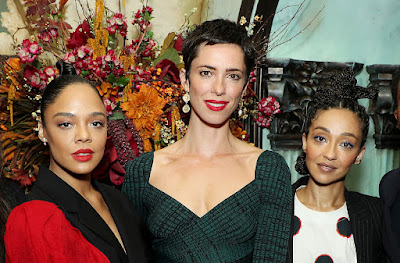
Hall with Tessa Thompson (left) and Ruth Negga

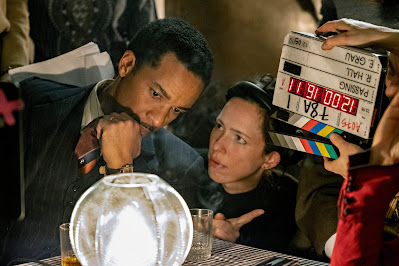
Hall on the set with André Holland

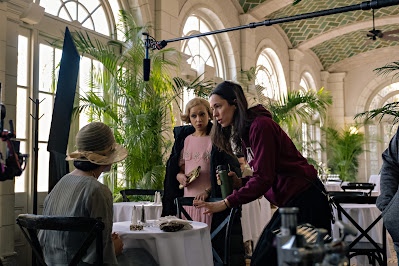
Cinematographer Eduard Grau with the director

(Left to right), Thompson, Negga, and Hall

Thompson, Hall, and Negga


PASSING                   B+                                                                                                                 USA  Great Britain  Canada  (98 mi)  2021  d:  Rebecca Hall

We’re all passing for something or other, aren’t we?                                                            —Irene Redfield (Tessa Thompson)

Rebecca Hall’s screenwriting and directorial debut adapts Nella Larsen’s 1929 novella of the same name, the first black woman to be awarded the Guggenheim Fellowship and a cornerstone work of Harlem Renaissance literature, also a central figure in American modernism, set during Prohibition just before the Depression, offering a despairing depiction in the lives of middle class black women.  Hall’s first draft took ten days, but she spent the next ten years mulling over the screenplay, eventually settling upon an intense character study of two light-skinned biracial women, Tessa Thompson as Irene Redfield and Ruth Negga as Clare Kendry, filled with meaningful and subtle glances, where the authenticity of the exceptional performances is the highlight of the film, as their lives couldn’t have taken more differing paths, yet they converge in what appears to be an exploration of transgressions.  Irene has married a prominent black doctor, Brian (André Holland), with two sons, living a successful middle class life in a Harlem townhouse, while Clare has decided to “pass” as white in order to elevate her social standing, marrying a white husband, John Bellew (Alexander Skarsgård), whose pet name for her is “nig,” as her skin tone appears to be darker than it initially appeared to be.  Meeting by chance at the Drayton Hotel, an upscale white establishment serving cool refreshing drinks such as iced tea, which is like gaining access to another world, one of white luxuries and indulgence, that she visits in a desperate search for relief from the insufferable heat of New York City (that is actually the Drake Hotel in Chicago), two childhood friends reconcile over their differing paths, with Irene meeting her husband John, a virulent racist who mistakenly believes both women are white, voicing his intense hatred for the black race, leaving Irene a bit disgusted at Clare’s self-inflicted predicament.  For the more carefully guarded Irene, whose life of “idealized domesticity” revolves around Harlem parties and a proper social circle, passing is an occasional indulgence, something she does on occasion for the sake of convenience, gaining entrance to restaurants, or theater tickets, allowing her to expand her social realms, while for Clare, passing is a means of survival, orphaned early on, coming from a home with white relatives who disdained her race, she wanted something more, something others had and she didn’t, so she grabbed the opportunity, making a permanent break, resorting to being reckless, flirtatious, and bold, living in a loveless marriage with a banker to gain access to a more affluent lifestyle.  This story has been told before, introduced earlier in films like PINKY (1949), LOST BOUNDARIES (1949), and IMITATION OF LIFE (1934, 1959), where the majority of blacks cannot pass for white.  Since passing was a crime in most states, secrecy was paramount to its success, so Hollywood typically toned down the sexual and political content in order to placate white audiences.  The moral of these Hollywood films seems to be to stay in your place, as passing narratives worked to maintain the status quo, playing into a Hollywood system that continued to cast whites in black roles from the silent era until well into the 60’s, allowing them to perpetuate the same racial stereotypes until a newly developed social consciousness raised questions not only about blacks, but Indians and Hispanics as well.  This project has personal ramifications for Hall, who discovered her own African-American roots in a 2018 Deadline interview, Rebecca Hall Tessa Thompson Ruth Negga - Deadline, “I came across the novel at a time when I was trying to reckon creatively with some of my personal family history, and the mystery surrounding my biracial grandfather on my American mother’s side.  In part, making this film is an exploration of that history, to which I’ve never really had access.”  Hall’s mother is opera star Maria Ewing, and her father, who died at an early age, was a light-skinned black man passing for white, with both identifying as white during their lifetimes.  Nella Larsen’s literature allowed Hall to explore deceptive avenues that light-skinned blacks utilized to gain entrance into white society, something rarely, if ever, mentioned in family histories, often discovered years afterwards, purely by accident.  Thompson appeared in a recent 50’s old-fashioned Hollywood romance movie set in Harlem, Sylvie's Love (2020), while Ruth Negga appeared in Loving (2016), a true-life historical drama that set the legal precedent liberating interracial marriage, which remained illegal in all the former states of the Confederacy 100 years after slavery was abolished.  What’s immediately apparent is the lyrical and often sensuous black and white cinematography from Eduard Grau, relying upon close-ups for intimacy and poetic introspection, with gorgeous jazz piano interludes heard between scenes, The Homeless Wanderer by Emahoy Tsegué-Maryam Guèbrou, The Homeless Wanderer YouTube (7:07), heard earlier in Gabe Klinger’s Porto (2016), an impressionistic piano piece that composer Devonté Hynes incorporates into the score, becoming familiar with Irene’s tree-lined neighborhood, with much of the film taking place in her multi-storied brownstone home, where rain out the window overlooking a collection of trees is among the more uniquely gorgeous images captured, like an impressionistic still painting, with tears of rain running down the window pane, creating a washed-out reflective image that remains permanently out-of-focus.

Nella Larsen, along with Jessie Forset, Jean Toomer, Langston Hughes, and a host of others were writers that examined the different and sometimes complex relationship of passing to black identity, which underwent a refashioning during the Harlem Renaissance.  At least initially, Irene ignores Clare’s repeated requests to meet, where the experience with her husband really left her cold, not really wanting to have anything to do with that, but when Clare arrives at her door unexpectedly, things change, as her friendship is welcomed, but she’s worried that she’s putting herself in danger with such a volatile husband, who might kill her if he found out, raising other perplexing questions such as the cost of personal isolation, paranoia, guilt, self-hate, and the fear of being outed, but Clare puts her mind at ease, thinking she will never be discovered, and that her deceptive practices aren’t on her husband’s radar, as she only intends to visit when he’s out of town on business.  Very quickly, however, she goes from being out of sight to part of the mix, with a “wild desire” to rediscover her real self, chipping away at her carefully-constructed façade, where even her accent grows more relaxed, making more frequent trips to Harlem, showing up for social events where she flirts her way into popularity, but the relationship remains a bit suspect, as Irene’s worries are justified, but Clare never seems worried, instead throwing herself into the next event, becoming more than a little comfortable to be back in the swing of things around black people, something she dreadfully missed in the white world, where there is a loss of self, loss of family, and loss of community, rediscovering who she really is, holding nothing back, regaining a natural feeling among her own, no longer having to pretend.  In contrast to that uninhibited display, Irene has a growing sense of dread, with thoughts that one wrong move might unravel her carefully planned life forever.  The intersection of the two extremes, an extrovert and an introvert, combine to create a single black identity, which appears to be filled with multiple, overlapping identities, some truer or more authentic than others, but continually evolving, seemingly in its antagonistic historical relationship with a modern America that is entrenched in racism, where passing is a strong indictment of American life, an example of the desperate measures people are driven to take in order to survive.  Irene has a black maid, Zulena (Ashley Ware-Jenkins), allowing her more free time to pursue her social interests, yet there’s an air of tension between them that goes unspoken, with Brian often coming to her defense, realizing the maid has her own independent life as well.  But Clare gets caught up in organizing social events, which often includes inviting prominent white people, where party sequences are frequent, drawing the illustrious presence of famed novelist Hugh Wentworth (Bill Camp), as one joyful aspect of the Harlem Renaissance was that it drew whites as well into a mixed throng of jazz music and bootleg liquor, where everyone seemed to overlook their differences for the sake of a good time.  Nella Larsen dedicated her book to Carl Van Vechten, represented by the Wentworth character, who despite having married two women was known for having sexual relations with men.  Many of the central figures of the Harlem Renaissance were gay, though usually closeted, as Harlem had a flourishing gay club scene with drag balls and drag kings, as evidenced by cross-dressing blues performer Gladys Bentley (The Great Blues Singer Gladys Bentley Broke All the Rules), where there is a discussion about female stars Josephine Baker and Ethel Waters, both of whom dabbled on the gay side, hinting this might be a glacially paced and overly restrained black lesbian period piece.  This closeted sexuality leads Irene to tell Hugh, “We’re all passing for something or other, aren’t we?”  The film mirrors the book and seems particularly interested in the interiority of the characters, often shown in lingering close-ups, as Clare grows increasingly comfortable returning to the richness of the Harlem social setting, which Irene can’t help noticing, yet also realizes that Brian, who initially detested her, has grown unusually fond of her as well, creating a ménage à trois of repressed desires, where his mood of irritability only seems to surface during her absence.  This note of jealousy couldn’t be more understated, yet feels alarming, especially coming from Irene, who feels comfortable in her skin, remaining true to herself, sticking up for her beliefs that Brian is introducing adult subject matter to their children too early, scolding him for emphasizing newspaper stories on recent lynchings, as she wants her children to be happy, not looking over their shoulder at a real world suddenly creeping into their lives.  Her position is typically sneered at by her male husband, who believes children need to be prepared for the world they live in, the sooner the better, as they’ll pick up on these things at school anyway, so why not hear it from their own parents in the safety of their home.  Regardless of who’s right or wrong, the manner in which her position is dismissed is typical male dominance, no matter the era, where the sting of the rebuff is never comfortable, but only festers over time, especially with the underlying fears of jealousy that magnify her growing unease.  

Part of the understated context is Irene’s relationship with Clare, initially viewed as a cautionary red flag, a danger zone fraught with ghastly outcomes that could at any minute go haywire, so she was to be avoided at all costs.  But as she re-entered the Harlem lifestyle, their friendship grew closer, with Clare attributing her newfound freedom exclusively to Claire, routinely deferring to her, realizing what a good thing she has by knowing her.  Irene wants to feel the same way, but treads more carefully, realizing Claire has an exhibitionist flair for being the center of attention and grabbing the limelight, for being that popular girl everyone talks about, who brazenly drinks and dances and seemingly doesn’t have a care in the world, valuing freedom and happiness over safety (like Icarus flying too closely to the sun), with Irene reduced to a more passive role of watching and observing.  As she curiously eyes that backless dress Claire’s wearing, she seethes with a smoldering interiority, mesmerized by her blatantly open sexuality on display, a fascination that borders on obsession, becoming a bundle of nerves, remaining on solid footing by being well respected and dignified, known for her impeccable manners and social grace, dedicated to family and home, yet underneath that good breeding lie fleeting feelings of jealousy that make her question her own marriage and this controversial friendship as well.  But it also raises the age-old question about skin color, where at least to whites, lighter skin shades are viewed as safely acceptable, yet darker skin tones produce more hostile feelings of angry denouncement.  Even within the black community, these same arguments raise contentious viewpoints, with darker-skinned blacks remaining skeptical about lighter skin tones gaining access and success within the white establishments, access they are routinely denied simply by the darker color of their skin.  Little progress has been made over the years, as whites continually promote lighter shades as the standard for beauty, which subconsciously makes its way through the black community as well, creating a social rift of jealousy and also fierce independence, as those who defy this social standard are defiantly on their own, setting their own trends, yet only few are successful, while the large population overall continues to believe lighter is better, as evidenced by the huge commercial success of artists like Whitney Houston, Mariah Carey, or Beyoncé, for instance, while Nina Simone fumes in her indignant black fury at being excluded.  One thing that’s clear is that darker women have never been able to pass as white, and may sneer at those who do.  On the other hand, Irene views her darker-skinned maid Zulena quite differently, yet her home is a picture of cleanliness and décor, where Zulena is obviously quite good at what she does, and is quite successful, taking care of a beautiful home filled with beautiful things.  This color angle is a major subtext to the film, as is an unspoken homoerotic element, more hinted at than revealed, though Irene often speaks of Clare’s beauty, which elevates her fear that Clare may steal her husband, yet her efforts to repress this underlying attraction ultimately drives the story, where Claire may actually become a projection of Irene’s repressed desires.  The unexamined question is what view the darker-skinned Brian holds of the lighter-skinned Clare.  Is he really enamored?  Or is it all in Irene’s head?  These questions are never really answered, but instead swirl around in the nuanced, atmospheric social settings where the two continually interact, yet the film does focus primarily on Irene’s experiences, with Clare presenting a distinctive moral challenge.  One astonishing voice of blackness is felt by a continuing sound of a neighboring saxophone player, played by an uncredited Shaun Hudson, where jazz notes linger in the air like afternoon heat, offering relief and solace to those fortunate enough to hear, yet some can be heard telling the player to pipe down as the evening lingers, yet the sound couldn’t be more sensually affirmative.  Devonté Hynes wrote the music for Gia Coppola’s Palo Alto (2013), yet it also sizzles here, offering a more electrifying presence throughout the film.  Certainly a foreshadowing moment has Irene walking down the street with her friend Felisse (Antoinette Crowe-Legacy), who is clearly darker-skinned, yet they run into Clare’s husband John, who immediately recognizes Irene, and calls her name, but she astutely avoids him without acknowledging his presence and keeps walking.  This singularly charged moment lingers in an otherwise subtle and carefully calculated film, the very picture of restraint, with malicious overtones that remain out of sight, only to resurface in what appears to be a New Year’s party, with a layer of snow already on the ground, when John angrily crashes the party, yelling and screaming as he pushes his way inside looking for his wife, creating instant turmoil as havoc ensues, remaining ambiguous as to what exactly happens, yet a tragedy occurs, a particularly harrowing moment that has been the subject of discussion for years, leaving unanswered questions that linger in the background, haunting viewers long afterwards, a metaphor for the price that can be paid for passing.  The novel was originally published with two different endings in two separate printings, with the original ending including a white policeman’s decree of “death by misadventure,” which by itself is an extraordinary choice of words, while another ends on the phrase, “Then everything was dark.”  There is no indication which version Nella Larsen preferred, having written both, adding to the critical debate of what constitutes the truth.