 |
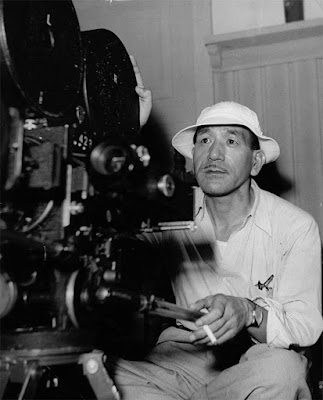
| Director Yasujirō Ozu |
EARLY SUMMER (Bakushû) B+ Japan (124 mi) 1951 d: Yasujirō Ozu
Ozu’s comment on marriage is perhaps his most sentimentalized film, at least in its overwrought musical soundtrack, featuring an angelic children’s choir that both opens and closes the film, yet it’s also among his most ambitious efforts. This is a particularly chatty film, yet deeply rooted in Japanese culture, offering a snapshot in time, revealing various layers of domestic family life, incorporating space for grandparents in the home, where the film is largely a choreography of daily activities, quickly grabbing a bite before they leave in the morning, announcing one’s presence when they arrive back in the evening, sharing carefully prepared meals together, all assembled together sitting on the floor around a single table, easily moving around the various rooms of the house, sharing everyday ordinary moments with more intimate, personal conversations, where rather than activity onscreen, motionless faces often speak directly to the camera, seemingly disconnected from any theatrical staging, while the initial music box score sounds like Christmas music, or a bells and xylophone (or glockenspiel) variation on “There’s No Place Like Home.” Written by Ozu and his longtime cowriter Kōgo Noda, this is an odd style of traditionalist filmmaking where little ever happens onscreen, where the essence is establishing a rhythm and routine, allowing viewers to familiarize themselves with the home and the various inhabitants, which includes the presence of several hanging birdcages, while also moving to the workplace, creating a rather idyllic family with few, if any, real problems to contend with. It’s important to realize this style of film comes “prior to” the prevalence of television, another medium that reflects modern day culture, with Ozu’s camera shot by Yūharu Atsuta framing the interior of Japanese style homes, cluttered with objects, yet organized by a precise geometry of Japanese design, where the familiar home setting was also routinely depicted in television shows, though Ozu has more extended time to elaborate his themes, with his habitual train shots reflecting the passage of time, including a gorgeous shot of a train passing through an immense hillside landscape, using more tracking shots than usual, spending the first half-hour simply introducing characters, with no narrative advancement at all. While there are connections to the war experience, which hovers over the entire film, almost like a commemoration honoring the war dead, this is a postwar film offering nothing but optimism about the future, examining one’s life with a sense of fulfillment, as each are invariably connected to one another. While there is no visible American presence, Japan at the time was still under American occupation, where Tokyo was in the midst of a massive reconstruction, as 65% of all residences were destroyed, with Japanese identities in flux, where Western influence abounds, particularly in the consumer-driven interest of the young children, always wanting more, then showing a disgruntled behavior when they don’t get it. Perhaps most importantly, this is the second Ozu film with Setsuko Hara, reprising her role as the kindhearted Noriko, following the first entry of the Noriko Trilogy, Late Spring (Banshun) (1949), completing the Trilogy with TOKYO STORY (1953), making six films together between 1949 and 1961, and although she acted in over 100 films, she is best known for her works with Ozu. After the war, Hara emerged as one of Japan’s biggest and most popular stars, mainly due to her role in Akira Kurosawa’s NO REGRETS FOR OUR YOUTH (1946), arguably Kurosawa’s most feminist film. Hara also starred earlier that same year in Kurosawa’s four-hour The Idiot (Hakuchi) (1951), which was streamlined considerably by the studio heads, also sharing two other actors, Chieko Higashiyama, playing a mother in both films, and Kokuten Kōdō in his only Ozu appearance, both films featuring large, ensemble casts, with 19-characters gracing the screen in this movie, where the distinct array of characters give both a novelesque look. Ozu’s films offer a time capsule of postwar life in Japan, with the director offering specific Japanese commentary on the changing times, often at odds with the American occupation and its mandate to bring about reform in Japanese society, where the differing reactions are clearly visible in Ozu films, with this film offering a changing perspective on marriage and how it impacts on each of the characters. Some have claimed this multi-character film may be an effective predecessor to Edward Yang’s Yi Yi: A One and a Two... (2000). One scene in particular comments on the ephemeral nature of time, as an elderly couple sits in a park watching children at play, thinking back on their own lives, with the father thinking this is the happiest time of their life. His wife is not so sure, indicating they could be happier. But the father confidently indicates they mustn’t want too much. That’s a stark indicator of this film’s measured tone, with the camera, as if by chance, finding a balloon floating into the sky. This makes the father think, “Some child must be crying,” as they watch the balloon float away into the clouds. It’s a moment of rare transcendence in an Ozu film, primarily concerned with the interior space of a family home, the familiar boundaries of one’s life. But in this instance, he breaks from the traditional parameters and reaches for something more, perhaps something sublime and universally transcendent that he would ultimately find in TOKYO STORY.
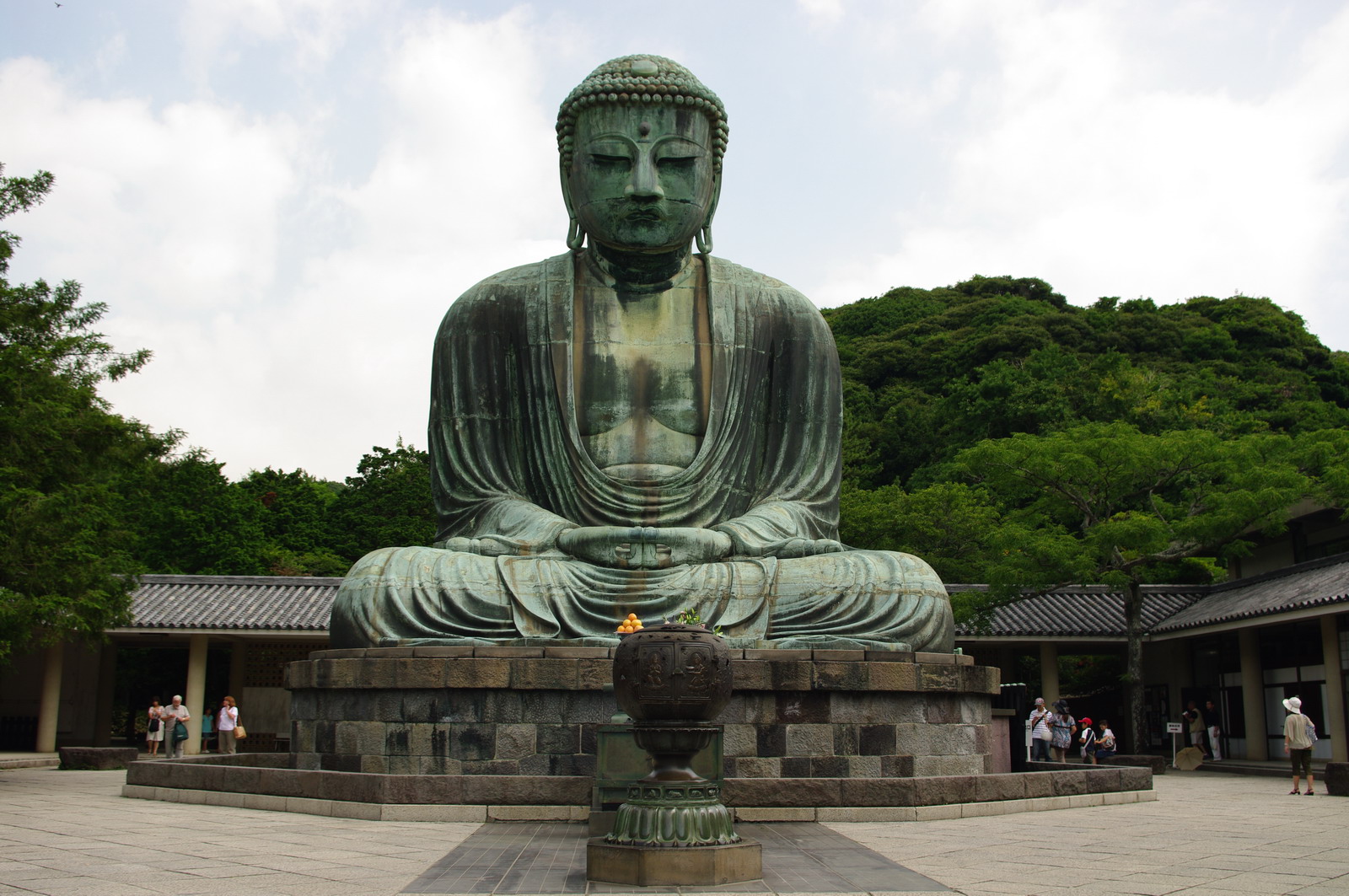
In what is basically a turning point in Japanese history, marriage was never seen as a singular decision, and was never about the individual, but was instead viewed as an extension of the family. It’s important to realize, then and now, that marriage does not equate happiness, and Ozu himself was never married, yet women throughout history have been sacrificed in the name of marriage, only to live in loneliness and solitude, surrounded by a family of strangers. These are the values Ozu is questioning, probing the effects over time. Among the more significant postwar reforms were newly written Constitutional laws on marriage that would no longer allow traditionally arranged marriages, which gave parents an exclusive right of choice, now explicitly based on mutual consent, essentially offering Japanese women new rights in both marriage and divorce, where the law guaranteed women’s independence and an equality of the sexes, a concept that never previously existed in Japanese society, even allowing them to enter the arena of politics, where they had historically been excluded, and with this film women are more prominently featured. Ozu presents these changing ideas, as they are openly brought to the forefront of the film, Women being forward (Early Summer) YouTube (1:02), modernist ideas conveyed in a traditional Japanese house with paper walls and sliding doors. While this film is largely based around a series of vignettes, revealing a natural rhythm of life expounding on traditional values, it’s also clear these values have undergone a radical Westernized restructuring whose impact at the time was not known. With Ozu offering such intense scrutiny of the Japanese family unit, with American censors reviewing each and every film script, Ozu examines the changing times through the eyes of Noriko (Setsuko Hara), a thoroughly independent woman who works as a secretary in Kamakura, a seaside community just south of Tokyo, living with her two parents, Shūkichi (Ichirō Sugai) and Shige (Chieko Higashiyama), her older brother Kōichi (a remarkably younger Chishū Ryū), a prominent physician, his wife Fumiko (Kuniko Miyake), and their two obstinately spoiled young sons who are largely used for comic relief, playfully calling their grandparents “Idiots,” believing they’re hard of hearing. Ozu rarely depicts three generations living under one roof, with an elderly uncle (Kokuten Kōdō) arriving later, initiating a familiar theme heard throughout the film openly inquiring about when 28-year old Noriko will decide to get married. It’s important to point out that this was the prevailing attitude in 1951, as marriage was considered a necessity, as it’s all they can think about, apparently, believing it is a family responsibility, though Noriko remains perfectly content the way things are. She also has a brother who was lost in the war, not as a combat death but as a war disappearance, with the father solemnly acknowledging there’s no hope he’s still alive, as it’s been eight years since he disappeared, yet the mother is distraught and brought to tears as she adamantly listens to the Missing Persons Hour on the radio. These parents are not alone, but reflective of a multitude of parents mourning a lost generation. Like a mirror image of that insurmountable loss, young children are a constant presence in this film, seen with the family as they visit the Great Buddha (1,600 × 1,063 pixels) on an afternoon sojourn, a place where the very old and very young congregate, as if under watchful eyes of protection, or joining other kids who come to play with them, spread out on the floor with an electric train set, taking up space, making a racket, pausing to eat sandwiches, driving Koichi out of the house to a friend where there’s considerably less noise. Similarly, Noriko is visited by several of her high school classmates that remain friends afterwards, though amusingly those who are married remain pitted against those who are not, claiming married life can never be understood by those who remain single. Perhaps the most provocative moment is a brief inference from her gossiping girlfriends that Noriko may be a lesbian, based on her extensive photograph collection of Katharine Hepburn (mis-translated as Audrey Hepburn, but her movie career had not yet begun), suggesting she may go for women. While this is initially categorically denied, they then backtrack to “You never know.” Truly a rare moment, particularly at that time in history, and from a postwar Japanese director labeled a social conservative. In this regard, her best friend Aya (Chikage Awashima) is also unmarried, with both representing Japanese modernity, as they are associated with Ginza coffee shops, Western dress, and even compulsive purchasing, where bringing home cake from a wedding to munch on as a snack is viewed as an act of decadence, with the adults quickly hiding it under the table when one of the kids unexpectedly shows up, as they greedily don’t want to share. On her way to work one morning at KitaKamakura Station, Noriko runs into a neighbor and childhood friend, Kenchike Yabe (Hiroshi Nihon’yanagi), a widower with a young daughter, but he arranges to have tea with Noriko, offering her a sheaf of wheat, which signifies the season the film is set in, early summer, a gift from his best friend who was killed in the war, who asked that it would be given to Noriko should he not return. Wheat becomes a metaphor for the continuing presence of the dead on the living, allowing the film to look backward, guided and perhaps haunted by war and tradition, while at the same time looking forward into modernity, with Noriko serving as the connecting thread, with Ozu’s comment on the cycle of life serving as a form of enlightenment.
At the suggestion of Noriko’s boss Satake (Shūji Sano), he recommends that she marry a friend of his, a successful, middle-aged businessman, Mr. Manabe, showing a photo of him on the golf course, believing he would provide the economic security she needs. While all seem to agree that it is time for her to marry, with her brother, in particular, taking charge and doing a little investigating behind the scenes that he forwards to his parents, all believing he is a satisfactory prospect, though her mother is concerned about the age difference, with the family getting their hopes up that she might agree. In a clear indication of a historical bias against women, Kōichi can be heard claiming they can’t be choosy, as Noriko’s not so young anymore, thinking this candidate may be the best Noriko can hope for. And while no one asks her what she thinks, she never agrees to meet with this prospect and never seems overly enthused about him. But that doesn’t stop the build-up of anticipation behind the scenes, with her parents and brother overly ecstatic, yet anxiously awaiting, thinking it’s all about to happen, exactly as it did at the end of Late Spring (Banshun). Amping up the interest is a conversation between Shige and their neighbor, Yabe’s mother Tami (Sugimura Haruko), about a private detective asking about Noriko, both making a big fuss about the marital implications. In stark contrast, the bratty kids disappear for an extensive period of time after being disappointed when their father brings back bread in a similarly-sized package they felt held new electric train tracks, sullenly kicking the bread on the floor and getting whacked by their father before making a petulant exit, only to be found insatiably hungry hours later huddled in a corner at the train station. This is a rare moment of flared-up violence in a normally placid Ozu film, though the children are clearly too young to remember the deprivations of wartime food shortages that may have been on the mind of their father. Kōichi also makes another important decision, sending his assistant Yabe to a hospital post in faraway Akita on the northern tip of the island, with reassurances that he can return to Tokyo after a few years. The town is so rural that Aya and Noriko make fun of the area’s accent, as if only hicks and farm yokels live there. But the tables quickly change when Tami impulsively asks Noriko to marry her son Yabe, claiming it has been one of her lifelong desires, only to be astounded when she accepts, indicating a willingness to accompany them on their northerly resettlement, as it’s an opportunity to escape from a family continually intervening in her life. No reason is given for her seemingly impulsive decision, though Yabe himself seems less than thrilled at the news, viewed only secondarily, never seen or heard from again. Only later do we learn that they, along with Aya and the missing brother, once hiked together before the war. It is these choices of omission that distinguish this film, like earlier Aya and Noriko were at a theater where Mr. Manabe was having dinner, where they amusingly wanted to have a peek, but the camera cuts away before we ever see him. When Noriko makes this announcement to her own family, they are bitterly hurt and quietly devastated to have been excluded from her decision, all hanging their heads in unison, thinking she has made a poor choice, as they will inevitably face financial hardships ahead, giving her the cold shoulder at dinner one evening where she is seen eating alone, yet Noriko is comfortable with her lifelong relationship with Yabe, knowing he is a man she could trust, where the spirit of their missing friend is more than a memory, as his soul connects them together while also watching over them. The reaction between the two families couldn’t be more markedly different, one ecstatically happy, the other downbeat and perturbed, with no mention at all of romance or attraction. Hoping she will change her mind, as her decision flies in the face of tradition, there are two extraordinary moments, one where the father takes a walk to buy birdseed, but stops at the pedestrian crossing to sit on a bench while a train passes, remaining there long afterwards in a state of contemplation, allowing his daughter’s decision to sink in, and another where Noriko walks with Fumiko along the beach at Kamakura, opening with a walk over sand dunes and undulating hills, containing the only crane shot in all of Ozu’s films, Early Summer 1951 YouTube (4:14). Perhaps more importantly, this decision means the breakup of the family, as without her income, they will have to move from their family home into another rural region to live with Noriko’s elderly uncle, where both generations will be moving away from the modern conveniences of the city. This puts additional pressure on Noriko, who instantly feels responsible. After taking a family photographic portrait together, she runs upstairs and breaks out into tears, unleashing all her pent-up emotions, finally feeling the pressure placed on her shoulders. Without ever showing the marriage (no signs of the earlier suitor either), the family ends up scattered across Japan, as the focus instead is on Noriko’s parents suddenly finding themselves in a much slower pace of life in the rural countryside of the uncle’s home in Yamato, where a bridal procession is seen passing down a country road wearing traditional costume, surrounded by vast wheat fields of barley, a collective remembrance of the war dead.
Early Summer (1951) HD Full Length Movie - Directed by Yasujirō Ozu (Bakushū) YouTube (2:05:01)