|
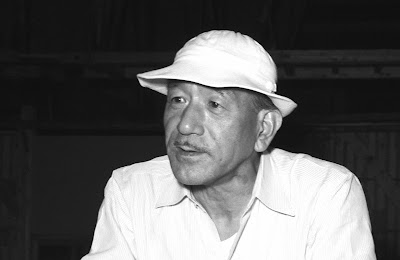
| Director Akira Kurosawa |
HIGH AND LOW (Tengoku to jigoku) A Japan (142 mi) 1963 ‘Scope d: Akira Kurosawa
My room was so cold in winter and so hot in summer, I couldn’t sleep. From that tiny room, your house looked like heaven. As I looked at it, I gradually started to hate you. —Ginjirō Takeuchi (Tsutomu Yamazaki)
One of the greatest films of Kurosawa’s career, better known for his epic samurai movies, it received only modest reviews in the Western press on its release, but has since gained a strong critical following. This is also among the best police procedurals in cinema history, rivaling Fritz Lang’s M (1931), the granddaddy of them all, but also Alfred Hitchcock’s Blackmail (1929), Jean-Pierre Melville’s Le Samouraï (1967), Richard Brooks’ In Cold Blood (1967), Konstantin Costa-Gavras’ Z (1969), Michael Mann’s HEAT (1995), Curtis Hanson’s L.A. Confidential (1997), Bong Joon-ho’s Memories of Murder (Salinui chueok) (2003), and David Fincher’s ZODIAC (2007), to name a few. When Kurosawa made this film, the thriller wasn’t yet universally accepted, having largely evolved out of literature, with crime stories leading to film noir thrillers in the 1940’s, while Hitchcock and Fritz Lang were really the only true cinematic practitioners, influencing films that focused primarily on the psychological aspects of murder, like Fritz Lang’s THE TESTAMENT OF DR. MABUSE (1933), SCARLET STREET (1945), and THE BIG HEAT (1953), or Hitchcock’s The Lodger (1927), Shadow of a Doubt (1943), and Psycho (1960). Currently listed at #6 from Letterboxd Official Top 250 Narrative Feature Films, Kurosawa’s modernist psychological thriller was a complete departure, exploring social inequality by telling the story of a wealthy industrialist whose son has been kidnapped—or so he believes. A black and white CinemaScope American style noir thriller originated with pulp writer Evan Hunter, aka Ed McBain, whose 1954 novel was the source material for Richard Brooks’ Blackboard Jungle (1955), while also adapting the Daphne Du Maurier short story for Alfred Hitchcock’s The Birds (1963), with Kurosawa adapting his 1959 novel King's Ransom (kings-ransom.pdf), the 5th book in a lengthy series of police procedural novels and stories called 87th Precinct Mysteries (made into a 30-episode TV series in 1961-62), which allows the filmmaker to utilize someone else’s story to help express his own unique vision, integrating character study and social commentary into a meticulously taut police procedure, literally dissecting the socio-economic divide in the city. The photography alone could serve as a perfect example of compositional technique for film schools, opening with a shot of Yokohama harbor, accentuating the city’s affluent hills and its low-lying slums. From a mansion high up on a hill, with floor-to-ceiling windows and a sliding glass door looking down on the ugly city port below lives Kingo Gondo, Toshirô Mifune in a sharp suit and tie, a successful, modern Japanese shoe manufacturer who comes from humble beginnings, but has a plan to take over the majority shares of a company that he has invested 30 years of his life, drawing out 30 million yen from his bank. It’s a risky proposition, borrowing against his home, but the other executives have a different vision of how to run the company, placing their hopes on making cheaper, less durable shoes, forcing customers to make repeat purchases, a position that galls Gondo, kicking them out of his home, as he believes the reputation of the company should stand for quality, High And Low (1963) -- (Movie Clip) Blood Sport - Turner ... YouTube (3:54). Just after showing his fellow board members the door, a curious thing happens, as his son Jun barges into the living room dressed in a cowboy hat and store-bought Western attire as a sheriff, toy rifle blazing, while his playmate, the chauffeur’s son Shinichi, falls to the floor in a mock death of the outlaw, an allegorical reflection of the Americanization of postwar Japan. In fact, all of the characters are dressed in Western attire except Gondo’s wife, who wears a traditional kimono, while they also do the unthinkable, wear street shoes in the house like foreigners, something rarely seen in Japanese films then or now.
Before his plan can materialize, however, Gondo receives a jarring telephone call, as a kidnapper is ransoming his son for the identical amount of 30 million yen. He and his wife Reiko (Kyōko Kagawa, the youngest daughter from Ozu’s Tokyo Story (Tokyo Monogatari)), immediately swear they will pay and do anything to protect the life of their child, but it turns out the kidnapper has snatched his chauffeur Aoki’’s child by mistake, forcing Gondo to choose between his personal fortune or the life of this child. When he initially swears he will never pay, his right hand man for the past 10 years, his personal secretary Kawanishi (Tatsuya Mihashi), reminds him it was his wife’s dowry that helped him get into business in the first place, suggesting he could at least listen to her interests. She pleads for the life of the child, reminding her husband, “I know how much this money means to you, but a human life means more,” which starts a real roller-coaster, whirlwind sequence of events. Aoki (Yutaka Sada) is always seen lingering in the background or on the edge of many shots, reflecting the powerlessness of his position, while also pleading to Gondo for his son’s life. Gondo’s ultimate decision, and how it affects his life and the lives of those around him, are scrutinized in this film, deciding whether this young boy is worth his family’s livelihood, or whether to be labeled a heartless executive for the rest of his days, thoroughly examining just what constitutes success of the prosperous in modern day Japan, a study of men who measure their lives not by their own personal gain but by their responsibility to others. Under this duress, Gondo is immediately betrayed by Kawanishi, as his business partners turn against him, holding majority shares, taking advantage of his financial dilemma, with the film making veiled references to the corruption and power play strategies that exist within corporate culture. The title refers to the distinctive class differentiation between those that can afford to live high up on a hill versus those that cram into the heavily populated slums below, though the Japanese title more accurately translates to Heaven and Hell, referring to the postwar Japanese reconstruction, where building something out of the ruins of war only accentuated an intensifying conflict between the rich and the poor, as there was a massive disparity in the distribution of national income, where working class suffering had a deep impact on the film. The last of Kurosawa’s crime thrillers is dark and murky, offering a deeply pessimistic view of Japanese society, illuminating a massive range of themes and ethical complexities, including class struggle, postwar Japanese industrialization, corporate greed, and humanist morality, where characters contain humanistic moral values about honor and courage that parallel the Bushido ways of the samurai, the traditional Japanese code of honor. While the source material is American, it feels like it has more in common with French policiers of the period than American film noirs from the 40’s and 50’s, like the flamboyant central figure in Jean-Pierre Melville’s Bob Le Flambeur (Bob the Gambler) (1956) or Claude Sautet’s Classe Tous Risques (The Big Risk) (1960), films that expose a rupturing middle class, where money is at the heart of all problems, often crossing the line of making questionable moral choices.
Stage-trained Tatsuya Nakadai, the aging patriarch from RAN (1985), is Tokura, the Chief Police Inspector on the case and the man running the operation, aided by Chief Detective 'Bos’n’ Taguchi (Kenjiro Ishiyama), and a host of others, turning into an exquisite morality play filled with personally compelling moral dilemmas. They immediately try to trace the incoming calls, with little success, thwarted at every turn, as the kidnapper is highly intelligent, able to remain undetected, while he’s also familiar with Japanese laws that would result in minimal incarceration, even if captured. One of the reasons Kurosawa made the film was due to the lax laws surrounding kidnapping cases, especially after an increase in postwar kidnappings in Japan in the late 50’s and early 60’s due to the rise in prosperity, as there simply weren’t sufficient criminal penalties, with the film exploring all the moral complexities involved. The kidnapper acknowledged he could see Gondo’s luxurious home out his apartment window, literally taunting him every day, fueling his class resentment, as he’s living in the sweltering heat while Gondo is nice and cool with his air-conditioning. The kidnapper complained that the curtains were closed in Gondo’s home (concealing the presence of the police), suggesting something fishy was going on, as he must have something to hide, acknowledging he had a direct line of sight into the home, High And Low (1963) -- (Movie Clip) Something Fishy - Turner ... YouTube (4:45). These clues give the police a specific area to investigate, including the pay phones he may have used with a direct viewpoint, so they begin a targeted manhunt with the full force of the department’s manpower and resources. The evening prior to the ransom exchange, under instructions of the police, Gondo fixes two briefcases to contain pods that release a foul odor when submerged in water or pink smoke when burnt. Following the kidnapper’s instructions, the money is put into the briefcases and will be thrown out from a moving bullet train at a designated spot, with Gondo receiving specific phone instructions from the kidnapper. A chamber drama that transitions into a more traditional police procedural, this divides the film into two halves, as the first takes place in the modernist décor of an interior living room, confined to one location, with Kurosawa exhibiting a particular skill in geometric blocking, where he situates men around modern furniture like figures in a landscape, staged like a theatrical production, with the characters rearranged over and over again in a series of abstract patterns within an expanded CinemaScope frame, highlighted by Mifune’s extraordinary performance along with some exceptional screenwriting. Kurosawa films these scenes as single, uninterrupted takes, with infrequent, but deliberate camera movement, as two or sometimes three cameras film the action simultaneously, changing the focus of our attention by changing camera angles, using slow pans, or zooming in and out, accentuating each character’s relationship to the other characters, where the movement within one static shot exudes plenty of drama, creating unbearable tension. The filmmaker was pleased enough with the results that this became his primary shooting method in his later films. In this instance, space is not organized around a point of view, but around social relations and the divisions between people, with larger implications suggesting there are absolute, irrevocable divisions between men that can be bridged only by compassion and understanding, not social change.
But then the film breaks out into the bright sunlight of the outdoors, an abrupt change of style that is like a shock to the system. The infamous train sequence is an intricately coordinated tour-de-force filmed in real-time with multiple cameras on an actual high-speed train, where money is flung from a bathroom window (the only window on the train that opens, but just barely) to the waiting bandits. Directed with breathtaking precision and virtuosity, Gondo is able to see the kidnapped child from the train (held by an accomplice), which is the sign of when to throw out the briefcases, Tsutomu Yamazaki - Turner Classic Movies YouTube (4:02). Kurosawa didn’t just make films, he created tableau style languages of movement, capturing the moral struggles and the visual representations of emotional states that are artistic and accessible at the same time, influencing filmmakers globally for generations to come. In this way, the police are unable to follow the money, as the element of surprise allows the kidnappers to get away, which is elaborately shown in great detail. The police photograph the incident from the train, using various angles and an 8mm film, hoping to identify the perpetrators, while setting off a massive city-wide police investigation. Gondo’s entire fortune is gone in a split-second, but the child is returned unharmed, and Gondo’s selflessness turns him into a folk hero. Balancing themes of sacrifice and greed, while also examining the specific class structure of contemporary Japanese society, Gondo’s character is complicated and multi-dimensional. For some, his actions are a means to reconstruct the identity and unity of the Japanese nation. Partly because of the film’s impact in Japan, the laws were changed a year after the film’s release to allow life sentences in cases of kidnapping for ransom. The young medical student turned kidnapper, Ginjirō Takeuchi (Tsutomu Yamazaki), is initially seen reflected in the murk of polluted standing water, briefly walking into his ramshackle apartment in the lower part of town, with a view of the mansion, high up on the hill, out his window, as he carefully inspects the newspapers for information. As the police expand through the terrain of the city, spending a great deal of time walking on foot through the seedy Yokohama backstreets, Tokura holds a briefing meticulously analyzing each and every aspect of every clue, reminiscent of the police manhunt in Fritz Lang’s M (1931), with each different department voicing what they’ve uncovered to their superiors in front of an enormous wall map of every precinct of the city, where they quickly identify the kidnapper, but the question is how they intend to apprehend him, where they are driven to file the most serious charges and not let him off easy. They discover a stolen car was used; the small child drew a picture of the sea and Mt. Fuji which could be seen from the kidnapper’s hideout; there was the sound of a trolley car on the taped police phone call, which is identified in a wonderful scene that anticipates DODES’KADEN (1970) when one of the stationmasters recognizes which train by the identifying sound it makes, mimicking the sound with a little burlesque movement; accomplices are found murdered by an overdose of pure heroin at the hideout; the newspapers are told to run a fake story to draw out the kidnapper with false information, forcing him to recreate their murders, deciding a 15-year kidnapping sentence is insufficient, hoping to entrap him, gathering needed evidence to convict him of murder, subject to execution. Kurosawa was criticized in Japan for the way the police allegedly baited the criminal. The faint color of pink smoke is used in a black and white film to signal the kidnapper has burned the suitcases, identifying his location, which is something of a cinematic revelation. While highly innovative, it had been done before in the silent era, as the technique was used in Edwin S. Porter’s black and white film THE GREAT TRAIN ROBBERY (1903), where the smoke from a bandit’s gun turns yellow onscreen. Fittingly, Kurosawa revives an obsolete cinematic practice.
But as brilliant as the film is to this point, it pales in comparison to the final sequences, a masterfully noirish mise-en-scėne through the sordid criminal underworld of Yokohama, rivaling any in the Kurosawa repertoire, as Kurosawa moves his handheld camera back to the streets of the crowded slums and amusement areas depicted so powerfully in STRAY DOG (1949) and IKIRU (1952), while also resembling the documentary style of shooting on the streets in Jules Dassin’s The Naked City (1948). As the relentless manhunt closes around the kidnapper, dozens of unidentified detectives follow him into the crowded dives of Yokohama bars filled with foreigners, especially American military personnel, and onto the frenzied dance floor, where we are supremely aware of the oppressive summer heat, with shirts soaked in sweat as he hooks up with a completely free-spirited young woman whose presence is so vivid it nearly freezes the action. She puts money in a jukebox that blares out 50’s rock ‘n’ roll music and the entire screen is ablaze in dance movement, making it unclear to the detectives whether he actually purchased drugs on the dance floor. So they follow him through a dreary, subterranean, nightmarish underworld, underscored by this truly raunchy, bluesy jazz music, where the criminal moves about undetected, even with the police planted on every corner, through a decrepit dope den that is masterfully creepy and claustrophobic, a literal labyrinth of depravity, diving into Dostoyevskian depths, where the screen again explodes into the utter horror of poverty, filth, and deprivation, as the camera reveals images reflected off the lenses of his dark glasses, where he picks up a random junky and feeds her the pure heroin. She dies instantly, an outcome the police apparently thought was justified in order to make the case for murder, holding up a moral mirror to the audience, but this is part of the lingering ethical quandary the film presents. Truly the work of a mature filmmaker, Kurosawa, who often edited his own work, exposes a microcosm of modern Japan, with its amoral abandon, its cruelty, viciousness, and overpowering animal sensuality, providing a stark contrast of those economically left behind just as Japan is beginning to grow prosperous. The cops give chase, and even witness a strange interaction on the street between Gondo, observing shoes through a storefront window, and the kidnapper who asks him for a light, completely unaware that this is the man upending his life, before finally grabbing him only when he is lured back to his hideout, as the kidnapper moves to kill his accomplices in order to cover his tracks, believing in the phony newspaper reports that he failed to kill them earlier. Interestingly, Gondo drops out of the picture during the police manhunt and all but disappears until the end of the film. His business partners defy the public outcry of sympathy towards him and fire him from his job, as we see items in his home being tagged for sale as he is about to lose everything. Before the execution, the kidnapper refuses to see a Buddhist priest, but calls on Gondo to visit him, having started over with a new company by then, his life completely transformed, so he’s no longer, geographically or economically, representative of “high,” as the kidnapper has succeeded in bringing him down to his own “low” level. From behind a glass pane, the reflection of their faces overlaps, recalling these same dichotomy of images from Bergman’s Persona (1966), as the prisoner never acknowledges his own personal motives for the crimes, which remain ambiguous, but does confess “Your house looked like heaven,” while also adding “Hate made my life worth living,” the only time he speaks in the entire film. Putting on a brave front of utter disdain, he can’t stop himself from shaking, and starts a terrifying scream when the police lead him out of the room back to his cell, leaving Gondo alone, his back to the camera, staring ahead as a metal shutter slams the glass window shut, where he is left with his own reflection.