






 |
| Director Paolo Sorrentino |

IL DIVO (Il divo: La spettacolare vita di Giulio Andreotti) B+ aka: The Extraordinary Life of Giulio Andreotti Italy France (117 mi) 2008 ‘Scope d: Paolo Sorrentino
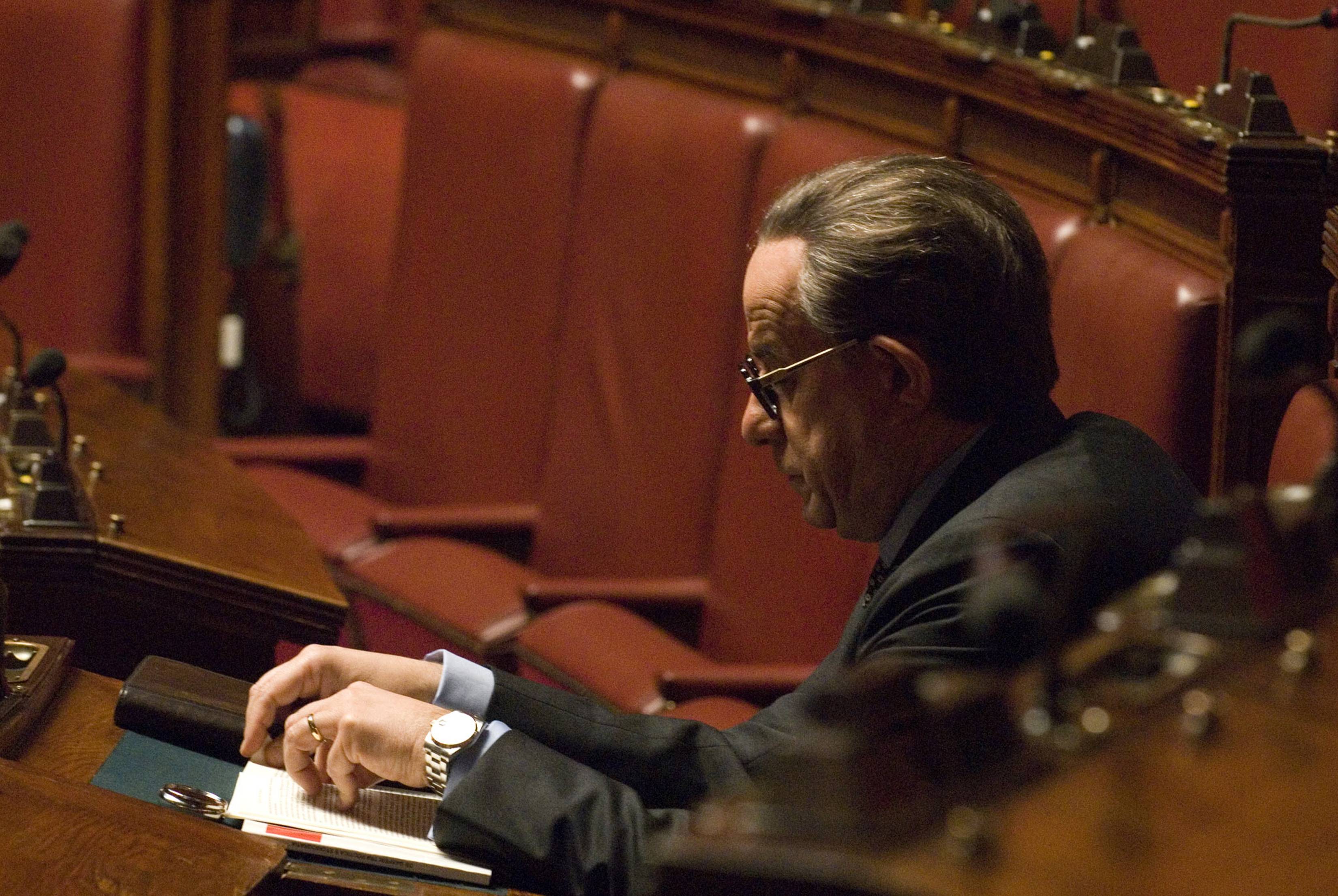
Winner of the Jury Prize (3rd place) at Cannes, this is a whirlwind of political intrigue, where nearly all of the specifics are lost to the viewer, yet it hardly matters at all, as this as one stylishly clever adaptation of the current Italian political scene where the center of attention is Toni Servillo’s weird but delightfully captivating screen portrayal of the uncharismatic Giulio Andreotti, a mousy postwar political mastermind who served in the Italian General Assembly for over forty years, appointed Senator for life, and on three different occasions in the 70’s, 80’s and 90’s, elected as the Italian Prime Minister, yet was charged and accused of the murder of a journalist and with having mafia connections, charges that were eventually dropped, then sustained in appeal, and then overturned on another appeal and dismissed, the results of which are shown only at the very end. From the outset, there is a glossary of important terms and organizations which pass by so quickly that it’s impossible to keep straight, with murky Masonic lodges and devious Vatican bankers, years of Red Brigades and fascist bombings, and a mafia that actually converged into the state, where the violent conflicts seemed like they would never end. Not knowing seems to be as good a way as any in approaching this film, as it still plays out with astonishing fluidity and directorial flourish, where Sorrentino’s taut musical choices by Fauré, Sibelius, and Saint-Saens alongside original music by Teho Teardo are nothing less than brilliant. The ease with which this man makes movies feel interesting is stunning, as this has an almost Fellini-esque, carnival-like atmosphere yet the sour looks on people’s faces show the deadly serious nature of their business, shot in the darkened corners of immense corridors of power where humans are dwarfed by the grandiosity of the ancient architecture that all but engulfs them. Andreotti’s repressive state of mind is so total and so complete that it resembles JULIET OF THE SPIRITS (1965), not in the phantasmagorical dream surrealism, but it mixes fabricated dreams of the protagonist with scenes of murder, orgy, and the mafiosi, entrenched in the impossibility of knowing the truth buried underneath his unchanging veneer of facial expression, veiled as it is in so many layers of denials and implausible explanations, each one of which might actually be partly true. He reminds us of Everett Sloane as Arthur Bannister in Orson Welles’ LADY FROM SHANGHAI (1947), especially the scene as the defense attorney in court when he cross-examines himself on the witness stand. What is anyone to make of this? Not just a biography, but a study of power, as Il Divo was the nickname of Julius Caesar, featuring a climactic “confession” sequence where Andreotti, alone in his house, has a sudden outburst. Shrouded in darkness, sitting in a chair facing the audience, it appears he is under interrogation, but never looks at the camera, instead seems to be talking to his wife, starting in a quiet whisper, but slowly raises his voice, speaking with personal conviction, expressed with strong religious overtones, ultimately calling upon God and his conscience in what resembles a Catholic confessional, claiming every evil act he committed was inspired by a greater good, a scene that very clearly connects religion to politics, calling into question the violence that maintains the state, Il Divo (2008) | The Confession Scene | Eng Subtitles YouTube (2:17). Andreotti justifies homicides and other acts of violence not as a means to consolidate personal power, but to carry out a divine mandate, as if he were on a mission from God, much like the religious wars stirred up by the Crusades in medieval times, carrying out bloody, violent, and often ruthless conflicts at the behest of the Catholic Church.
While this is an extraordinarily sinister portrait of Andreotti, what this really resembles is an Italian version of THE GODFATHER (1972) shot by someone other than Francis Ford Coppola, as this is simply another brilliantly expressed version of the same thing, only set in Italy instead of the United States. What immediately strikes viewers is how the leading character is so morbidly lifeless, lacking all the attributes of a leading man, older, less imposing, completely asexual, striking no fear in the hearts of anyone. If anything, he fits the Max Schreck profile for Murnau’s NOSFERATU (1922), a shadowy vampire figure who is weakened by sunlight. Toni Servillo, on the other hand, is running on all cylinders, exaggerated to the point of being grotesque, looking monstrous with his big glasses and impassive demeanor, almost robot-like in his rigidly, mechanical movement, as he’s a creepily queer, brainy, oddball character who is an insomniac, having never kissed his mother, has a personal acquaintance with half a dozen popes, attends mass every morning, rips out the page in murder mysteries that reveals whodunit, and surrounds himself with a fully armed militia, yet is also seen with younger, more energized people who are seen dancing crazily as if in the 60’s, a video camera veering through the crowd, yet he sits quietly with his loyal wife (Anna Bonaiuto). When someone asks him if he’d like to dance, he responds that in politics, he’s been dancing all his life. The film is full of cryptic answers and responses like that, some hilarious, almost all of them witty, as apparently this is the guy who knows where all the dead bodies in Italian politics are buried. Like early Godard films, as each new character is introduced, colorful titles fill the screen identifying them by their name and nickname, organization, and other biographical information, usually to humorous ends, such as the violent manner of their death. The men that surround Andreotti are enormous-sized behemoths exuding menace, secrecy, and brutality, all stereotyped heavies looking like a bunch of criminals. The film actually traces several decades of Italian history, including the 1978 kidnapping and eventual murder of then Prime Minister Aldo Moro (the president of Andreotti’s own Christian Democracy Party), which could have been by either the communists or the mafia, where we see many men come to violent unpleasant ends, including a barrage of mysterious killings shown in a dizzying fashion, all somehow linked to Andreotti, directly or indirectly, from 1969 to 1984, aka the Years of Lead, when precisely 236 people were killed and 817 left injured in a series of notorious attacks from both left and right-wing terrorism, yet the film doesn’t dwell in details, instead it enlarges Andreotti’s cold demeanor and operatic world, much of it shown in brief flashbacks with the verve and panache of the director’s unbridled energy in satirizing much of this, almost in comic caricature fashion. It’s clear he dealt with some bad men, where in trial sequences witness after witness point him out as their mafia connection, but he’s equally at home with the hierarchy of the Catholic Church, where on one occasion he had the nerve to tell a Pope, “Your Holiness, forgive me, but you don’t know the Vatican like I do.” This is about more than a depiction of a political figure, as he is also a symbol of the Christian Democracy Party with strong ties to the Vatican and the Catholic Church that ruled Italy nonstop from the end of WWII to the early 1990’s, profiling a guy who loves spending time alone writing his memoirs in his own hand-written archives, personal records he’s kept about his meetings, appointments, and dirty dealings with everyone he’s ever done business with, all in a lifelong pursuit to remain in power. In the past 70 years, from postwar Italy until the end of the Cold War, the Church has identified the advance of communism as the primary enemy, consistently viewed as the ultimate Evil. With this film, Sorrentino is questioning whether doing Evil is necessary for the triumph of Good, particularly when that vehement hatred of Evil (communism) led to a political party, in association with the Catholic Church, aligning themselves with the mafia to eradicate that threat.
Born out of the distinctive political styles of prominent Italian film directors like Francesco Rosi and Luchinio Visconti, whose films are characterized by a very realistic, almost documentary-like stylistic approach, while Elio Petri, on the other hand, veered in an opposite direction, known for a grotesque, often hallucinatory style. Two films raised public awareness on the kidnapping of Aldo Moro, Marco Bellocchio’s GOOD MORNING, NIGHT (2003) and Renzo Martinelli’s FIVE MOONS PLAZA (2003), both playing an important part of Italian culture, offering reconstructions of political killings and terrorist acts that may challenge the official police versions. Matteo Garrone’s ultra-realistic crime drama GOMORRAH (2008) and Sorrentino’s film were both released the same year, mixing historical documentation with a flamboyant visual style, including a hyperactive presence of the camera, showing a preference for the long shot and plenty of fluid camera movement. While this film is an exposé on Andreotti’s controversial political career, it is also a reflection on power, told in Sorrentino’s distinctive style, dazzling edits with a free-wheeling camera by Luca Bigazzi using a variety of shots from all angles, yet this is clearly a darker subject matter, as he’s capturing an impressionistic, behind the scenes glimpse of a shady, unprincipled man who may be the most influential Italian in the last 50 years co-existing right alongside a violent underground mafia movement that interacts freely within the normal political framework of government. Add to this anti-communist radicals inside and outside Italy, alliances that taint nearly every aspect of social progress, as political assassinations are commonplace, from bankers to judges to elected officials, where arrested witnesses are notorious for remaining silent on his behalf. How does one ascertain the truth in this kind of disfigured mythological landscape, where what we see onscreen only supposes what might have really happened? Embodied by the Red Brigades, one of several left-wing terrorist organizations, they were ultra-Marxist, the most radical of the radical, viewing communists as their declared enemy. Aldo Moro’s kidnapping occurred when he was on his way to broker an unprecedented alliance between the Christian Democrats and the Communist Party, yet his assassination by the Red Brigades closed off that possibility. The fact remains the Christian Democrats did nothing to help free Moro, with Sorrentino’s film dramatizing Andreotti’s moral responsibility for a multitude of crimes while avoiding any direct accusation. Speculation has swirled around Andreotti as to his degree of involvement in Moro’s death, with the film certainly accentuating a perception that he felt tragically guilty over the affair long afterwards, with blood on his hands, as he consistently refused to negotiate with terrorists, effectively sealing Moro’s fate. The impression left was that Moro was sacrificed to preserve political stability. What we do know is where this all leads to, as the failed practices of this corrupt government led us to the oily practices of yet another perhaps even more corrupt government led by Italian television billionaire Silvio Berlusconi (the longest serving leader of a G-8 country), whose three national television channels comprise half the nation’s viewing audience. But the film barely casts a nod in his direction, instead relishing the time spent with a deftly underplayed Andreotti and his band of merry men, all of whom eventually desert him or are killed, a man, surprisingly enough, who will have the thrill of watching this movie portrayal of his life while he’s still alive to see it. One would think he would be amused, though his actual response, “I don’t agree with Sorrentino’s portrayal of me, but I understand he had to make certain dramatic choices to make it interesting; my real life is actually quite boring.” A meticulously researched work that can be exhilarating and oddly captivating, as it seems to elevate Italian politics to an unending series of Mephistopheles deals with the devil. Viewed as some sinister, Machiavellian embodiment of power, all that’s missing in this illustrious Andreotti portrait is a three-pronged trident in his hand.


