Showing posts with label Montana. Show all posts

Saturday, January 1, 2022

2021 #1 Film of the Year The Power of the Dog


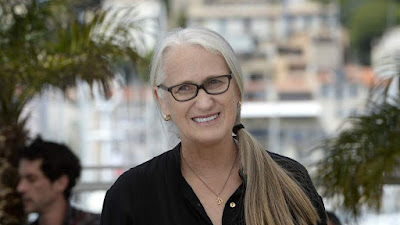
Director Jane Campion


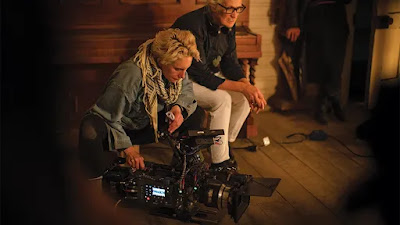
Cinematographer Ari Wegner (left) with Campion

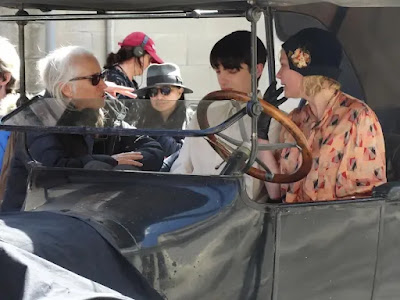
Campion checks with Kodi Smit-McPhee and Kristen Dunst

Campion checks the camera on the set


THE POWER OF THE DOG                        A                                                                        USA  Great Britain  Australia  Canada  New Zealand  (126 mi)  2021  ‘Scope  d: Jane Campion                                                                                                                                                                                                        Deliver my soul from the sword, my darling from the power of the dog.                                         —Psalm 22:20, King James Bible

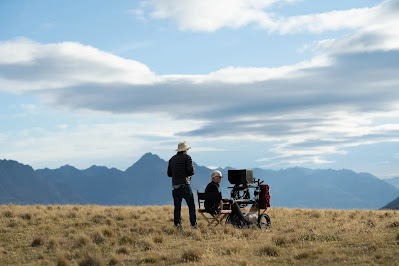
Beware the unseen power of a scorpion bite, as that insidious poison infects the overall storyline of what we see, as there’s an underlying sting of macho dread and horror that underlies every frame of the film, haunting some, if not all, where a noxious male influence spreads untouched, like a Biblical plague that pervades throughout the land, wreaking havoc, destroying lives, literally running roughshod over the women, yet the story is beautifully told with a carefully calculated and complex mastery, producing a surprising outcome, imbued with such an understated discretion that it may leave viewers perplexed.  Her first feature film since Bright Star (2009), and her first male-led picture, Campion immerses her audience into a very specific time and place, the vastly underpopulated Montana in 1925, though sumptuously shot in ‘Scope in the Otago region of the South Island of New Zealand by Ari Wegner, capturing the breathtaking beauty of the surrounding landscape, whose enormity is captured in ways not seen since William Wyler’s THE BIG COUNTRY (1958), speaking a language all its own, literally dwarfing the human presence to solitary figures of near insignificance.  Adapting the Thomas Savage novel of 1967, Savage is an American author who described the conditions of the American West, while Campion’s film celebrates the rampant masculinity of the Western genre, but turns it on its ear, subverting the topic through a feminist lens, but couldn’t be more subtle, expressing a rare mastery of the Western landscape that exerts its own mysterious power, as the sheer look of the film is simply extraordinary, yet more than any other Campion film feels indebted to The Piano (1993), exposing the human flaws of the people attempting to tame the land, revealing a carefully calibrated characterization that typifies stories of the Old West.  We are introduced to two brothers who couldn’t be less alike, wealthy ranchers Phil Burbank (Benedict Cumberland in the role of a lifetime), a lone wolf, malicious and homophobic, college educated at Yale yet used to working with his hands, displaying all the standard markers of Western manhood, grace in the saddle, wit in the saloon, and an apparently unlimited tolerance for pain and discomfort, and his more generous brother George (Jesse Plemons) who manages the business, remaining steady and decent, honest and simple, but wears a suit in the saddle, constantly referred to as “Fatso,” with Phil bullying his brother, apparently, simply because he can, where an openly displayed derision is built into the dynamics of their relationship, despite sleeping in the same bed for nearly forty years.  Together they manage the day‑to-day running of their huge cattle farm, evoking some of the more spectacular scenery in the vast and open range as they herd their cattle back into familiar pens when the weather turns cold.  When George marries Rose (Kristen Dunst, his real-life partner), a kind, yet sad and overly anxious widow with an effeminate teenage son Peter, Kodi Smit-McPhee, grown up from the 10-year old kid following Viggo Mortensen around in John Hillcoat’s version of Cormac McCarthy’s apocalyptic The Road (2009), also Slow West (2015), Phil is appalled and explodes with a virulent anger, tormenting Rose and her “sissy” son with cruel mockery, emotional cruelty, and threats of violence, pitting a cold, Machiavelli-like superiority complex against what he perceives as weakly and undeserving intruders, turning Rose into a closet alcoholic as her own protection from a man she views as a beast.  A vicious, yet spectacularly filmed movie, this overblown toxic masculinity that Phil represents influences every scene of the film, literally carrying the picture with its own infectious energy, providing the nuance and rhythm of the film, yet subverted by a feminist touch, extremely rare to see, especially done as well as this.  Premiering at the Venice Film Festival, it won a Silver Lion for Best Director, and may be the most important film Campion has ever made.    

A rich and challenging psychodrama broken into chapter headings, offering brilliant character development, the film is a picture of restraint, yet thrives in its own brooding intensity, where Cumberland mirrors the misanthropic amorality of Daniel Day-Lewis’s Daniel Plainview, offering an early capitalist counterpoint to the enthrall of Paul Thomas Anderson’s There Will Be Blood (2007) set in the same time period, similarly scored by Jonny Greenwood with an unsettling musical soundtrack that captures the essence of the underlying tension with simple guitar strums, expanded to a more abstract musical accompaniment that accentuates the emotional strains below the surface, turning this into a quietly sustained horror movie, filled with an underlying dread.  Yet the film’s first lines (differing from the book, omitting the first third of the novel) come from Peter in an unseen voiceover during the opening title sequence, pondering “When my father passed, I wanted nothing more than my mother’s happiness.  For what kind of man would I be if I did not help my mother?  If I did not save her?”  This quotation stands alone, never referred to again, and is seemingly forgotten over time, in stark contrast to the daily scenes of cattle ranchers leading a hardscrabble life out under the hot sun, roping, fencing, branding, pitching hay, and castrating cattle, which Phil proudly performs without wearing gloves, the only one who scorns that practice.  So their calloused hands are used to getting blisters, cuts, and splinters, making this the brother’s twenty-fifth year together driving cattle from the southwest Montana plains.  Yet Campion adds an alternative female gaze perspective, showing the men stark naked while bathing in the creek, then lounging on the rocks afterwards, sunning themselves in nothing but their birthday suits, with their hats carefully placed over their privates.  It’s the kind of scene never shown in earlier Westerns, which would instead accentuate the male bonding experience, where spending time out in the open range allows men time to think and ponder their existential situations.  Yet there’s very little of that here, as the men are indistinctive, becoming a Greek chorus of conformity, led by Phil as their leader, following his every move.  Phil takes great care to acknowledge his predecessor, Bronco Henry, recalling the glory days of his dead mentor, the original leader of the pack, where a shrine in his honor rests out in the barn, along with his saddle that Phil fastidiously keeps polished and clean, unlike his own body that he rarely ever bathes, perhaps once a month in the creek, never bathing at all in winter.  Rose runs a boarding house in nearby Beech, a small town where her husband used to practice medicine, serving patients who often couldn’t pay, yet his late descent into alcoholism and depression is a disturbing revelation, where his early demise has left Rose to raise her son alone, where Peter is seen displaying extraordinary patience and a skilled artistry in creating paper flowers from cut paper that are extremely lifelike, with Rose proudly placing them on the tables for her customers.  Yet when Phil brings his ranch hands into town, Peter quickly becomes the object of Phil’s derision, mocking his voice, his hand towel, and for painstakingly crafting the delicate flowers, using one to light his everpresent cigarette, dumping it in a used glass, while his men join in offering more scorn, with Rose scurrying to collect the table arrangements before more are destroyed.  Peter storms out the back, trying to ignore what happened, leaving Rose weeping in the kitchen, comforted by George, who remains in the background for the most part, yet is forced to apologize for his brother’s open cruelty.     

There’s an unsettling nature to the depiction of male masculinity as being intentionally cruel and hurtful, which only escalates when George decides to marry Rose, viewing her with an affectionate tenderness Phil would never understand, railing against her with all his will, refusing to welcome her to the family, calling her “a cheap schemer,” certain that she’s after their money, becoming a menacing force, particularly when they all move into a huge, cavernous ranch house with two servants, Geneviève Lemon from Sweetie (1989) and Thomasin McKenzie from 2018 Top Ten List #5 Leave No Trace, turning into a chamber drama, much of it shot through doors or windows, reminiscent of John Ford’s THE SEARCHERS (1956), where the floor creaks and every door and window can fly open any second, feeling a bit haunted to Rose, particularly when her bedroom is located right next to Phil, who can hear every sound, seething with anger in what has been his own personal domain, master of his own house, now infested by a women he perceives to be an interloper and gold-digger.  When Peter comes home from medical school and joins them, Phil immediately identifies him as “Little Lord Fauntleroy,” mocking his slight lisp, with the Greek chorus joining in with the catcalls, calling him “Nancy Boy,” instantly thought of as soft, a young man smothered by his mother’s affections, labeled a gay blade.  Decorated to the hilt with slim jeans, a white shirt and an oversized white cowboy hat, the kid fits the part, yet he has a secret life unknown to the others, as he’s studying to be a doctor, catching rabbits only to dissect them for practice, something Rose forbids in the house, as it can be viewed as a gruesome hobby.  George proudly delivers a baby grand piano for Rose, who once played in the pits for Silent movies, continually prodded into playing by her husband, as if turning her into a spectacle that she has little interest in becoming.  Nonetheless, she awkwardly practices the Radetzky March, Johann Strauss Sr.: Radetzky March piano - YouTube (2:55), continually playing the wrong notes, a metaphor for her excruciating struggles, yet what’s worse, Phil is sitting in his room playing the same tune on the banjo, only playing it better, always having the upper hand, whistling the tune when he sees her, where his psychological campaign of terror leaves her exhausted and emotionally depleted, continually feeling diminished and weak, driving her to drink, shrinking back to being a little girl, living in a delusionary world of her own, losing all grasp of reality.  Yet Rose is the key component, as neither George nor Peter appreciate the way Phil treats her, literally manhandling her, keeping her under his thumb, scoffing at her acute weakness and lingering depression.  Still, no one stands up to him, as he remains top dog of the manor, and what he says goes.  The brother’s split their profits 50/50, as they always have, yet it’s clear who actually runs things, though Rose has mysteriously come between them, becoming a thorn in his hide.  Taking a different tact, Phil decides to befriend her son Peter, help turn him into a man by teaching him how to ride, going on extended trips together up into the mountains, offering extensive hands-on experience that he would otherwise never receive, becoming the mentor Bronco Henry was to Phil.  While Rose is in alcoholic distress, Campion curiously weaves Brokeback Mountain (2005) homoerotic overtones into Phil’s own repressed sexuality, seen alone bathing himself in his own private spot by the creek, sensually caressing himself with an old handkerchief that once belonged to Bronco Henry, with Peter finding his hidden stash of magazines that showcase the naked male physique, offering a window into his suffering soul of always having to fend off any pain, never allowing anything to affect him, always living up to a mythical façade of Bronco Henry, who was impervious to pain or weakness.  So it comes as a bit of a surprise that a mysteriously reconciled Phil and Peter have their own tender moments together, particularly a quietly extended scene in the barn that coolly observes cracks in the armor, sharing a cigarette, hearing anecdotes about Bronco Henry, solidifying their relationship, with Phil, against all odds, hoping to turn him into a man.  The calculated twist at the end comes as a huge surprise, with Campion cleverly inverting nearly everything that has come before, where tragedy takes on a dramatically different face, using the same subtlety and restraint that has pervaded throughout the entire film, telling a significantly different story than the one we imagined.    

Saturday, December 17, 2016

Arrival


ARRIVAL           B               
USA  (116 mi)  2016  ‘Scope  d:  Denis Villeneuve       Official site

Language is the first weapon drawn in a conflict.
—Louise Banks (Amy Adams)

An old-fashioned love story dressed up in a Spielbergian sci-fi package, like the return of CLOSE ENCOUNTERS OF THE THIRD KIND (1977), where the director has formulated an intriguing opening and closing, which stand out for their novel originality, yet the middle seems to drag under the weight of standard military operations that seem to always suggest anything that can go wrong will go wrong.   Only in the movies do people actually live in these picture-perfect locations, like a gorgeous, heavily windowed home on the side of a commercially undeveloped lake, where there’s no neighbors to speak of and a stunning landscape for as far as the eye can see.  It’s an idyllic place of retreat that becomes synonymous with home, the place you raise your children and return to night after night when returning from work.  In this setting, to the elegiac music of Max Richter - On the Nature of Daylight - YouTube (6:14) that opens and closes the film, also used in a dream sequence in Scorsese’s SHUTTER ISLAND (2010), a narrator announces in somber tones that “I used to think this was the beginning of your story,” with this being the place where a certain child was born, as Dr. Louise Banks (Amy Adams)  announces “We are so bound by time…by its order…These are the days that define the story of your life,” as we witness a fast-moving flashback montage of her young daughter Hannah’s life quickly developing through childhood with her single mom until she dies mysteriously of a rare illness.  “Now I’m not sure I believe in beginnings and endings.”  What follows is an indication that there’s a different beginning, something significant that comprises the majority of the film, though we are caught off-guard, wondering if this all happened in the past, or in the future, or if time has somehow been altered in some way.  Recollections of her daughter occur throughout as the film takes an eerie shift to aliens landing in twelve different spots on the globe, where linguist expert Dr. Banks is whisked to the scene by military escort along with physicist Dr. Ian Connelly (Jeremy Renner) to help communicate with these extraterrestrials.  Based on Ted Chiang’s acclaimed 1998 short story entitled Story of Your Life, winner of the Nebula Award for Best Novella in 1999, the film has been adapted by screenwriter Eric Heisserer, where Canadian director Denis Villeneuve, fresh from his Hollywood action thriller Sicario (2015) that takes us into the heart of the Mexican drug cartels, Enemy (2013) , a curiously compelling indie film where a supposed body double turns into an allegorical nightmare of a coming apocalypse, Prisoners (2013), an intriguingly cast Hollywood vigilante movie that veers into torture porn, and 2011 Top Ten Films of the Year #7 Incendies, arguably the best of the bunch, a search through a war-torn Middle East for the missing truth about one’s mother, all of which in some way are an exploration of grief.   

From a sparsely populated university class by Dr. Banks on the Portuguese language where what few students showed up are completely glued to their cellphones following news updates on the alien landings, panic breaks out across the globe, as students walk out on class, the stock market plunges, fights break out in public, riots ensue, end of the world cults declare a coming apocalypse, while TV demagogues call for radical actions, and everyone immediately calls their moms, as this event has a way of altering the world order, with various nations developing their own way of responding to this unknown presence.  While the book never ventures into a military response, that’s simply not the Hollywood way, who after all, sent the military after King Kong (1933), laying its imprint all over this picture that might have been so much better without it.  Curiously, the film never shows that actual aliens landing, but instead follows the fierce public outcry, showing images of giant-sized, vertically hanging blimps, showing no signs of releasing toxic gas, while at the same time there is no follow up response from the extraterrestrial creatures, who never leave their ships and are content to sit there passively.  By the time Dr. Banks arrives to a rural Montana farmland, a military protocol has been established, as they are the only units allowed close to the landing sites, as the public has been prevented from being anywhere near them, which is why television figures so prominently in the ensuing panic.  While there are military officers constantly monitoring the alien ships, Dr. Banks and Dr. Connelly are escorted to the site by Colonel Weber (Forest Whitaker), revealing as little as possible about their mission, but basically wanting to know why are they here? While Connelly immediately goes into a litany of mathematical possibilities that will be unearthed by their successful interplanetary travels, it’s Dr. Banks that insists upon basic communication first before they get ahead of themselves.  Therein lies her specialty, claiming being in the presence of the aliens helps her understand how they communicate.  Dressed in bulky biohazard spacesuits, where they are hosed down afterwards to prevent contamination, they are hoisted into the interior of the alien ship, as they soon learn a lower door opens every 18 hours for visitation.  The anticipation of the initial contact has an extraordinary suspense factor, as no one, including the audience, knows what to expect.  This aspect is deftly handled by the director, elevating the level of expectation to unseen heights, which is arguably the best part of the film.  Once inside, they reach what looks like an elevator shaft that they must ascend, where surprisingly they are able to climb up themselves, as gravity disappears, though they stumble from the newness of it all and the bloated awkwardness of their suits.  Their destination is enclosed with a large window panel containing the only light, behind which the aliens appear, as if rising out of a haze of smoke, strangely resembling the arachnid creatures hovering over the city seen in Enemy (2013) .

While this is the third time the director has used music from Icelandic composer Jóhann Jóhannsson, cinematography by Bradford Young, who also shot Selma (2014) and  A Most Violent Year (2014), there are sounds emanating from the aliens, perhaps resembling oceanic creatures like whales, yet no one has been able to make any sense out of them.  Described as heptapods, for their seven dangling legs, they actually resemble jellyfish, but the question remains for viewers, how would any of us attempt to start a conversation?  Dr. Banks chooses to start with the word “human” written on a notecard, holding it out for them to see.  The movements of the creatures is a bit unexpected, as they have a star-like appendage at the end of one leg that emits a cloud of black ink, like a squid, which mysteriously assembles into a circular image with slight variations around the edges, like pieces of growing ivy, making each image distinct, which is how they convey their language.  Back in the science lab afterwards, she and Dr. Connelly pour over the images they received trying to make some sense out of it, returning again 18 hours later for another visit.  We lose any sense of time, as the visits are compacted, though Dr. Banks continues to collect her images while we continue to get mixed messages about what’s happening around the world, as China and Russia are growing increasingly irritated and militarily belligerent, where they fear the aliens are threatening their authority, wanting to send a message through gunfire.  Dr. Banks disagrees, thinking they have initiated no dangerous acts of any kind, and should be understood accordingly.  But as the military of each nation seems to be in charge, the mere presence of these extraterrestrials is sending the world into a frenzy, while the real question is more about humans, asking how are we going to learn to understand “the other” without being afraid and resorting to violence?  This is perhaps the central theme of the film, all part of the learning curve of discovery, as the military reviews any and all progress being made, holding a heavy hand over what happens next.  Over time, Dr. Banks collects what amounts to a working vocabulary, with each message conveying multiple meanings, where she marvels at their originality, claiming “They can write a complex sentence in two seconds.”  But when the military insists she finally ask why are they here, the answer is surprising, “offer weapon,” which ambiguously may have multiple meanings, as Banks feels weapon may also mean tool, while Col. Weber reminds her, “Remember what happened to the aborigines.  A more advanced race nearly wiped them out,” but the aggressiveness associated with the word “weapon” sends military units around the world into heightened paranoia, disconnecting from worldwide communication systems, basically signing off into radio silence, first one nation, but eventually everyone, where no one wants to share what they’ve learned, overwhelmed by a sense of national self-preservation. 

With rogue military units on the loose, Banks’ missions appears to be spiraling out of control, especially after receiving a much larger image with hundreds more symbols, something they had never seen before that leaves them completely bewildered.  Connelly comes up with the idea that maybe each of the twelve sites is communicating only partial messages, which need to be combined to make sense, requiring mutual cooperation if they are to be understood.  Of course, that’s not the way military operations see things, and they uniquely, instead of scientists, have control of the operations, while around the globe their heavy-handed approach is winning out.  Unfortunately, this military angle diminishes the quality of the film, as it reduces the moral dilemma to black and white, good and evil, with the military representing the one-dimensional superficiality of the latter.  This is never a good sign, and might have worked during the surprisingly benign era of Spielberg, where life always seemed to recall the innocence of the Eisenhower era of the 50’s, but in the present day they are too easy a target, with the film placing a bulls-eye on their back, making them the bad guys, including rudely ordering people around, refusing to listen to any other views, and basically being hard-asses.  In an event this extraordinary, requiring as many variant points of view as possible, one would think we could rise to more sophisticated levels than this, where perhaps NASA and their people might be involved, as after all, they have actual experience in space exploration.  While this element doesn’t ruin the film, but it certainly dampens one’s enthusiasm overall, as this amazing discovery and consequent burst of scientific curiosity has the possibility at least of providing so much more elevated material, where the military aspect simply bogs down the exploration of ideas.  Banks, who has flashbacks of her own daughter throughout, as if having visions, suggests the aliens may be able to communicate with her even after she leaves the vessel, or is perhaps suffering unanticipated side-effects, yet it’s all part of the turmoil of the times, where China is on the verge of attack and the military is ending all communications, evacuating the premises, and pulling back from the alien ship.  At that moment, when our future as a planet is at risk, Banks has a breakthrough, discovering “Time isn’t linear to them!”  With that, she understands that her flashbacks are actually flash-forwards, as she’s seeing the future, something only possible through the use of the alien language.  This reassembled concept of how we view time has a beautifully composed final montage filled with miraculous accomplishments and poetic ruminations, where we’re literally able to see inside the soul of Louise Banks, who becomes strangely heroic and vulnerable in the process, becoming an extremely compelling character, something not often associated with scientists in film, but Amy Adams offers the performance of her career, projecting a highly motivated figure who is bold, warmhearted, and resilient, committed to her responsibilities, exuding a maternal sweetness that contrasts with those around her, becoming a moving sci-fi film that explores the future yet searches just as deeply within the hearts of our own humanity.