Showing posts with label Wes Anderson. Show all posts

Tuesday, July 1, 2025

The Phoenician Scheme


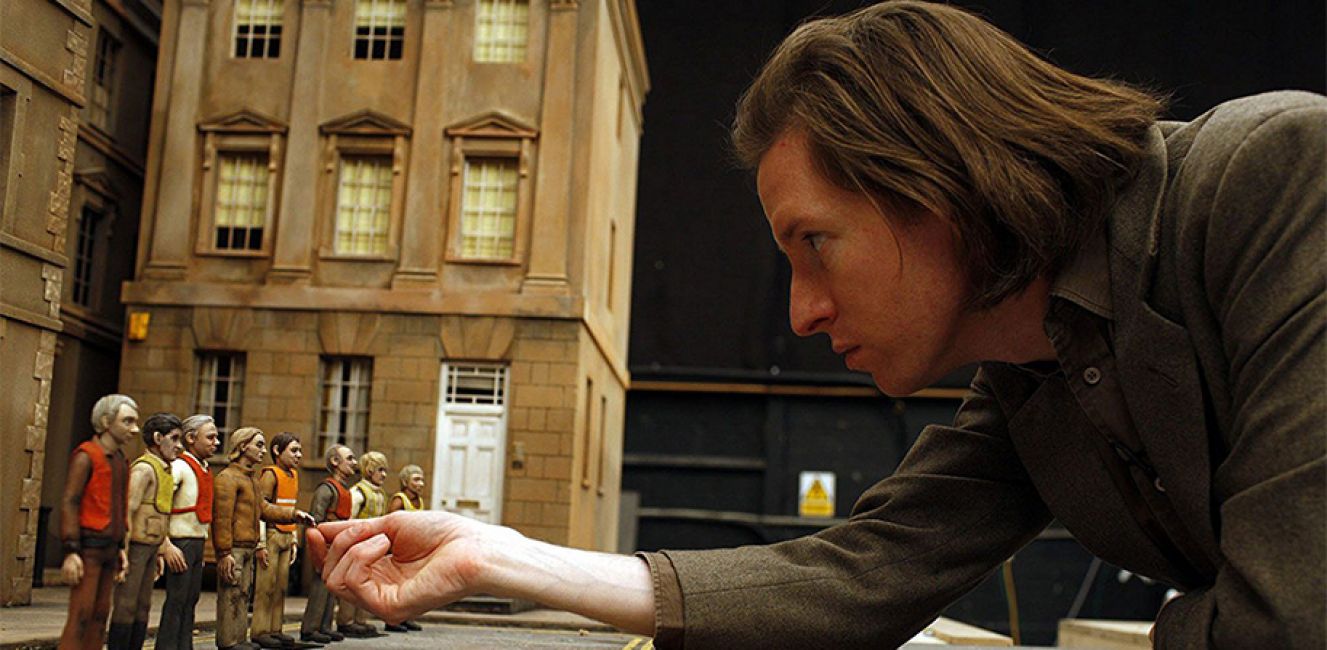
Director Wes Anderson

Anderson on the set

Anderson with Mathieu Amalric,Mia Threapleton, and Benicio Del Toro

Kate Winslet with her daughter Mia Threapleton

Benicio Del Toro with Mia Threapleton and Scarlett Johansson


THE PHOENICIAN SCHEME             B                                                                               USA  Germany  (101 mi)  2025  d: Wes Anderson

Wes Anderson is a descendant of the Marx brothers and Jacques Tati, humorists enthralled with the idea of creating their own cinematic universe, and while Anderson’s quirky dollhouse world may not be for everyone, with production designer Adam Stockhausen on full display, this esoteric espionage caper is among the harder to follow storylines of all his films, but that hardly matters as this just barrels along at a scintillating pace, with an evocative score by Alexandre Desplat, where one thing that is unmistakable is just how bat-shit crazy it is, told with a deadpan, screwball comedy relish, taking us places no one else in the world is willing to go, where this unique mindset and miniature visual aesthetic are certainly his own, as the attention to detail is stunning.  With all the throwaway gags, witty asides, and the historical and cinematic references, it’s nearly impossible to follow it all onscreen (an entire exhibition is dedicated to Anderson’s career at the Cinémathèque Française in Paris, Enter the world of Wes Anderson at the Cinémathèque ..., while an exhibit at London’s Design Museum is planned in the fall, Wes Anderson: The Archives), as it’s gone in the blink of an eye, like the product placement of L.S./M.F.T. during a blood transfusion, a notorious advertisement for cigarettes, Lucky Strike Means Fine Tobacco, Lucky Strike Commercial #1 (1948) YouTube (1:01), a seemingly insignificant detail that only speaks to those old enough and crazy enough to remember that advertisement jingle.  While a darkness has crept into his later films, often reflecting contemporary authoritarian trends, the director is way ahead of his times in that regard, as evidenced by The Grand Budapest Hotel (2014), which allegorized a creeping fascism, or 2018 Top Ten List #7 Isle of Dogs, where a corrupt authoritarian mayor has banned all dogs to an abandoned island, mirroring the current practice of Trump sending so-called dangerous immigrants to languish in overseas prisons.  Anderson’s framing and composition are, as always, exquisite, producing stills that are literally designed to look good enough to hang in an art gallery, where the end credits are among the more uniquely designed in recent memory, showing images of famous paintings that inspired the look of the film, all set to the music of Stravinsky’s Firebird, Stravinsky: Finale - Suite from The Firebird / Los Angeles ... YouTube (3:00), suggesting they have a profoundly liberating influence, while also including an amusing statement that this may not be used for the purposes of training AI.  Perhaps the biggest surprise is the casting of Kate Winslet’s daughter, Mia Threapleton, as a novitiate nun, who surprisingly holds her own against a cast of stars, most only appearing briefly, yet the A-list of names in the ensemble cast is impressive, suggesting there’s no shortage of people who want to work with Anderson, who is one of the defining visionaries of our generation, whose influence is felt far and wide.  Threapleton watched the animated feature FANTASTIC MR. FOX (2009) when she was about eight or nine-years old, then was blown away by 2012 Top Ten Films of the Year: #3 Moonrise Kingdom, deciding then and there that she wanted to work with Anderson one day, sending him a self-made audition tape for this film, recreating a scene from ISLE OF DOGS (2018), which the director loved, choosing her immediately after reading with leading protagonist Benicio Del Toro, who felt a connection working with her.  While people have different reactions to the idiosyncratic Wes Anderson experience, as all the characters are essentially cartoons, yet this film would just not be the same without her, providing the heart and soul that the other characters lack, inspired by Anderson’s relationship with his own daughter, making this a very personal film for him.  The film is dedicated to Anderson’s late father-in-law, Fuad Malouf, a Lebanese engineer and businessman who had a vast array of ongoing international projects in the works.  

Anderson has a multi-billionaire benefactor/business partner in Steven Rales, whose Indian Paintbrush (company) has almost exclusively produced every Anderson movie since 2007, with just a handful of other movies thrown in.  As for the film itself, it’s a wild and wacky affair, shot on 35mm in the Babelsberg Studio in Germany (the same studio where Fritz Lang shot METROPOLIS in 1927) by Bruno Delbonnel, responsible for the cutesy style of Jean-Pierre Jeunet’s AMÉLIE (2001), Julie Taymor’s psychedelic Beatles fantasia ACROSS THE UNIVERSE (2007), and the magnificent look of Joel Coen’s 2022 Top Ten List #5 The Tragedy of Macbeth (2021), where this is the first live-action film not shot by Anderson’s regular cinematographer Robert Yeoman.  Premiering at the Cannes Film Festival, with a script co-written by Anderson and Roman Coppola, this film delves into the nefarious world of trade and commerce, which includes sabotage, a hidden espionage ring, and multiple assassination attempts, as personified by industrialist and arms dealer Anatole “Zsa-Zsa” Korda (Benicio Del Toro), a ruthless opportunist and the richest man in Europe who also dabbles in the defense and aviation industry, loosely based on Armenian oil magnate Calouste Gulbenkian, who helped Western companies exploit the oil-producing regions of the Middle East while amassing a huge fortune and art collection of more than 6000 works of art, which he kept in a private museum at his Paris house (now housed in a museum in Lisbon), described by an art expert in a 1950 article from Life magazine, Mystery billionaire, "Never in modern history has one man owned so much."  This unscrupulous element of wielding power in order to make as much money as possible is a stark contrast to the art-inspired visual feast that commands the screen, showing a darker side of the American artist, perhaps reflected by that same turn of events in American politics, as it’s difficult to say whether Anderson really wanted to offer thoughts on global capitalism, but the connection to a contemporary reality, and some well-known billionaires, is all too evident.  Set in 1950, we first meet Zsa-Zsa flying in his private plane somewhere over the Balkans when he hears a strange sound, like a loud thump, quickly turning around, only to see a bomb blast completely eviscerate a fuselage side panel, taking his personal secretary with it, but he miraculously survives a crash landing.  This near death experience, apparently his sixth or seventh assassination attempt, plunges him headlong into a vision of the afterlife, shifting to black and white imagery, where he literally sits in judgment of his life from beyond the grave, confronted with his own mortality, where God is played by Bill Murray, a large bearded figure in white robes, surrounded by otherworldly beings.  Because of the shadowy forces repeatedly targeting him with assassination attempts, while also trying to undermine his business ventures, he summons his long-abandoned and pious daughter Liesl (Mia Threapleton), who he hasn’t seen in years, to discuss making her the sole heir to his fortune, having mysteriously disinherited all his many sons, The Phoenician Scheme Movie Clip - Sole Heir (2025) YouTube (42 seconds).  This brief, yet highly effective scene taking place in his palazzo-inspired residence full of fine art establishes the particulars, “Never buy good pictures.  Buy masterpieces,” setting the framework for the rest of the film, becoming a battle of wills, like a morality play, where despite all the absurd encounters and theatrical shenanigans turning into an action-packed, globe-trotting romp, it’s all essentially a cover for a story about a father trying, in his own bizarre way, to connect with the daughter he barely knows, embracing themes like tragedy, redemption, honor, and yes, happiness.

Zsa-Zsa has a habit of carrying around a satchel of hand grenades, which he hands out to business partners like souvenirs during their encounters, where he typically starts out with the familiar refrain, “Help yourself to a hand grenade,” which people are more than happy to accept.  His titular “scheme” is to develop multiple infrastructure projects across “Modern Greater Independent Phoenicia,” a fictional land populated by princes, spies, revolutionaries, and large investors, and a mammoth Korda Land and Sea Phoenician Infrastructure Scheme involving a canal, a massive tunnel, a railroad line, and a hydroelectric dam.  His wheeler-dealer style has created many enemies, known disparagingly as “Mr. Five Per Cent” for his ability to always take a cut, hated the world over as he thinks everyone can be bought, having no friends and an unloving family he has largely ignored, but the business world hates him for exploiting local workers as slave labor, for his rampant lies and deceit, accountable to no laws whatsoever, and for dubiously cutting corners to become ridiculously successful.  Liesl has lived in a convent ever since her mother died when she was young, still stinging from the belief that Zsa-Zsa may have had something to do with her demise, as all his ex-wives died under suspicious circumstances, yet he steadfastly denies any involvement.  While he’s obviously a galvanizing figure, her insistence at discovering who was behind her mother’s murder leads her to accept this vaguely conceived succession agreement, on a trial basis, of course, bringing these seeming opposites together.  Zsa-Zsa’s grand scheme is outlined in a series of labeled shoeboxes, each containing a core component to the project, but rising production costs means he needs to close a gap in the plan’s financing, requiring visits to various key players to cover the artificially inflated costs, as his enemies have skyrocketed building material prices for his construction projects.  Liesl agrees to join Zsa-Zsa on his journey, accompanied by his special assistant, the family’s Norwegian tutor and entomologist, Bjørn (Michael Cera), who utters the unthinkable, “I speak my heart, I’m a Bohemian,” returning to the skies once again, with Zsa-Zsa repeatedly offering the reassuring words, “Myself, I feel very safe.”  Liesl is stunned to discover he’s been spying on her, though Zsa-Zsa is quick to retort, “It’s not called spying when you’re the parent.  It’s called nurturing.”  Where it all leads is to pure chaos and pandemonium, with a flurry of scenes strewn together, each more strangely disconcerting than the next, THE PHOENICIAN SCHEME - "Human Rights" Official Clip YouTube (1:10), THE PHOENICIAN SCHEME - "Oh Dear" Official Clip YouTube (42 seconds), THE PHOENICIAN SCHEME - "You Used to Work for Me ... YouTube (44 seconds), meeting with fez-wearing, French nightclub owner Marseille Bob (Mathieu Amalric), a reference to Jacques Becker’s TOUCHEZ PAS AU GRISBI (1954), interrupted by a group of armed revolutionaries, weirdly getting stuck in quicksand, while also visiting his second Cousin Hilda (Scarlett Johansson), who runs a “Utopian Outpost.”  But the ultimate showdown is with his big-bearded brother, Uncle Nubar (Benedict Cumberbatch, looking like a Russian czar), “He’s not human, he’s biblical,” which is literally a blood feud made to resemble a battle between a Marvel superhero and a villain, set to the bombastic music of Russian composer Modest Mussorgsky, Mussorgsky: Pictures at an Exhibition (Orch. Ravel) : Promenade 1 YouTube (1:44), turning into a day of reckoning.  What follows is not what anyone would expect, with a beautifully charming Buñuelian twist at the end that does not disappoint, feeling strangely humanizing all of a sudden, saturated with dry wit and humor, yet the incessant business jargon used throughout seems intentionally designed to leave viewers emotionally disconnected through an obsessive ironic detachment, as none of it really makes any sense, nonetheless this is a welcome addition to the Wes Anderson universe, filled with pastel appeal and memorable charm, where what really stands out is that the actors truly shine, displaying impeccable comic timing in this elaborately constructed geometrical puzzle box.      

Thursday, October 6, 2022

The French Dispatch


Director Wes Anderson


Anderson shooting Frances McDormand

Anderson shooting Benicio del Toro

Anderson on the set


THE FRENCH DISPATCH                    B                                                                                 USA  Germany  (107 mi)  2021  d: Wes Anderson

In Paris, anytime I walk down a street I don’t know well, it’s like going to the movies.  It’s just entertaining.  There’s also a sort of isolation living abroad, which can be good, or it can be bad.  It can be lonely, certainly.  But you’re also always on a kind of adventure, which can be inspiring.

—Wes Anderson, New Yorker interview, September 5, 2021, How Wes Anderson Turned The New Yorker Into “The French ...

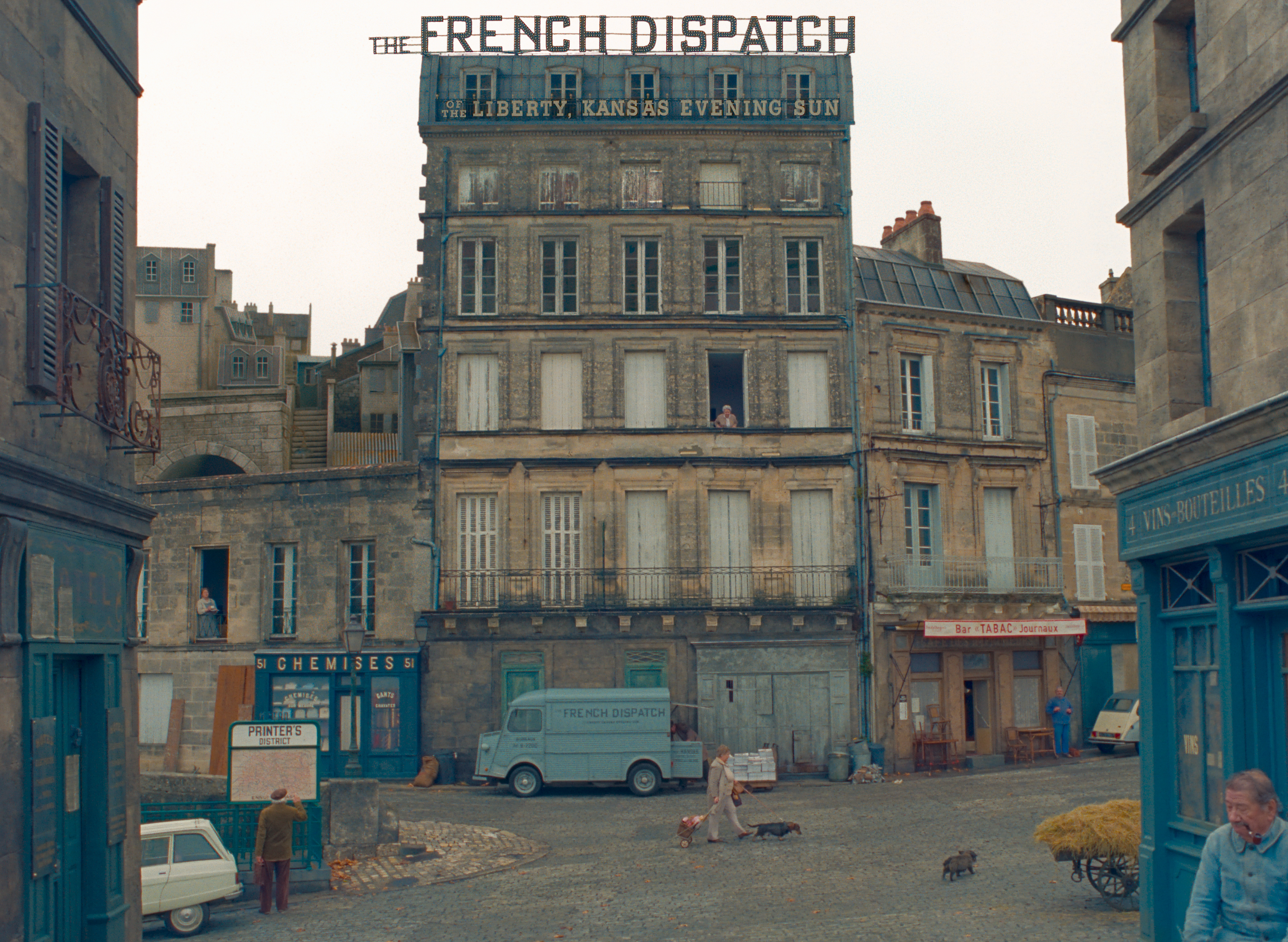
Following in the same hyperbolic mindset as The Grand Budapest Hotel (2014), yet accentuated even further, where this may be viewed as a magnum opus for Anderson, an expat living in Paris, throwing out any pretense of a narrative while heightening the densely layered, exaggerated effect by squeezing so much into each perfectly framed composition, drawing attention to the extraordinary intricacy of each shot, matching that same subversive tone he has always utilized, going for moment-to-moment exhilaration, like a 1930’s screwball comedy, arguably utilizing more words here than is humanly possible, literally racing to get them all said, with many more dancing on the screen to be read, much more than can be comprehended in a single viewing, again using a cavalcade of stars (most onscreen for barely a minute) to provide that deadpan look he is going for.  Paying homage to The New Yorker magazine and the eccentric intelligentsia style of stories they have tended to print, perhaps targeting bookworms, this overtly literary film provides a you-were-there attitude, taking viewers inside the story by individualizing the experience through the perspective of each writer, journalists working abroad for an American audience, combining four separate stories, bringing each to life, while also adding the perspective of the editor, Bill Murray as Arthur Howitzer, editor of The French Dispatch, inspired by Harold Ross, the founding editor of The New Yorker, published in the picturesque yet fictional French town of Ennui-sur-Blasé, which translates to Jaded Boredom or Indifference, a stand-in for the artist’s cynical perspective of the real world, avoiding it at all costs, instead inventing a parallel universe of exacting precision, a flippant parody on the modern world that exhibits an air of scoffing smugness, literally thumbing his nose at the rest of us mere mortals with a kind of snobbish superiority while bathing his artificially constructed characters with tenderness and loving affection.  While the film literally races through each story with an adrenal rush, Anjelica Huston adds her own elaborate commentary through a wry narration, with each of the writers adding their own personalized narrative commentary, yet the problem with this wildly formalized style is there is simply no character development, as the performers aren’t really acting, but feel more like controlled mannequins reading a script without a hint of emotion.  Instead, the dominant attention is focused on the ostentatiously stylized development of each frame, accenting a static, meticulously composed tableaux, often incorporating carefully choreographed background action, merging exterior locations with painted backdrops that can slide off the screen, mixing models and miniatures with live-action photography, changing aspect ratios, skewing sightlines, while mixing black and white with color, and pushing the film to an absurd surrealism, where the precision of each shot requires a dolly, beautifully represented by a distinguished tracking shot through a police station, French Dispatch long shot - Vimeo (1:33).  You’d have to go back to 2012 Top Ten Films of the Year: #3 Moonrise Kingdom to find a Wes Anderson film that actually advances the narrative through an elevated attention to character, where the audience investment into the tender emotional world of the child protagonists actually pays off in the end.  That simply doesn’t happen here, where the characters are purely at the disposal of the exaggerated look of the film, polarizing audiences more sharply than usual, as style matters more than substance.  For many viewers, that’s enough, as Anderson’s artistry is in mastering the staggering detail of each image (and has even produced a website, Accidentally Wes Anderson), but that wasn’t always the case, as his earlier films like Rushmore (1998) relied more upon a clever and hilariously written script.  Yet all artists change and evolve over time, with Anderson clearly more comfortable with creating meticulously designed sets, like a dollhouse in miniature, with characters playing a secondary role and having a significantly reduced influence, yet this film received a 9-minute standing ovation when it premiered at the Cannes Film Festival, winning no awards but was thoroughly appreciated, like entering an enchanted land, sort of like reading a children’s book, where the adventure mostly plays out in the imagination of the reader, listed at #6 on the end of the year Top Ten list from Cahiers du Cinéma, Cahiers du Cinéma: Top Ten Films of 2021 - Year-End Lists.  Beautifully shot by Robert D. Yeoman, who has shot nearly all his films, missing only the animated features FANTASTIC MR. FOX (2009) and 2018 Top Ten List #7 Isle of Dogs, with astonishing production design by Adam Stockhausen, while another surprising development is the Erik Satie-like musical score written by Alexandre Desplat, at times becoming a ticking clock driving a distinct visual rhythm of the film, featuring exquisite piano solos by Jean-Yves Thibaudet.  Interestingly, this is the second film in a row, after Bruno Dumont’s France (2021), dedicated to the recently deceased musical composer Christophe, who died from Covid.   

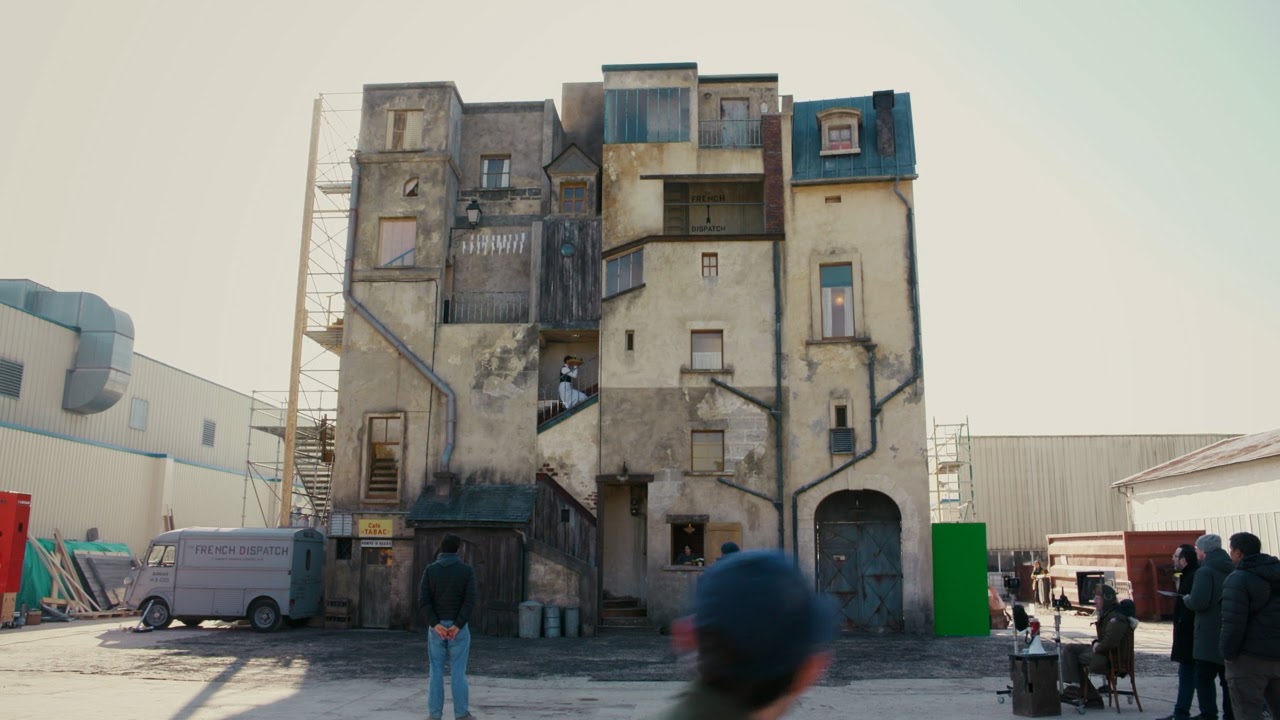
Essentially a series of short stories and vignettes, offering a behind-the-scenes glimpse of how these articles came to fruition, becoming something a journalistic exposé on the art of writing, getting into the minds of the writers themselves, while exalting in the freedom and joy of taking poetic license, yet also accentuating the editing process, where Howitzer encourages his writers to produce diverse stories of human interest, allowing them to be totally themselves in their articles, as his one mantra is “try to make it sound like you wrote it that way on purpose,” mirroring the challenging storytelling abilities of a film director, yet the wacky quirkiness of Wes Anderson exists in its own imaginary realm, separate and apart, suggesting a world of elitism and privilege that thrives in a luminous glow of well-executed construction.  Mostly set in the 60’s, much of the film is actually shot in the city of Angoulême, accentuating cats gathering along the rooftops, balconies overlooking narrow streets, with residents peering out their open windows at the myriad of meticulously choreographed street activity, all captured in vibrant colors that offer such a tantalizing view, incorporating a carefully calibrated rhythm established in the very first shot.  Told in flashback, the film opens with the death of Kansas-born publisher Arthur Howitzer, founder of The French Dispatch, the weekly arts and culture supplement of a large Midwestern newspaper based in the American heartland, The Liberty, Kansas Evening Sun, which he inherited from his father, initially convincing his father to fund his college education and transatlantic adventures that would produce a series of travelogue articles published locally in the Sunday supplement, raising a few eyebrows, eventually opening an offshoot bureau of the newspaper in France, traveling to Europe as a young man and simply never returned.  Howitzer assembled a team of the best expatriate journalists of the time, along with a few eccentrics, one apparently a voracious reader who never writes a single word, with their articles blossoming into the entitled publication, which was known for their rigorous fact checking and copy editing, along with an exacting inspection of grammar usage, yet his passing dictates the end of the publication, following one final farewell issue in which four articles are published along with an obituary.  Identifying the articles, authors, and pages of the magazine as we go along, simulating the experience of reading the magazine, the stories are told in chapter headings, often shifting from color to black and white and then back again, jumping headlong into the quaint charm of the small provincial French town of Ennui, as Herbsaint Sazerac (Owen Wilson, narrating his own segment, inspired by New Yorker writer Joseph Mitchell), otherwise known as the cycling reporter, writes about his favorite subjects, rats, hobos, pimps, and junkies, taking us around the city on his bicycle, offering a seamy working man’s perspective on a subterranean layer of the city most never see, like marauding children attacking unsuspecting victims, an alley of pickpockets, a corner of the red-light district, or dead bodies collected from the river, comparing images of the past with the present, showing how little has changed, with a pervasive air of pickpockets, dead bodies, prisons, cemeteries, and other dreary subject matter.  The grim brevity of the piece simply whets our appetites, like an appetizer or an amuse-bouche, as what follows may be the most delectable item on the menu, featuring a lecture and accompanying slideshow by arts reporter J.K.L. Berensen (Tilda Swinton, inspired by art critic and historian Rosamond Bernier), taking us back to examine how such a majestically avant-garde art creation was formed, a large-scale painting of epic proportion, a series of frames that resemble Rorschach inkblots, subject to one’s imagination, each sharing a common theme, but that only becomes evident with some backstory taking us into the deranged mind of a mental patient who committed a brutal double-murder, Moses Rosenthaler (Benicio Del Toro), convicted of decapitating two men in a barroom brawl and imprisoned for life, yet we observe him at work painting a nude subject, Simone (Léa Seydoux), a rare standard of beauty that may symbolize an idealized vision of France, demonstrating enormous elasticity in posing for long durations, which sets her apart, able to hold difficult positions even in extreme cold, yet when he comes too close, she flicks his paintbrushes away and orders him back to his easel.  Shortly afterwards, she changes into her prison guard uniform and places him in a straightjacket, leading him back to his cell, where he struggles with a tortured artist’s existence of manic depression and suicidal intentions, miraculously saved by needed therapy from the prison arts and crafts program where he happens to meet Simone, exhibiting a kind of gallows humor, Léa Seydoux In (The French Dispatch) "I grew up on a farm." YouTube (1:00).  The bright colors of Berensen in the present are a remarkable contrast to the black and white images inside the prison, as Berensen describes the weird symbiotic relations that can occur between a ruthless convict and a secret admirer, exuding an extraordinary bond that defies belief, yet she serves as his behind-bars mentor and model throughout his artistic career. 

In something of a demented turn of events, Rosenthaler’s art is discovered while in prison by unscrupulous art patron and tax dodger Julien Cadazio (Adrien Brody), inspired by S. N. Behrman’s 1951 six-part profile on Lord Duveen entitled The Days of Duveen, The Days of Duveen | The New Yorker, immediately contacting his uncles (Henry Winkler and Bob Balaban) after his release, heavily promoting his work in their art gallery where his paintings skyrocket in value, but they encounter difficulties in attempting to obtain more artworks to sell, with Rosenthal stubbornly refusing, yet they believe he’s working in secret on a massive project.  Eventually setting a deadline, they round up all the significant patrons of the art world and head to France, while paying enormous sums of money in bribes in order to allow them all inside the prison grounds to inspect his latest masterwork, yet when they arrive, the artist defers, claiming he needs another year, but Simone quickly acknowledges it’s ready.  What’s unveiled, however, is not what they expect, challenging their prevailing views of art, revealing a magically abstract set of ten fresco works imprinted into the concrete walls of the prison.  Cadazio calls it a masterwork before realizing he can’t haul it out of there, impulsively assaulting Rosenthal, going for his throat, leading to mayhem and a massive prison riot where lives are lost, expressed in a single freeze frame, yet for his exemplary behavior in saving lives, Rosenthal is released on probation, while Simone also departs the prison after receiving a large sum of money, and neither ever see one another again, while the frescos are airlifted out of the prison into a private museum in the middle of a Kansas cornfield where Berensen is conducting her lecture.  Yet the heart of the 60’s is embodied by an ode to the student rebellions of May 1968 in France, reported on by Lucinda Kremetz (Frances McDormand), inspired by New Yorker writer Mavis Gallant, specifically her two-part article, The Events in May: A Paris Notebook~I | The New Yorker and The Events in May: A Paris Notebook—II | The New Yorker.  Expressed with mocking sarcasm, which does a great disservice to what actually happened (Kristin Ross; May '68 and its Afterlives), the revolutionary spirit in the air is initially inspired by narcissistic concerns over access to a girl’s dormitory, The French Dispatch - Timothée Chalamet opening sequence YouTube (57 seconds), yet when police intervene, an overreaction of epic proportion, the students are radicalized, becoming a youth movement who split on their ever-expanding demands, with the opposite sides best expressed by two young student revolutionaries, Zeffirelli (Timothée Chalamet) and Juliette (Lyna Khoudri), a reference to Italian stage and film director Franco Zeffirelli and his breakout international film version of ROMEO AND JULIET (1968), with aging radical Kremetz trying to remain detached, but takes a romanticized interest in the youthful Zeffirelli, actually having an affair while helping him write a manifesto, including an appendix.  With Juliette evidently growing jealous of their closeness, Kremetz urges them to “Stop bickering.  Go make love,” turning into a star-crossed romance that unfortunately ends in tragedy, with the story resurrected years later in the form of a theatrical stage play.  The final story is written by erudite food journalist Roebuck Wright (Jeffrey Wright), an amalgamation of James Baldwin wandering through Paris reflecting on his outsider status, james baldwin - collected essays (pdf), and A. J. Liebling commenting on food, profiling the Police Commissioner (Mathieu Amalric) and his famed chef Nescaffier (Stephen Park).  Soon a gastronomy lesson on police cooking morphs into a kidnapping, with Wright seen interviewed years later by a Talk Show Host (Liv Schreiber, inspired by Dick Cavett), The French Dispatch - Never Ask a Man Why YouTube (2:00) as he recollects, with typographic memory, the Commissioner’s missing son and the harrowing events to recapture him alive, with shoot-outs and showdowns, expressed in near cartoonish fashion, including hand-drawn animation, yet the connecting threads are the meals prepared by Nescaffier, a specialist in French haute cuisine, described in intimate detail.  In this instance a food review turns into a wacky adventure story, filled with unexpected thrills and heightened suspense, including a coda back inside the offices of the Dispatch, where Howitzer hears Wright’s reasons for deleting a private conversation with Nescaffier, conflicted by his own feelings as an outsider, but prefers to include it, contending it’s the essential aspect of the story, interjecting a strangely compelling ruminative quality.  While there’s plenty of wit and obvious affection on display, exhibiting an undisputed poetic artistry expanding the realms of cinema that can be uniquely attributed to this director, nonetheless much of this feels coldly manufactured and self-reverential, a product of his own self-confining aesthetic, lacking an emotional center while missing dramatic impact, leaving viewers impressed by the magnitude of a visual collage in time with a strict choreography of action, but hardly moved by it all.  It’s essentially a nostalgia piece about memory that tries to replicate what these writers embodied, but fails to reach the depths of their passion and unbridled imaginations, creating instead an irreverent kind of mocking tribute that some might find mesmerizing, visually sumptuous, with occasional moments of brilliance, yet can also feel insufferable, an overwhelming experience that may leave viewers exhausted and emotionally drained, having little or nothing to do with the real world.  In an epilogue, the Dispatch staff congregate to mourn Howitzer’s death, putting together a final issue to honor his memory, with a series of New Yorker magazine covers designed by Javi Aznarez seen in the closing credits that capture the look and playful humor of the magazine, with the film paying tribute to a host of New Yorker writers that include Harold Ross, William Shawn, Rosamond Bernier, Mavis Gallant, James Baldwin, A. J. Liebling, S. N. Behrman, Lillian Ross, Janet Flanner, Lucy Sante, James Thurber, Joseph Mitchell, Wolcott Gibbs, St. Clair McKelway, Ved Mehta, Brendan Gill, E. B. White, and Katharine White.   

The Absurd Intricacy of The French Dispatch video essay pointing out the level of formal detail borders on absurdism, by Thomas Flight on YouTube (13:35)