Showing posts with label László Kovács. Show all posts

Thursday, November 25, 2021

Pocket Money


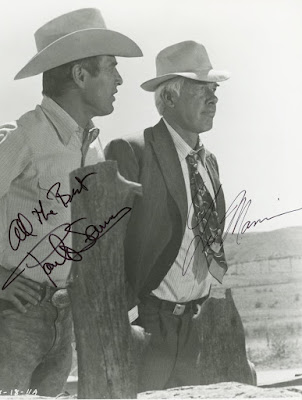
autographed photo of Paul Newman and Lee Marvin


POCKET MONEY           B                                                                                                          USA  (102 mi)  1972  d: Stuart Rosenberg

You just can’t buy back a bad impression.                                                                                   —Jim Kane (Paul Newman)

An existential road movie that time nearly forgot, this unassuming film, with Paul Newman and Lee Marvin, is surprisingly offbeat, perhaps the best directed of Rosenberg’s work with Newman, unusually low key for films of that era.  Terrence Malick, just before he released his first film BADLANDS (1973), helped write this aimless and meandering comedic screenplay!!  László Kovács, from Easy Rider (1969), That Cold Day In the Park (1969), Five Easy Pieces (1970), The Last Movie (1971), New York, New York (1977), and The Last Waltz (1978), did the memorable photography.  One other familiar face in all these movies with Newman is Strother Martin, who shows up like Henry Gibson does in Robert Altman flicks, usually with comical effect.  Rosenberg is just not a skilled director, and one must lay the blame at his feet for why such well-written films that he worked on didn’t turn out better.  Very much a reflection of the times, a slow moving western with almost no story and surprisingly little action, chiseled down to a barebones character study, where Newman and Marvin make the most of it, bringing their legendary screen history to the film, where it feels like we know these guys, as if we’ve spent time with them before, kind of like relatives we know all too well but that you really don’t want to spend a lot of time with, sort of a loveable loser’s buddy movie, funny, personable, filled with plenty of charm, where that’s really the picture.  Marvin confessed that he did not much appreciate working with Newman, upset about being the sidekick, apparently, with Newman getting the more prominent role, claiming Newman had control over the final edit, trimming down Marvin’s part considerably, yet Newman vehemently disputed this.  Both felt attracted to the originality of the dialogue, while also acknowledging it never translated well to the screen.  Despite the poor reviews, never getting a lot of love at the time of the release, this film breaks the mold, as they don’t make movies like this anymore, particularly with big name stars, instead turned into smaller, more independent features made for next to nothing.  The real problem is the overly conventional wall-to-wall music by Alex North, which is all wrong for this movie, breezy, lighthearted, even peppy, more appropriate for a television series, Paul Newman - Pocket Money (1972) YouTube (44 seconds), where it needed to be quieter, less intrusive, and much sparer, allowing the actors plenty of room to breathe.  In something of a surprise, Carole King sings the opening theme music, Carole King - Pocket Money (1972, Paul Newman, Lee Marvin) YouTube (2:47), adding to an overall mainstream feel.  Based upon the 1970 novel Jim Kane by J.P.S. Brown, who felt this movie “demeaned the Mexicans,” this is a dialogue-driven story following the actual exploits of two brothers, J.P.S. Brown and Gene Adams, two authentic cattle buyers and horse traders in Mexico, transformed into two clowns and misfits trying to make a buck by screwing local Mexicans out of their cattle in shady deals, but end up getting screwed themselves. 

Paul Newman plays Jim Kane, a small-time, naïve, overly passive and dimwitted cowboy, who never lives up to the billing of actually being a cowboy, basically a horse trader who is down on his luck, but he’s stymied when several of his newly purchased Appaloosa horses from Mexico are contaminated with the dourine, described as the clap, quickly put out of their misery while the rest are sent to quarantine for six weeks upon reaching the border, making it impossible to collect his payday.  Unable to make his alimony payments and in need of some quick cash, he accepts an offer from a shady rancher, as unscrupulous as they come, Bill Garrett (Strother Martin) and his henchman Stretch Russell (Wayne Rogers), to bring 250 rodeo cattle from Mexico to the Texas border.  Once south of the border, he meets up with his partner Leonard (Lee Marvin), a seemingly shrewd businessman always dressed in a business suit, ready for the crassness of cutthroat business deals, usually ending in a standoff, where each side holds out until the other caves.  But Jim has no patience for this kind of thing, preferring to get in and out without wasting his time, so he overpays the premium prices, much to the chagrin of Leonard, muttering something under his breath about establishing a good reputation, but he’s getting out-finagled by cunning Mexican farmers who have done this sort of thing for centuries.  Jim is the outsider, the new guy on the block, where the back and forth between Newman and Marvin is what makes the picture, a tag team of ineptitude, principled but outfoxed, usually caving in to the initial asking price, which drives Marvin nuts, as these are his stomping grounds, so it’s his reputation on the line that’s taking a hit, constantly reminding Jim how to play the game, but he’s just not interested.  This rapport between them is the entire picture, as everything else is simply window dressing.  Marvin shows signs of his drunken escapades in CAT BALLOU (1965), resorting to gestures, talking to himself, smart aleck comebacks, and all manner of physical comedy, including driving like a maniac through the Mexican desert, while Newman pretty much plays himself, a noble hero, the picture of decency, a bit befuddled, a nice guy on the straight and narrow yet out of his element, but he hates being cheated out of money, feeling morally obliged to stand up for himself, unafraid to make a spectacle of the situation, but more likely than not, he’s still going to end up getting screwed.  Mostly shot in Ajo, Arizona and Chihuahua, Mexico, the rambling, scatterbrained aspect of the adventure lends itself to the freewheeling visual style of László Kovács, capturing the open spaces of the endless landscape, becoming a silent witness to the shenanigans pulled by this oddball team, where their individualistic yet reckless ways lead them absolutely nowhere.   

Newman Is a particularly generous actor, deferring to others onscreen and allowing them to shine, where his work with Robert Redford is what made Redford a star, and this picture with Lee Marvin is no different, as it’s Marvin’s tics and eccentricities that stand out, pocket money scene YouTube (1:36), on the edge of sheer lunacy and drunkenness, always feeling a bit deranged, where he’s the comical sidekick, endlessly getting the punch line joke to Newman’s straight man, yet their back and forth banter comes to resemble the modern day futility and absurdism of Beckett’s Waiting For Godot.  Marvin has got a bag full of hair-brained schemes, something of an idyll dreamer himself, where they get rip-roaring drunk in seedy cantinas and fleabag motels, mostly getting beaten down by life and the toll it takes on them, endlessly humiliated and defeated, as if this is the American way, particularly in foreign lands.  This is not among the better pictures for either of them, yet it’s distinctively different anyway, rare that they’re even working together, but their hamming screen personas are fun to watch, adding a few side characters to ramp up the horseplay, like Gregory Sierra and Héctor Elizondo in Mexico, or Kelly Jean Peters as Kane’s ex-wife, working in a miniskirt at one of those iconic American diner drive-ins, just part of the lovingly detailed Texas setting.  While there are odorous stereotypes, and no female characters to speak of, getting short shrift from these writers, it’s still an oddball western comedy with plenty of uniquely developed character, and even an occasional ruminative tone, yet there’s surprisingly little complexity or depth to speak of, and no innovation whatsoever, typical of this director, making this fairly lightweight material, perhaps trying to replicate the outcast individualism of the extremely popular COOL HAND LUKE (1967), the first Newman picture made with this director, or the subversive undertones of the next, WUSA (1970), where this third pairing has an aimless quality about it, like a moral void, perhaps reflective of Nixon’s re-election, already stained by Watergate, and the American misadventure in Vietnam.  Their final work together was THE DROWNING POOL (1975), an offshoot of Jack Smight’s HARPER (1966), with Paul Newman playing a gum-chewing private detective from the squalid LA underbelly transported to the bayou of Louisiana, not nearly as atmospheric or as dramatically effective as the original, which remains a classic in film noir, largely in tribute to Humphrey Bogart, turning a man of action into a cerebral thinker, something of a template for Altman’s The Long Goodbye (1973) and Polanski’s CHINATOWN (1974).  After they wind up getting cheated and hoodwinked, once again, they’re at a lone Mexican railway station with no one else seen for miles, trying to make it back into the states with a heartwarming finale, Newman turns to Marvin and says, “Leonard, you come down here and what do you got?”  Marvin instantly replies with a smile, “You’ve got me, Jim.”  Makes you want to revisit the beginning of a beautiful friendship at the end of CASABLANCA (1942). 

Thursday, October 1, 2020

Targets


TARGETS                    C+                                                                                                          USA  (90 mi)  1968  d:  Peter Bogdanovich                         

Targets are people…and you could be one of them!                                                             —Tagline for the film

Peter Bogdanovich, like the young French New Wavers from Cahiers du Cinéma before him, was first a film critic and historian, taking an interest in recorded interviews with earlier directors in the twilight of their careers, exactly how he was portrayed in the unfinished final film by Orson Welles, The Other Side of the Wind (2018), where he was affectionately known as “the human tape recorder.”  Writing articles for Esquire in the early 60’s while curating film programs at MOMA that showcased early American film pioneers, he moved to Los Angeles in the mid 60’s and began a collaboration with renegade director/producer Roger Corman, as did many other young American directors at the time, such as Francis Ford Coppola, Martin Scorsese, Monte Hellman, Jonathan Demme and John Sayles, finding himself working on the biker flick THE WILD ANGELS (1966) with Peter Fonda, a surprise hit, grossing over $15 million dollars in 1966, which was 15th overall at the box office that year, where he’s an uncredited writer, cinematographer, and editor, while also working as an extra and assistant director.  In his essay on this film, Targets | New Beverly Cinema, Quentin Tarantino best describes Corman’s unorthodox working methods, cannibalizing existing footage from one film and putting it in another, surrounding it with newly shot material, essentially churning out an assembly line low-budget style of moviemaking that was in stark contrast to the high-powered studio system that existed at the time.  So if Bogdanovich wanted to make his own film, he’d have to meet several seemingly odd Corman requirements, incorporating twenty minutes of footage from Corman’s Gothic horror snooze THE TERROR (1963) starring Boris Karloff (and a young Jack Nicholson), shooting an additional two days (twenty minutes of new footage) with Karloff (time still owed on his contract), while he was free to invent the rest.  Surprisingly, Bogdanovich jumped at the offer, shot by László Kovács, receiving uncredited (free) advice from none other than Sam Fuller behind the scenes, releasing the film between Arthur Penn’s Bonnie and Clyde (1967) and Sam Peckinpah’s The Wild Bunch (1969).  Working with his wife at the time, Polly Platt, they constructed a modern day horror film, one that marked the passing of the torch from one generation to the next while accentuating the calamitous horrors leaping out of modern era newspaper headlines, in this case, the story of ex-Marine Charles Whitman, who became known as the Texas Tower Sniper, climbing to the top of the observation deck from the Main Building tower at the University of Texas at Austin carrying a bag filled with weapons, where for the next 90-minutes he proceeded to take sniper pot shots at anyone wandering by, slaughtering 16 people, wounding 32 others, and traumatizing many more in what at the time was considered the deadliest mass shooting by a lone gunman in U.S. history, now surpassed by the 2017 Las Vegas shooting, almost all using semi-automatic weapons, with the U.S. having the highest per-capita gun ownership in the world with 120.5 firearms per 100 people, the only nation in the world with more guns than people. 

Made for $130,000, shot in 23 days, the film is an orgy of gunfire, critically praised at the time of its release for its social commentary on the prevalence of guns (though hardly the masterpiece claimed by some), but the public had little appetite for it.  Although completed in late 1967, it was released the following year after the assassinations of Civil Rights icon Martin Luther King Jr. in April and aspiring Presidential candidate Robert F. Kennedy in June, not to mention an endless war raging in Viet Nam, coming on the heels of earlier assassinations of President Kennedy’s in 1963 and Muslim activist Malcolm X in 1965, creating a political vacuum and a void in the heart of a surging 60’s leftist cultural ideology, leading to a right-wing law and order purge afterwards with the election of Richard Nixon as President in the fall of 1968.  Opening with a movie-within-a-movie, playing the finale of THE TERROR, the dual storyline has aging 80-year old actor Boris Karloff as horror legend Byron Orlok disgusted with the irrelevance of the film, viewing himself as an extinct dinosaur (appearing in 140 films, including 40 silents, starting as an extra in 1916), with horror films not scaring anyone anymore, retiring right there on the spot after viewing a preview with the studio heads, walking out as a supposedly free man, cancelling all his scheduled appearances, no longer beholden to the studios.  A secondary story follows Bobby Thompson (Tim O’Keefe, bearing a surprising resemblance to Matt Damon), viewed as your typical All-American boy next door, clean cut, polite, and unassuming, still addressing his father as “sir,” yet both have an obsessional devotion to guns, seen practicing together at the firing range, while Bobby has a trunkful of guns in his car.  With such a stockpile, it seems strange that he revisits gun stores regularly for still more rifles and ammunition.  Viewers learn he served in Viet Nam, and despite his passive nature around the house, he seems disturbed about something (“Sometimes I get funny ideas”) and tries unsuccessfully to talk to his wife before she’s off to work on the night shift, spending the rest of the night brooding alone.  By morning, he’s flipped out, losing his grip, crossing over to the dark side.  Bogdanovich plays a scriptwriter, Sammy Michaels (using Sam Fuller’s middle name) who offers a script to Karloff, disappointed that he decides to retire just at the moment he’s written something promising for him, which turns out to be the film we’re watching.  He’s got a fling going on with Karloff’s attractive young personal assistant Jenny (Nancy Hsueh, excellent, very surprising she didn’t have a more prominent career), who may be following Karloff back to England, though Orlok graciously releases her, not wanting to interfere with their budding romance.  Orlok changes his mind, however, and agrees to make one final scheduled appearance at the Reseda Drive-In Theater screening of his film, offering fans one final chance to see him.  Meanwhile, Bobby goes on a shooting rampage, shooting his wife and parents at home in the morning before heading out to a nearby oil refinery and climbing to the top of the tanks, in something of an homage to James Cagney in White Heat (1949), shooting randomly at passing cars on the freeway, with viewers seeing through the high-powered scope of the rifle, intentionally resembling the Zapruder tape of President Kennedy's assassination.  Never receiving permits to make a film along a busy LA freeway, this example of guerilla filmmaking best reflects Roger Corman’s economical style of filmmaking, getting in and out before drawing attention of the police.

Instead of a musical score, scattered throughout the film are lengthy stretches of loud radio noise playing during Bobby’s many car rides and banal, mind-bogglingly dull family conversations at home, drowned out by an always turned on television, adding a mindless tone to each sequence, lending an air of shallow superficiality to his psychological mindset, as endless layers of brainless mush are drummed into his head, suggesting the dumbing down of America.  While this doesn’t play a part for his gun obsession, it does weigh into his thoughtlessness and lack of remorse, as he simply doesn’t question what he’s doing, as if led by voices in his head, unable to distinguish between fantasy and reality.  With endless violence capturing the television replays and newspaper headlines, author Tom Wolfe coined the phrase “porno-violence,” suggesting viewers were becoming addicted to even more violence, adopting the point of view of the shooters instead of the victims, dulling one’s senses for empathy.  This film exploits that mentality, allowing the shooter to dominate the film, all done so casually, as if he’s at a sporting event picking off targets, overshadowing any link to an otherwise genuinely affecting performance by Karloff.  After evading police during his first shooting rampage, Bobby plans yet another, this time arriving early at the Reseda Drive-In Theater, eventually wandering to a sniper’s position behind the screen and shooting indiscriminately at cars, apparently attracted to lights, offering him an easy target, turning the evening’s events into utter chaos and bloody mayhem, with Karloff’s film playing on the screen, a symbol of Victorian horror that has been outdated by a prevalence of graphic war and violence imagery, becoming a link to our historical fascination with violence.  Even after the first few shots, the drive-in continues uninterrupted, with business as usual (there is a lovely tribute to another dying breed, the projectionist), as viewers have no idea what’s happening unless a body happens to fall nearby.  Downplaying the victims, always viewed in a detached manner, never accentuating the graphic horror, instead viewers see a collecting body count laying on the ground.  The focus, however, remains the shooter, which is a disturbing aspect of the film, as he’s a blank slate, learning next to nothing about him, seemingly without any real motive, where he could be anybody.  Even 50 years later, this is a difficult film to endure, watching him repeatedly load and reload, accompanied by an incessant sound of gunfire, a reminder of all the senseless shootings, over one-and-a-half million American gun related deaths since the release of the film, more than all those lost in wars since the Revolutionary War, with our nation failing to learn how to prevent these devastatingly traumatic events from happening, where there were more mass shootings than days in 2019, rarely even mentioned on news reports anymore unless they reach epic death count proportions.  What this suggests is that as a nation, we have built up a tolerance for these heinous sorts of activities, where the regular loss of lives is deemed acceptable, not out of the ordinary, requiring no lawful cure or remedy.  This era of filmmaking in the late 60’s and early 70’s opened the floodgates not just to excessive violence permitted onscreen, but an overtly stylized realism, exacerbated by these young American directors who were equally enthralled and fascinated by what they could get away with, which is starkly different than the previous generation.  Later surpassed by Alan J. Pakula’s The Parallax View (1974) and a host of other films, this film was largely forgotten, drowned out by the mainstream commercial success of The Last Picture Show (1971), placing the director among the Hollywood elite.