Showing posts with label James Gray. Show all posts

Monday, March 20, 2023

Armageddon Time


Director James Gray


Gray with cinematographer Darius Khondji


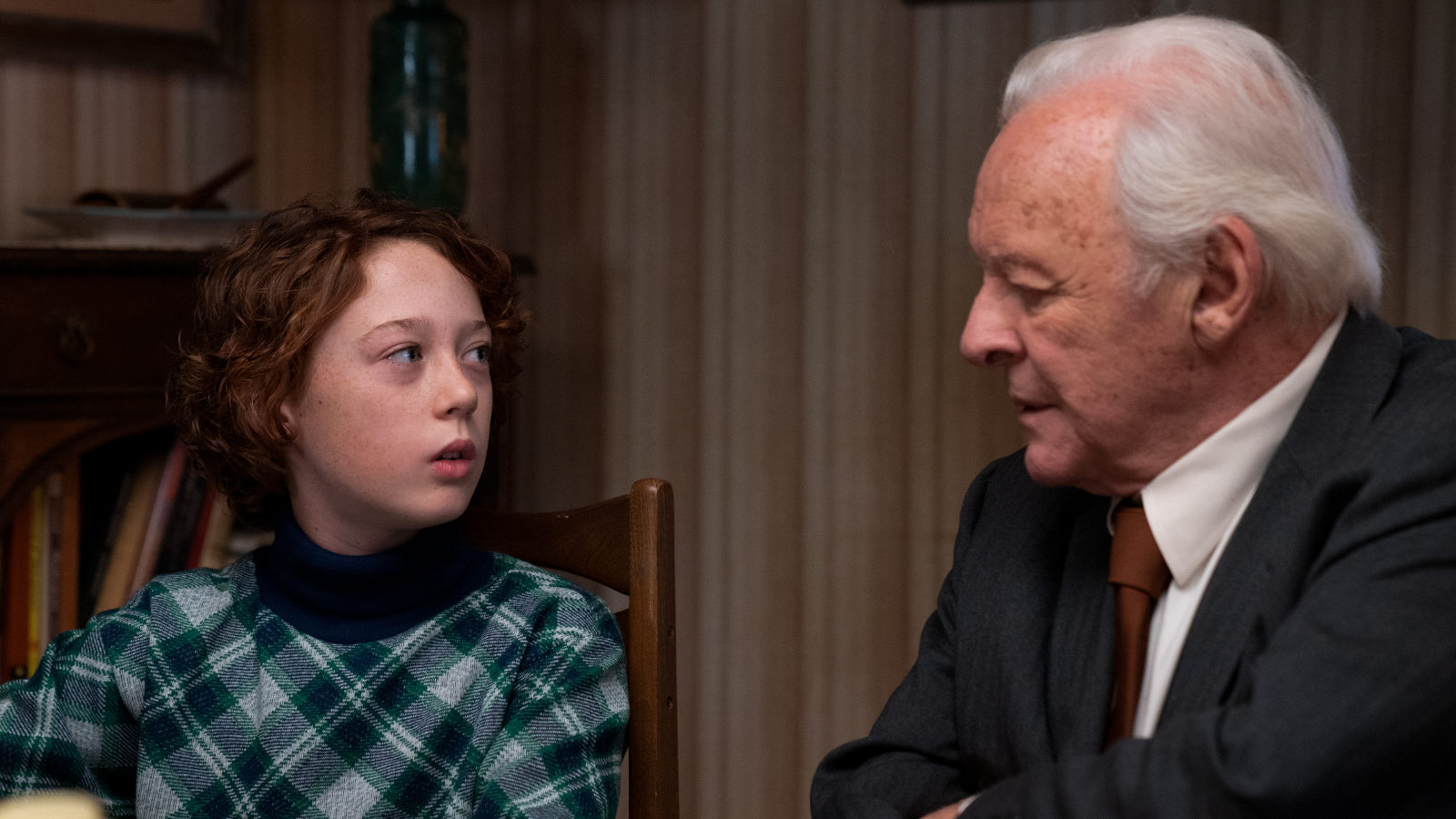
ARMAGEDDON TIME        B                                                                                                     USA  Brazil  (114 mi)  2022  ‘Scope  d: James Gray

The thing that most white people imagine that they can salvage from the storm of life is really, in sum, their innocence.  It was this commodity precisely which I had to get rid of at once, literally, on pain of death.  I am afraid that most of the white people I have ever known impressed me as being in the grip of a weird nostalgia, dreaming of a vanished state of security and order.      —James Baldwin, The Black Boy Looks at the White Boy, from Esquire magazine, May 1, 1961, The Black Boy Looks at the White Boy - ALLISON BOLAH

James Gray is one of those filmmakers who is better received in Europe than he is in America, as his early films like LITTLE ODESSA (1994), The Yards (1999), and WE OWN THE NIGHT (2007) express a shocking violence where death is a prominent theme, known for also creating memorable nightclub sequences, yet despite rave reviews at Cannes, these deeply personal films were often overlooked and received sharply divided reviews.  But for all their dramatic expansiveness, these early crime pictures were of a kind not seen since the New Hollywood classics of the 1970’s, where Gray is a cinephile clearly impacted by the films of that era, citing Bernardo Bertolucci’s The Conformist (Il Conformista) (1970), William Friedkin’s THE FRENCH CONNECTION (1973), Francis Ford Coppola’s THE GODFATHER (1972), and THE GODFATHER Part II (1974), and the films of Martin Scorsese, Robert Altman, and Stanley Kubrick, yet claims the film that has had the most enduring influence on him was Coppola’s APOCALYPSE NOW (1979), noting that the “swell of the architecture of a movie is part of what makes it the most beautiful visual art form.”  While he has passionate supporters, he has just as many detractors, where he’s never been able to find a mass audience, yet French critics love him, which is why he’s become a Cannes regular for over twenty years, with this film receiving a 7-minute standing ovation.  A native of Flushing, Queens, Gray’s first films tell personal, if loosely autobiographical, stories set in Brooklyn, venturing to Ellis Island for his historical drama The Immigrant (2013), making his way to the Amazon jungle and even outer space for his next projects, before finding his way back home to Queens, making his most autobiographical film, a portrait of his upbringing in the 1980’s, with the Gray family name shortened from Greyzerstein at Ellis Island, a time when a post-Vietnam, post-Watergate America returned to conservatism, placing a halt on any socially progressive agenda.  The youngest son in an upwardly mobile Jewish-American family, 11-year old Paul Graff (Banks Repeta) is an alter-ego of the director, with an antagonizing older brother Ted (Ryan Sell), and second-generation parents Esther (Anne Hathaway) and Irving (Jeremy Strong), while Anthony Hopkins plays the kindly grandfather Aaron Rabinowitz, whose family fled first from the murderous acts of the Cossacks, and then the Nazi’s.  While Jewish history is a predominate theme, this film slyly overlays a similar theme taking place in America with the routine persecution of blacks, who are subject to a heavy-handed authoritative approach from government, schools, and police, quickly labeled troublemakers or criminals, never receiving the breaks or second chances that whites often receive.  A family drama that reflects on a small scale where the whole country is headed, the film is a sober reflection, a coming to terms with one’s own past, which clearly haunts the filmmaker to this day, exploring a generational failure, characterized by the 1980 Presidential election of Ronald Reagan, who was swept into office on a tide of racism and a legacy of dog-whistle bigotry, featuring his slogan, “Let’s make America great again (sound familiar?),”  Pandering to racists through Nixon’s Southern Strategy, which continues to harm communities even today, Reagan released southern states from school desegregation and voting rights mandates while demonizing black women as welfare queens who want free hand-outs and are unwilling to work for a living, making the rest of the country despise who they are and everything they stand for, planting the seeds for the white supremacy of Trump, whose family makes its eerie presence, almost like a horror film.  By the time Donald Trump becomes President in 2016, Republicans hold almost every governor’s office and control most legislatures across the South.

The film’s title comes from a 1979 reggae song by The Clash, The Clash - Armagideon Time [Single] - YouTube (3:51), the B-side of London Calling, while also referencing Ronald Reagan’s 1979 quote on Jim Bakker’s evangelical PTL television network, openly campaigning as an evangelical Christian, expressing his growing interest in the anti-gay theology of Armageddon, “Do you ever get the feeling sometimes that if we don’t do it now, if we let this be another Sodom and Gomorrah, that maybe we might be the generation that sees Armageddon?”  This coming-of-age story reveals the different trajectory of the lives of two young boys, one white and one black, Paul and Johnny Davis (Jaylin Webb), quickly becoming best friends in a 6th grade class at P.S. 173, as both are singled out for being disruptive in class by the overzealous teacher Mr. Turkeltaub (Andrew Polk), who bears a resemblance to Ben Stein, the cartoonish teacher in FERRIS BUEHLER’S DAY OFF (1986).  While the point of view follows Paul and his family, we learn that Johnny has none, living with a grandmother suffering from dementia, basically leaving him homeless where he’s fending for himself, held back the previous year, the only black kid in class, with the teacher reminding him of his failures at every turn.  There are subtle differences in the punishment of each student, as Johnny is the one automatically blamed, even when Paul is the instigator, where he’s able to hide behind his race, learning very early about how racial dynamics play out in the real world, which only grew more exacerbated with the election of Reagan.  Despite such different backgrounds, they take solace in being outsiders, with Paul having little interest in school, spending his time drawing instead, with a talent for illustrations, creating a science-fiction superhero character named Captain United, dreaming of one day becoming an important artist.  Both share a passion for outer space, with Johnny dreaming of being an astronaut with NASA, while Paul wants to illustrate comic books about space travel, but their friendship is defined by the rebellious things they do together, like skip out on school, smoke weed in the bathroom, and hang out in the clubhouse built in Paul’s backyard, which Johnny secretly uses as his makeshift home.  While his mother Esther is the head of the PTA, Paul thinks she runs the school, protecting him from any adverse punitive acts, viewing himself as near invincible.  Overall, however, despite telling a personal story, the film feels distantly impersonal and heavy-handed, never becoming dramatically engaging, as outside of Johnny, there are really no likable characters in the film, with Paul in nearly every frame, and he’s kind of a bratty kid, misbehaving at home and at school, where he gives his parents plenty of grief, acting up in inappropriate situations.  When they try to express the gravity of their family history, Jewish-Ukrainian immigrants who escaped anti-Semitism in Europe, it’s beyond his comprehension, showing little interest as he routinely backtalks while tuning them out.  It’s rare to see a coming-of-age film with such a snotnose kid as the lead protagonist, yet he has a special relationship with his grandfather, who looks after him like a guardian angel, buying him gifts, showering him with affection, never letting him forget his past, as they may otherwise end up haunting you, which is exactly what happened in America, where embracing the sins of Ronald Reagan was a breeding ground leading us into the disaster of the Trump era.  Following in the footsteps of demagogue radio priest Father Coughlin, who commanded a massive audience in the 1930’s, viewed as the father of hate speech, spouting anti-Semitic and pro-Nazi tirades on the airwaves during the lead-up to World War II, (The Deplatforming of Father Coughlin - Slate Magazine), these are quasi-celebrities who blend populist appeal and right-wing politics, where today a narcissistic self-interest is the new moral dilemma plaguing the nation, as politicians openly seek face time on the networks, hoping to bathe in the social media spotlight of “Me-ism,” while everything else is purely secondary, like running the government or serving the interests of the nation.   

While America is supposedly a land of equal opportunities, one thing this film makes perfectly clear is how opportunities don’t happen equally, as the privileged take advantage by overlooking the many doors that were opened for them, typically at the cost of excluding the more disadvantaged.  Jews escaped persecution in Europe, as Aaron’s family discovered freedom in the welcoming doors of America, yet blacks have never experienced that same welcoming experience, as the doors have continually been closed for them throughout hundreds of years of history, which is astonishing when you think about it, as it goes back to the era of Columbus.  Even though this autobiographical film is not openly political, the experience of “white privilege” resonates strongly, as the education system fails students from marginalized groups in a disproportional way, while the paths of justice operate only for one of these kids, while the other feels the wrath of racial hatred.  Paul’s parents react with horror when they discover his partner in crime is a black kid, transferring all the blame to that kid, suggesting he’s a “bad influence,” overlooking their own child’s explicit responsibilities, while pulling him from the school and transferring him to Forest Manor, in real-life The Kew-Forest School, an all-white private school located in the affluent neighborhood of Forest Hills, Queens, the same school attended by his brother, along with Donald Trump and his family, where Donald’s father Fred is on the board of trustees.  Paul is extremely unhappy, as this means he will no longer see Johnny, but he quickly experiences a culture shock at the new school, where he’s required to wear a uniform, catering to upper middle class and wealthy families, with readily available computers in the classrooms.  When Johnny visits on the school playground, Paul pretends to barely know him, painfully aware of how his presence is perceived by the other students, who use the n-word to describe him, mocking his lowly status, while making him the butt of racial jokes.  When Paul attempts to talk about this with his grandfather, a bit ashamed that he didn’t stand up for his friend, his grandfather reveals how “the game is rigged” against marginalized groups in America, who experience a collapse of faith when the nation’s promise of freedom and equality doesn’t apply to them, which may explain his own family’s eager assimilation in pursuit of the American Dream.  While Paul and his family also face discrimination, he has the ability to escape much of it, as they have the resources to help him be successful.  Johnny is not so fortunate, with no support whatsoever in helping him achieve his dreams.  A powerful exposé of privilege and inequality, and how it is systematically perpetuated over time, the film is conscientious but difficult, as it’s a rather blunt depiction, providing little insight or background into Johnny’s character, who comes across as a token black figure, and doesn’t compare well to Barry Levinson’s Proustian sagas of Jewish life in post-war Baltimore in films like AVALON (1990) or LIBERTY HEIGHTS (1999).  In addition, the film has a very muted color palette, making it feel colder as it articulates heavier themes, with Gray using digital for the first time, shot by Darius Khondji, where the camerawork is dark and oppressive.  The Trump family are major donors to this new school, with Paul encountering Fred Trump (John Diehl), a powerful real estate magnate in Queens, in the hallway on his first day.  This period in his life is when Paul begins to understand how race, religion, and social class are used as reasons for bigots to inflict their damaging prejudice on others, often veiled and disguised in patriotic and life-affirming rhetoric which is meant only for a privileged few, perfectly encapsulated in a cameo appearance by Jessica Chastain as Maryanne Trump (Donald’s older sister, a federal appellate judge appointed by Ronald Reagan), who gives a rousing speech to the students about the importance of hard work to achieve success, declaring “you are the elite,” conveniently leaving out the part about inheriting a fortune from her father.  While many may not want to hear this message, just as they tuned out on Jimmy Carter’s prescient “crisis of confidence” message in favor of Reagan’s sunny optimism, but it is crucial nonetheless.  

Friday, July 4, 2014

The Immigrant


THE IMMIGRANT          B     
USA  (120 mi)  2013  ‘Scope  d:  James Gray 

What led the American director to this subject matter is open to question, the last big wave of European immigration, which is given the epic, grandiose treatment, co-written by the director himself along with the late Richard Menello, reportedly with Marion Cotillard in mind, where it's the overwrought writing that is the weakest link in this picture.  Gray met the actress over dinner with her husband Guillaume Canet, claiming he had never seen her in anything before, but was instantly drawn to her, “I thought she had a great face, and not just physically beautiful because she is, but a haunted quality, almost like a silent film actress.  I’ve talked about this, but she reminded me of Maria Falconetti in the Carl Theodor Dreyer film THE PASSION OF JOAN OF ARC (1928), able to convey depth of emotion without dialogue specifically.  I watched every film of hers I could get my hands on.  And then I knew I had to write something for her.  So that’s the genesis of this thing. I wrote the movie for her and Joaquin Phoenix, and if they hadn’t wanted to do the movie, I’m not sure I would have made it.”  Taking a turn from his earlier contemporary work dominated by male characters, Gray gets the idea to craft a historical period drama set in 1912 New York City, including the arrival at Ellis Island, the gateway for millions into America (which shut down shortly afterwards in 1924, allowing only refugees afterwards), where he attempts to recreate the emotional and moral price of the immigrant experience as seen through the eyes of a female protagonist alone in America, separated from her family, where she’s forced to navigate her way through murky waters.  Guided by his own family’s history (it’s their photo in the locket), the movie is largely based on the experiences of the director’s grandparents who were Russian immigrants that came through Ellis Island in 1923, a historical period that saw a large influx of Italian immigrants, as this is the era of Sacco and Vanzetti (2006) and the First Red Scare of 1919-20, when the nation was caught up in a witch hunt hysteria of rampant racism and xenophobia.  In this setting, shot onsite, Marian Cotillard is Ewa Cybulska, seen arriving at Ellis Island with her sister Magda (Angela Sarafyan), Polish immigrants who share a similar dream of making a new life in America.  Things go badly from the start, however, as Magda is instantly pulled out of the line and quarantined with a lung disease (later diagnosed as tuberculosis), leaving Ewa to fend for herself, promising she’ll find her sister, though she is separated as well and placed into a line where she’ll be sent right back to Europe, as written reports from the ship during the crossing suggest she “may be a woman of bad morals.”  Hovering around the proceedings is the strange figure of Bruno Weiss (Joaquin Phoenix), a man who seems to prey on the misfortunes of others, as he notices Ewa in line and bribes an official to admit her into his custody.  The bustling street life, where Gray recreates the crowded streets of the tenement-era Lower East Side in the Bronx, bathed in sepia tones by cinematographer Darius Khondji, recall similar scenes from Francis Ford Coppola’s THE GODFATHER:  PART II (1974).

Bruno brings her back into his home in a largely Jewish neighborhood, where his use of Yiddish commands a certain respect, as people don’t bother him, where we soon learn he runs a small burlesque strip theater that is a front for a whorehouse run by the daunting figure of his boss, Rosie (Elena Solovey).  Immediately the audience gets a sense of his moral manipulation, where he pretends to treat her kindly and with respect while forcing her into the compromising position of having no other choice.  Bruno’s method of bribery is the only hope to get Magda (confined to the hospital) released, but that requires a large sum of money, while Ewa remains penniless.  Cast as the Statue of Liberty in his Prohibition era theater, she is the subject of whistles and catcalls, becoming one of his most popular acts, even as she’s seen recoiling at being touched, where her initiation into the business is particularly degrading, where Cotillard plays the part with excessive fragility and innocence, reminiscent of Björk’s overwrought performance in Lars von Trier’s DANCER IN THE DARK (2000), both forced into insufferable misery, where economic circumstances lead them into the depths of human depravity and despair.  If there is anything particularly troubling about this picture, it is this incessant tone of torment and suffering, where the entire film is cast in a cloud of neverending gloom, where most of it feels like a funeral dirge.  Lacking the lyrical poeticism of Bresson’s Mouchette (1967), one of his bleakest films, Gray elevates the suffering of unappreciated and misunderstood women, using the classic Hollywood-style soap opera treatment of overly manipulative melodramas by Barbara Stanwyck in STELLA DALLAS (1937) or Greta Garbo in CAMILLE (1937), where there’s also an element of Maria Falconetti’s saintly masochism, made worse by the wretchedness of sexual servitude.  Ewa escapes to her aunt and uncle, relieved, as she was told by immigration authorities that their address was invalid, where there is a moment where she can breathe again, only to be turned back over to officials for deportation back to Poland, as her uncle runs a “legitimate business” and refuses to be stained by her “morals” accusations.  While awaiting departure, one of the strangest developments in the entire film is an entertainment sequence for detainees at Ellis Island, which includes no less than Italian tenor Enrico Caruso singing Puccini, and Orlando the Magician (Jeremy Renner) doing a levitation act, both given a near mythical context to reinforce the idea of America as a land of dreams and unimagined opportunities. 

It’s not Orlando, who attempts to befriend her, however, but Bruno who returns to spare Ewa from deportation, again springing a bribe for her release, but only under the pretext that she’ll work for him as a prostitute on a 50/50 basis.  While Orlando promises her hope, it’s Bruno that deals in the harsh aspects of reality, making the necessary connections by exploiting women for money, pitting the two men against one another as rivals in love, which seems overly ridiculous as Ewa can be obtained by any man for a price.  This love triangle is reminiscent of Gelsomina’s fate in Fellini’s LA STRADA (1954) or Mieze in Fassbinder’s BERLIN ALEXANDERPLATZ (1980), thoroughly mistreated women (prostitutes) who are desperate to find a way out of their economic and emotional strangleholds.  While there’s plenty that feels overbearing and lacks any realistic connection to the audience, where the American dream of freedom is bathed in a baptism of soul crushing suffering, what distinguishes this film is Ewa’s unwavering hold on her own self worth, her continuing devotion to her sister, and her faith in God, where she says in Polish “Nie jestem niczym (I am not nothing),” becoming a prominent theme echoed later in the film.  Even as her lowly position moves from bad to worse, where she is continuously debased by her mortal sins, egged on by Bruno who cheerfully exclaims, “You helped your sister today!” in the end she only ends up thoroughly hating herself.  Easily the most poignant scene of the film takes place in an immense Catholic church where Ewa offers a prayer and a full-blown confession to a priest, confessing her “many, many sins,” where she asks “Is it a sin to want to survive when I have done so many bad things?”  While acknowledging being raped on passage, where people were starving without food or water, her thoughts are heart wrenching as she longs for absolution, yet remains convinced, despite the redemptive power of her faith, that her sins have condemned her to eternal damnation.  While Bruno is a Jewish street kid, reminded of his place by the police who beat him, call him racial slurs, and steal his money, with no illusions about the necessity of hard work, Ewa’s compassionate nature contrasts his seeming indifference, where the film combines the Catholic and Jewish concepts of sin and spiritual salvation, using Ewa’s arduous journey as a life of exile and suffering, where she’s seen as a mythic innocent, despite her sins, recalling the meadows back home in a surprisingly lyrical dream sequence.  It’s Bruno—pimp, ultimate betrayer and manipulator—that delivers an epic notion of self-loathing in a tortuous monologue where he’s so disgusted with himself that he literally “feels” as if he’s already condemned to damnation, yet it’s Ewa who tenderly consoles him, the repugnant man who may have condemned her to the same fate.  In the finale, the two share separate fates, shown in a split-screen image captured in the same shot, where the notion of forgiveness remains an unanswered question, as Ewa’s thoughts of transcendence remain at odds in a coldly indifferent and uncaring world, but one hopes she may yet reach a better place.   

Of Note:  
Enrico Caruso, along with Rudy Vallee, Jimmy Durante, Bob Hope, and Lionel Hampton and his orchestra, among others, all performed at Ellis Island as one of the steps along their world tour that included entertaining U.S. military troops.  Also, Cotillard had to memorize twenty pages of Polish dialogue, while Maja Wampuszyc, who played her nervous aunt in the film, taught the actress how to speak Polish.

Sunday, January 1, 2012

2011 Top Ten Films of the Year #10 Oslo, August 31


OSLO, AUGUST 31           A-                    
Norway  (96 mi)  2011  d:  Joachim Trier

Joachim Trier is something of a revelation, known for only two feature films, but both have quietly surpassed anyone’s expectations, where REPRISE (2006), released in the U.S. in 2008, made several end of the year Top Ten lists, including my own, seen here at #8:  2008.  Born in Denmark and twice Norway’s skateboard champion during his teens while also making several skateboard videos at the time, Joachim is a cousin of the more internationally known brash Danish director Lars von Trier, whose clownish publicity stunts seem to overshadow the work of this young director who is still in his 30’s.  But make no mistake, on the evidence of these two films, Joachim is the more talented director.  They may not have the ambitious scope and apocalyptic overkill of Lars, but his films are effused with so much intelligence and vitality that they are among the most appealing films anywhere on the planet, which raises the question, who is this guy and why is he flying under the radar?  While REPRISE was an extraordinary depiction of youth rarely seen in films, this may be one of the best films ever made about drug addiction, as it offers a raw and searingly confessional approach to the kind of character transformation needed to make a clean break from addiction, where one rigorously questions one’s own progress through a relentless form of psychological self-examination, where one is constantly questioning whether they are deluding themselves.  This pursuit for some kind of unknown truth is unprecedented, as drugs have always clouded one’s judgments before, and without drugs nothing seems to fit anyone’s idea of clarity, as life is a jumbled mess passing by at an all too accelerated pace, where opportunities are lost and vanished before they ever really have a chance of success.   

Mind you, this isn’t a film that shows crack houses or junkies shooting up, as it refrains from that kind of exhibitionism and bleak miserablism and instead focuses on one man’s internal quest to get clean, Anders (Anders Danielsen Lie), one of the stars from Trier’s previous film, where it plays out like a journey, almost like a road movie, as we follow the various places he visits in one day of his life.  Opening with stream-of-conscious reflections on the city of Oslo uttered by a series of unnamed persons, all mixed together to form a verbal mosaic of someone’s idea of Oslo.  Not any one of them stand out, but collectively the series of thoughts seem to represent the idea of human brain activity at work, which leads us to Andres sitting in a group therapy session listening to the personal difficulties of other recovering addicts, some of which is heart wrenching testimony, also challenging, openly honest and surprisingly truthful.  Anders has been sober for just under a year and is near the end of his confinement in a drug rehab center, where he is given a pass for a job interview in Oslo.  As he freely walks the city streets, it’s as if he’s revisiting the previous steps of his life, viewing them with a sober eye, dropping in on several friends while also trying futilely to make cell phone contact with his former girlfriend.  Hans Olav Brenner as Thomas is likely Anders best friend, now married, but a man with an intellectual background that Anders apparently shares, so their extended conversations together comprise the film’s best efforts to confront sobriety, as Anders has little faith that he will succeed and feels he is sliding into a regressive state where suicide seems like an acceptable option.  This isn’t lily coated stuff, examining Thomas’s less than ideal marriage as well, but these two men are confronting their personal demons with a kind of intelligence rarely seen in cinema.  Frankly put, this is superb writing and even more fascinating direction that emphasizes the mobile, hand held cinematography of Jakob Ihre.

Trier and his collaborator Eskil Vogt loosely rewrite a semi-autobiographical novel by French Nazi collaborator Pierre Drieu La Rochelle, which has already been adapted by Louis Malle in his equally candid work THE FIRE WITHIN (1963).  Having seen both films, and both are blisteringly honest, Trier’s approach couldn’t be more different, where Malle’s is a downbeat and despairing mood of a former drunk with a quick wit who has “squandered away his youth carousing,” while Trier adds a special emphasis on Anders exploration of the special exhilarations in life, where through a hyperactive visual and sound design Trier allows the audience to share the hypersensualized state of alertness where Anders can overhear several different conversations, or see cars, bikes, trains, or pedestrians moving all around him at once, where his sense of time has shifted and inexplicably the world is spinning at a faster pace without drugs, right alongside the recollections or past memories that are also simultaneously streaming through his head.  It’s a mind shattering experience, yet this is an illustration of the world *without* drugs. Anders job interview is a spectacular example of how sobriety is a double edged sword, where the mood shifts from some brilliantly comedic observations that display his wit and powers of social criticism, yet no one is quicker to render harsh and condemning judgment on an addict’s mistakes than the addict himself.  Sobriety is a slippery slope, where his descent back into his own personal hell couldn’t be more brilliantly realized than as he revisits several bars and underground hangouts, where no one can shoot party sequences with this kind of authority except perhaps the exemplary night club sequences of James Gray, as both are literally bursting with life, where Trier uses music as well as anyone in the business.  This film is an exposé of everything that supposedly matters in life, but seen through the eyes of a man with faltering vision, whose doubts outnumber his beliefs, who’s not in command of his own brilliant mind anymore, as everything is beyond his capacity to accept and understand, where he’s literally drowning throughout the entire picture, shown through a somber and mature lens, feeling at times earth shattering.