Showing posts with label millennials. Show all posts

Sunday, September 1, 2024

The Feeling That the Time for Doing Something Has Passed


Writer/director Joanna Arnow


THE FEELING THAT THE TIME FOR DOING SOMETHING HAS PASSED     C                     USA  (87 mi)  2023  d: Joanna Arnow

Do you think people can change?        —Ann (Joanna Arnow)

Mumblecore has come a long way since the minimalist realism of Andrew Bujalski’s FUNNY HA HA (2003), Mark Duplass’ THE PUFFY CHAIR (2005), Joe Swanberg’s HANNAH TAKES THE STAIRS (2007), Lynn Shelton’s HUMPDAY (2009), Lena Dunham’s TINY FURNITURE (2010), Noah Baumbach’s Frances Ha (2012), and Charlie McDowell’s The One I Love (2014), movies about the tedium of modern life, featuring meandering almost nonexistent plots that are very dialogue/character focused.  This feels like a post-Mumblecore movie, the modern day answer to the contemporary confusion from dead-end jobs, having to deal with a soulless corporate culture that not only feels dehumanizing, but exhausting, having to ping-pong back and forth from a series of one awkward moment after the next, with people languishing in their own ineptitude and banal existence, using deadpan, self-deprecating humor to exaggerate the absurdity of the moment, where the operative word in all this is distanced.  While the featured Mumblecore protagonists were mostly white, middle-class, and college educated, they are also indecisive and completely apolitical, alienated from their own lives, people who can’t ever make up their minds, who exist totally in a world of ambivalence.  These small budget D.I.Y. indie projects were ultimately a small phenomenon, very personal films made by twentysomethings and their friends, exploring the malaise at the core of our lives, often made on smartphones or home computers, receiving bare-bones theatrical runs, distributed instead on the internet befitting the general lack of industry financing, and never fully entered the mainstream until the concept was embraced by television, like Lena Dunham’s HBO series Girls (2012) or Joe Swanberg’s Netflix series Easy (2017).  Bored with what work entails, people could instead laugh at the absurdities they find themselves in, where the dysfunction plays out in interpersonal relationships, leading to a series of small, confessional sitcoms that have become the new cinematic cultural vanguard embraced by the nation with shows like Curb Your Enthusiasm, Arrested Development, The Office, 30 Rock, and Parks and Recreation.  Suddenly awkwardness and social discomfort was the norm, feeling disconnected with life, bored with the surrounding world and what it has to offer, even going so far as to make fun of meaningless family rituals that are the bane of one’s existence, or so it seems.  Mumblecore embraced the internet but was firmly influenced by cinema, while now the internet has fully integrated itself into real life, and social media has become its own influence.  While there’s an expressionless perception of coldness, reminiscent of similar films by Todd Solondz and Yorgos Lanthimos, spiritual depravity apparently hounds this new generation, having no role models or any confidence in the rapidly changing technological advancements, where new training sessions are continually replacing outdated work models, where pointless work is sustained at the expense of a disposable workforce, instilling a lack of trust in authority and the ill-effects of inequitable power dynamics, apparently espousing the views of David Graebner’s Bullshit Jobs - Wikipedia, who contends that more than half of available work today is meaningless, having a psychologically destructive impact on the workforce, who inevitably feel useless.  Whether it’s work, love, or family, they are all intertwined, yet this will likely appeal more to the attention deficit challenged social media generation of Millennials, making it all too easy to mock others and cast blame when things don’t go well, where it’s always someone else’s fault, as there’s little to no existential soul-searching, which was all the rage for the socially conscious Baby Boomers. 

Screened at Directors’ Fortnight at Cannes, there is an ambitious desire to make this matter to audiences, using a long shot, long take style of Tsai Ming-liang, also his quietness, but there’s nothing to lure them in, no character to identify with, and no actual humor to speak of, though some find the bone-dry delivery ridiculously funny, accentuating the pathetic awkwardness of uncomfortable situations.  However, this is not Roy Andersson, who offers a surreal and deeply philosophical Nordic take on the absurdities of modern existence, while also lacking the focus and originality of Radha Blank’s autobiographical insights that humorously explore the black experience in 2020 Top Ten List #9 The 40-Year Old Version.  This is instead largely an empty exercise in futility, a piece of autofiction with an exaggerated sense of detachment (like texting someone who is literally standing ten feet away), as if technology has completely shut down our ability to socialize or be human, where it’s too late to turn back now.  The title says it all, though it can also infer that the time for finding something meaningful in this film has also passed.  Mileage will vary depending on the individual viewer, but it’s hard to comprehend just who the audience is for this film, as it seems to target those who appreciate quirky comic sitcoms that resort to caricature, so watching this on television makes more sense than viewing it in theaters.   Made up of short, concise vignettes, capturing the frustrated feeling of early adulthood where you’re mechanically going through the motions, this is a collection of small moments in the life of an educated young woman in her 30’s, Ann, played by the writer/director herself, where there are stark moments of nudity splintered throughout the film, told in chapter headings that focus on the men in her life, as she plays a submissive in a comically absurd long-term BDSM relationship with an older man, Allen (Scott Cohen), which itself feels like a parody in its ordinariness, as he’s always fully clothed while she is completely naked for nearly half the film, which is not something you see today, yet this is so unglamorously unsexy, where the brunt of their relationship seems designed around sadomasochistic humiliation.  There’s nothing remotely fulfilling about the sex, as he doesn’t give a damn about her needs, or the details of her life, where she reminds herself “It’s like I don’t even exist,” so she apparently takes some comfort in not having to take responsibility for her thoughts or feelings, as if giving up control is a safe space, but it also prevents her from developing any longterm friendships or relationships, a bone of contention with her quarrelsome and suffocating Jewish family, particularly her real-life mother (Barbara Weiserbs), while her standoffish real-life father (David Arnow) is too busy ignoring her, having already given up on her.  The dysfunctional root of her existence appears to be in finding value in her life, as her parents don’t value her choices, while her employer feels the same way, viewing her as a small, low-level cog in a larger organization, where an irritated boss reminds her, “You didn’t become obsolete like you promised when I hired you,” leaving her all alone to fend for herself, finding little satisfaction to speak of.  Unfortunately, that same dissatisfaction is transferred to viewers, who are more than a little uncomfortable with what we’re seeing onscreen, while it’s also hard to understand the documentary advantage of using her own family.

While Arnow also writes fiction and draws comics (which this resembles), she is also the editor of her first feature film, which feels very choppy, some scenes lasting for just a few seconds, trying to do the most with the least, subverting conventional story structure in favor of a character progression, with her life changing with the passing seasons, yet there’s no unifying sense of cohesion other than things are continually happening to the same lead protagonist, who feels anesthetized throughout the film, as the absurdity and discomfort of that opening sequence pretty much defines the rest of the film.  Even around the office, subject to long meetings that go nowhere, Ann does not easily make friends or socialize with anyone, where it’s hard not to feel she’s created her own self-inflicted purgatory, never branching out, imprisoned by her own choices, none of which give her the power to explore the wide array of humanity, with the film exploring the monotony of lives trapped in routines.  Feeling a bit like Sartre’s No Exit, always stuck in the same rut, with a vast feeling of emptiness, which only feeds into a lack of self-worth and a sense of stagnation, where “I hate myself” seems to be the recurring mantra, which, coincidentally, is the title of an earlier short film, I HATE MYSELF :) (2013).  Perhaps, as a result, she decides to go on a dating app to meet someone, discovering an affable yet more conventionally acceptable Chris (Babak Tafti), and while their disjointed connection does feel authentic, fueled by a similar middle class intelligence, it’s more about the trials and travails of trying to make it work, though Chris seems more eager in that regard, as he’s openly optimistic, The Feeling That the Time for Doing Something Has Passed ... YouTube (59 seconds), yet she’s continually pulled back down into the mud of her own anxieties and lack of ambition, where she just doesn’t believe in anything.  As a result, nothing ever happens for her, with no aspirations for anything better, so she continually falls back on what she knows, at one point breaking out into a Les Misérables-style show tune that appears to have been personally written by Arnow to avoid paying copyright fees, while she has just about memorized the entire repertoire of Andrew Lloyd Webber, a throwback to Debra Winger in TERMS OF ENDEARMENT (1983).  Similarly, her introverted father at one point breaks out into a guitar-accompanied rendition of Solidarity Forever, with his wife joining in, yet what it ridiculously exposes is the giant rift in the family’s lack of solidarity, leaving her left adrift on an island with no chance of rescue.  While the essence of the film is a pervasive sense of hopeless depression, which is never really taken seriously, by the way, preferring to mock or make fun, there are infused moments of humor peppered throughout, yet they don’t lift the spirits of either this character or the audience wondering where all this is leading, where the title comes from a conversation near the end of the film.  Shot with a handheld camera and muted color palette by Barton Cortright, the film hopes to convey the subjective experience of the way time passes, playing out like a cringeworthy TV show, but it’s hard to find joy in such abject despondency, or the plight of other people’s emotional and psychological doldrums, leaving viewers just as stranded as she is, where it’s hard to find reasons to care about someone who has all the advantages handed to them through education and opportunities, but then squanders those opportunities, doing as little with them as is humanly possible.    

Saturday, January 1, 2022

2021 #3 Film of the Year The Worst Person in the World (Verdens verste menneske)


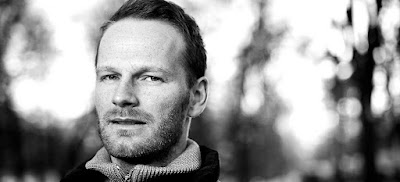
Director Joachim Trier


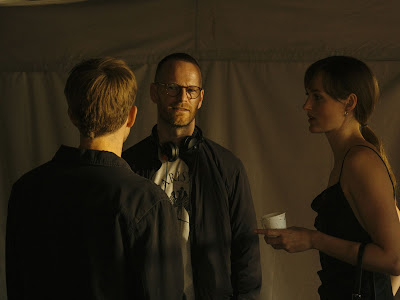
The  director with actress Renate Reinsve (right)


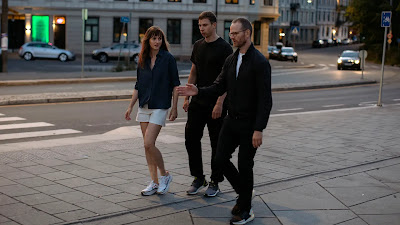
Reinsve, actor Herbert Nordrum, and Trier


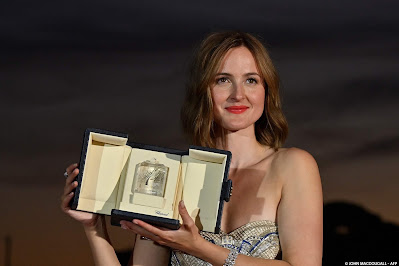
Reinsve winning Best Actress at Cannes


The Worst Person in the World (Verdens verste menneske)        A-                                      Norway  France  Sweden  Denmark  (127 mi)  2021  d: Joachim Trier            

For a long time I have wanted to make a film about love.  One that goes a bit deeper than normal onscreen love stories, where everything is so simple, the stories so clearcut, the feelings so admirably unambiguous.  A film that will look seriously at the difficulties of meeting someone when you’re struggling to figure out your own life; at how irresolute and uncertain even the most rational and otherwise self-confident people can become when they fall in love; and how complicated it is, even for romantics, when they actually get what they have been dreaming about.             —Joachim Trier

The third installation of Trier’s Oslo Trilogy, consisting of Reprise (2006) and 2011 Top Ten Films of the Year #10 Oslo, August 31, both told from the male perspective of Anders Danielsen Lie, who is a central protagonist in all three films, yet the twist here is it moves to a female point of view, all films about young people immersing themselves in Oslo, where the city itself is filmed as lovingly as the characters, with its mix of classical and modern architecture juxtaposed against the natural beauty of its hills and fjords, beautifully shot on 35mm by Kasper Tuxen.  Renate Reinsve, who won Best Actress at the Cannes Film Festival earlier this year, is the heart and soul of the picture as Julie, a somewhat quirky woman who feels like her life has never gotten on track, as something’s always missing, like she’s never really gotten started, yet this is a coming-of-age film that questions at what age do we suddenly realize that we’re grown up?  Like his other films that he writes with longtime collaborator Eskil Vogt, this features smart and witty dialogue, often ponderous, yet intensely meaningful in a personal sense, given a literary sweep, often with narrator Ine Jansen offering the unspoken internal thoughts, yet this method draws us into the characters, with their quirks and habits, yet we become intimately familiar with them, as the dialogue is straightforward and direct, feeling unfiltered, where one of the characters, Aksel (Anders Danielsen Lie), has a name that sounds like co-writer Eskil, so there’s a ring a familiarity that feels honest and true, perhaps a stand-in for the director himself, as he’s a well-known underground cartoon artist 15 years her senior, whose Bobcat is a variation of Robert Crumb’s Fritz the Cat, yet he remains a bit headstrong and overly analytic, while she shies away from being defined by him, but doesn’t always have the words to express how she feels.  But they both come from dysfunctional families who chiseled out their own paths, feeling comfortable with themselves, but not always with each other.  Both aim to please, are polite and considerate of the other, but the excessive verbiage starts to wear on Julie, as it can feel like too much.  Broken down into 12 chapters with a prologue and an epilogue, this is a fragmented and episodic story of watching Julie try to figure her life out, reduced to a series of vignettes, feeling somehow incomplete, but that’s the way life is, as it’s not always perfect.  Yet the generational difference slowly exudes its own importance, becoming a defining aspect of the film, where the director himself is highly aware that he’s a more mature version of the uniquely original artist that broke new ground with Reprise (2006), a stunning depiction of youth in full bloom, setting a standard for cool, where punk music and playful cinematic techniques felt trend-setting, yet now looking back, he wonders what’s happened with the world he used to know, as it’s no longer there, and only exists in his memory, making him feel oddly distanced from young people of today, even old.  Filled with a mocking tone of self-deprecation, a renowned Norwegian trait (“It’s our national sport,” Trier joked at Cannes), this film focuses on the indecision and angst of younger millennials still in doubt about their future, as Julie is a twentysomething medical student who has a suddenly unexpected epiphany realizing it’s not medicine, but psychology, with its insight and inquiry, believing the inner mind suddenly interests her, sharing her decision with her mother, who supports her fully, so long as that’s what she really wants to do.  Another epiphany moment quickly leads to yet another field, this time photography, though we never see her in a dark room, instead she starts working as a clerk in a bookstore, where ultimately writing makes its way onto her resumé.  She similarly goes through various men before finally settling upon Aksel, who she meets in an extended photo shoot with a handsome actor, turning into an ill-advised make-out session, but quickly leaves him at a party for the much more fascinating Aksel, though it’s only when he breaks up with her, realizing the age difference is too severe, as they’re at different points in their lives when they want different things, that she falls for him right then and there, spending time with his family in their summer home on the lake, yet they’re the one couple that’s different as they have no children, putting pressure on their relationship as Askel is ready but Julie is more ambivalent on the subject. 

All this occurs in the prologue, establishing the ground rules of the relationship, where an opening shot reveals Julie in a backless cocktail dress smoking a cigarette on a balcony overlooking a panoramic view of the Oslo skyline, with its exquisite modern architecture overlooking the downtown waterfront.  This picture postcard view of perfection is quickly wiped away by the daily difficulties that life seems to bring, with Julie struggling to find herself, where she’s witty and bright, easy to talk to, and distinguishes herself by being one of the better listeners we’ve seen in a while, offering a fresh new perspective on a developing story of a young woman’s life, always wanting more, thinking something better is just around the corner, yet she’s emotionally transparent, a whirlwind of internal combustion, offering her own commentary, “I feel like a spectator in my own life, like I’m playing a supporting role in my own life.”  Her existential dilemma is remaining true to herself, where she has separation issues with her father, who never seems to be able to see her, recently separated from her mother, with a laundry list of medical issues that seem to keep him homebound, so she rarely sees him anymore.  Instead she’s immersed in Askel’s family, with spoiled and unruly grandchildren whose parents squabble and bicker endlessly, so she’s confronted by a model of family bliss gone wrong, seeking new experiences that will help rectify her uncertainty.  One of the chapter titles is “Oral Sex in the Age of #MeToo,” which cleverly examines modern flirtatious practices, suggesting women shouldn’t feel guilty about their sexual pleasures, taking it to the extremes as we examine all the loveless marriages in her family tree, going back to a time when the life expectancy of a woman was only 35 years of age.  That’s a lot of years and multiple generations of overly unhappy women who willingly bore children, but never loved the men they were with.  While there is a humorous tinge to her Alice-down-the-rabbit-hole search for the unknown, more than willing to put herself out there, she surprises us all by crashing a random party, knowing no one on the premises, but making herself right at home, presenting herself as a doctor, telling an overly proud mother that excessive hugging of children is now considered bad parenting, as recent medical evidence suggests it is likely to turn them into drug addicts, with the mother recoiling in righteous indignation at the thought.  After surveying the landscape, she discovers a new excitement in Eivind (Herbert Nordrum), about her same age, and as undecided and as carefree as she is, where the two play a game testing how far they can go, intimately, without cheating on their respective partners, finding themselves still together at the morning sunrise without even knowing each other’s names, where Eivind is the one referenced in the film title, as that’s how he feels when thinking about leaving his all too conscientious wife.  This is actually one of the better films at capturing the ambivalence of today’s generation, with access to the world at their fingertips, yet the endless variety of choices may seem exhaustive, as where do you turn?  In this case Julie has the power, evidently, to make time stop, as one morning, like any other morning, Askel is pouring the coffee, yet he’s frozen in time, allowing Julie to run through the streets gleefully making her way through the cars and pedestrian traffic who are similarly stuck like statues, as if she’s the only one that matters, happily making her way to the bakery where Eivind works as a barista and their eyes meet, where the two of them are the only ones in the world with the capability of movement, evolving into a lush, romantic surge of emotion, like a moment you’d see in a summer Hollywood romance movie like (500) Days of Summer (2009).  Accordingly, Julie dumps Askel, who is still pouring the coffee when she returns, a bit dumbfounded, never expecting this, leaving him hanging, literally (exhibiting male frontal nudity), as her reasons ironically are attributed to bad timing, coming along at the wrong time period in each other’s lives, each needing something different, exactly what he predicted in breaking up with her initially.  Yet this break-up scene lingers with unexpected poignancy, invested with great care by both characters, who actually explore the personal ramifications as it is happening.   

One thing that feels different in this film is Trier’s use of music, which feels surprisingly blasé and unoriginal, having been blown away by radically subversive choices in earlier films, so that aspect never really comes into play, instead it’s all attributed to the writing and acting, which are superb, particularly the three leads, but especially Renate Reinsve, as this is her film, and her dizzying tour-de-force performance never disappoints, yet there is a hole where the killer knock-out blow from the music should be, as that would have only elevated this film.  For instance, there’s a chapter entitled “Julie’s Narcissistic Circus,” where she and Eivind happen upon a bag of magic mushrooms, which she immediately gulps down with that wondrous anticipatory smile, yet it takes awhile to kick in, but completely stops you in your tracks, leading to a head rush that completely alters reality, losing your bearings, where a glass of water turns into an uncontrollable oceanic wave, with Julie ending up dropping to the living room floor, pretty much unable to move, hallucinating the night away in slow motion until the next morning looks like everything has been knocked over, reliving fears and anxieties and a host of other unmentionables that are nightmarishly hilarious.  While Eivind is a terrific guy who treats her well, she’s stymied by his lack of ambition, still a barista after all these years, where she can’t help thinking there must be more.  This film has an ebb and flow to it, at times light and whimsical, followed by darker moments of reflection, all the while examining what kind of life she wants to lead, constantly questioning herself, doubting her choices, finding no answers, claiming “Being young today is different,” speaking about the increased pressures millennials face in daily life, “They have no time to think, there’s always something on the screen.”  Unwilling or unable to make the transition to adulthood, not really wanting to adopt a bourgeois, middle-class lifestyle, she always views herself growing into something she hasn’t yet become, but she would never be able to define who and what she is.  By chance, she sees Askel on television in a panel discussion with two ardent feminists who find his work demeaning and offensive to women, wondering how he could ever view himself as an artist when his work is so deplorably outdated and behind the times that it is completely irrelevant in modern day culture.  When he attempts to describe how underground attitudes tend to delve into extremes as a way of rebelling against the norm, suggesting Bobcat is a rebel against the bourgeoisie, they can’t get past the blatant misogyny, where he is literally crucified with a morally righteous condemnation.  Not long afterwards, she learns he is dying of incurable pancreatic cancer, where the final few chapters delve into darker waters, but they result in some of the most profoundly moving scenes, where Anders Danielsen Lie rises to the occasion, offering what may well be his finest performance, as nearness to death has a way of eliminating all filters, where talk can be straight and direct, recalling growing up in an era without the Internet or social media, where you’d value the time spent going to a record store or a book store, and you’d value holding a book in your hand.  “I grew up in a time when culture was passed along through objects, and we could live among them,” revealing the time they spent together were indisputably the best years of his life, calling her the love of his life, regretting his own shortcomings, as he was unable to make her see in herself what he always knew. “I failed to make you see how wonderful you are.”  Renate Reinsve is equally mesmerizing without having to say a word, just playing off the power of his final extended confession, where the chilling honesty couldn’t be more poignant, as he simply affirms her worth, where there can be no doubt.  Profoundly provocative, the film ends on a somber note where all the years have led us to this moment, where we have to finally face ourselves and live with our decisions, bordering on the magnum opus feel of the finale of Charlie Kaufman’s Synecdoche, New York (2008), like a summation of all the previous parts.  She listens to everything he has to say at the end, everything, including the pain, the exhaustion, the futility, the last remaining hopes, and the resignation, all the exquisitely tragic sorrows and the forgotten tomorrows, all of it.  It’s an extraordinary gentle finale, soft and lyrical, filled with calmness and tranquility, and perhaps a restless peace, which couldn’t be more beautifully photographed, essentially capturing the stillness of the night, continuing into the following morning.  Both are at their absolute best at the end, yet time is unstoppable, as Nordic revelations come with the realization of morbidly depressing circumstances, leading to final moments of reflection and isolation, leading her back to herself, perhaps finally content, no longer a whirlwind of unanswered questions, as we clearly see Julie in a different manner, as this scene punctuates how much every decision matters, and how important we finally all are to one another.