Showing posts with label Michelle Williams. Show all posts

Monday, January 1, 2024

2023 Top Ten List #4 Showing Up


Writer/director/editor Kelly Reichardt


Reichardt on the set with Michelle Williams


Reichardt and Williams at Cannes


SHOWING UP                      A-                                                                                                   USA  (107 mi)  2022  d:  Kelly Reichardt

The portrait of an artist takes an unusual turn, immersing viewers inside a defunct art school, the Oregon College Of Art And Craft in Portland, which shut down in 2019, one of the nation’s last remaining craft-focused degree programs, first opening in 1907 as part of a movement reacting against changes brought about by the Industrial Revolution.  According to a recent New Yorker article (The End of the English Major), “In 2022, a survey found that only seven per cent of Harvard freshmen planned to major in the humanities, down from twenty per cent in 2012, and nearly thirty per cent during the nineteen-seventies,” a pattern that is reflective across the national landscape, mirroring a society that denigrates art and literature as purely frivolous, having little to do with the economic realities of the future.  This film begs to differ.  Establishing an alignment within the artistic community, Reichardt takes us through the college from room to room, like a Frederick Wiseman exposé, offering a wordless commentary on the making of art, as this becomes the predominate focus of the film, filling the classroom spaces with Portland-based artists whose pieces are seen throughout the film, exposing viewers to more artworks in this brief timespan than they have likely seen in years, which is a remarkable accomplishment.  Working with actress Michelle Williams in their fourth collaboration, initially seen as a homeless woman trying to find her stolen dog in Wendy and Lucy (2008), then part of a wagon train heading west bound for the Oregon Territory in Meek's Cutoff (2010), and as a domineering matriarch hellbent on building that perfect home in Certain Women (2016), this couldn’t be a more unglamorous role, wearing no make-up, looking frumpy in colorless attire with an unstylized, pageboy haircut, exhibiting little flair or personality, strangely inhabiting the same desolate universe as Barbara Loden’s Wanda (1970), whose very character is personified by a lack of personal drive.  There’s not an ounce of artifice anywhere to be found on the screen, becoming an unflinching portrait of a dour woman who takes little pleasure in doing anything other than working on her art, which dominates every waking minute of her life, spending her time doing small ceramic sculptures of women in various states of motion, while colorful watercolor drawings decorate her studio walls, yet her only companion is a finicky cat who rules the roost with persistent meows.  Returning to Oregon, notably Portland for the umpteenth time, known for its DIY counterculture lifestyle, perhaps more than any film since Robert Altman’s The Long Goodbye (1973) this perfectly encapsulates that West coast vibe, where there’s a chill about each of the secondary characters, as nothing is ever rushed, yet they exhibit something eccentric and individualistic about the West coast that simply doesn’t exist anywhere else in the country.  Despite her inestimable talent, Kelly Reichardt is not a household name, though her films can be overpraised to the hilt, yet some find it hard to engage with the lack of onscreen drama.  Still, she can always be counted on to make low-key, quietly naturalistic films in her own distinct style, using minimal plot devices to build contemplative, meditative spaces about ordinary people living life on the margins, where her vast catalogue of independent films also includes River of Grass (1994), Old Joy (2006), Night Moves (2013), and First Cow (2019).  Lizzy Carr (Michelle Williams) lives in a cramped apartment over a garage that she’s turned into a studio, renting space from a longtime friend and fellow artist who lives next door, Jo, played by Hong Chau, so good in Alexander Payne’s mystifyingly weird Downsizing (2017), who makes more dramatically eye-appealing collages of yarn, fabric, and metal that occupy greater dimension and space.  The two exhibit a passive-aggressive relationship throughout the film, not exactly rivals, as their work is so different, yet their approach couldn’t be more different.  Jo is a more celebrated artist-in-residence at the school, surrounding herself with a roomful of admirers, where her home can sometimes resemble a party atmosphere, releasing the tension after being cooped up in an art studio all day, while Lizzy struggles to find time after hours, working alone at home, where solitude works for her, undisturbed by outside forces as she embodies an unspoken ambivalence, where the fragility of her work resembles the intricacy of Tennessee Williams’ The Glass Menagerie.  While Jo earns money from the sale of her work, Lizzy does not, yet in something of a pleasant surprise, Reichardt is completely nonjudgmental about implying any instrinsic value, allowing viewers to decide.  In that sense, her observational style is diametrically opposed to the ostentatiousness of Ruben Östlund’s The Square (2017), which does nothing but make value judgments about class distinctions in a calculated contempt for art.  However, not since Rivette’s LA BELLE NOISEUSE (1991) has a film so comically dealt with some obsessional human eccentricities involved in creating art.

This is the sixth collaboration with Portland screenwriter Jon Raymond, while working with cinematographer Christopher Blauvelt for over a decade, developing a comfort zone working together with films unraveling in a relaxed pace, where there’s something calmly appealing about this film, with an underlying humor that’s often missing from her other films, yet it also carries with it a profound sadness.  Lizzy supports herself by working in an uninspiring desk job at a campus office (where a dog sits in the doorway) which is inexplicably run by her mother Jean (Maryann Plunkett), which allows her access to the facilities, seemingly existing in a state of personal dissatisfaction, where part of her frustration is designing posters for other featured artists, routinely seen sitting alone outside on the steps eating out of her tupperware container, just staring off into space, watching the “Thinking and Movement” class out on the grass, or roaming through the various rooms in an attempt to escape the drudgery of her job, where it’s clear this takes her away from doing what she’d prefer, which is working on her art.  Ironically, she’s surrounded by a multitude of student artists who are doing exactly that, as hanging out is an essential component to making art, each working at their own unhurried pace, where the filmmaker presents the panorama of their works as a kind of collective collage of creative inspiration, where stenciled onto one of the classroom walls is a sign that reads “Do Not Mix Chemical Dyes with Natural Dyes.”  Reichardt works with such a deliberately low-key approach that it resembles a documentary style with fictitious interludes, yet what’s immediately clear is just how ordinary the artists appear to be, as they could be anybody walking down the street, completely unrecognizable from the wide breadth of humanity, yet the extreme degree of focus in their work is as unique as it is exemplary.  With just a few days before an upcoming exhibition, Lizzy’s life is continually interrupted by unexpected events that take her away from what she needs to be doing, starting with her cat, waking her up in the middle of the night as she’s nearly mauled to death a captured pigeon, having already nibbled on one of the wings, leaving it incapacitated and unable to fly, quickly disposing of the bird by sweeping it up and placing it out the window on the end of a broom, leaving it to its fate somewhere else, but like bad karma, it comes back to haunt her.  Jo discovers the injured bird the next morning and immediately attempts a rescue, enlisting Lizzy to help her wrap the wing in a bandage, place the bird in a cardboard box, and leave it right back with a stunned Lizzy to look after before running off to her art studio, as she has two upcoming exhibitions, and a prospective buyer from New York, hilariously described by Guy Maddin in a wonderfully illuminating interview as “It’s almost like a Preston Sturges gag as directed by Kelly Reichardt,” (A Need to Focus: Guy Maddin Interviews Kelly Reichardt About Showing Up).  Meekly reminding Jo that she has no hot water, she’s alarmed at her dismissiveness, but it will have to wait due to more pressing needs.  This is what amounts to drama in this film, as the saga of the injured bird becomes the link between these two women, each passing it off to the other, with Jo expressing less and less interest, while Lizzy develops a certain fascination, alarmed enough to take it to the vet, who suggests there’s little else to do, reminding her that “it’s a pigeon.”  Babysitting duties create a dilemma, as she’s obviously forced to keep the cat away from the bird while she works in her studio, but we see the paws underneath the door, like an ominous reminder.  The quirkiness of the set-up, along with the instant likeability of Jo, who’s mind always takes her to places that demand our attention, like a force of nature, is something rare in film today, as this is a woman who steadfastly follows her instincts, in stark contrast to Lizzy, who seems to be on the short end of the stick most of the time, where this little saga only escalates the mounting tension between them, as Lizzy has no place to shower, becoming a grating nuisance that wears on her after a while, as she’s in a daily battle for basics like hot running water and a decent wage, remaining dedicated to her craft with no discernible financial reward in sight.  Yet we can’t help but be mesmerized by the diverse collection of her artworks that she readies for the exhibition, as each of her “Little Women” exists in their own space and time, exuding distinct personalities that their creator seems to lack.  She enlists the aid of Eric (André Benjamin, aka André 3000, co-founder of Outkast whose flute playing can be heard near the end), an amiable guy who runs the kiln at school, always giving her time to heat and glaze her collection, while others continually drop in to see her latest creations, where there’s a student-generated interest that’s much more enthusiastic than anything we ever see from her, which is one of the fascinating aspects of the film.     

An Artist-in-Residence in the Film Arts program at Bard College since 2006, Lizzy’s life resembles the director’s own, an undervalued artist struggling to make ends meet, writing, directing, and editing films on a shoestring budget while supplementing her income by teaching college students, which also provides her with health insurance, something she doesn’t have within the film industry’s Director’s Guild as she works so infrequently.  With claims that independent filmmaking has not been open to women in any way, Reichardt has spoken candidly about the reality of making low-budget films, saying, “It also just means that I’m not getting paid, and I’m in my 50’s.”  The opening title sequence is beautifully orienting, as it simply lingers on various paintings lining the walls of Lizzy’s studio, which has a way of imprinting the subject into viewer’s imaginations.  Lizzy’s intense fixation on caring for the injured pigeon is mirrored in her complicated family dynamics, as her parents are bitterly divorced, and she’s seemingly the only member of her family that’s consistently concerned about Sean (John Magaro, the gentle frontier chef in First Cow), her unstable brother prone to frequent bouts of paranoid conspiracy theories (described in Variety as a little like one of R. Crumb’s brothers), seen digging a giant hole in his back yard, clearly agitated that Lizzy doesn’t hear the voices that are speaking to him, “You have to listen to what’s not being said,” claiming she’s not listening hard enough.  She’s following in the footsteps of her father (Judd Hirsch), an accomplished pottery artist who’s now retired, yet she’s concerned that two nomadic bohemian guests have moved into his home with no indication of leaving, yet he’s not bothered, as he seems to enjoy their company.  The combined stress of caring for the bird, looking after her family, surviving without hot water, and trying to get her sculptures done in time takes an exasperating toll, leaving Lizzy thoroughly exhausted, yet for all her accumulated fatigue, her exhibition is rather inspiring, as her pieces are unique, like little pieces of herself, well-attended by the people who matter most to her.  While her parents get into a personal dispute that expose the family dysfunction, all is well with the world.  However there’s a beautifully designed sketch involving the bird that plays out through the entire film, often darkly humorous, though it takes everyone by surprise when it suddenly takes flight within the indoor exhibit, drawing the interest of the entire gallery who are spellbound by the unexpected turn, and flies away, with all the patrons moving to the outdoor sidewalk to watch.  It’s a liberating moment that feels effortless, but unusually refreshing, as this kind of thing never happens in a Kelly Reichardt film, as she never resorts to sight gags, but it achieves the desired effect, as there’s such a sense of relief afterwards, as all the built-up tensions are washed away, suddenly of little consequence.  Lizzy and Jo go looking for the bird in the trees, but never seem to find it, and go walking down the street chatting together as if they’re best friends, which they very well may be, while the camera offers a bird’s eye view from one of the tree branches overlooking it all.  It’s a magical moment that delivers, like a much appreciated wave of fresh air that has the effect of joyously cleansing our souls, eradicating all the unnecessary content.  Among her better edited films, viewers are left with a stream of artistic images of rotating art projects, almost like a video instillation, each capturing that moment of surprise when first seen, offering generous support for the creative student artists of the future, where a film like this elevates the cultural significance of art, which is typically among the first programs cut out of public schools, which only shortchanges developing lives.  To put it bluntly, no men are making films like this.  With a nation obsessed by the male-dominated brutality of gun violence and weaponized political views, quiet, contemplative films offer such a peaceful alternative, providing painstaking visual detail of people working on their art, offering a celebratory tribute to the work of rarely seen artists, including Jessica Jackson Hutchins, Michael Brophy, Chris Johanson, Storm Tharp, Johanna Jackson, and others, embracing the idea that artistic communities are a haven for friendship and for working, and that a lack of community, or an each man for himself scenario, is a bad idea, emphasizing what a difference a creative outlet can provide in establishing a human connection while strengthening the ties of any community.  Lizzie’s works are by CYNTHIA LAHTI, a largely unrecognized artist based in Portland, while Jo’s are by Israeli-American artist Michelle Segre, a MacArthur Fellow working out of a Bronx studio, while it’s notable that the uncredited Portland location scouting was done by Janet Weiss, the former drummer for the all-girl rock band Sleater-Kinney. 

Thursday, January 27, 2022

Synecdoche, New York


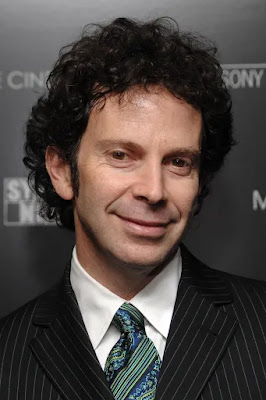
Writer/director Charlie Kaufman

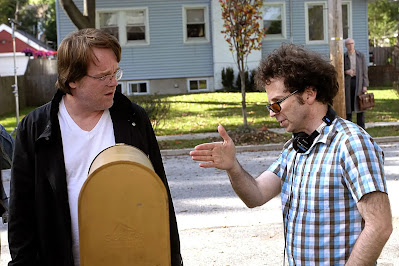
Kaufman with Hoffman on the set

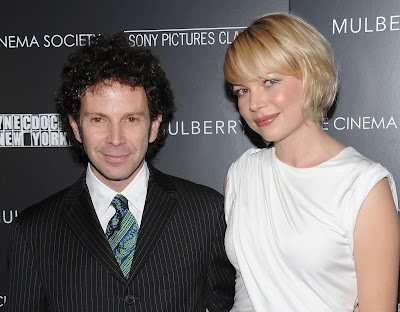
Kaufman with Michelle Williams


SYNECDOCHE, NEW YORK             B+                                                                                     USA  (124 mi)  2008  ‘Scope  d: Charlie Kaufman  

If the year is a life, then September, the beginning of fall                                                             is when the bloom is off the rose and things start to die.                                                              It’s a melancholy month and maybe because of that, quite beautiful.

Whoever has no house now, will never have one.                                                                        Whoever is alone will stay alone,                                                                                                will sit, read, write long letters through the evening,                                                                  and wander the boulevards, up and down,                                                                              restlessly, while the dry leaves are blowing. 

— Elke Putzkammer, Professor of literature at Union College heard on the clock radio in the opening reading an excerpt from Rainer Maria Rilke’s Herbsstag, translation by Stephen Mitchell, TRANSLATIONS OF RAINER MARIA RILKE'S "HERBSTTAG"

Wistfully sad and melancholic with more than a touch of irreverent humor, yet more than anything this is a film of astonishing imagination that will challenge any viewer, something of a brilliant head trip subject to multiple interpretations, a multi-layered puzzle piece that exacts a price from your brain, yet is meant to test even the most acutely aware among us, offering a mirror to our soulless modern existence.  Grap a rope, as this film takes us to the precipice.  Wildly off-the-wall, this can elevate poetically to one of the most ambitious films ever seen, mad beyond all expectations, yet also remain confusing and frustrating, perhaps overly autobiographical in tone, too drenched in miserablism and self-loathing to really like or appreciate, feeling more like a dirge for many, making it easy to dismiss, but enthusiastically hot-wired nonetheless, where the magnitude and scope is beyond essential, even if most of the surreal thought and effort put into this sprawling work may ultimately be lost on the audience, failing miserably at the box office, generating an onslaught of negative reviews, yet entering the cultural consciousness with its staggering originality, where over time the right audiences have discovered this momentous film.  What is most appreciated is the sensational acting throughout, especially the women, and the lilting musical score by Jon Brion which casts a serious pall on the entire affair, turning this into a ghostly, scorchingly morose version of Arthur Miller’s Death of a Salesman, a piece of iconic Americana that continuously plays out in the lead character’s head, as if on automatic replay.  The use of younger actors in his revival play is a controversial move, not something everyone will appreciate, as not all will see that they too are destined to live lives that are exhausted and worn out, conveying a life full of despair, as Willy Loman’s fate is already sealed, a tragedy of epic proportions, with suggestions that this is the kind of thing young theater directors should aspire to do.  Unfortunately, sometimes a writer’s worst enemy is writing itself, becoming too cutesy, word-obsessed, obliquely clever, and even veering towards the obscure in order to hide behind a cloud of unfathomability, which may, in essence, describe exactly how this film is conceived.  Much of it plays out like a sci-fi time traveling movie, with time moving forward at such a fast clip in the early scenes, where months go by in minutes, as the first eight minutes are like a film-within-a-film, nearly indecipherable when initially seen, yet revealing kernels of truth in unlocking key aspects of what follows, unraveling throughout the entirety of the film, where the world changes around our insufferable lead character, constantly commiserating over his failing health, until it simply leaves him behind, wallowing in his own pathetic misery, yet the actors playing certain characters keep getting replaced by other actors, where sometimes two or even three are onstage at the same time, similar to Shane Carruth’s PRIMER (2004), or the multiple Dylan characters in Todd Haynes’ I’M NOT THERE (2007), but this musical chairs in character development may initially feel forced, yet the performances eventually take on a curious significance.  There are two halves to this film, one that takes place in the real world and one that takes place within the mind of the director behind the scenes making an unwieldly and overly cumbersome play, veering into a mindset where one ages but otherwise loses all concept of time, as the director attempts to come to grips with his own mortality, where this has a vaguely clever stream-of-conscious feel, exploring a subjective reality, yet seen through the eyes of one man’s experiences as he hurtles towards his own death, yet distinguishing between the established reality and the fiction of the characters’ performances can prove confusing, as the distinctions between reality and the imagination are never clear.  Philip Seymour Hoffman as community theater director Caden Cotard is not so much the lead character in this film but a medium for Kaufman to communicate his thoughts.  His obsession with dying is met in equal proportions with an intense fear of love, becoming infatuated with the box-office girl, Hazel (Samantha Morton), after getting dumped by his wife, becoming a surrealistic nightmare, as she moves into a house smoldering in fire and smoke, where any personal connection seems doomed from the outset, as she quickly tires of his insufferable gloominess and moves on, yet Caden can never move on, still haunted by all the precious memories that brought him to this point in time, where what feels like a week for him is actually a year, yet Hazel is someone he never forgets, becoming the love of his life, the object of all his yearning, but he lacks the courage to act upon his feelings, overwhelmed by his anxieties, with theater being the only way he can project his true self, veering instead into an ill-advised marriage with his leading actress Claire (Michelle Williams), whose initial fascination turns sour, as their lives resemble a staged play, with Caden assuming more and more of Claire’s role, who suddenly realizes Caden’s only interested in himself, no longer able to fulfill her role as the compliant and content housewife, with Caden resorting to writing small notes offering inspirational suggestions to his cast, but ultimately returns to Hazel, where the two remain inseparable even into old age, at least in his mind.  As he ages, a stand-in takes his place, Tom Noonan as Sammy, a stalker who has followed him nearly all his adult life, who knows him better than he knows himself, eventually acting on his impulses in ways Caden never could, routinely flirting and having sex with Hazel, while Caden is stuck with a stand-in version of Hazel, Emily Watson as Tammy, where this revolving carousel of characters is an emotional roller coaster with exposed feelings on display, yet Caden never sees in himself what he’s transparently able to see in Sammy, needing others to finally do and say what he cannot, stuck living a life of perpetual observation, needing others to live his life for him.      

Having already written extraordinary screenplays for such a dizzying array of films as Being John Malkovich (1999), ADAPTATION (2002), CONFESSIONS OF A DANGEROUS MIND (2002), and ETERNAL SUNSHINE OF THE SPOTLESS MIND (2004), surely Kaufman is the film writer of our generation, with a reputation for avoiding clarity at all costs, spinning entangled webs that only grow darker and more complex, yet here he just lets it fly in an exhilarating attempt to reach for the skies, reminiscent of the absurdist Before the Law parable so brilliantly expressed in the opening sequence of Orson Welles’ version of Kafka’s THE TRIAL (1962), a vast metaphor for the struggle of life itself, where the trials of living offer a nagging sense of guilt for some vague and unspecified sin or wrongdoing that can never be traced or identified, yet the feeling persists throughout one’s lifetime, even at the hour of one’s death, with vague references to The Myth of Sisyphus, where an artist’s work is never completed, or viewed as successful, yet he persists, claiming “I won’t accept anything but the brutal truth.”  Perhaps he was referring to his wife’s eviscerating comments, “I can’t get excited about your restaging someone else’s old play.  There’s nothing personal in it,” calling him a “tool of suburban, blue-haired regional theater subscribers.”  How’s that for blunt honesty?  So on-target that it left ‘Hoffman as Kaufman’ with a bull’s-eye on his back, his tail between his legs, leaving him to pursue an endlessly futile search for grand existential themes, which may as well be a mythical search for the Golden Fleece.  Much of this feels oddly self-absorbed and obsessed with itself, taking on a kind of 8 ½ (1963) or All That Jazz (1979) vanity project, where the world revolves around a single man and his work, at nearly all times conflicted and at odds with each other, where Caden’s world is shattered early on by the loss of his family that ran out on him, as his wife Adele (Katherine Keener) becomes a hugely successful miniature artist in Berlin, taking their young daughter Olive with her under the pretense that she would return, but discovers she’s never been happier since she separated from Caden, who’s emotional core remains forever damaged, guilty that he was too self-involved to really connect with Olive, becoming truly devastated by her absence, as he rarely if ever has sex anymore without tears.  Some may actively dislike this kind of confessional self-hatred, where insecurities and paranoia take on a life of their own, presenting the life of an artist as incredibly tortured, tragically unfulfilled, and profoundly depressing, where Caden’s body when stressed out seems to turn against him, becoming a grotesque physical specimen with his mysteriously degenerative medical conditions, neurotically obsessed with the idea of dying, leaving him feeling like a pathetic outcast, where all he can do is apologize for being such an unlikable wretch of a human being.  For such gorgeous women to fall for such an unendurably miserable man who reeks of failure and self-pity in every aspect of his life feels like the most unrealistic kind of wish fulfillment, something out of Keith Gordon’s THE SINGING DETECTIVE (2003), making this all a projected fantasy world that has pretenses of realism and inner reflection.  In other words, it’s hard to take this seriously.  However it’s hard not to take seriously the complexities and multi-dimensional performances of the actors, all of which seem to be extensions of this single man’s thoughts and imagination.  While Caden takes great pains at identifying himself as such an ordinary man, a heavily flawed man who is subject to a wealth of fantasies and a wrath of medical ailments in equal measure, when he wins a MacArthur Grant for sheer inventiveness and originality, this feels totally preposterous and is certainly at odds with the Walter Mitty-like man we see onscreen who is wracked with guilt and self-doubt, and who humiliates himself in such bizarre fashion.  In an unusual form of storytelling, everything Caden does couldn’t be less interesting, yet the people around him remain fascinating, notably Samantha Morton, Tom Noonan, Emily Watson, Catherine Keener, the almost unrecognizable Jennifer Jason Leigh, and Dianne Wiest, all of whom are sheer marvels of invention.  Using a top notch cast and a touch of surrealism, we follow Caden along his path to glory, only the journey he takes and the characters he encounters have an inventive, visually expressive flair, though as a cohesive whole it’s not always dramatically engaging, as he continually retreats into a more submissive role, apologizing for his loathsome existence, living almost entirely in an interior existence that wants to reflect upon the world around him, but can’t see past his own deficiencies.  There are no flashback sequences in the film, only forgotten memories, yet they always occur in the present, as this is a film where time is always present, and may leap forward, or may constantly repeat itself, causing a huge discomfort, where especially baffling is the time at the end of the film is mysteriously linked to the same time as the beginning.  Yet this eternal present is continually lived until the body expires, as Caden’s own mega-colossal creation is on a repeating loop.  The death bed sequence with his grown-up daughter Olive (Robin Weigert) is among the more emotionally excruciating scenes, as he’s forced to come to terms with all the pathological lies, full body tattoos, and disturbing behavioral incidents that she’s been force-fed to explain her father’s absence, leaving her hating him with a ferocious vengeance, unable to forgive what she perceives as all the wrongs he has perpetrated, easily becoming the bleakest scene in the entire film, as he’s helpless to change the outcome, yet he still views her as an innocent 4-year old girl who had her entire future in front of her, somehow stolen out from under her.   

Not an easy film to digest with its cliché’d philosophical meanderings, blending the horrific with the terrific in its obsession with not being good enough, expressing all the hopes and dreams Caden always dreamed of wanting but unfortunately could never pull off, leaving him with an exasperating  sense of loss, alienated even from himself, left as if on an island, a man alone with his ambitions unfulfilled, where it’s hard to enjoy much of the morbidity in the more comic first half of the film, while the last half is near brilliant, as it re-examines everything that came before, much like Stanley Kwan’s film Rouge (Yan zhi kou)  (1988), where a ghost from the past searches through the present with such an incredible sense of longing for what was missing in her life.  Similarly, Caden becomes a ghost from his past searching through a netherworld between life and death.  In dreams, it is said that all the characters in the dream actually represent the dreamer.  Here as well, Caden becomes all of the characters on the set, all of the people in his life, a living metaphor for all the thoughts and aspirations that people have that go unnoticed.  As he attempts to make sense of it all, to find his real and authentic self through a colossally expansive theatrical production, a myriad of plays-within-a-play that are in a perpetual state of endless rehearsals all taking place simultaneously for years on end under an enormous Xanadu-like warehouse in the Manhattan theater district where he recreates a smaller model version of the burgeoning city around him, yet his megalomaniacal conception on a massive scale is the exact opposite of his ex-wife Adele whose paintings get tinier and tinier, where you need a magnifying glass to see them.  Fueled by his doubts and insecurities, he lacks the artistic security of Adele, who is comfortable in her own skin, free to express her feelings in her own life and comfortably interacts with the artistic community around her, continually breaking boundaries through her work, while Caden instead feels the need to make grander and ever-expanding spectacles with towering sets of the city, one stacked upon another, creating enormous rooms with endless space, yet he’s never comfortable filling the empty space, as all sense of capturing the truth has been lost in an extended succession of disconnected scenes that lead nowhere, exhibiting very little connectiveness with people, never able to successfully complete what he sets out to do.  Adding to the absurdity of his creation, he hires actors not just to play the people in his life, but also actors to play the actors, so what we see is a musical chairs of regurgitated moments from Caden’s past, reiterating the same themes over and over again, never finding anything new to say about them, growing agitated when actors change the lines, arguing that may be what he was thinking, but not what he actually said, remaining completely oblivious to the way the world has changed outside this bubble existence.  A telling moment occurs when hired actors begin to die, creating a series of funerals, each one bringing Caden closer to his own death, but he outlives nearly everyone.  In old age he rediscovers Hazel, finally re-taking the reins from Sammy, and discovers a kind of earnest simplicity, which is especially heartfelt because of what both have gone through in the intervening years, as she’s always been his one true love, but just as quickly, at the point he realizes what he’s been missing, she’s gone, in the flick of an eye, leaving him to fend off the hideousness of his existence alone, yet he surprisingly makes the claim afterwards that he knows how to do the play now, “There are nearly thirteen million people in the world.  None of those people is an extra.  They’re all the leads of their own stories.  They have to be given their due,” which reasserts the “Attention must be paid” theme from Death of a Salesman, a direct cry for human dignity, a fanfare for the common man, where if he wants to do the play right, he’ll have to achieve the impossible and give everyone their due attention.  Among the more conscientious revelations is that Caden, like Willy Loman before him, was never that rare and exceptional artist that comes along once in a lifetime, but is a more ordinary person, representative of each and every one of us. 

What was once before you, an exciting, mysterious future, is now behind you.  Lived; understood; disappointing.  You realize you are not special.  You have struggled into existence, and are now slipping silently out of it.  This is everyone’s experience.  Every single one.  The specifics hardly matter.  Everyone’s everyone.  So you are Adele, Hazel, Claire, Olive.  You are Ellen.  All her meager sadnesses are yours; all her loneliness; the gray, straw-like hair; her red raw hands.  It’s yours.  It is time for you to understand this.  As the people who adore you stop adoring you; as they die; as they move on; as you shed them; as you shed your beauty; your youth; as the world forgets you; as you recognize your transience; as you begin to lose your characteristics one by one; as you learn there is no-one watching you, and there never was, you think only about driving, not coming from any place; not arriving any place.  Just driving, counting off time.  Now you are here, at 7:43.  Now you are here, at 7:44.

After seventeen years of endless rehearsals he loses track of time, never once performing before a live audience, as he only grows older and more tired, where others eventually have to help him along the way, and instead of giving directions, he finally has to accept direction.  Dianne Wiest, in particular, elevates the last 30 minutes of this film with her phenomenal presence as Ellen, who grows from a simple washer woman to the director taking the place of Caden, re-imagining and conceptualizing things differently, strangely producing greater results, more emotionally charged, which most of all surprises Caden, moved beyond belief, where the tragedy is that he lacked the originality to stake new ground.  And though he yearned to leave behind something monumental, he never really gained any original insight during a lifetime of directing.  Yet even more astonishing, Wiest assumes the thoughts and voice of Caden himself—not really thoughts so much as his final spiritual direction, like the voice of God.  Beautifully expressed by the end credits reprise of Deanna Storey’s ultra downbeat rendition of the song “I’m Just a Little Person,” Deanna Storey - Little Person (Synecdoche New York) YouTube (3:53), blending all of the characters and the musical soundtrack into a single unified mood that has a sublime similarity to the use of the Aimee Mann song “Save Me” Aimee Mann - Save Me YouTube (4:27) in Magnolia (1999), which beautifully encapsulates the sadness that permeates throughout each film.  What stands out is a magnum opus feel to the finale, like a summation of all the previous parts, yet the final moments, especially, breathe sadness, where all that has come before slowly slips away in an apocalyptic finale where everyone appears to be dead or incinerated, blending into a forgotten landscape of thoughts and dreams that are slowly disappearing from the earth, becoming a uniquely quiet and sorrowful expression of acceptance given a grim, desolate look before one goes peacefully into the night, while the final chapter is more like an epilogue or an elegy, as it carries with it a prayerful tone of transcendence.

Synecdoche, New York - Looking Through Caden's Eyes  Film Radar, Daniel Netzel video analysis (12:47)