Showing posts with label Andrea Arnold. Show all posts

Saturday, December 14, 2024

Bird


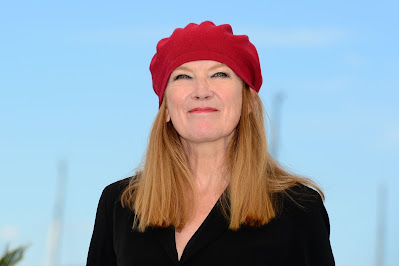
Director Andrea Arnold

Arnold with Jason Buda and Nykiya Adams


Arnold with her lead cast at Cannes


Cinematographer Robbie Ryan


BIRD                          B+                                                                                                        Great Britain  USA  France  Germany  (119 mi)  2024  d: Andrea Arnold

This is the next century
Where the universal’s free
You can find it anywhere
Yes, the future has been sold

Every night we’re gone
And to karaoke songs
How we like to sing along
Though the words are wrong

It really, really, really could happen
Yes, it really, really, really could happen
When the days they seem to fall through you
Well, just let them go

No one here is alone
Satellites in every home
Yes, the universal’s here
Here for everyone

Every paper that you read
Says tomorrow is your lucky day
Well, here’s your lucky day

It really, really, really could happen
Yes, it really, really, really could happen
If the days they seem to fall through you
Well, just let them go

—The Universal by English alternative rock band Blur, 1995, inspired by Alex and his Droogs from Stanley Kubrick’s A Clockwork Orange (1971), Blur - The Universal (Official Video), Full HD (Digitally ... YouTube (3:55)

From the director of social realist films like RED ROAD (2006), FISH TANK (2009), and American Honey (2016), each of which won the Cannes Jury Prize (3rd Place), winning an Academy Award with her short film WASP (2003), converting to an overly abstract, experimental style in both Wuthering Heights (Arnold) (2011) and Cow (2021), this is a return to form for Arnold, an adrenaline-laced, kitchen sink exposé of a British underclass in the north Kent region (the same area where Arnold grew up) that feels like FISH TANK on steroids, where this is an aggressive, in-your-face assault to the senses, almost as if time and the film speed itself was sped up.  The raucous music adds an underlying layer of unbridled punk ferociousness, while the abstract, psychologically fractured style is unique, minimizing narrative form, instead creating a hallucinogenic atmosphere of drug-induced ferocity balanced against the internal world of a coming-of-age 12-year old Bailey (newcomer Nykiya Adams), who is vulnerable yet resilient, mature beyond her years, navigating her way through a suffocating atmosphere and a seemingly endless series of labyrinthean challenges, an extension of the young female protagonists in both FISH TANK and AMERICAN HONEY, where the creative sound design is phenomenal, making this one of the best edited films of the year, where you never really know where this is going.  As is Arnold’s style, rarely working with established actors, she allows an unknown lead character to literally carry the film, and Adams is electrifying, onscreen for nearly the entire film, yet this film defies expectations, adding surreal elements that simply alter the landscape, creating tonal shifts that are as wildly expressive as the furious post-punk of the Irish rock band Fontaines DC, where a punctuating opening song Too Real asks “Is it too real for ya?,” BIRD | Official Clip | In Theaters Now YouTube (1:36), a theme that permeates through every frame of the film, challenging viewers at every turn, upending any idea of what we’ve seen before, creating something entirely new, a brash expression of the new world order.  Bailey, who is black, straddles two families, one that is white, living with Barry Keoghan playing Bug, a mostly shirtless, perpetually loud and chaotic father to Bailey, literally adorned with insect tattoos, and her equally troubled older half-brother Hunter (Jason Buda), a family marked by dysfunction and hopelessness, and one that is black, as her mother, Peyton (Jasmine Jobson), lives in a decrepit drug house with three younger siblings on the other side of town, where the brazen abuse of her terrifying boyfriend Skate (James Nelson-Joyce, the nastiest piece of work in any Arnold film) and the paralyzing fear he generates, especially towards the children, adds a brutal dimension of extreme psychological harm in a tumultuously exploding world.  Bug, who doesn’t look much older than his kids (a father at 14), is a troublemaking knucklehead and drug dealer who doesn’t really concern himself with parenting in any real sense, as his virtually unemployable, irresponsible life is so out of control in their graffiti-strewn neighborhood that his constant diversions and distractions allow them to pretty much run their own lives, where in this world unsupervised children are the norm.  Featuring an extraordinary selection of music, Bird by Andrea Arnold (Soundtrack), so integral to the enveloping atmosphere, where Bug seems to have a particular affection for singing along with Blur - The Universal (Later... with Jools Holland 1995) - Full ... YouTube (4:01), a dystopian song that oozes a fake optimism, synonymous with an elated sense of Britpop promise in the 90’s that was subsequently crushed under a wave of conservatism, yet when he makes a surprise announcement that he’s going to get married, introducing Kayleigh (Frankie Box), who is a complete stranger, and Kayleigh’s baby daughter into their lives, Bailey is thoroughly disgusted by the idea, as their lives are already complicated enough.  “There’s no place like home” this isn’t.    

In an article for The Guardian in 2021, We are animals. We need to connect to the millions of non- ..., Arnold wrote:

Whenever I have felt troubled or lost or overwhelmed with life I have always sought nature.  It has always grounded me and put me in touch with myself again.  No one taught me this.  It came quite naturally.  Like some innate knowledge.  Partly I think because I had a very free childhood.  My mum had me very young, at 16, and three siblings followed by the time she was 22.  My dad was only a few years older.  I never saw him that much in my early years and he was gone completely by the time I was 10.

So, unsupervised most of the time, I lived a fantastically wild life.  I grew up in north Kent on an estate surrounded by liminal wilderness.  From early, I would spend entire days roaming wherever the fancy took me.  Between estates and chalk pits and deserted old industrial spaces and woods and motorways.  Out of this grew a deep love of insects and birds and animals and plants.  Stray estate dogs, the Traveller ponies chained by the motorway, the fish and frogs in the water-filled bomb site, wild strawberries on the banks of the chalk pits.  I can conjure up these places vividly now.  The smells and sounds and feels and colours.             

At Cannes the film won the Carrosse d’Or, or Golden Coach Award, bestowed by the Society of French Directors showcasing “innovative qualities, courage and independent-mindedness,” joining a distinguished group of past winners including Martin Scorsese, Werner Herzog, Jia Zhangke, Jane Campion, Jim Jarmusch, Kelly Reichardt, and Clint Eastwood, with Arnold tearfully indicating it was the toughest shoot of her career, and the most painful, with many more challenges than usual, making it particularly difficult to find the film she envisioned from the footage she shot, which may explain the kaleidoscopic editing structure that continually keeps viewers on edge.  Yet this also may be the most cinematic film she’s ever made, as Arnold fearlessly refuses to be pigeonholed as a social realist, capturing the extremes of the fantastical with the unending challenges of living in a world that is literally crumbling under your feet.  What’s different about this working class exposé is that nobody is actually working, or even going to school, leaving them precariously vulnerable to the violence that is seemingly everywhere, with no love in sight, where an escape from reality is a necessity, opening up a crack of light in an area otherwise consumed by rampant poverty and social decay.  Bailey is a sensitive and rebellious girl who lives in Gravesend, a Kent neighborhood mentioned in several Charles Dickens novels characterized by apartment blocks covered in graffiti and dysfunctional families, who doesn’t even have a bed, just a sleeping bag that she curls up in, spending much of her time alone, or sometimes with a group of young thugs in the area who view themselves as the “protectors,” targeting domestic abuse offenders with their own extremely violent, vigilante justice style brand of retribution.  But her life changes when she meets Bird (Franz Rogowski), a mysterious wanderer who appears out of nowhere doing a twirl for her camera dressed in a kilt in search of his birth parents he has never known, and while she’s initially wary, keeping her distance, she ultimately decides to help him in his search, as he seems to have a special connection with children, eventually making a deeply profound personal connection, where he takes on the role of her guardian angel.  Her innocence stands in stark contrast to the shadowy underworld dealings of her manic father, who spends a good amount of time attempting to persuade a Colorado River toad to secrete a slimy hallucinogenic substance, something he thinks will make him a fortune, or at least pay for his wedding, but this only seems to happen when he plays “sincere,” old-style “Dad music” that he hates, hilariously turning to Coldplay’s rendition of Coldplay - Yellow (Official Video) YouTube (4:32), which seems to work like a charm.  Bailey has a habit of filming what she sees on her phone, including the flight of birds, butterflies, horses, or disturbing moments of violence, as well as her initial meeting with Bird, all of which comprise a personal journal, like diary entries that document her evolving life, projecting her videos on the walls of her room at night, though sometimes they just run through her mind, showing us the world through her eyes.  Captured through a dizzyingly frenetic handheld camera, reflective of the emotional inner instability of these lives, so fragile against the eruptive violence that surrounds them, yet there is poetry to be found in the wretched ugliness of life on the poorest margins of society, where there are flashes of mysterious and dreamy moments, like the camera pointing upwards to the sky, or seeing Bird continually standing atop a high-rise building, recalling the reckless impulsiveness and daredevil games of the alienated high school youth in Toshiaki Toyoda’s Blue Spring (Aoi haru) (2001) or the angels perched atop the ledges of skyscrapers high above the city in Wim Wenders’ Wings of Desire (Der Himmel über Berlin) (1987).   

With references to Vittorio De Sica’s MIRACLE IN MILAN (1951), where protagonists escape the misery of postwar ruins by broomstick, a neo-realist fable that no one complained about, by the way, ranked 3rd on Cahiers du Cinéma’s Top 10 Films of the Year List in 1951, or more overtly Ken Loach’s KES (1969), as both realistically portray, with poetic elements, the daily lives of teenagers who take refuge from their harsh reality through a friendship with birds, this film depicts a turbulent transition from childhood to womanhood, struggling with everyday problems, where nothing is remotely straightforward, continually taking strange detours along the way, becoming, in essence, a metamorphosis in action, where the ideas just keep coming.  Despite her tender age in a time of transition, Bailey has to deal with much greater conflicts and responsibilities, where we are literally lured into her child’s-eye view of the world, showing the brutality of forgotten environments that children are forced to live in, where there is seemingly no place for them, as the entire system has failed them, suggesting they are able to dream of freedom (“It really, really, really could happen”) beyond the squalor that surrounds them.  Shot on 16mm by Arnold regular Robbie Ryan, who also works with Ken Loach and Yorgos Lanthimos, this rich and layered film is most of all an exhilarating experience, easily her most “out there” film, as the audacity of the “what the fuck” factor screams originality, skillfully told with striking empathy and ingenuity, where some have criticized elements of CGI magical realism mixed in, something never seen before in an Andrea Arnold film, but they feel more like surreal moments, as the transformations are completely in character, initially manifested with relative subtlety until the film explodes with the full force of unleashed creativity, where viewers need to keep an open mind on the power of cinematic suggestion.  Having the courage to make outrageous narrative choices leads the film on unexpected paths, like the perilous side journeys Odysseus takes in The Odyssey, while also grasping a child’s state of grace and wonder that recalls Benh Zeitlin’s 2012 Top Ten Films of the Year: #1 Beasts of the Southern Wild (2012), as otherwise this might be mired in miserablism or poverty porn, yet this feels elevated and empowering, completely grounded in a grim reality, yet it’s so much more rewarding, both bleak and hopeful all at once, literally transcending the material, as there’s a surprise in nearly every shot.  Arnold seems to specialize in stories of neglected and endangered girls on the verge of becoming young women while living in brutal or inhospitable environments, yet this adds another layer, namely Bailey’s fascination with birds, while she also may be queer, or at least leaning in that direction, showing an aversion to girly things, where her self-absorbed father is just too oblivious to notice, or care.  Yet one of the featured aspects of the film is a parallel curiosity about parenting, as Bird is as interested in his journey of discovery about his missing parents as Bailey is with unlocking the buried secrets of hers, leading to a powerfully dynamic and emotionally riveting conclusion, with these revelations beautifully interwoven into the film, where one of the questions this film asks is whether we can ever really be free of the trauma that shaped our lives.  The raw, unforgiving world of Arnold’s movies and the struggles of these young girls to survive are brutally honest observations that are overwhelmingly truthful and sincere, embracing life’s imperfections, accentuating class disparity and familial neglect while offering resilience in the face of adversity, tenderness in the face of chaos, where the poetic excursions are like an epiphany that only add, not detract, from the film’s overall impact, as it simply refuses to end in tragedy, and continues to play out over the end credits.  Difficult, experimental, and ambiguous, yet exquisite.    

Thursday, December 9, 2021

Cow


Director Andrea Arnold


Cow                C-                                                                                                                      Great Britain  (94 mi)  2021  d: Andrea Arnold        

A documentary film that delves into the existential worldview of a cow, that may also be viewed as a snuff film, as the entire life of the film draws viewers into the perspective of a single cow, seen giving birth in the opening, cleaning up the newborn afterwards with her tongue, just like so many other animals, and then cruelty hits, as they take the young calf away from the mother during a mechanical milking session, moved to a nursery where it is bottle-fed milk, their ears clipped and tagged, their horns cauterized to prevent growth, with the mother seen in distress afterwards searching for the missing calf while calling out with endless mooing, yet there is no answer.  It’s a cruel turn of fate, as the film follows the routine at an English dairy farm over the course of six years, completely unglamorized, shot with an often shaky, handheld camera by Magda Kowalczyk, developing a relationship with this one cow, where the farmers themselves are viewed as secondary characters, often seen and heard on the periphery whistling or chatting away, regularly herding the cows from one pen to the next, often heading them into the milking stations, using mechanical milking devices while flooding the region with a Top 40-approved playlist of primarily female soft pop tunes that are heard as ambient noise in the backgound, as if this helps calm the animals down, but they never mix up the sounds to include jazz or classical music, so it feels overly melancholic, from Billie Eilish, Khalid - lovely - YouTube (3:20) to SOAK - Everybody Loves You (Official Video) (3:22), Mabel - Mad Love (2:51), for the mating scene, of course, or Birdy - Skinny Love [Official Video 2014] - YouTube (3:20), where the lyrics are often sorrowful and sad, where one wonders what effect this has on the animals.  With so much attention paid to a single cow, it brings to mind Pietro Marcello’s Lost and Beautiful (Bella e perduta) (2015), which similarly follows a man leading a young bull around the countryside in an attempt to keep it from the slaughterhouse, much of it conveyed from the bull’s perspective, given its own dreams, and even a soul, a film that also questions man’s relationship to animals, routinely taking them for granted, while also recalling an early Errol Morris First Person made-for-television short documentary film entitled STAIRWAY TO HEAVEN (2001), where Temple Grandin, an American scientist and expert on animal behavior devises a more humane way to slaughter animals, originating by communing with the livestock animals themselves and imagining how they would feel. 

While some may claim the wonders of viewer empathy with a barnyard animal, but that’s already been done to perfection by Robert Bresson in Au Hasard Balthazar (1966), a near perfect film that reaches for transcendence and the sublime, so without any narration or dialogue concocting anything resembling a storyline, what this film really has going for it is length, as it sticks with an animal for an extended period of time, most of it spent in the crowded confines of a barn with other dairy cows, where it lives in its own filth, urinating and defecating where it stands, with hay strewn around to help filter the odors, but the grounds where they stand are always wet and muddy, where humans need heavy boots to walk around, yet cows have to live amongst constant filth.  On the occasion when they are released into open pasture land, it feels like an exhilarating freedom, where the space to roam and the quality of grasslands to eat is greatly elevated, immediately offering a higher quality of life, yet cows have only two options, either they can stand or sit, so there’s not a whole lot to identify with.  Much of this gets bogged down in the same old routine, where the monotonous life of a cow just isn’t that interesting to those of us who don’t live amongst them everyday, where they may take on a life of their own, like owning a horse, where a good part of the relationship is established in taking care of it, as you develop an affection during the time spent together.  That does not happen here, as the screen time is not with a single animal, but an entire herd of dairy cows, though one single female is highlighted throughout much of the film.  Andrea Arnold has made some powerful films, winner of the Jury Prize (3rd Place) at Cannes on three different occasions with RED ROAD (2006), FISH TANK (2009), and American Honey (2016), unafraid to accentuate miserablism, while also going off the rails on occasion with an overly abstract, experimental style in Wuthering Heights (Arnold) (2011), but this veers into different territory entirely, expecting a lot from her audience, indulging in her own personal fascination, offering her own autobiographical comments earlier this summer in The Guardian (We are animals. We need to connect to the millions of non ...), challenging our relationship with millions of animals around us that, according to recent scientific developments, Cambridge Declaration on Consciousness, each have their own conscious awareness.      

As the cycle of life continues, we are surprised how soon after giving birth (60 to 90 days) that cows are again impregnated, placing them alone in a stall with a male bull, surrounded by all the other cows nearby, it’s not like this female was given any choice, as the high pregnancy turnover fits the farmer’s schedule, not the cow’s.  The juxtaposition of a nearby fireworks display seems trite and overly humanized, as that’s clearly not how the cow feels.  The farmers are elated to discover she’s pregnant again, where the exact same process plays out all over again, searching for that missing calf, where the repetitious brutalization of her life starts to become apparent.  Arnold intersperses shots of birds in flight, or airplanes, exuding a kind of freedom this animal simply doesn’t have, grounded in its own mundane reality, once more exposed to that top of the pops music which drones on as if having to listen to elevator music all day, as again, it’s not as if the cows have any choice.  When the snow flies and winter is in the air, one of the farmers is dressed in a Santa hat while the distinctive voice of Shane MacGowan can be heard singing an Anglo-Irish Christmas song, The Pogues - Fairytale Of New York (Official Video) (4:02), yet these animals have no real protection from the cold, as the barn is open-aired and not covered or heated.  In one scene a dead cow is seen simply laying on the ground, unattended, perhaps an all too frequent reality from which we’re naively unaware, but the starkness of the image seems to accentuate how little we know about the harsh life of farm animals.  The film offers ponderous moments where cows seem to stick their heads up, as if looking out into the sky, but more often than not it’s to evade the network of steel bars that surround them, pushed into them by the overcrowded pens, nearly impossible to avoid. Yet the cruelest fate is when they are led to their own destruction, a bleak reality that jars viewers into disbelief, wondering why a filmmaker would show that, as they’ve already established the heartless fate that awaits them, yet to watch an animal being killed that you’ve been observing over the course of an entire film is like a snuff film that some will find not just deplorable but unforgivable.  The scene brought to mind questionable choices in Haneke’s Benny's Video (1992) that were shown offscreen or the merciless Columbine shooting from Gus Van Sant’s ELEPHANT (2003).  While the director’s intent is to accentuate our disconnect with nature, according to a recent interview (Andrea Arnold on Capturing Cow, Bovine Beauty, and the ...), “We avoid all the uncomfortable things in life.  We don’t want to know, but life is uncomfortable sometimes.  Life is brutal sometimes.  That’s our reality.”  Yet it’s the spacy dreariness of the music that seems to haunt us at the end as we hear the gloomy and despondent sounds of Garbage - Milk (3:54) play out over the end credits. 

Wednesday, November 22, 2017

The Florida Project


THE FLORIDA PROJECT      B                 
USA  (111 mi)  2017  ‘Scope  d:  Sean Baker

A glimpse of the hidden homeless tucked seamlessly inside the nooks and crannies of a near invisible American underclass, premiering at Director’s Fortnight at Cannes, by the maker of Starlet (2012) and the in-your-face TANGERINE (2015), a cinéma vérité experience shot entirely with an iPhone, this is like the kiddie version of Andrea Arnold’s American Honey(2016), a raw and blistering look at the seamy underside of America, set initially to the outlandishly upbeat music of Kool & The Gang - Celebration - YouTube (4:18), though it feels much closer to a Harmony Korine film, yes, the man who made Spring Breakers (2012), who typically adores those living on the fringe of society, where reality is not the essential truth about the film, but a carefully constructed candy-colored artificiality.  The grimness of the film is a deluded sense of empowerment.  Remove the illusion and what you’re left with is scathingly empty.  Set just off the highway in a cheap, strip-mall motel in Orlando, Florida, a transient city where people come and go, home of the renowned Disney World, which promises to be “the happiest place on earth,” this is an eye-opening, tour-de-force exposé that centers around 6-year old child actress Brooklyn Kimberly Prince as Moonee, who is in nearly every shot of the film, basically running free, ruler of her own little world, free from adult supervision, and just simply has the run of the place.  Co-written, directed, edited, and produced by Baker, in a very atypical experience, spending so much time in the company of kids onscreen, he’s made a film that has white trash written all over it, yet withholds judgment, as it’s not so presumptuous, offering a more free-form expression of kids on the loose, brash trash talkers, wildly uninhibited, full of mischief and back-talk to adults, where they seem giddily happy most of the time, with nothing and no one stopping them from doing whatever they want.  This liberated spirit is the heart of the film, as the place is surrounded by rampant commercialism, the kinds of places seen in every tourist trap, grotesque examples of crass capitalism in play.  Conformity and proper decorum follow these family-oriented businesses, as they cater to kids, luring families and their pocket books by being child-friendly in a landscape of Disney paradise, but it’s all about the dollar signs, as anyone stepping out of line will be rudely escorted out of these places.  But the Magic Castle Motel, where Moonee lives, or Futureland Inn around the corner, are dead-end motels further off the track, away from the strip, seemingly lost in a netherworld, a grungy and decaying depiction of a dilapidated world, where people only find them by making a wrong turn, hilariously exemplified by a Brazilian couple on their honeymoon, who take one look at the dump before heading off in another direction.  Completely off-limits from established middle-class joints, Magic Castle is painted a bright lavender color that makes it look Wes Anderson surreal from The Grand Budapest Hotel(2014), shot on 35 mm, though of course projected on digital in theaters, with an incandescent color scheme by Alexis Zabé, the cinematographer for Carlos Reygadas and 2012 Top Ten Films of the Year: #2 Post Tenebras Lux, yet the film has a cinéma vérité documentary style, offsetting the blatant artificiality with a searing realism.

While these are the kinds of kids you might see running up and down the aisles of Walmart or Target, dodging shopping carts, grabbing food or candy off the shelves, inadvertently knocking things over, and then high-tailing it out of there before the manager can catch up to them, all brazenly done out in the open, and probably repeated in store after store, where despite the fact these are misfit kids, they already have a dubious reputation.  Because of their age, they probably avoid criminal prosecution, but are more likely viewed as smart-alecky kids that get away with murder because their parents are too lax to scold them or hold them accountable for their behavior.  We’ve all seen kids like this, but mostly they remain off the radar, as rarely do films focus their full attention on their lives as they do here.  Moonee’s partner in crime is Scooty (Christopher Rivera), another kid from the motel (wildly adorable, both of whom appeared in formal wear on the red carpet premiere at Cannes), as we follow their misadventures wandering into another apartment complex and creating havoc, spitting on cars from an overhead balcony railing, before running away.  Quickly identified as the culprits, we see them returned to the scene of the crime, where they are ordered to wipe up the mess, but rather than view it as punishment, they turn it into a playful game where one of the kids from the offended party actually wants to join in, Jancey (Valeria Cotto), becoming their new best friend.  And off they go on another adventure, visiting the local ice-cream parlor, hitting on adults for money to buy a cone that all three can share, delightfully lapping it up before it melts.  When we meet Moonee’s mother, Halley (Bria Vinaite), we’re not surprised, as she’s a foul-mouthed, heavily tattooed con artist who also happens to be a pathological liar.  What we witness from her is atrocious and reprehensible adult behavior, as she weasels her way out of everything, rarely keeping a watchful eye on her daughter, always blaming others, thinking only of herself, believing she has a free ride.  She pays rent week by week by scraping up whatever she can, buying discount items and selling them to tourists at more upscale locales, using her daughter as part of the scam.  While she’s a completely unsympathetic character, even resorting to prostitution, she adores her daughter and loves playing with her, always making her the center of attention.

Holding down the fort as manager of this hell-hole is none other than Willem Dafoe as Bobby, the guy that has to deal with all these bottom-dwelling personalities, as the place is filled with people of questionable character, while he’s charged with maintaining the property, fixing all disputes, and taking care of things that break down.  Dafoe plays it straight, making no judgments, abiding by the house rules, refusing to be taken advantage of by overly frugal guests or people with questionable character, such as an aging woman who prefers sitting at the pool topless, causing commotion with the kids, or more disturbingly runs off an old man who takes a perverse interest lurking around the kids, who for the most part comes across as a decent, stand-up guy who treats people fairly, understanding the fragility in their lives, often standing up for them, while also overlooking things and minding his own business.  While there is plenty of outrageous humor in this film, it’s a surprisingly upbeat film that grows more devastatingly grim toward the end, as this film shows what it feels like to be down-and-out in America, with Halley growing more desperate, resorting to riskier criminal activity, where her best friend cuts off relations, then bans Scooty from hanging out with Moonee, feeling like a noose is pulling ever tighter around Halley’s neck, with her world collapsing like a house of cards.  Moonee has no idea what’s going on, showing surprising resiliency, yet there are stark moments where boundaries are crossed, such as when a strange man walks in on her while she’s naked in the bathtub, violating her space, but seen from Moonee’s vantage point, those moments vanish in the blink of an eye, as each day stretches longer and longer, seemingly filled with limitless time, as there’s no real narrative here, where instead each successive day blends blurry-eyed into the next one.  There are moments that stand out, such as when charity food trucks pull up to hand out free food, quickly relocated out back, away from roving eyes, or when Halley and Moonee treat themselves to an all-you-can eat banquet, literally stuffing themselves, with the camera staring straight at Moonee’s face as she devours every bite, offering a view of instant fulfillment, but it’s a mood that can’t last, as everything in their lives is temporary, where there is never any forethought or plan, as this is a fly-by-night operation.  When things further deteriorate with Halley, it’s inevitable that Moonee’s world will also be affected, and though alluded to, that’s not the focus of this film, which dreamily prefers a more impressionable view of children as wild animals running free, scampering through the artificially constructed landscape, where her fate is all too reminiscent of rounding up the wild horses at the end of John Huston’s The Misfits (1961), where the thought of taming and caging them is unthinkable, and ultimately heartbreaking.