Showing posts with label Tom Blyth. Show all posts

Thursday, October 1, 2026

The Fence (Le Cri des Gardes)


Director Claire Denis


THE FENCE (Le Cri des Gardes)      B                                                                                 France  Senegal  USA  (109 mi)  2025  d: Claire Denis

Claire Denis goes back to her roots for this one, an adaptation written by Denis, Suzanne Lindon (daughter of frequent Denis actor Vincent Lindon), and Andrew Litvack in an English language version of the 1979 allegorical play by French playwright Bernard-Marie Koltès, who was inspired by Samuel Beckett, that depicts a tense nocturnal confrontation between white managers and black laborers at a British multinational construction site at an isolated, neocolonial outpost in West Africa, where colonial plantations with soldiers have now been replaced by corporate work contracts in a film deeply rooted in symbolism, decidedly more abstract than most of her other work.  During a trip to Lagos, Nigeria in 1978, Koltès witnessed a black workman die at a construction site, an event that drew little concern from the white foremen, which forced him to confront the casual racism and violence that Europeans directed toward Africans.  Denis met Ivory Coast actor Isaach de Bankolé while she was writing the screenplay for her first film Chocolat (1988), which was shot in Cameroon where Denis grew up as the daughter of a French colonial official and starred Bankolé, discovering he was a close friend of the playwright, starring in three of his plays before Koltès died of complications from AIDS in 1989, which is how she discovered his plays, where one in particular stood out in her mind, Black Battles with Dog, as it connected to her childhood of growing up in Africa.  In Nigeria, specifically a construction site, Koltès discovered English is spoken between whites and blacks, where the excessive politeness and distinct use of the word “sir” belies the racist anger and hidden violence that lies underneath the surface just simmering to explode.  Denis is a French director who spent much of her childhood in West and Central Africa colonial outposts, which deeply influences her films, exploring themes of colonialism, isolation, and the complex relationships between Europeans and the African continent, where this is her fourth film set in Africa, including Chocolat (1988), a semi-autobiographical depiction of her childhood in colonial Cameroon, Beau Travail (1999), visually exploring the rigid, ritualistic lives of the French Foreign Legion, confined to their base in Djibouti on the northeast African coast, and White Material (2009), where Isabelle Huppert plays a stubborn French coffee farmer refusing to flee her colonial land during a civil uprising from an unnamed, war-torn African country.  Continually subverting expectations, what these films have in common is native black African cultures being wiped out by white European influences, fueled by hypocrisy and corruption, often through racist male privilege and toxic masculinity, which runs rampant throughout this film, with a Tindersticks musical cue taken from her earlier film WHITE MATERIAL, Tindersticks "Children's Theme" -- Claire Denis Film Scores ... YouTube (2:04), that plays over the end credits, eloquently described by Denis, “This piece of music broke my heart at that time,” noting that using it “once was not enough,” Watchtowers in the Wilderness: Claire Denis on “The Fence”.    

The film opens poetically with an African mother laying a palm leaf on a pool of blood in the desert sand, while there’s also CGI references of a snarling white dog viciously attacking pieces of human organs.  Two African brothers lay shirtless in the sand side by side, but only one appears to be alive, Alboury (Isaach de Bankolé), evoking a parable about a biting dog before concluding, “White man’s fantasy are the black man’s nightmare.”  Following themes of racism, colonialism, and gender, this is a film that dares to confront uncomfortable truths about Western exploitation and power dynamics, as we are introduced to a non-local white engineer named Cal (Tom Blyth), seen driving a truck while boisterously singing along to a Midnight Oil song from the 80’s, Midnight Oil - Beds Are Burning (Official Video), HD ... YouTube (4:33), a rock anthem on Aboriginal land rights that asks, “How do we sleep while our beds are burning?”  We soon find ourselves in a massive industrial refinery outpost of strung-together shipping containers and looming oil drums surrounded by barbed wire, with armed guard towers watching over, where the African guards speak to one another in the Yoruba language, which is fairly widespread in West Africa, but completely indecipherable to most whites living there.  The stage is set with the introduction of a world-weary construction supervisor Horn (Matt Dillon, a close friend of Isaach de Bankolé), who out of the corner of his eye sees an African man smartly dressed in a suit and tie pacing just on the other side of the fence, Alboury, who speaks Yoruba with the guards, allowing him entrance through the first gate, portrayed with a quiet intensity, announcing he’s there to claim the body of his brother, Nouofia.  The ever-evasive Horn, a picture of colonial arrogance, claims he died in a construction accident, an all-too-common occurrence, but it’s a horrible tragedy, cordially inviting the man to join him for a whisky where they can discuss the matter.  But Alboury does not budge, politely refusing the offer, claiming he wants the body as soon as possible as their mother is in mourning, crying and wailing relentlessly, which he aims to stop by bringing the body.  Horn is willing to accommodate his request, even offering a small sum of money, described as “funds of retribution,” but not until the next day, which Alboury deems unacceptable, as Western style negotiations are worthless with someone who is fluent in the language of oppression.  The entire film surrounds this non-negotiable impasse, with the film’s title operating on multiple levels, with a visible fence that separates the construction facility from the surrounding community, but the larger barriers are invisible, reflected internally by each of the characters, as the film shifts from the filmmaker’s usual impressionistic style to a more direct approach.

Like Jean Genet and other absurdist writers, Koltès felt exiled as a homosexual in a heterosexual world, while also growing painfully aware of his own skin color and the repressive history and the power structure it represents in Africa, where land and resources were plundered by European colonial powers, completely ignoring native interests and cultures, fueled by centuries-old racist beliefs that blacks were ignorant and subhuman.  The dangerous and unpredictable Cal is seen again picking up a woman at the airport, Léonie (Mia McKenna-Bruce), Horn’s recent wife arriving from London, adding further psychological strain to the volatile environment.  A lone woman in an all-male landscape, much like Isabelle Huppert in White Material (2009), she quickly becomes an object of desire, whose mere presence is provocative enough, but her revealing attire and stiletto heels add another layer of intrigue and sexual tension, as the men see only one thing – sex, with an always condescending Cal drinking the couple’s celebratory marital champagne while continually pestering her and nonchalantly coming on to her, even in the presence of his boss who sent for her, like the mail-order bride in François Truffaut’s MISSISSIPPI MERMAID (1969).  Cal represents the archetypal racist colonizer, whose violent rage is activated by Nouofia’s perceived disrespect by wanting to leave an hour before closing time, and later, when he sees Horn negotiating with Alboury, he worries that the foreman will sell him out for the deadly way he handled it, where even the idea of his boss listening to a black man pisses him off.  Examining the racial root of this barbaric act of violence shows the lengths men will go to in order to make a bad situation even worse, where the opening dream sequence features Cal’s lost dog.  Shot in Senegal by Éric Gautier, the longtime cinematographer for Olivier Assayas and Alain Resnais, while also shooting the two previous Denis films, Both Sides of the Blade (Avec amour et acharnement) (2022) and Stars at Noon (2022), this can be read as a fable about the evils of neocolonialism, yet there’s still plenty of underlying poetry, worlds of ambivalence, and multiple layers of ambiguity.  The slow-moving film is about an encounter built on desire, hatred, and frustration among three men and a woman divided by everything, as there’s simply no place for her there, which becomes apparent almost immediately, as the fortress-like look of the place resembles a prison, keeping natives from intruding, yet also keeping those residing there trapped inside, amplifying the psychological tension.  This is a dialogue-heavy, tense study of space and shifting power dynamics between white occupiers and black laborers, where the fence in the film acts as a border between the privileged white compound and the local African workers, representing deeply ingrained systems of post-colonial exploitation.

Set in a largely abandoned construction site where they pave roads through the bush for economic development, with bulldozers and hastily constructed barracks, the atmosphere, unfolding mostly at night, is dreamlike, deeply psychological, bordering on the supernatural.  At night, the guards, all of them black carrying automatic weapons, in order to keep themselves from falling asleep, would call out to one another with strange melodic sounds, which is what made Denis decide to call it The Cry of the Guards (Le Cris des Gardes), the first adaptation of a play and the first movie she ever shot in sequence, mostly defined by a nocturnal space, which she believes best suits what Koltès had in mind.  Koltès understood that writing in the name of Africans would redouble the colonizer’s violence, so instead he presents Alboury as the colonizer’s nightmare, one who answers the most human call for mourning, but who ends as a powerful and uncompromising avenger against white oppression.  While the workers try to normalize the death, claiming it’s something that happens all the time, Alboury’s refusal to capitulate to the white demands alters our perception, forcing viewers to look beneath the surface, as this begins to feel more and more like a cover up, with echoes of Greek tragedy, as Alboury’s spectral-like presence acts like a Greek Chorus, like a persistent force of moral consciousness, eventually viewed by his white counterparts as an act of aggression, bringing to bear something that doesn’t really exist within the compound, namely any sense of justice.  This takes the film into deeper philosophical levels, becoming a morality play, where the outsider, Léonie, learns as we learn, as it’s not at all what she was led to believe, including the man she presumably loves, discovering she is completely unprepared for this environment, as she watches the disaster play out before her in a haunted space filled with a mix of desire and terror.  There are any number of different directions that might be imagined in our heads as we’re watching this, but the film refuses to abide by convention, feeling more like a poetic allegory, with Horn and Cal managing their own fears and isolation, which immediately brings to mind Valerio Zurlini’s film THE DESERT OF THE TARTARS (1976), which is about the relentless psychological torment from an outpost on the edge of nowhere where an isolated platoon sits awaiting the threat of attack from an unseen enemy.  Haunted by a lurking dread of an impending sense of doom, Horn and Cal are exacerbated by a similar fear of the unknown, psychologically projecting their own fears into the minds of others, which eats at the inner core of these men who literally unravel before our eyes, living in a world abandoned by time. 

Sunday, January 1, 2023

2022 Top Ten List #6 Benediction


Writer/director Terence Davies


Davies on the set with Kate Phillips and Jack Lowden


Siegfried Sassoon


Sassoon with close friend Robert Hanmer

shooting on the set


BENEDICTION                    A-                                                                                               Great Britain  USA  (137 mi)  2021  ‘Scope  d: Terence Davies

Alone he staggered on until he found                                                                                         Dawn’s ghost that filtered down a shafted stair                                                                             To the dazed, muttering creatures underground                                                                               Who hear the boom of shells in muffled sound.                                                                             At last, with sweat and horror in his hair,                                                                                    He climbed through darkness to the twilight air,                                                                  Unloading hell behind him step by step.

—excerpt from The Rear-Guard, by Siegfried Sassoon, written on the Hindenburg Line, April 1917, siegfried sassoon - The War Poems - Project Gutenberg

This has a towering, epic feel about it, something of a gay anthem, coming in the latter stages of the director’s career when history, vintage photographs, poetry, cinema, and Catholicism, which is painfully prominent, all merge together, incorporating his own queer history, telling the story of English poet, writer, and soldier Siegfried Sassoon (Jack Lowden), decorated for bravery on the Western Front, officer with the Royal Welch Fusiliers and winner of the Military Cross, becoming one of the most influential and historically important poets of the First World War.  Angry at the futility of war, having lost his younger brother at Gallipoli, his compassionate anti-war poems differed from the jingoism and sentimentality of other war poets, more political and more edgy, instead writing about the horror and brutality of trench warfare and the tragic waste of human life, like ordering young men to charge against machine guns that literally mow them down, always remaining connected to those frontline soldiers while blisteringly satirizing the generals, politicians, and clergymen for their incompetence and blind support of the war.  Public reaction was fierce, some complaining the poet displayed little patriotism, while others found his shockingly realistic depiction of war to be too extreme, accentuating the graphic detail, but he eloquently captured the feeling of trench warfare, where the accumulated war deaths in WWI were simply staggering, First World War: fatalities per country 1914-1918 - Statista, with soldiers dying by the millions, shown in a lyrical stream-of-consciousness montage of black and white photographs that are simply striking, set to the starkly unusual choice of music of (Ghost) Riders In The Sky - Vaughn Monroe (a #1 record) - YouTube (3:01), with WWI metaphorically supplanting the Wild West, quoting Wilfred Owen’s opening line “What passing-bells for these who die as cattle?” from Anthem for Doomed Youth, Anthem for Doomed Youth by Wilfred Owen | Poetry Foundation, or underlined by an impassioned reading of Sassoon’s poetry that reflects the weariness of British soldiers in a war that never seems to end.  He wrote a letter to his commanding officer after throwing his Military Cross medal into the river, declining to return to duty because he believed the war was being deliberately prolonged by those who had the power to end it, A Soldier’s Declaration, Sassoon's Protest Statement, which was published in newspapers and read aloud in the House of Commons, causing an extreme degree of embarrassment for the British military and very nearly got him court-martialed, BENEDICTION (2022) movie clip: "I simply cannot remain silent..." YouTube (1:27), instead, after intervention from important figures, including British poet and historical novelist Robert Graves, his commanding officer in the Fusiliers, he was sent to the Craiglockhart War Hospital in Scotland for recuperation and treated for shell shock, a condition he did not have.  It was there he met his treating psychiatrist, Dr. W. H. R. Rivers (Ben Daniels), the first in Britain to use “talking therapy,” discovering they both share a “love that dare not speak its name,” an Oscar Wilde reference to homosexuality, one of the first gay men he became close to, while also meeting fellow poet Wilfred Owen (Matthew Tennyson), who was the editor of The Hydra, a literary journal produced by the patients.  Immediately striking up a friendship, they each shared a profound respect for each other’s enormous talent, each believing the other was the superior poet, providing a brief solace in their lives, developing a homoerotic friendship that was never consummated, seen dancing the tango together, cheek-to-cheek, but they kept in contact through correspondence, even as Owen was quickly sent back to the front lines, dying just a week before armistice was declared at the age of 25, with the war taking perhaps the only man he ever really loved.  Owen’s work inspired Benjamin Britten to write his War Requiem, also Derek Jarman’s 1989 film by the same name, while his loss, added to Sassoon’s younger brother, and the collective loss of the millions of war dead affected him greatly, haunted by the cries of “the muffled dead,” losing so much at such an early age, never really coming to terms with the psychological damage of unfathomable trauma, all but confirming his worst fears. 

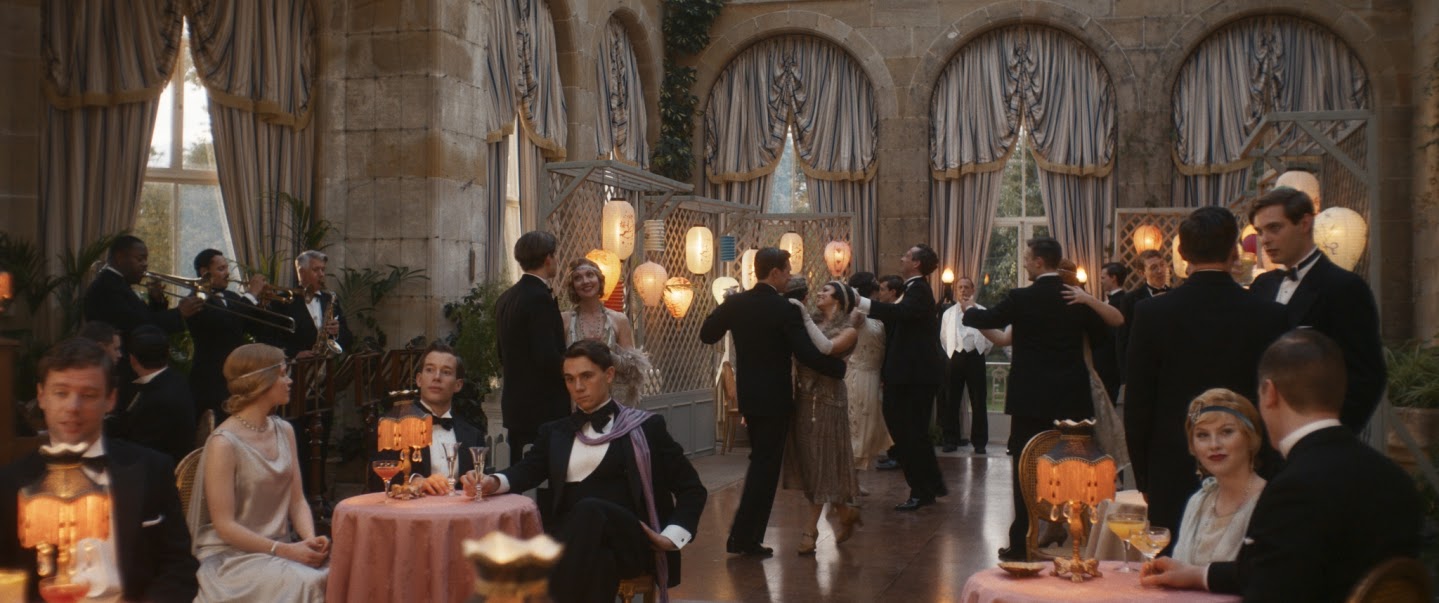
Davies lyrically examined his own childhood in Distant Voices, Still Lives (1988) and The Long Day Closes (1992), created a passionate ode to his hometown, Of Time and the City (2008), explored the literary passages of Edith Wharton in THE HOUSE OF MIRTH (2000), Terence Rattigan in The Deep Blue Sea (2012), Lewis Grassic Gibbon in 2016 Top Ten List #7 Sunset Song, and American poet Emily Dickinson in A Quiet Passion (2017), and while this fails to meet the poetic depth of his earlier films, the dramatization still feels like an elegiac transformation onto the screen, creating haunting moments that simply linger in the air, including beautifully constructed sequences shot by Nicola Daley, working with the director for the first time, that eloquently express Davies as a superb conceptual artist.  Bringing a theatrical quality to the production, with Sassoon returning home after the war, Christmas is laced with an anguished memory of all that has just transpired, leaving one exhausted and emotionally spent, Benediction Movie Clip - Reliving the Past (2022) | Movieclips Coming Soon YouTube (1:19), while also searching for the sublime in a portrait of cherry blossoms set to exquisitely delicate music, Butterworth: A Shropshire Lad - Loveliest of trees - YouTube (3:27).  Brilliantly written by Davies, in tune with the sensitivity of each character, the wit and elocution of the dialogue is among the director’s best, each word precisely chosen, initially established through the tender exchanges between doctor and patient, both proper English gentlemen, developing an immediate rapport through their erudite language, but growing more intellectually testy as he enters the upper echelons of British society after the war, developing an Oscar Wilde flair for the dramatic in a series of romantic affairs and encounters with rich socialites, reciting one of his own poems, Benediction: Blaze Of Lights (HD CLIP) Jack Lowden, Tom Blyth WWI Movie YouTube (1:41), while indulging in parties and extravaganzas in the Gatsby-like era of the Bright Young Things of the 1920s - Historic UK where gay and lesbian relationships were commonly accepted.  In this richly decadent atmosphere he meets Ivor Novello (Jeremy Irvine), a matinee idol, composer of witty stage music, and openly gay silent screen star in Hitchock’s atmospheric murder mystery drenched in fog, The Lodger (1927), who sings his own deliciously witty novelty song, And Her Mother Came Too (Harold Lloyd) - YouTube (1:53), before scandalously ditching his boyfriend and taking the arm of Sassoon to commence yet another romantic fling.  This same song was sung by Jeremy Northam when playing Novello in Robert Altman's Gosford Park (2001), aptly reflecting the times in which it was written, when risqué tongue-in-cheek comedy was all the rage.  The screen is a bouquet of gay narcissists flaunting their flamboyant effeminance, literally snarling at one another with their claws out, including actor and theater director Glen Byam Shaw (Tom Blyth), coupled with Novello before Sassoon came onto the scene, and Stephen Tennant (Calam Lynch), an impetuous and beguiling prize with a flair for the rich and glamorous, something of a social climber habitually looking at himself in the mirror while continually exhibiting an insouciant flair.  All handsome and divinely dressed, at times this resembles a chic costume drama where the winner takes the prize, like when they meet Hester Gatty (Kate Phillips), the well-connected and wealthy daughter of a Chief Justice who dabbled in painting and writing poetry, quickly grabbing Sassoon when the occasion suits her, BENEDICTION - Frist Clip For Terence Davies’ Siegfried Sassoon Biopic Starring Jack Lowden #TIFF2021 YouTube (2:16).  Described by Sassoon’s mother as the “pretty boys,” they all interchange with one another in relationships at some point in time, trying one another out like some kind of social experiment, where the freedom they are looking for resembles the free love movement from the 60’s, while hovering over them is art critic Robbie Ross (Simon Russell Beale), an elder gay statesman who bravely defended Oscar Wilde (who was imprisoned for his sexuality) from scurrilous attacks and helped protect his literary legacy.  Left out of the film is the affair Sassoon had with Prince Philipp of Hesse, a German aristocrat who later joined the Nazi Party, serving as Hitler’s art collector.  The fleetingness of these Bohème relationships mirror the cattiness of the characters and the ferocity of the sharp barbs intended to stab their prey, exhibiting a stifling self-centerdness of people utterly caught up in themselves, where you wonder why anyone would stick around, Benediction: The Fight (HD CLIP) Jack Lowden, Tom Blyth WWI Movie YouTube (2:19), but it reflects the underlying anxiety of being gay during a time when it was outlawed, something that has also plagued the director throughout his life, scurrying to the hallowed realms of the Catholic Church in hopes of salvation, only to end up bitterly disappointed. 

Rather than telling Sassoon’s story in a biographical sense, Davies approaches his life subjectively, accentuating the accompanying feelings expressed through his poems, where his films are often memory plays, using associative editing and an evocative use of music, offering reflections of looking back at one’s life with a sense of regret.  The length of the film feels rightly deserved in this film, as poetry needs space to breathe, where the silences and pauses need to be felt.  By scouring Sassoon’s diaries, the actor Jack Lowden quickly realized he was playing a conglomeration of Sassoon mixed with the director’s own personal feelings, merging into a starkly authoritative depiction of growing up gay in the moral straightjacket of the British empire (homosexuality was outlawed until 1967, with a new law passed just weeks after Sassoon’s death), leading to a tortuously repressed existence.  This is the director’s most openly gay film, though he maintains the self-loathing factor associated with his own homosexuality ('Being gay has ruined my life' – The Irish Times), while the reverence Sassoon feels for the community of brothers lost in the war has a nearly homoerotic connotation, as they represent the hopes and dreams of a future generation that never see the light of day, expressing so much love and admiration for them, as they carried with them his own aspirations for a better world and a better life.  When they died, something within him died as well.  While there is frivolity in youth, with economic privilege granting them sexual freedoms, Sassoon’s life evolves into unusual sadness, hiding behind an angry veneer of an almost sneering honesty, though his mother (Geraldine James) reminds him “it’s more humane to be kind than honest.”  Filled with a gravity of emotions that suggests an endlessly combustible inner turmoil, Sassoon is driven back into the closet where he leads an overly repressed shadow life, searching for redemption through societal respectability and the protected sanctity of marriage, and ultimately religion, never really enunciating his disappointment, instead hoping for the sought-after salvation.  Thinking this may come in the form of Hester Gatty, at age 47 Sassoon marries her, twenty years younger than him, hoping to have a child together, then somewhat later he converts to Catholicism, where the great promise of a more stabilized life turns into an unmitigated disaster.  One of the most startling images is an age transformation in a held shot, as Jack Lowden morphs into a much older Peter Capaldi, thoroughly embittered and dejected at the abysmal state of his life, supremely angry at the world and disgusted with himself, living in a sterile relationship with an unhappily discouraged partner, where the alluring Kate Phillips transforms into a frumpy Gemma Jones, losing all sense of her former sensuality, looking positively dour, neither one having anything to say to each other, with Gatty eventually departing for Scotland, driven to unending despair by a relentless onslaught of verbal abuse from an uncaring husband.  Yet for abject cruelty, it would be hard to top a scene with the now older Stephen Tennant (Anton Lesser), as it appears there are simply no feelings left, Benediction (2022) Clip | Jack Lowden, Peter Capaldi YouTube (1:30).  Their grown-up son George (Richard Goulding) looks nothing like either one of them, blending into the landscape with a thoroughly average appearance, where nothing about him stands out, apparently playing referee between his two parents, acting as a go-between until they separate, trying to get his father to utter anything, as he goes into catatonic states of aloof despondency, sitting for hours without saying a word.  When he finally gets his father to go to the theater, thinking this would have a positive effect on his outlook, they go to the overly cheery Anthony Newley British comedy Stop the World – I Want to Get Off, a show that ends with the song What Kind of Fool Am I?, yet what Davies chooses to show is the cheesy sentiment of Typically English (Live) - YouTube (3:42), which Sassoon must have found dreadful.  The film opens with Sassoon’s A Soldier’s Declaration and closes with Wilfred Owen’s poem Disabled, Disabled by Wilfred Owen | Poetry Foundation, which is read while a young Sassoon sits on a bench and witnesses a legless war veteran in a wheelchair being taken outside a medical facility and simply forgotten, leaving him drowning in an abject state of horror, where the title takes on an elegiac significance, merging into a final wordless sequence that is as bleak as it is enthralling, endlessly holding onto a face, where you may recall a similar heart-wrenching finale, Visions of Gideon- Sufjan Stevens (Call Me By Your Name Soundtrack) High Quality YouTube (4:42), though this shakes the very core of one’s being, set to a Vaughan Williams theme, Fantasia on a Theme by Thomas Tallis - YouTube (16:35), where Sassoon has simply lost all faith in the world, leaving him heartbroken and dismally sad, seemingly frozen in time, transformed into an agonizing state of morose despair.