Showing posts with label brothel. Show all posts

Thursday, March 17, 2022

Black Venus (Vénus noire)


BLACK VENUS (Vénus noire)              C+                                                                           France  Belgium (164 mi)  2010  d:  Abdellatif Kechiche  

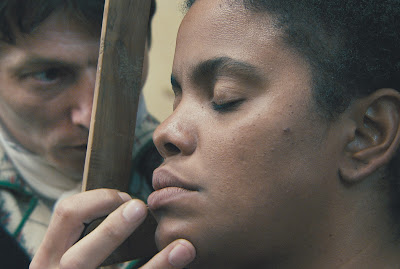
If you thought the final dinner sequence of Kechiche’s earlier film The Secret of the Grain (La graine et le mulet) (2007) was infuriating and overlong, to the point of almost ruining the picture, which previous to that was an extraordinarily intelligent and well acted piece of naturalistic filmmaking, then this film picks up where that one left off, as Kechiche has taken a wretchedly abusive early 19th century historical example of European racism that is utterly appalling in the opening five minutes and extends this exact same theme for nearly three hours, just becoming a bleaker and more miserable, anti-humanist portrait.  From the start, the scientific introduction of what is at the time perceived to be a newly discovered species of human being from Africa, supposedly a direct link to the apes, along with monkeys and baboons, takes on a peculiar interest in the civilized European society, where the continued taunts and racist derision from whites leave an exasperatingly horrific picture of colonialist mentality, one that uses science to justify their own racial superiority.  Watching this is as uncomfortable as one can imagine being in a theater all year, but it is a project of love and meticulous documentation by this director, an unforgettable experience, a historical recreation of the life of Saartjes Baartman, an oversized black woman from South Africa, particularly her pronounced breasts and buttocks, who heads a carnival act of the wild and the grotesque, a kind of King Kong exhibit of taming the wild beasts of Africa on display in 1810 – 1815 for all to see, moving from London to Paris. 

What is particularly debasing is the manner in which she is exploited, treating her like a freak of nature, continually making her appear primitive and subhuman, subject to mocking laughs and contemptuous catcalls, allowing people to touch her buttocks to prove she’s real.  Baartman, played by Cuban nonprofessional Yahima Torrès, says very little in this film, never raising her voice, instead offering a void of blank stares, drowning her sorrows by drinking excessively, as this is the only way she can block out the demeaning treatment.  Her white handler Hendrick (Andre Jacobs) supposedly captured her and brought her back from the depths of Africa, keeping her locked in a cage, using a whip to control her, releasing her in front of the audience while still on a chain, or so the routine goes, all designed to sell tickets, where Baartman grows tired of the reality.  Hendrick, however, is blind to her considerations, as she’s his cash cow, continually claiming it’s in her best interests to continue along in this manner as they’ll supposedly make a ton of money, sending her back out there to be humiliated once again.  In London, some abolitionists tried to legally shut down the show, claiming it was exploitive, that Baartman was an unwilling slave subjected to public mockery, where slavery had been abolished in England just a few years earlier, but her own testimony reveals that Hendrick discovered her as a domestic worker in South Africa, offering her a contract for exhibitions in Europe, sharing half the proceeds, where she agreed to perform as an actress pretending to be a native from the wilds of Africa.  

This is a relentless and punishing portrait of racist humiliation, where Hendrick sells the examination of her body to a group of French scientists in Paris, who measure her anatomy as if compiling statistics for a slave auction, but while undressed except for a loincloth, she refuses to let them examine her private parts which leads to an open rebellion on her part, an act that leads to a terrible beating and the parting of the waves with Hendrick, who is soon replaced by Olivier Gourmet as Réaux, the bear handler at the carnival, who continues to present the act in the same way, but to the aristocrats of French society in Paris who find this creature to their amusement, treating her like a sexual object they can toy and play with.  When it stops being fun and games, however, when the theatrical veil of artificiality is removed, they don’t like what they see, which is an utterly sad girl who’s led a deplorable life, who hasn’t had a moment of happiness since she was born, yet she is openly displayed half naked and exhibited as one of the wonders of the world.  When she refuses to continue to be treated like a whipped slave, Réaux brutally throws her to the wolves as well, where she spends the rest of her life as a dying and diseased prostitute, moving from the elegant brothels catering to the wealthy back into the streets where she eventually succumbs to pneumonia and venereal disease.  Even after her pitiful death, the exploitation continues, as Réaux sells her body to the French scientific community who dissect her like a frog, placing pieces of her in a jar, showing them in scientific demonstrations to help prove European racial superiority.  The intensely provocative, nightmarish experience is overly repetitive and exhausting, undermining its own effectiveness by becoming a dreary exposé, but it is a raw and graphic portrait of her continual mistreatment, shown with meticulous detail, where the director takes liberties in imagining her state of mind, as she left no evidence behind like a diary.  This near documentary film serves as a public exhibition of egregious colonialist abuse, where racist actions and intentions are often shrouded in the name of art, science, civilization and culture.

Tuesday, February 14, 2012

House of Tolerance (L’Apollonide – souvenirs de la maison close)


HOUSE OF TOLERANCE (L’Apollonide – souvenirs de la maison close)    B+
aka:  House of Pleasures
France  (125 mi)  2011  d:  Bertrand Bonello

Stylistically, this is one of the more remarkable films of the year, beautifully shot by Josée Deshaies (the director's wife), where the French title is more appropriate, as souvenirs is a French expression for a remembrance or a memory, where perhaps the most exact usage here is a cinematic reverie, where the film has a remarkably lush decorative bordello environment, as champagne flows freely, a perfect compliment for the open display of naked female bodies which are prominently featured throughout this film.  There’s nothing remotely pornographic about this movie, as it rarely shows male anatomy, never aroused, and there are scant few shots of couples actually engaging in sex, and no sex is ever graphically revealed.  Instead, Bonello is more interested in the down time, in the type of activity that normally occurs offstage when they’re not working.  His camera is all over documentary style repetition of banal detail in showing the ordinary, day-to-day routines that the women follow, cleaning themselves and rinsing their mouths regularly, lorded over by the house Madame, Noémie Lvovsky, usually seen in lighthearted, dialog-driven French comedies, and a writer/director in her own right, where the rarely seen LIFE DOESN’T SCARE ME (1999) was one of the best films of the year.  Lvovsky, however, is exceptional in the smart yet manipulative way she understands the business, where the secret is to keep the girls incurring more debt to the house in costumes, clothes, perfume, and other refinements so they can never move elsewhere or obtain their freedom.  In this way, they are literally owned, the property of the house, a flesh and blood commodity to be used in a business transaction.  Very much in the exotic mode of Hou Hsiao-hsien’s Flowers of Shanghai (Hai shang hua) (1998), both historical pieces and both nearly entirely studio shot, where the deep richness of the plush interior colors are illuminated by candlelight, giving these films a rarely seen sensual opulence that overshadows the more deeply disturbing side of forgotten and discarded souls. 

Bonello’s interest lies in the suffocating treatment of women, where despite the everpresent titillation of the flesh, nothing that we see is the least bit sexually arousing.  In fact the audience is numbed by the desensitization of their dreary working lives, much like the monotonous routine of real life prostitution highlighted by Godard’s VIVRE SA VIE (1962), as despite the frequent repeating customer that asks for you, what you’re expected to endure, because the customer is paying for it, is filled with sexual humiliation and degradation, which is seen as part of the tools of the trade, something women are supposed to get used to.  Set in the waning months of the 19th century, one should recall child labor was prevalent, there were few opportunities for women, as this was the era of Ibsen’s A Doll’s House, which portrays a woman in a loveless marriage as a caged animal where all the power and rights belong to the husband, as he has a source of employment, effectively owning his wife as his own exclusive property, under the law, free to do with as he wishes.  Here, as in Hou Hsiao-hsien’s work, the filmmaker establishes the various character traits of the women, who and what they like, showing their habits and general tendencies so they become familiar to the audience. Bonello also accentuates the developing sisterhood between the women, who share the same harrowing fate, often seen lying listlessly and motionless in the precious few moments before they have to come to life for their customers.  One of the women of the house beautifully performs as a wind-up porcelain doll for her paying clientele.  In both films, the idea of a wealthy man buying their freedom and taking them out of prostitution for marriage is the ultimate dream, where many believe their beauty and dazzling sexual prowess will bring them what they desire, thinking they are more alluring than a continually deserted wife who doesn’t know how to fulfill her husband’s needs.  Perhaps the ultimate insult is the lie and continual betrayal of men who keep promising to leave their wives, but never do.  Left on their own without a wealthy benefactor, these women age and deteriorate quickly. 

While Bonello dwells on the demeaning internalized side effects of continually pretending to be something you’re not, constantly feigning happiness, he also shows the devastation once reality sets in, using a theme of a brutally treated woman who becomes horribly disfigured, but has noplace else to go, so works in the kitchen or as a maid, or helps dress and prepare the women.  In a rather macabre turn, her value as a grotesque object becomes a specialty item, a sexual novelty that interests the perverse and exotic interests of an aristocratic secret society, similar to Kubrick’s EYES WIDE SHUT (1999), but as imagined by Diane Arbus.  What seems to set the wheels in motion for a steady downward descent is the mention by one of the regular house customers that recent scientific studies suggest prostitute’s brains, along with criminals, are decisively smaller than a normal brain, which accounts for their idiotic behavior.  Rather than the illusory beauty that opens the film with a rush of intoxication, naked flesh, and perfume, the filmmaker retraces the precious few moments before the brutal attack, adding a parallel story of shame from the deteriorating health by one of the women succumbing to syphilis, which at the time was incurable, accounting for the deaths of noted artists Franz Schubert and Édouard Manet.  The director shows no less than a thousand endings, and easily prolongs his movie, some may be a bit overdone, but each one adds another piece of the carefully constructed mosaic, becoming a lament for a forgotten era layered in the heartbreaking sadness of these women, perfectly expressed in one of the most haunting sequences set to the Moody Blues L'Apollonide Nights In White Satin - YouTube (2:59), a kind of vacuous last dance that eptimomizes their lost dreams slipping away.  Bonello reverses the brief whisp of hope offered by Nora’s freedom at the end of Ibsen’s play as an illusory phantom and leaves her stuck forever with no escape from A Doll’s House.  By the end, all the women characters inhabiting this film do look and feel a bit like glassy-eyed ghosts, lost and dispossessed souls with vacant looks emptied and disassociated from the real world. 

One should mention some of the featured actresses, all excellent, who let it all hang out for this film:  Samira, Hafsia Herzi from THE SECRET OF THE GRAIN (2007), Julie, Jasmine Trinca, the daughter in THE SON’S ROOM (2001), Clotilde (Céline Sallette), Léa (Adele Haenel), Madeleine (Alice Barnole), and Pauline (Iliana Zabeth), while two noted French directors are among the house regulars, Jacques Nolot as Maurice and Xavier Beauvois, who recently directed the acclaimed OF GODS AND MEN (2010).