Showing posts with label Jane Campion. Show all posts

Saturday, January 1, 2022

2021 #1 Film of the Year The Power of the Dog


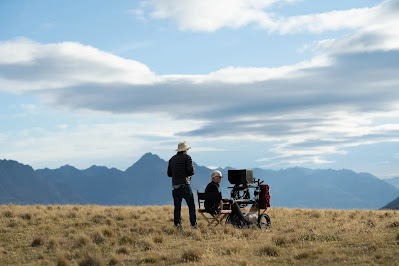
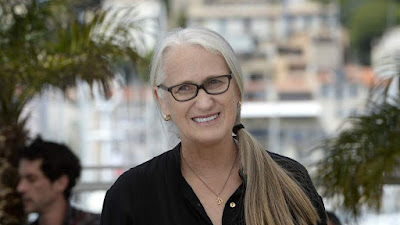
Director Jane Campion


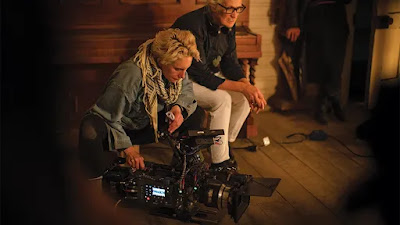
Cinematographer Ari Wegner (left) with Campion

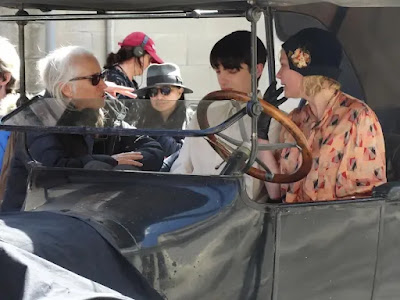
Campion checks with Kodi Smit-McPhee and Kristen Dunst

Campion checks the camera on the set


THE POWER OF THE DOG                        A                                                                        USA  Great Britain  Australia  Canada  New Zealand  (126 mi)  2021  ‘Scope  d: Jane Campion                                                                                                                                                                                                        Deliver my soul from the sword, my darling from the power of the dog.                                         —Psalm 22:20, King James Bible

Beware the unseen power of a scorpion bite, as that insidious poison infects the overall storyline of what we see, as there’s an underlying sting of macho dread and horror that underlies every frame of the film, haunting some, if not all, where a noxious male influence spreads untouched, like a Biblical plague that pervades throughout the land, wreaking havoc, destroying lives, literally running roughshod over the women, yet the story is beautifully told with a carefully calculated and complex mastery, producing a surprising outcome, imbued with such an understated discretion that it may leave viewers perplexed.  Her first feature film since Bright Star (2009), and her first male-led picture, Campion immerses her audience into a very specific time and place, the vastly underpopulated Montana in 1925, though sumptuously shot in ‘Scope in the Otago region of the South Island of New Zealand by Ari Wegner, capturing the breathtaking beauty of the surrounding landscape, whose enormity is captured in ways not seen since William Wyler’s THE BIG COUNTRY (1958), speaking a language all its own, literally dwarfing the human presence to solitary figures of near insignificance.  Adapting the Thomas Savage novel of 1967, Savage is an American author who described the conditions of the American West, while Campion’s film celebrates the rampant masculinity of the Western genre, but turns it on its ear, subverting the topic through a feminist lens, but couldn’t be more subtle, expressing a rare mastery of the Western landscape that exerts its own mysterious power, as the sheer look of the film is simply extraordinary, yet more than any other Campion film feels indebted to The Piano (1993), exposing the human flaws of the people attempting to tame the land, revealing a carefully calibrated characterization that typifies stories of the Old West.  We are introduced to two brothers who couldn’t be less alike, wealthy ranchers Phil Burbank (Benedict Cumberland in the role of a lifetime), a lone wolf, malicious and homophobic, college educated at Yale yet used to working with his hands, displaying all the standard markers of Western manhood, grace in the saddle, wit in the saloon, and an apparently unlimited tolerance for pain and discomfort, and his more generous brother George (Jesse Plemons) who manages the business, remaining steady and decent, honest and simple, but wears a suit in the saddle, constantly referred to as “Fatso,” with Phil bullying his brother, apparently, simply because he can, where an openly displayed derision is built into the dynamics of their relationship, despite sleeping in the same bed for nearly forty years.  Together they manage the day‑to-day running of their huge cattle farm, evoking some of the more spectacular scenery in the vast and open range as they herd their cattle back into familiar pens when the weather turns cold.  When George marries Rose (Kristen Dunst, his real-life partner), a kind, yet sad and overly anxious widow with an effeminate teenage son Peter, Kodi Smit-McPhee, grown up from the 10-year old kid following Viggo Mortensen around in John Hillcoat’s version of Cormac McCarthy’s apocalyptic The Road (2009), also Slow West (2015), Phil is appalled and explodes with a virulent anger, tormenting Rose and her “sissy” son with cruel mockery, emotional cruelty, and threats of violence, pitting a cold, Machiavelli-like superiority complex against what he perceives as weakly and undeserving intruders, turning Rose into a closet alcoholic as her own protection from a man she views as a beast.  A vicious, yet spectacularly filmed movie, this overblown toxic masculinity that Phil represents influences every scene of the film, literally carrying the picture with its own infectious energy, providing the nuance and rhythm of the film, yet subverted by a feminist touch, extremely rare to see, especially done as well as this.  Premiering at the Venice Film Festival, it won a Silver Lion for Best Director, and may be the most important film Campion has ever made.    

A rich and challenging psychodrama broken into chapter headings, offering brilliant character development, the film is a picture of restraint, yet thrives in its own brooding intensity, where Cumberland mirrors the misanthropic amorality of Daniel Day-Lewis’s Daniel Plainview, offering an early capitalist counterpoint to the enthrall of Paul Thomas Anderson’s There Will Be Blood (2007) set in the same time period, similarly scored by Jonny Greenwood with an unsettling musical soundtrack that captures the essence of the underlying tension with simple guitar strums, expanded to a more abstract musical accompaniment that accentuates the emotional strains below the surface, turning this into a quietly sustained horror movie, filled with an underlying dread.  Yet the film’s first lines (differing from the book, omitting the first third of the novel) come from Peter in an unseen voiceover during the opening title sequence, pondering “When my father passed, I wanted nothing more than my mother’s happiness.  For what kind of man would I be if I did not help my mother?  If I did not save her?”  This quotation stands alone, never referred to again, and is seemingly forgotten over time, in stark contrast to the daily scenes of cattle ranchers leading a hardscrabble life out under the hot sun, roping, fencing, branding, pitching hay, and castrating cattle, which Phil proudly performs without wearing gloves, the only one who scorns that practice.  So their calloused hands are used to getting blisters, cuts, and splinters, making this the brother’s twenty-fifth year together driving cattle from the southwest Montana plains.  Yet Campion adds an alternative female gaze perspective, showing the men stark naked while bathing in the creek, then lounging on the rocks afterwards, sunning themselves in nothing but their birthday suits, with their hats carefully placed over their privates.  It’s the kind of scene never shown in earlier Westerns, which would instead accentuate the male bonding experience, where spending time out in the open range allows men time to think and ponder their existential situations.  Yet there’s very little of that here, as the men are indistinctive, becoming a Greek chorus of conformity, led by Phil as their leader, following his every move.  Phil takes great care to acknowledge his predecessor, Bronco Henry, recalling the glory days of his dead mentor, the original leader of the pack, where a shrine in his honor rests out in the barn, along with his saddle that Phil fastidiously keeps polished and clean, unlike his own body that he rarely ever bathes, perhaps once a month in the creek, never bathing at all in winter.  Rose runs a boarding house in nearby Beech, a small town where her husband used to practice medicine, serving patients who often couldn’t pay, yet his late descent into alcoholism and depression is a disturbing revelation, where his early demise has left Rose to raise her son alone, where Peter is seen displaying extraordinary patience and a skilled artistry in creating paper flowers from cut paper that are extremely lifelike, with Rose proudly placing them on the tables for her customers.  Yet when Phil brings his ranch hands into town, Peter quickly becomes the object of Phil’s derision, mocking his voice, his hand towel, and for painstakingly crafting the delicate flowers, using one to light his everpresent cigarette, dumping it in a used glass, while his men join in offering more scorn, with Rose scurrying to collect the table arrangements before more are destroyed.  Peter storms out the back, trying to ignore what happened, leaving Rose weeping in the kitchen, comforted by George, who remains in the background for the most part, yet is forced to apologize for his brother’s open cruelty.     

There’s an unsettling nature to the depiction of male masculinity as being intentionally cruel and hurtful, which only escalates when George decides to marry Rose, viewing her with an affectionate tenderness Phil would never understand, railing against her with all his will, refusing to welcome her to the family, calling her “a cheap schemer,” certain that she’s after their money, becoming a menacing force, particularly when they all move into a huge, cavernous ranch house with two servants, Geneviève Lemon from Sweetie (1989) and Thomasin McKenzie from 2018 Top Ten List #5 Leave No Trace, turning into a chamber drama, much of it shot through doors or windows, reminiscent of John Ford’s THE SEARCHERS (1956), where the floor creaks and every door and window can fly open any second, feeling a bit haunted to Rose, particularly when her bedroom is located right next to Phil, who can hear every sound, seething with anger in what has been his own personal domain, master of his own house, now infested by a women he perceives to be an interloper and gold-digger.  When Peter comes home from medical school and joins them, Phil immediately identifies him as “Little Lord Fauntleroy,” mocking his slight lisp, with the Greek chorus joining in with the catcalls, calling him “Nancy Boy,” instantly thought of as soft, a young man smothered by his mother’s affections, labeled a gay blade.  Decorated to the hilt with slim jeans, a white shirt and an oversized white cowboy hat, the kid fits the part, yet he has a secret life unknown to the others, as he’s studying to be a doctor, catching rabbits only to dissect them for practice, something Rose forbids in the house, as it can be viewed as a gruesome hobby.  George proudly delivers a baby grand piano for Rose, who once played in the pits for Silent movies, continually prodded into playing by her husband, as if turning her into a spectacle that she has little interest in becoming.  Nonetheless, she awkwardly practices the Radetzky March, Johann Strauss Sr.: Radetzky March piano - YouTube (2:55), continually playing the wrong notes, a metaphor for her excruciating struggles, yet what’s worse, Phil is sitting in his room playing the same tune on the banjo, only playing it better, always having the upper hand, whistling the tune when he sees her, where his psychological campaign of terror leaves her exhausted and emotionally depleted, continually feeling diminished and weak, driving her to drink, shrinking back to being a little girl, living in a delusionary world of her own, losing all grasp of reality.  Yet Rose is the key component, as neither George nor Peter appreciate the way Phil treats her, literally manhandling her, keeping her under his thumb, scoffing at her acute weakness and lingering depression.  Still, no one stands up to him, as he remains top dog of the manor, and what he says goes.  The brother’s split their profits 50/50, as they always have, yet it’s clear who actually runs things, though Rose has mysteriously come between them, becoming a thorn in his hide.  Taking a different tact, Phil decides to befriend her son Peter, help turn him into a man by teaching him how to ride, going on extended trips together up into the mountains, offering extensive hands-on experience that he would otherwise never receive, becoming the mentor Bronco Henry was to Phil.  While Rose is in alcoholic distress, Campion curiously weaves Brokeback Mountain (2005) homoerotic overtones into Phil’s own repressed sexuality, seen alone bathing himself in his own private spot by the creek, sensually caressing himself with an old handkerchief that once belonged to Bronco Henry, with Peter finding his hidden stash of magazines that showcase the naked male physique, offering a window into his suffering soul of always having to fend off any pain, never allowing anything to affect him, always living up to a mythical façade of Bronco Henry, who was impervious to pain or weakness.  So it comes as a bit of a surprise that a mysteriously reconciled Phil and Peter have their own tender moments together, particularly a quietly extended scene in the barn that coolly observes cracks in the armor, sharing a cigarette, hearing anecdotes about Bronco Henry, solidifying their relationship, with Phil, against all odds, hoping to turn him into a man.  The calculated twist at the end comes as a huge surprise, with Campion cleverly inverting nearly everything that has come before, where tragedy takes on a dramatically different face, using the same subtlety and restraint that has pervaded throughout the entire film, telling a significantly different story than the one we imagined.    

Friday, February 3, 2017

2013 Top Ten List #9 Top of the Lake


TOP OF THE LAKE – made for TV        A     
Australia  Great Britain  (350 mi – 7 episodes) 2013 d:  Jane Campion and Garth Davis   

You can be very hard. And what I don't like is that you think it’s strength.    
—Robin’s mother Jude Griffin (Robyn Nevin) 

There’s no match for the tremendous intelligence of the body.     —GJ (Holly Hunter)

There has been a gradual introduction of movies made for television into film festivals, where the Melbourne and Telluride Film Festivals were among the first to program the three films in the RED RIDING TRILOGY (2009) made for British television, while the full-length, 5-hour French version of the Olivier Assayas film Carlos – made for French TV (2010) premiered at Cannes, and the Venice Festival premiered Todd Haynes’ MILDRED PIERCE (2011), all to critical acclaim.  This year Jane Campion’s feminist noir TOP OF THE LAKE became the first television series to ever premiere at the Sundance Film Festival, later screening again at Berlin, a 6-hour jointly produced BBC and Sundance Channel film TV miniseries spread out over 7 episodes, though the pacing and burning intensity are much more effective when compressed into a single viewing, especially without having to undergo commercials and the repeating credit sequence.  Since it had been four years since she made a film, Campion reveals her thoughts on finding more freedom working in television from the Hollywood Reporter, “Feature filmmaking is now quite conservative. The lack of restraints, the longer story arc:  It's a luxury not there generally in film.”  Campion’s An Angel at My Table (1990) was originally produced as a New Zealand television miniseries, but was re-edited and released internationally as a film.  Set in Laketop, a small town set on a gorgeous lake in a remote and mountainous area of New Zealand (actually shot by Adam Arkapaw at South Island’s Moke Lake and the cities of Queenstown and Glenorchy, including Lake Wakatipu seen here:  1,280 × 960 pixels), Elisabeth Moss plays Robin Griffin, a big city Australian police detective from Sydney with a specialty in child investigations, who happens to be visiting her mother who is stricken with cancer, but it’s also something of a coming home experience, as she grew up in the region as well.  Called in for an emergency, the local police, under the command of Detective Sgt. Al Parker (David Wenham), have a pregnant 12-year old Thai girl named Tui Mitcham (newcomer Jacqueline Joe, supposedly discovered at an Auckland swimming pool), who may have been attempting a miscarriage or drowning herself in the lake.  What’s immediately clear is not just the plight of the child, but the antiquated male-dominated police procedures where women continue to be leered at as sexual objects, routinely called sluts (or worse), and crimes against women are not really taken seriously by anyone in town, seen more as the usual sport between a man and a woman, so no one respects Robin’s authority on the case and can be heard making snickering comments on the side.  No one, for instance, takes the crime of rape against a 12-year old girl seriously except Detective Griffin, where they all heartily agree to her face that she’s right but then make no effort whatsoever to find the rapist.

It’s no accident that the best episodes are directed by Campion herself, including the first, fourth, and final two episodes, feeling almost mythical, featuring some stunning performances, where the richly detailed pieces of information unraveling in the opening few minutes are nothing less than intoxicating, filled with the beauty of the landscape, local color and plenty of eccentric characters.  Echoes of David Lynch’s TWIN PEAKS (1990 – 1991) are evident, especially in the exotic setting, the small town mindset, a body washed ashore, the toxic effect of holding onto secrets, strangely offbeat characters, and the presence of an outsider, in each case an abnormally astute police detective.  Like Laura Palmer, Tui is at the heart of the film, attractively appealing and the picture of innocence, as no one knows the truth about her, especially after she reveals the name of the father is literally “no one.”  Through Tui, Campion seems to be suggesting that women’s behavior in particular is a product of family dynamics, the surrounding community values, and the random events that comprise our lives.  What’s perhaps most frightening is the callously disturbing and pathological behavior of her father, Matt Mitcham (Peter Mullan at his most sinister), the town’s drug lord whose two sons are equally psychopathic in carrying out his dirty business (where the patriarchal family circle is actually Matthew, Mark, Luke, and John).  We see evidence of their nonchalant brutality in an opening scene, where they haven’t an ounce of concern for human life, living in a heavily armed fortress compound protected by modern surveillance equipment and intentionally starved pitbulls that run rampant.  When Tui quickly disappears, we begin to understand what it might be like as a girl growing up in this town.  This exact same subject is then explored through black and white flashback sequences, as Robin suffered her own share of childhood trauma growing up in this town, where the parallel lives of Robin and Tui remain linked throughout the film.  Interestingly, Elisabeth Moss was not the first choice for the film, as Campion offered the part to Anna Paquin, who declined due to her pregnancy, and when the part was offered to an American actress, the Australian Broadcasting Corporation pulled out of the project, insisting that it would only fund the film with an Australian or New Zealand lead actress.  The choice of Moss is literally perfect in the role, where it’s hard to think of the film without her, largely because she never overacts or displays too much, and though she is deeply scarred, reminiscent of Jodie Foster’s tenuous predicament as Clarice Starling in THE SILENCE OF THE LAMBS (1991), she continues to be defined by her intelligence, constantly guarding her thoughts, where the impact of others can easily be read upon her face, an opaque presence that mirrors the world around her, remaining mysteriously vulnerable and even fragile while standing up to a dominating male presence.

What distinguishes this film is the densely plotted novelesque quality, where even comically drawn secondary characters are significant to the overall portrayal of humans desperately in need, where there’s an untapped ferocity of spirit seen in both Tui and Robin.  Adding to this picture of a lone voice in the wilderness is an inspired idea to create a separatist women’s collective, a Greek chorus of damaged women living together in trucked-in shipping containers at a lakeside retreat called Paradise that sits on disputed land, as Matt claims they’re trespassing, a rag tag group of exiled women led by Holly Hunter as the dispassionate GJ, a guru-like presence in pants spouting Zen-like philosophic utterances, as if she can read each person’s future, but possessing the deranged personality of a social misfit herself, often seen pacing the grounds while off in the distance a few naked women are continually seen running free.  The lustful nature of the women is part of the untold story, including the sexual promiscuity of several of the women living on the compound, including a memorable scene from Geneviève Lemon (the 7-minute woman) who played the lead role in Sweetie (1989), as the men in town are perceived as testosterone fueled adolescents, especially in the moments Robin spends enduring endlessly abusive taunting by men in bars, yet woman have to find their place in an existing contemporary landscape, including Robin’s own sexual desires, seen developing for Johnno (Thomas M. Wright), a childhood sweetheart and one of Matt’s offspring, a good son that rejects the maniacal nature of his tyrannical crime boss father.  The two are a sexual force bonded together by her childhood trauma, where Johnno was her high school prom date and suspiciously absent afterwards on a night she was brutally gang raped by four drunken men.  This trauma gives her all the more reason to protect Tui, even if the town has given up looking for her, suspecting she must be dead after the passage of two months.  There’s an interesting thematic projection of men’s fears and limitations, expressed through the perceived effects of hostile elements, as no one thinks she could survive out there alone in the cold, while the repeated mention of the lethal quality of the water is always described as so cold that “no one could survive in that water.”  Yet somehow, just when Robin is told her mother has terminal cancer, easily one of the key moments in the film, intimately captured with the camera holding completely onto Robin’s face, at that exact moment when all hope is lost, there is also a chance that Tui has somehow survived.  

Tui’s absence changes the nature of the film, as her unseen presence, Robin’s own personal trauma, and her mother’s impending death all blend together and continually haunt Robin, who becomes the film’s dominant force, as events are continuously seen through her eyes.  The on again and off again relationship with her boss, Al, always seems to be of secondary importance, part of the police procedural component of the film, as their presence together is usually mandatory.  But his exclusively male take on events offers a differing viewpoint than her own, but Campion is careful not to make him one-dimensional, where he’s one of the more complexly drawn characters in the film, though never entirely likeable, especially as he’s seen to be in cahoots with Matt’s criminal empire, usually protecting him or tipping him off about upcoming police activities.  But Robin doesn’t know this and continually exposes a vulnerable side to him, where her life is an open book while we know almost nothing about him.  His extravagant home offers a clue, and is the setting for one of the more controversial events in the film, as he invites her over for dinner where she stupidly drinks too much and eventually passes out, waking up alone in his bedroom the next morning wearing one of his shirts.  He reassures her that nothing happened, that she vomited all over her clothes, so he was forced to wash them, all of which sounds like a perfectly acceptable explanation.  And that’s the problem with Al’s character, as his answers are too pat, sounding overly detached and too well reasoned ahead of time, never speaking passionately in the moment, where what comes across is an arrogant and pompous man that’s used to getting his way and never having to answer for it.  Al typifies the male mentality of the town, even if Matt is the Alpha male, while he sits quietly lurking in the background collecting his cut of the overall operations, running a secret Ecstasy and amphetamine lab underneath Matt’s home.  In contrast to Robin and Al, Matt has his own sexual experience with one of the women from the compound, Anita, Robyn Malcolm, who simply craves male companionship.  Their hallucinogenic outdoor experience in the woods on Ecstasy is unusual for how it sensitively portrays a ruthless crime boss at his most vulnerable state, used much like the LSD cemetery sequence in Easy Rider (1969), where the dealers are seen under the influence of their own drugs, often haunted by impending thoughts of death and mortality.    

At some point, and one barely realizes when it occurs, the focus shifts from the overly destructive and malicious behavior of the adults to the often misunderstood and more innocent motives of kids, where a strange young girl (Georgi Kay) dropped off at the women’s compound is continuously seen playing an electric guitar in various natural outdoor locations, NEW Ipswich- Georgi Kay (live) (4:50), offering voice to a new and different force that hasn’t been seen much or heard from, namely the next generation, Tui’s generation.  Robin interrogates a young boy for shoplifting, Jamie (Luke Buchanon), seen crossing the lake in a kayak, suspected of bringing food to a drop site, significant as he’s one of Tui’s best friends, perhaps even the father.  Jamie has the unusual habit of not speaking to adults, so Al tries to knock some sense into this kid, using decisively forceful measures until he’s thrown out of the interrogation room by Robin.  The kid disappears the next day, along with all the food in the refrigerator and kitchen cabinets, leading to a kind of idyllic Lord of the Flies gathering of kids in the woods without the presence of a bullying leader, where we discover the re-emergence of Tui along with boatloads of friends.  But Matt and his gang are soon on to them, forcing a very pregnant Tui and Jamie to escape, only to lead to certain tragedy, which has a horrific effect, especially within the women’s compound.  The slowed pacing also reflects a kind of impasse, a turning in the tide, where some of the women are finally willing to stand up to these powerful men, refusing to be scared or intimidated by them.  In a memorial sequence for one of the lost kids, Georgi Kay - Joga (Top of the Lake - Jamies memorial scene ... (2:40), featuring Mirrah Foulkes as the distraught mother, some may be shocked or confused at just how unmanly the women are, as they don’t go the Eastwood vigilante route and demand justice through the power of a gun or through brute strength, which is what movies have trained us to expect, but this psychological transformation has been slow in coming and continues to evolve at an excruciatingly slow pace, yet it’s among the more unique scenes in the film, as the women collectively express a quiet desperation without any hint of violence, viewed as an exclusively male domain.  

The finale goes even further down that road, where the discovery of a date rape drug figures prominently into the tortured lives of teens, many of whom in the past have ended up dead under mysteriously unexplained circumstances.  It’s all a bit alarming, but it also figures into Robin’s own past, where it doesn’t do her any good to dig too deeply into the heart of her own trauma, never wanting to meet the child she gave up for adoption as she never wanted to explain to a child that they were the product of a gang rape, thinking this revelation could induce suicidal thoughts of zero self-worth, deciding it’s better to “Fuck the truth,” where life is so much more complicated than we could ever imagine, where human behavior is simply too despicable.  One theme Campion appears to be advocating is that the more attention paid to pain, the worse things often become.  The movie can be shocking at times with its spurts of sudden violence, but in this film it’s not about women chasing after vengeance, where the obsession for justice only creates more injustice, as it’s so easy to lose sight of the arc of your own life, but it also shouldn’t be some inhumane evil that we continually answer to.  In the end, the film veers into an ambiguously disturbing road movie, like a journey through an existential wasteland, actually discussed at great length in the women’s group talkathons, which are almost a parody of self-help groups, where GJ often berates their whining and moaning, claiming they’re “madder than ever,” saying she needs to “just get away from these crazy bitches,” getting as far away as she can, yet still taking us on an interior journey more self-reflective and psychologically complex than what we’re used to from crime dramas, like say the highly successful THE MILLENNIUM TRILOGY (2009).  Actually it’s more like the continuing arduousness of The Odyssey, a prolonged journey filled with epic challenges, where the hero survives only by extraordinary cunning and perseverance, where likewise the collective effect of this film is an assault on the senses, causing a shock to the system and a rewiring of the circuitry, finding oneself at the center of a great human tragedy, offering no societal cure or moral answers, nothing more than the brave choice of learning how to discover our own humanity, often the last one thing we pay any attention to as we’re so busy navigating our way through life.  But in the end, eerily enough, someone, perhaps even Robin, is going to be in a position to help raise a child that is the product of gang rape, as the cycle of life continues where we’re continually forced to face our worst fears.