|
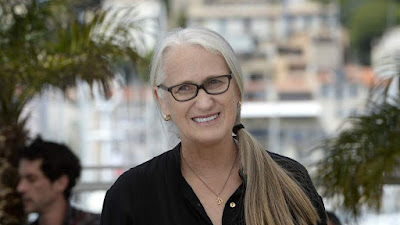
| Ethan Coen and Tricia Cooke |


 |
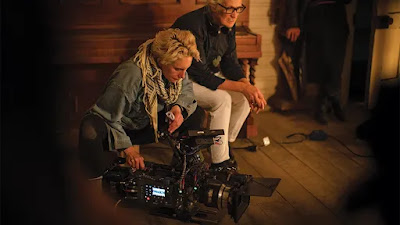
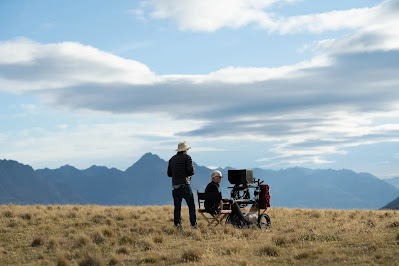
| The directors on the set |
 |
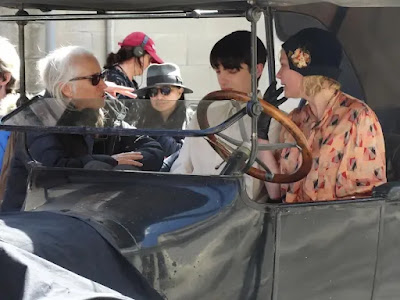
| Ethan Coen directing a scene |
DRIVE-AWAY DOLLS B- USA (84 mi) 2024 d: Ethan Coen and Tricia Cooke
Love is a sleigh ride to hell.
Not to be confused with DOWN AND OUT WITH THE DOLLS (2001), the Portland all-girl band movie by Kurt Voss, Joel and Ethan Coen have not made a movie together since The Ballad of Buster Scruggs (2018), each going their own separate way, with the older Joel making the murky, heavily atmospheric Shakespearean drama with Denzel Washington and his wife Francis McDormand, 2022 Top Ten List #5 The Tragedy of Macbeth, while the younger Ethan, in collaboration with his openly lesbian wife Tricia Cooke (which is a story in itself, with clear autobiographical elements that she co-wrote, edited, and produced, both brothers working with their respective wives), made this screwball lesbian comedy that was largely inspired by Cooke’s queer youth in New York City’s dyke bars in the 80’s, which at that time were considered communal safe spaces for lesbian women (see Nan Goldin in the Laura Poitras film, 2023 Top Ten List #2 All the Beauty and the Bloodshed). While there used to be two hundred lesbian bars in the U.S. during the 1980’s, those numbers have been steadily dwindling (There's 32 Lesbian Bars Left in America. Here's Where ...), so this may be a very deliberate love letter to lesbian bars, while also a satiric response to the current political wave of extreme Republican homophobia, especially in Florida. Actually written back in the 90’s under the original title DRIVE-AWAY DYKES, which was deemed unsuitable by the studio and Motion Picture Association, concerned about negative connotations, they were unable to get financing at the time for anything that wasn’t deemed serious, so the project sat on the shelf for years. They thought their West coast friend Allison Anders, who directed her own idiosyncratic road movies Border Radio (1987) and GAS FOOD LODGING (1992), would direct the film in 2007 with Selma Blair, Holly Hunter, Christina Applegate, and Chloë Sevigny on board, which sounds like a blast, actually, but it simply wasn’t to be, as there wasn’t a cultural acceptance of LGBTQ characters at the time. The Covid pandemic gave them time to revisit the earlier work, where Cooke is actually a co-director, but since she’s not a member of the director’s guild, she is not credited. Somewhat reminiscent of the zany comedy of the politically subversive spy thriller BURN AFTER READING (2008), made during a time when making fun of the bungling misadventures of the Bush government was commonplace, this retro take on the seemingly simpler times of 1999 offers a raunchy yet nostalgic glimpse of a lesbian subculture tucked away from a more conventionally mainstream America, which also happens to be the beginning of an era of stifling conservatism that still exists today, offering a wild ride of a road movie that none of us ever actually took, but who says it has to make sense, where the absurd nonsense of sex jokes and off-the-wall humor is an entertaining mess that has its moments, but is also hard to appreciate, feeling more like a discarded script by the Farrelly brothers. Universally panned by critics, perhaps it never lives up to its ambitious stab at making lesbians likeable and easy to identify with. And that may be the biggest flaw, as the exaggerated caricature is simply not for everyone, making it hard to like any of the characters, who are so over-the-top to the point of being ridiculous, but perhaps that’s the point. Apparently all this really wants to do is have a few laughs, with some neo-noir crime elements, road trip comedy, raunchiness, and a bit of mystery surrounding this adventure that sounds like a wacky delight, with eclectic musical selections assembled by music supervisor Tiffany Anders, the daughter of Allison Anders, like Le Tigre - Eau D'Bedroom Dancing YouTube (2:55) or Lizzy Mercier Descloux - Fire YouTube (5:15), but it never really comes together, feeling anxiously chaotic and randomly stitched together in the editing. Fueled by plenty of ideas, this tries to capture the sleazy energy from 60’s and 70’s B-movies, like Russ Meyer’s FASTER, PUSSYCAT! KILL! KILL! (1965), or an homage to the queen of underground sexploitation movies, Doris Wishman, where a clip from one of her films, Deadly Weapons (1974), was featured in the John Waters’ slasher film SERIAL MOM (1994), but it fails to find that excitement level, though this is reportedly the first of a planned “lesbian B-movie trilogy.”
An LGBTQ film like you’ve never seen, even featuring explicit girl-on-girl sex, this brings queer cinema into the mainstream, where a road movie with a queer storyline may have made waves back when it was initially written, but complex queer characters and queer sex have long since arrived in the mainstream, becoming a differently envisioned ode to freedom and happiness, like THELMA AND LOUISE (1991) as a queer couple on the run with a happier ending, where the bright, visual canvas is provided by Ari Wegner, the visionary force behind the camera of Jane Campion’s 2021 #1 Film of the Year The Power of the Dog. According to Cooke in a Moviemaker article, “Being married to Ethan and being queer, there’s always a little disconnect sometimes,” yet this film champions female empowerment. Maybe these aren’t the characters we’ve come to expect in movies, feeling more like the shallow world that we see routinely on television, but these days the line between movies and television is not that distinct, as it’s all blurred together into one hot mess, and this film reflects that amalgamation. Most films benefit by being shown in theaters, as the screen is bigger and the sound is incredible, but in this film, not so much. How it really improves, though, is being in a communal audience where you can hear and appreciate the spontaneous outbursts, which opens up new possibilities we may have missed, but honestly, that’s a stretch, as this film needs all the help it can get. There’s probably a joke that starts with, “A girl walks into a lesbian bar,” which seems to be the premise for the film, then providing any number of multiple scenarios. While it’s amusing in an oddly flat sort of way, it just never takes off, with a few diversions down memory lane that are less than memorable. Perhaps the most obvious example is the nearly indecipherable Southern drawl from lead actress Margaret Qualley as the high maintenance yet free-spirited Jamie, who serves as a kind of insatiable alpha-lesbian from Texas, perhaps channeling Holly Hunter in RAISING ARIZONA (1987). And if you haven’t seen it, check her out in this wild dance video by Spike Jonze, Kenzo World - Spike Jonze YouTube (3:55), which ostensibly served as her audition, as she’s all over the place, exhibiting astonishing range. This is the same actress used so effectively by Claire Denis, mired in the intellectually measured, clandestine political intrigue of Stars at Noon (2022), going completely bonkers here in an unhinged example of girl power, where she’s an unrestrained illustration of sexual liberation, unable to confine herself to a single partner, even bragging about it at an open mic lesbian bar. That proves to be her ultimate undoing, as her partner Sukie (Beanie Feldstein), a local cop with aggression issues, kicks her out for her acknowledged serial cheating, but she quickly finds a comfortable landing spot with the more practical and sexually uptight office worker Marian (Geraldine Viswanathan, an Australian actress of Indian and Swiss descent), who of all things, is planning a road trip to Tallahassee, Florida to go birding with her aunt. It’s Marian’s level-headedness that grounds the picture, offering intelligence and humor, while the more scatterbrained Jamie can go flying all over the place (in sync apparently with the editing), becoming a lesbian Odd Couple road movie. Rather than just drive, they decide to utilize the drive-away car service of transporting someone’s car one-way, which lessens the cost considerably, but instead of plotting the quickest and safest route, Jamie decides to take detours to a bunch of lesbian bars along the way, because who knows when they’ll ever come this way again, which pits their diverse, starkly contrasting personalities in motion, with Jamie chasing casual hook-ups, constantly urging Marian to loosen up and get laid, since it’s been years (with a Ralph Nader staffer, nonetheless), but she prefers to read Henry James’ The Europeans, insisting that is fun. While the film is brazenly proud about being lesbian forward, sending a message of queer female empowerment, the actual storyline is unrelated to the characters’ sexual orientations, which are instead explored through dialogue and heavily circuitous side plots. The jarringly disconcerting opening sequence in the back alleys of Philadelphia haunts the entire picture, as a devious crime was committed that just happens to plague their jaunt across the country, though the events are seemingly unrelated. When Jamie decides to pick up her stuff at Sukie’s apartment, there are drawbacks, yet this scene epitomizes the type of ribald humor used throughout, DRIVE-AWAY DOLLS - "That Was A Gift " Official Clip - Only In ... YouTube (56 seconds). In a lesbian drama, the male penis, apparently, has hilarious ramifications, becoming the core aspect of male patriarchy that must be subverted.
A group of inept mobsters led by Colman Domingo, along with C.J. Wilson and Joey Slotnick (both cast in Ethan’s off-Broadway theater production of A Play Is A Poem), strongly reminiscent of Steve Buscemi and Peter Stormare in Fargo (1996), under orders from an unseen crime boss heard on the phone, are on the lookout for the drive-away car, as it contains something they view as essential. Yet somehow, someway, there was a mix-up by the car service giving to the girls what was intended to be their car, Drive-Away Dolls Movie Clip - Don’t Call Me Curlie (2024) YouTube (42 seconds), providing them access to a suitcase with questionable contents, becoming a comedy of errors, like some kind of ode to Robert Aldrich’s Kiss Me Deadly (1955), or the on-the-run-from-the-mob zaniness of Billy Wilder’s Some Like It Hot (1959). So while there’s a breezy, lightweight comedy of lesbian thrill seekers, erupting into something along the lines of spring break, there’s also a band of gunmen trying to track them down, but are stymied by their inexplicable route digressions. This adds a dark side to the jaunty fun that the girls seem to be having, but the most unexpected detours are recurring flashbacks to the psychedelic era of the 60’s, complete with period artwork that’s neither funny nor insightful, with cameo appearances from two unforeseen stars. The first is a billboard advertisement for virtuous all-American Senator Gary Channel (Matt Damon) preaching family values, eventually finding himself in an uncompromising position, a clear shot at the current homophobia in Florida, and the other is an uncredited appearance by Miley Cyrus as hippie flower child Tiffany Plastercaster, aka visual artist Cynthia Plaster Caster (the film is dedicated to her), who gained fame from making dildos of the erect penises of various rock musicians and celebrities. She appears in TV advertisements that resembles turn-of-the-century computer animation for a one-of-a kind “groovy” experience that is enveloped in free love and flower power psychedelics, uttering “Hey handsome, you want to get plastered?” with Eddie Hazel’s high wire guitar solos swirling around in the background, Funkadelic - Maggot Brain [HQ] YouTube (10:34), which may or may not have anything to do with this film. Once more, the male penis, in this case the Senator’s (a nod apparently to his youthful transgressions in the 60’s), plays a prominent role in this lighthearted comedy, having a little fun at someone’s expense, which becomes the central focus of the drama, secretly meeting our girls in a lesbian bar where they attempt to extort what they have that belongs to him, DRIVE-AWAY DOLLS - "Democrats" Official Clip - Now ... YouTube (49 seconds), but he only ends up finding himself in an even more compromising situation. But two smaller scenes really stand out for their sheer originality, one is when our protagonists crash a slumber party of teenage girls and end up making out with an entire soccer team to the music of Linda Ronstadt, though there was never a thought that Linda Ronstadt’s music could be considered lesbian music, but hey, it’s all in the mind of the beholder, and they appear to evoke powerful memories, though the two songs heard, "Long Long Time" by Linda Ronstadt from DRIVE-AWAY DOLLS YouTube (4:24) and Linda Ronstadt - Blue Bayou (Official Music Video) YouTube (4:18), are not from the 1976 record album shown on a coffee table, Hasten Down the Wind. Nonetheless this scene certainly gets Marian’s juices flowing, tempting her in ways she can’t refuse, while the other is one of Marian’s flashbacks. As a child, she loved jumping on her trampoline, and if she jumped high enough, she could see over the fence at her neighbor next door, discovering a bare-assed Savanna Ziegler (in her first role) sunbathing and swimming in the nude, a welcome sight for repressed sexual desires, which feels like an ultra-personal childhood memory that simply reeks of authenticity, mirroring a similar scene in A Serious Man (2009). This oddball film stands in stark contrast to the overbloated, overproduced films that seem to dominate the awards season, where fantasy, sci-fi, and superhero movies have become an American cultural affectation. Setting out to make an “unimportant film,” the knock on this may be the incessant juvenile antics on display, where it’s uneven, at best, exhibiting a heavy underutilization of supporting characters, where many just disappear without a word, feeling more along the lines of the underwhelming Hail, Caesar! (2016) than what we have come to expect from the superlative work of the Coens.