Showing posts with label George Segal. Show all posts

Sunday, November 28, 2021

The Hot Rock


Director Peter Yates

ensemble cast photos


THE  HOT ROCK      B                                                                                                               USA  (101 mi)  1972  ‘Scope  d: Peter Yates

A somewhat quirky comedy of errors movie that is a combination of character study and heist film gone wrong that got poor reviews at the time of its release, yet is something of a hidden gem to watch, offering a time capsule of Manhattan in the early 1970’s, with an aerial helicopter shot that beautifully merges the Hudson River with New York City skyscrapers, providing ample evidence of the still-under-construction twin towers of the World Trade Center buildings clearly seen when they were nearing completion.  With more than a hundred novels and non-fiction books to his credit, specializing in crime fiction, Donald E. Westlake had been providing material for some of the better American thrillers for years, usually centered around a single character, where he is perhaps best-remembered for creating two professional master thief criminal characters who each starred in a long-running book series with over a dozen books, starting with the relentless, hardboiled Parker, published under the pen name Richard Stark, where his 1962 novel The Hunter was the source material for John Boorman’s Point Blank (1967), later introducing the more stoic and notably pessimistic John Dortmunder, where bad luck seems to find him, developing the reputation of being jinxed, allowing the author to explore greater aspects of unexpected humor.  Written in 1970, adapted for the movie by heralded screenwriter William Goldman, this was the first of the Dortmunder novels, the protagonist of 14 novels and 11 short stories published between 1970 and 2009, a character known for his careful and meticulous planning, where there’s literally nothing he can’t steal, yet he’s twice been convicted of burglary, where hanging over his head is the knowledge that a third conviction will mean that he will be sent back to prison for the rest of his life with no chance of parole.  Yet moments after his release from his second stint in prison, he’s already plotting the masterplan for a new crime.  According to Westlake, this started out as one of his darker Parker novels, but that “it kept turning funny.”  Essentially a story involving a precious gem that is stolen, lost, reacquired, stolen again, lost again, becoming a revolving door of utter futility, featuring a likable yet bumbling cast of characters, where despite their best efforts, something always seems to go wrong.  In the eyes of British director Peter Yates, who had a short-lived career as as a professional race car driver, he actually preferred this movie to the much more acclaimed Bullitt (1968), proving there’s just no accounting for taste, yet this film accentuates characters who, “like many people, plan things all their lives and never have it work out.”  While the film was surprisingly nominated for an Academy Award for best editing, what stands out is the eloquent and sophisticated quality of the jazz score composed by Quincy Jones, where each of the musicians are listed in the end credits, an unheard of practice at the time. 

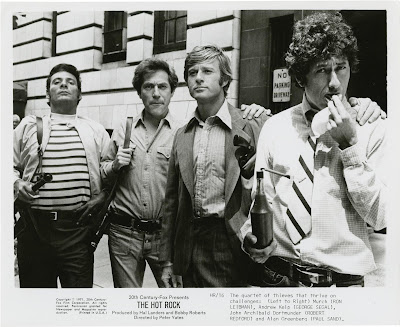
Robert Redford plays Dortmunder, having recently learned the trade of plumbing while in prison, met on the outside in a stolen Cadillac by his perky brother-in-law Andy Kelp, George Segal, a locksmith whose cheerful optimism is the polar opposite of Dortmunder’s dour reticence, schmoozing up to him while making immediate suggestions, as a giant African diamond, the Sahara Stone, is currently on display in the Brooklyn Museum, the crown jewel of a former British colony that was recently granted independence and split into two nations, remaining a bone of contention between two rival African nations, unfortunately claimed by both ever since it was stolen during colonial days.  Hired by an unscrupulous United Nations ambassador representing one of the countries, Dr. Amusa (Moses Gunn), Dortmunder hires his team, including Kelp, of course, explosives expert Allan Greenberg (Paul Sand), learning his trade at the Sorbonne and from esteemed college campuses across the country known for expressing political dissent, and the gang’s driver, Stan March (a memorably over-the-top Ron Leibman), a jack-of-all trades who can drive anything, living at home with his cab-driver mother (Charlotte Rae), where his life is consumed by cars, yet his happiest moment is listening to audio LP recordings of the revving engines racing by from the Indianapolis 500 race for relaxation, and virtually every conversation he has includes a wildly detailed account of his most recent excursions in his car.  Despite careful planning, something always goes wrong, and the group must steal the diamond all over again, as the list of items needed keep accumulating expenses, yet the inventive aspects of each heist grow wildly imaginative, where the preposterousness of their daring acts is extraordinary to behold, becoming the template (along with the Ratpack’s original version of OCEAN’S 11 in 1960) for Soderbergh’s Ocean's film series (2001 – 2007), with an all-female spinoff in 2018, along with a host of other heist flicks, becoming an elaborate choreography of outlandish criminal acts mixed with well-known celebrities, recognized for displaying stellar ensemble casts.  The real flavor of this film is just how unlikely the personalities mesh, as they all kind of get on each other’s nerves, yet they’re all skilled at what they do.  Dortmunder, as the master planner, gets no more than the rest, each one distinguishing themselves in their roles, so it’s a carefully calibrated operation where everyone gets an equal share, yet the atmospheric jazz music gives this a cool, laid-back vibe, where the whole thing looks effortless.  The 70’s was a terrific era of American films, (In '70s, movies were more daring, real - Chicago Tribune), with many scholars claiming it was the greatest decade overall due to the arrival of a new young crop of directors, not only New Hollywood, but around the world.  Adding to the illustrious mix of Martin Scorsese, Francis Ford Coppola, Steven Spielberg, and George Lucas would be new talents like Hal Ashby and Alan J. Pakula, Sidney Lumet and Robert Altman, Barbara Loden and Elaine May, John Cassavetes and David Lynch, Gordon Parks and Melvin van Peebles, along with German New Wave legends Rainier Werner Fassbinder, Wim Wenders, and Werner Herzog, just to name a few. 

In an interview with Daily Blender back in 2017, Steven Soderbergh offered some insight into his Ocean’s films, An Interview with Steven Soderbergh | Daily Blender.  “There’s no rational reason why, as a kid, what I would call caper movies would have such an appeal to me.  But they always did.  There’s a great film called The Hot Rock.  It’s really good.  Robert Redford, 1972.  It’s hilarious.  You’ll see how much of an influence it was on the Ocean’s films.  That sense of humor.  I just like them.  That kind of humor and a sort of puzzle.  It’s something that movies are good for.”  When the film tanked at the box office, Redford blamed it on the British director, known for making action movies, contending this is a small, character-driven comedy filled with American humor that had a difficult time resonating onscreen.  Not so sure that’s true at all, as this is a comedy of misdirection, providing some zany, off-the-wall heists, carried out to perfection, yet something invariably goes wrong, something impossible to plan for, reality perhaps.  They’re such smooth operators that you have to admire their obvious skills, ability to improvise on the spot, and continuously throw others off-track, and while these are career criminals, their perspective is so calculated and so expertly realized that audiences will side with them, turning this into an ensemble buddy movie, where the extreme degree of personal flavor added only adds to our appreciation of them as a group overall.  They’re just a likable bunch, willing to go the extra mile to create and execute ingenious plans that carry a heavy entertainment value, where handing over the new shopping list of their requirements grows increasingly hilarious, and it’s not based on guns and explosions, or heavy gratuitous violence, and no sex to speak of, yet the ability to bring so much character development into the film works wonders, as we feel like we know these guys, having hung out with them for a good part of the film.  But things take a sudden and unexpected turn for the worse when we are introduced to a new character, the larger-than-life, fedora-wearing Zero Mostel as Abe Greenberg, a scene-stealer if ever there was one, a variation of his slimy role of Max Bialystock in THE PRODUCERS (1967), a man who could con anyone out of their money and do it with a smile.  He is the unexpected roadblock that puts the kibosh on all their hard-earned plans, suddenly outsmarted by a venerable old lawyer whose wretchedly underhanded tactics are the picture of corruption and sleaze, so extravagantly unorthodox and evil that even this cabal of thieves must sit back and admire, throwing a monkey wrench into their entire operations.  Mostel is so adorably repugnant that in the theater he would get a standing ovation for his mastery of sheer gall on display, taking a back seat to no one, where in a nod to THE MANCHURIAN CANDIDATE (1962), a hypnotist named Miasmo (Lynne Gordon) provides the missing ingredient.  Seeing as how this is a breezy, feel-good movie, it all works out in the end.  Bookending the beginning with Redford cautiously walking down the street after he gets out of prison, yet breaking into a playful dance at the end as he so effortlessly strolls across the busy streets and down the heavily populated Manhattan sidewalks of New York, confidently walking a couple of blocks, relishing his celebratory mood to the music of Dixieland, bringing the film to a rollicking curtain-ending close where it will likely leave you with a smile.  

Friday, April 25, 2014

California Split


CALIFORNIA SPLIT                    A
USA  (108 mi)  1974  ‘Scope  d:  Robert Altman

One of the unsung films of the 70’s, coming on the heels of Vietnam, Watergate, and ending with the resignation of President Richard Nixon in August, 1974, just two days after the American release, films such as Altman’s The Long Goodbye (1973), Polanski’s CHINATOWN (1974), Coppola’s The Conversation (1974), and this one all contribute to a pervasive feeling of nihilism running rampant throughout America, where a government of laws and even a Presidency that we once thought was sacrosanct are suddenly fallible.  Slamming the door on 60’s idealism, when the deflated hopes of the Civil Rights era and anti-war protests did not eradicate poverty, racism, or even ignorance, the 70’s was an era of especially edgy and well-made paranoid conspiracy thrillers in movies, including Alan Pakula’s Klute (1971), The Parallax View (1974), ALL THE PRESIDENT’S MEN (1976), and Sydney Pollacks’s THREE DAYS OF THE CONDOR (1975), all of which express an impending doom creeping into the moral fabric of society. But rather than deal with this issue head-on, Altman chooses to make a modest film where not a lot happens, yet the atmosphere is rich with intimate detail, becoming one of his loosest and freest expressions, feeling as if there was plenty of on-the-set improvisation. The film was unseen for decades other than out-of-print VHS tapes due to music clearances and copyright issues and when a DVD was finally released in 2004 there were three minutes missing, with specifics detailed here:  DVDBeaver.com [Gregory Meshman].  Nonetheless, this is easily Altman’s most naturalistic, Cassavetes-like film, especially the way the lead characters spontaneously break out into song at a moment’s notice, unleashing pent-up emotions, where this is largely a dense, character driven portrait of the effects of gambling addiction (the director and screenwriter are both recovering gamblers, where Altman acknowledges “At one time I could stand at a craps table for two days”), starring George Segal and Elliot Gould as Bill and Charlie, two compulsive gamblers, where one is unfortunately down-on-his-luck, while the other is a more free spirited soul that takes a liking to him.  Accentuating the authenticity of the gambling lifestyle, and the theme of addiction, the director chooses to use extras in the opening gambling sequence that are actually recovering drug addicts from Synanon, while also using real life gamblers and bystanders throughout the film from authentic locations

Mostly shot in gambling casinos using an 8-track recording device, which allows 8 overlapping layers of dialogue to be heard simultaneously throughout the room, this method creates a mix of chaos amidst a world on the verge of spiraling out of control, where the two are caught up in random events, where the attempt to gain control seems futile and senseless, yet their will to prevail feels infinitely complex and ultimately absurd.  While this is not an acid tinged, nightmarish vision, it’s more a Dostoyevskian plunge into the lower depths of reality.  The two characters meet, seemingly by chance at a poker table in a room filled mostly with older women, like typical bingo parlors, where one guy at the table is a particularly sore loser.  As Bill and Charlie celebrate their winnings in a nearby bar, they get stinking drunk, delving into the hazards of memory loss where neither one can remember all of the Seven Dwarfs, where their euphoria is short-lived, as the sore loser laying in wait (Edward Walsh, brother of the screenwriter Joseph) beats the crap out of both of them, stealing their money, where the two can be seen licking their wounds over breakfast in Charlie’s apartment the next morning, which he shares with two call girls, Ann Prentiss and Gwen Welles, who provide a kind of ditzy LA alternative mindset.  While Bill is more close to the vest and has a somewhat square job working as a magazine editor, Charlie is a freewheeling, live wire act who continually lures him away from his desk with the promised land of a world out there filled with fast action at the track, where the two quickly become best friends, giving this the unique feel of a buddy road picture, as these guys are always on the run somewhere, going to boxing matches, playing poker, or drinking, where their world consists of drifting from one impulsively driven, adrenaline-packed high to the inevitable lows that follow, where Bill in particular starts accumulating heavy debt, where writer and co-producer Joseph Walsh also makes an appearance as his loan shark, Sparkie, whose patience runs thin.  “Didn’t I tell you that I’ve got busts happening all over the city, that my parents are in town, and you come in here and you don't have dollar one?” 

Down and out and seemingly at his wits end, Bill gets the harebrained idea to sell his car and most of his belongings in a desperate attempt to make a splash in Reno, where he just has a good feeling and he doesn’t need Charlie spoiling it for him.  Never afraid to bet a hunch, Charlie gets behind this crazed energy, where the two agree to split whatever winnings.  Told in episodic segments that are little more than real life vignettes, the two spend a wild weekend in Reno, resplendent in its artificiality, but once we get a feel for the lay of the land, beautifully expressed by the running musical commentary of piano lounge singer Phyllis Shotwell, Altman takes us underneath the surface through the differing perspectives of these two guys.  Bill is driven to succeed with near manic zeal, searching out a private, high-stakes poker game, while Charlie is equally enthralled just taking it all in while sitting at the bar.  Before a seat opens up at the table, Charlie gets into Bill’s ear, sizing up each of the men sitting at the table like a boxer getting last minute instructions before entering the ring, while Bill is maintaining his composure by staying sober.  But after the first few games, Bill asks Charlie to leave the room, as his presence is affecting his concentration.  Both men then go into their own internalized rollercoaster ride of changing emotions, where Altman uses Charlie’s exclusion to feed into the audience’s own expectations, as they likely feel just as cheated missing out on all the action.  Without a dime to his name, as he’s given everything to Bill, Charlie wanders around kibitzing on other poker games going on in the casino, where his overly sarcastic running monologue matches the song selection by Phyllis Shotwell, who keeps churning out the old standards, all of which continually coats the film in a layer of superficiality, while offscreen reverberations continue to swell, as Bill occasionally comes out for air, reporting the latest update, but he keeps going back for more, intermixed with an improbably driven need to switch to blackjack, or roulette, all the while keeping Charlie away, who is dying a slow death not knowing what’s happening.  Finally, Bill allows Charlie to join him at the craps table, where Bill goes on a roll that most can only dream of, where the house players and the watching public are simply in awe, pointing at the guy who’s winning all the money, like he’s a headline story.  When Charlie collects the winnings, he can’t contain his unbridled enthusiasm, like pulling his finger from the hole in the dam, and all the water comes gushing out, breaking into a frenzied moment of delirious, nonstop commentary.  But Bill is exhausted, in a state of hushed quiet, where he literally doesn’t feel anything, no jubilation, no joy, no ecstasy, only the hollowness of the moment, where the American Dream is viewed as an empty landscape filled with pitfalls, suddenly feeling senseless and self-defeating.  There’s a river of delusion under both men’s vantage point, continually covered in cocktails, lounge songs, and the everpresent red carpet that beckons, but by the end, despite the comic tone, both players feel equally lonely and pathetic in what is ultimately a devastating portrait of crumbling dreams.             

Monday, April 25, 2011

Who's Afraid of Virginia Woolf?


WHO’S AFRAID OF VIRGINIA WOOLF?              A                    
USA  (131 )  1966 d:  Mike Nichols

A searing drama that strips away the surfaces and artificialities and leaves the cast of only four players totally wiped out and devastated afterwards, disgusted with themselves and one another, as this kind of abhorrent behavior is the stuff of live theater.  Edward Albee’s dialogue is stunningly rich and densely descriptive, but abusive and dehumanizing in every respect, as these characters learn to come after one another using words as claws, ripping into each other’s flesh until their souls bleed.  For some, it’s just a question of who bleeds more.  George and Martha are played by the real life married couple of Richard Burton and Elizabeth Taylor, both of whom blew enough smoke in each other’s lives to get divorced and married again, and then divorced a second time as well.  Their troubles likely revolved around excessive alcohol consumption, which is one of the main threads of this film, as the relationship turns into a boxing match where the players fight for a round, take a brief rest, then fight another round, etc.  Well the rules of the game are to keep playing until somebody gets knocked out.  In this case it’s pretty clear that there’s no one left standing.  George is an associate professor in the history department who married the daughter of the college president, but fell short of qualifications needed to head the department, even after being there for some twenty years, a weakness his wife uses for target practice.  They are joined for drinks one evening by a young newlywed couple, George Segal as Nick, a biology professor at the school with a driving ambition for more and his weak-stomached wife, Sandra Dennis as Honey.  

Shot in black and white by Haskell Wexler, the quiet opening could just as easily be the opening of TO KILL A MOCKINGBIRD (1962), as it’s a peaceful pastoral setting overgrown by trees and plenty of closely cut grass.  The setting is night, as George and Martha return home after a dinner party, pour themselves a few more drinks, and the liquor continues to pour until dawn.  After a brief dust up, which plays out like foreplay, their anger with one another is sufficiently riled up until they continue on even after their guests arrive, who awkwardly see the incendiary fireworks flying fast and furious, as Martha can’t stop using her husband as a punching bag, insulting him, diminishing his stature and masculinity, and pretty much calling him a failure in every respect.  This is how the evening begins, as initially Nick and Honey politely stay out of it, but after a few rounds of drinks, they’re fair game as well, because who else can George retaliate against, since his wife has already shown herself to be a pretty tough customer.  Though only age 34 at the time the film was released, winning her 2nd Academy Award as Best Actress, Elizabeth Taylor as Martha is physically way over the top in this picture, drowning in alcohol, bellowing at the top of her lungs, hurling continual insults at the man she portrays as her mousy, good-for-nothing husband while curling up next to the “other” George, flirting openly with someone else’s husband whose wife is in the bathroom sick to her stomach from excessive alcohol consumption, perhaps the only sensible response all night.  But believe it or not, they’re only just getting warmed up.         

Somewhat reminiscent of Jean Eustache’s blisteringly honest The Mother and the Whore (La Maman et la Putain (1972), by the time the dust clears and people’s feelings and dignity have been obliterated, there are moments of quiet grace and poetry, especially in Martha, whose fragility and marital dysfunction draws a parallel to the delusional behavior in Eugene O’Neill’s Long Days Journey Into Night, especially the use of morphine in that play as a shield of illusion to hide behind, like alcoholism here, to avoid having to live with the real pain in their lives.  Language is the key component, used here as weapons, like heat-seeking missiles, that embellish the drop dead sensational acting performances, where characters can continually express that exact moment in time when their lives began to deteriorate and unravel, the incident that occurred when they began hating and despising one another, and that magic moment when it hit them that their lifelong dreams were a lost cause, including marital love and happiness.  Like Anthony Schaffer’s later play Sleuth, there’s a dynamic involved to disguise everything that’s real in games and parodies, in stories and making fun of others, but really what they’re covering up is their own broken hearts and dreams.  This is ultimately a sad, mistrustful affair, a series of hurt miscalculations cruelly undermining the worth of the human being, given a foreboding hint near the opening with a Betty Davis quote from a movie where she ultimately meets a tragic fate (BEYOND THE FOREST, 1949), described by critics as “the longest death scene ever seen on the screen,” which pretty much describes what happens from start to finish in this movie adaptation of one of the great American plays, one that spells out the end of hope, the end of love, and the end of illusion.