|
| Director Stuart Rosenberg |
 |
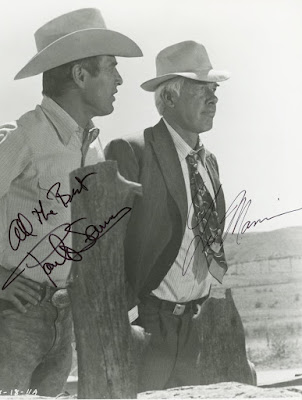
| Rosenberg with Paul Newman |
THE DROWNING POOL B USA (108 mi) 1975 ‘Scope d: Stuart Rosenberg
You have no talent for surrender. —Iris Devereaux (Joanne Woodward)
It’s always a treat to see Paul Newman and Joanne Woodward work together, having met in 1953 while both were working in the Broadway production of Picnic, making their first film together in Martin Ritt’s THE LONG, HOT SUMMER (1958), an adaptation of three William Faulkner stories, where the two got married in Las Vegas during the production, also working together in Ritt’s Paris Blues (1961), a tribute to jazz, with Newman directing her in Rachel, Rachel (1968), an extremely quiet and unassuming film that is completely devoted to Woodward, as it showcases her extraordinary talent. They were a romantic Hollywood couple that left Hollywood to remain a couple, sharing a love unlike any other Hollywood couple, remaining together from the time they were married in 1958 until the day Newman died in 2008, spanning fifty years, with three children, eloquently described by Newman, “I don’t like to discuss my marriage, but I will tell you something which may sound corny but which happens to be true. I have steak at home. Why should I go out for hamburger?” All told they made 10 films together, none of which are household names, which suggests they were willing to take chances with more off-beat material, like Stuart Rosenberg’s WUSA (1970), a confounding yet fascinating character study that was decimated by critics, a discussion on race relations and political hypocrisy, made during the heyday of those 70’s paranoid political conspiracy thrillers. Both that film and this one were both shot in New Orleans, but this doesn’t utilize the uniqueness of the culture or the setting, which are largely overlooked, written by a successive trio of writers, Walter Hill, Lorenzo Semple, and Tracy Keenan Wynn, transporting the seedy world of an LA private eye to Louisiana, conceived as a loose sequel to Harper (1966), the only sequel Newman ever appeared in, reviving his role as a quick-witted detective becoming embroiled in a treacherous murder mystery at the behest of an old flame in Woodward. An early scene, shot in the shadows of chandeliers from an antique store, has a rare intimacy between the two of them that the rest of the film never lives up to, but those captured moments together add to the allure of the picture. Adapting the second of Kenneth Millar, aka Ross Macdonald’s 18 novels of private detective Lew Archer, the author offers a panoramic tour of Southern California in the 1950’s, even prowling the suburbs, in particular his home of Santa Barbara (renamed to Santa Teresa), corresponding to the rapid postwar growth of the valleys and coastal communities, yet some of that is lost in this new landscape, which is given a contemporary setting with considerably more action added, as the mood switches quickly from contemplative to grimly active. Before the story is finished, characters will be shot, drowned, drugged, beaten, and tortured, all in the name of greed and vanity, as it feels like something Oedipal in a classical Greek tragedy style happening here.
Newman also worked with Rosenberg in the zany and quirky existential road movie/western Pocket Money (1972) shot in Mexico with Lee Marvin, a small gem of a film written by none other than Terrence Malick, and before that they made the extremely popular COOL HAND LUKE (1967), where the outcast individualism struck a chord with mainstream America. Newman was nominated for an Oscar in five different decades, including three nominations, and a win, after he was given a Lifetime Achievement Award in 1985. An enticing quote from the novel that is not in the movie:
I turned on my back and floated, looking up at the sky, nothing around me but cool clear Pacific, nothing in my eyes but long blue space. It was as close as I ever got to cleanliness and freedom, as far as I ever got from all the people. They had jerrybuilt the beaches from San Diego to the Golden Gate, bulldozed super-highways through the mountains, cut down a thousand years of redwood growth, and built an urban wilderness in the desert. They couldn’t touch the ocean. They poured their sewage into it, but it couldn’t be tainted.
Lured into a stately antebellum mansion with servants galore and Spanish moss dripping from the old oak trees (reportedly filmed at Oaklawn Manor, a famous historical plantation built in the early 1800’s located near Franklin), Harper is hired by Iris Devereaux (Joanne Woodward), having had a brief yet torrid affair with her six years earlier but she disappeared without a trace, the wife of an emasculated old-money Louisiana aristocrat, James Devereaux (Richard Derr), who idles away his time as an alcoholic, unpublished playwright. It’s his mother, however, Olivia Devereaux (Coral Browne), who runs the place with an iron fist, tightly controlling the family purse strings, while the family lineage in Beau Rivage has been intact for 175 years, where “the abolition of slavery was viewed as a mild agitation for them.” Exploring the Southern Gothic theme of dysfunctional family dynamics, with disturbing suggestions of incest, Iris wants him to find out who’s blackmailing her about her extramarital dalliances, suspecting it may be the chauffeur she fired a few days ago, Pat Reavis (Andy Robinson), whose current whereabouts are unknown. Iris has an enterprising young daughter, Schuyler (Melanie Griffith, just 17 when the film was shot), fresh off her teenage temptress role in Arthur Penn’s Night Moves (1975) released a month earlier, playing a similarly spoiled and sexually precocious role here, meeting Harper coming out of the shower in his motel room with designs on seducing him, but he doesn’t play along. When asked about Reavis, she responds with a bemused smile, “He was fun. Mild psychopaths often are if you don’t cross them.” Nonetheless, having been seen in her company, he’s rounded up by the overzealous police on child molestation and statutory rape charges, specifically by overenthusiastic Lieutenant Franks (Richard Jaeckel), where he’s warned by Police Chief Broussard (Anthony Franciosa) that he’s in over his head, as the Devereaux’s are a highly influential family in Louisiana. It’s soon clear that it’s much more than a simple case of blackmail, as Harper is whisked off the street at gunpoint and brought to the home of millionaire oil tycoon J. Hugh Kilbourne (Murray Hamilton), where the brutality is immediately evident, as he trains pit bulls for mortal combat, something he enjoys for fun and leisure, The Drowning Pool (1975) - Lew Harper meets J.J. Kilbourne YouTube (6:56). What he’s really interested in is the land owned by the Devereaux family, claiming it is oil-rich and worth more than $100 million, so anyone who comes in contact with the family is on his radar. By nightfall, Olivia Devereaux is discovered dead in the bayou, having been struck in the head with a rake and dropped into the swamp. Immediately suspecting Reavis, Harper goes searching for him at a roadside bar, hooking up with Gretchen (Linda Haynes), his suspected prostitute girlfriend, and through her he uncovers a lead.
As he was in Harper, Newman is utterly appealing as the cool-as-ice investigator, while Woodward is quietly introverted and refined, Franciosa puts his spin on the Cajun dialect, while Hamilton is almost leisurely in his enjoyably quirky spin on a villainous role, with Gail Strickland as Kilbourne’s terrified yet deplorably conniving trophy wife Mavis. Griffith’s character knows no bounds when it comes to moral turpitude, figuring prominently in the outcome, a poisonous “Bad Seed,” while Browne commands great authority in her brief appearance as Woodward’s domineering mother-in-law, her first film after her marriage to actor Vincent Price in 1974. The plot is extremely convoluted and risks losing all sense at times, but what it really lacks is that tightly cohesive yet snide edge of William Goldman’s screenplay in the first film, where this follow-up is just not in the same class, yet the markedly downbeat and pessimistic tone is fairly typical for 70’s private-eye thrillers, yet here self-interest borders on murderous psychopathy. It attempts to pay homage to the original with a cutely facetious opening sequence, and a surprise freeze frame finale, but in between there’s a sadistic edge of cruelty and double cross that may not sit well with viewers, with suggestions that for the right price anything can happen, as the stalwarts of the law will turn a blind eye. The same can’t be said for Harper, as he turns down a highly lucrative, life-altering offer and gets very little in return except the satisfaction that he’s nobody’s patsy. Nonetheless, things take a dark turn for him as well, as some people refuse to take no for an answer, where it can cost you your life. The most protracted action sequence takes place in an abandoned sanitarium, where the film’s title refers to some excessive water therapy, as patients would be dressed down with a fire hose. Things get a little out of whack, getting into the extreme, yet the camera work by Gordon Willis is a definite plus, offering a masterclass on neo-noir color cinematography, taking us right up to the edge, even verging on exploitation while nearly drowning in the murky waters of this treacherous murder mystery, Paul Newman, Gail Strickland in 1975's The Drowning Pool | 4K YouTube (5:28). All revolving around the secrecy of a little black book, which documents the extent of the fraud and corruption, it ends up in an unexpected place, with Harper simply shrugging his shoulders at the end, as if life never makes sense, until it does, The Drowning Pool | Last Scene & Funny Freeze-Frame Ending YouTube (2:49). The 70’s was a classic decade for crime flicks, including THE GODFATHER saga, but also Alan J. Pakula’s Klute (1971), William Friedkin’s THE FRENCH CONNECTION (1971), Don Siegel’s DIRTY HARRY (1971), Peter Yates’ The Hot Rock (1972), Robert Altman’s The Long Goodbye (1973), John Huston’s CHINATOWN (1974), Alan J. Pakula’s The Parallax View (1974), Francis Ford Coppola’s The Conversation (1974), Joseph Sargent’s THE TAKING OF PELHAM ONE TWO THREE (1974), Arthur Penn’s Night Moves (1975), J. Lee Thompson’s Cape Fear (1975), Sidney Lumet’s Dog Day Afternoon (1975), Sidney Pollack’s THREE DAYS OF THE CONDOR (1975), Robert Aldrich’s HUSTLE (1975), John Frankenheimer’s FRENCH CONNECTION II (1975), and Martin Scorsese’s Mean Streets (1973) and Taxi Driver (1976), among others.
The Unloved - The Drowning Pool on Vimeo video essay by Scout Tafoya, YouTube (10:16)