


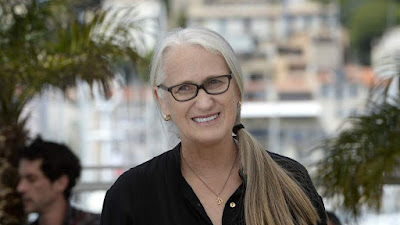
 |
| Director Jane Campion |

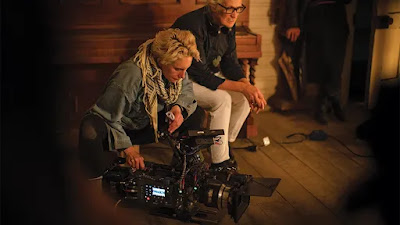 |
| Cinematographer Ari Wegner (left) with Campion |
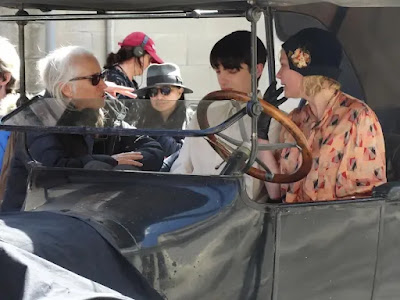 |
| Campion checks with Kodi Smit-McPhee and Kristen Dunst |
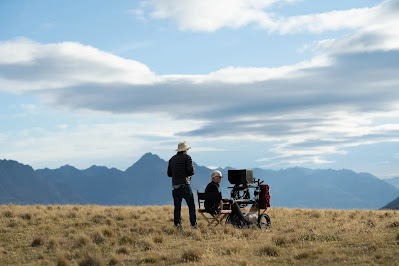 |
| Campion checks the camera on the set |
THE POWER OF THE DOG A USA Great Britain Australia Canada New Zealand (126 mi) 2021 ‘Scope d: Jane Campion Deliver my soul from the sword, my darling from the power of the dog. —Psalm 22:20, King James Bible
Beware the unseen power of a scorpion bite, as that insidious poison infects the overall storyline of what we see, as there’s an underlying sting of macho dread and horror that underlies every frame of the film, haunting some, if not all, where a noxious male influence spreads untouched, like a Biblical plague that pervades throughout the land, wreaking havoc, destroying lives, literally running roughshod over the women, yet the story is beautifully told with a carefully calculated and complex mastery, producing a surprising outcome, imbued with such an understated discretion that it may leave viewers perplexed. Her first feature film since Bright Star (2009), and her first male-led picture, Campion immerses her audience into a very specific time and place, the vastly underpopulated Montana in 1925, though sumptuously shot in ‘Scope in the Otago region of the South Island of New Zealand by Ari Wegner, capturing the breathtaking beauty of the surrounding landscape, whose enormity is captured in ways not seen since William Wyler’s THE BIG COUNTRY (1958), speaking a language all its own, literally dwarfing the human presence to solitary figures of near insignificance. Adapting the Thomas Savage novel of 1967, Savage is an American author who described the conditions of the American West, while Campion’s film celebrates the rampant masculinity of the Western genre, but turns it on its ear, subverting the topic through a feminist lens, but couldn’t be more subtle, expressing a rare mastery of the Western landscape that exerts its own mysterious power, as the sheer look of the film is simply extraordinary, yet more than any other Campion film feels indebted to The Piano (1993), exposing the human flaws of the people attempting to tame the land, revealing a carefully calibrated characterization that typifies stories of the Old West. We are introduced to two brothers who couldn’t be less alike, wealthy ranchers Phil Burbank (Benedict Cumberland in the role of a lifetime), a lone wolf, malicious and homophobic, college educated at Yale yet used to working with his hands, displaying all the standard markers of Western manhood, grace in the saddle, wit in the saloon, and an apparently unlimited tolerance for pain and discomfort, and his more generous brother George (Jesse Plemons) who manages the business, remaining steady and decent, honest and simple, but wears a suit in the saddle, constantly referred to as “Fatso,” with Phil bullying his brother, apparently, simply because he can, where an openly displayed derision is built into the dynamics of their relationship, despite sleeping in the same bed for nearly forty years. Together they manage the day‑to-day running of their huge cattle farm, evoking some of the more spectacular scenery in the vast and open range as they herd their cattle back into familiar pens when the weather turns cold. When George marries Rose (Kristen Dunst, his real-life partner), a kind, yet sad and overly anxious widow with an effeminate teenage son Peter, Kodi Smit-McPhee, grown up from the 10-year old kid following Viggo Mortensen around in John Hillcoat’s version of Cormac McCarthy’s apocalyptic The Road (2009), also Slow West (2015), Phil is appalled and explodes with a virulent anger, tormenting Rose and her “sissy” son with cruel mockery, emotional cruelty, and threats of violence, pitting a cold, Machiavelli-like superiority complex against what he perceives as weakly and undeserving intruders, turning Rose into a closet alcoholic as her own protection from a man she views as a beast. A vicious, yet spectacularly filmed movie, this overblown toxic masculinity that Phil represents influences every scene of the film, literally carrying the picture with its own infectious energy, providing the nuance and rhythm of the film, yet subverted by a feminist touch, extremely rare to see, especially done as well as this. Premiering at the Venice Film Festival, it won a Silver Lion for Best Director, and may be the most important film Campion has ever made.
A rich and challenging psychodrama broken into chapter headings, offering brilliant character development, the film is a picture of restraint, yet thrives in its own brooding intensity, where Cumberland mirrors the misanthropic amorality of Daniel Day-Lewis’s Daniel Plainview, offering an early capitalist counterpoint to the enthrall of Paul Thomas Anderson’s There Will Be Blood (2007) set in the same time period, similarly scored by Jonny Greenwood with an unsettling musical soundtrack that captures the essence of the underlying tension with simple guitar strums, expanded to a more abstract musical accompaniment that accentuates the emotional strains below the surface, turning this into a quietly sustained horror movie, filled with an underlying dread. Yet the film’s first lines (differing from the book, omitting the first third of the novel) come from Peter in an unseen voiceover during the opening title sequence, pondering “When my father passed, I wanted nothing more than my mother’s happiness. For what kind of man would I be if I did not help my mother? If I did not save her?” This quotation stands alone, never referred to again, and is seemingly forgotten over time, in stark contrast to the daily scenes of cattle ranchers leading a hardscrabble life out under the hot sun, roping, fencing, branding, pitching hay, and castrating cattle, which Phil proudly performs without wearing gloves, the only one who scorns that practice. So their calloused hands are used to getting blisters, cuts, and splinters, making this the brother’s twenty-fifth year together driving cattle from the southwest Montana plains. Yet Campion adds an alternative female gaze perspective, showing the men stark naked while bathing in the creek, then lounging on the rocks afterwards, sunning themselves in nothing but their birthday suits, with their hats carefully placed over their privates. It’s the kind of scene never shown in earlier Westerns, which would instead accentuate the male bonding experience, where spending time out in the open range allows men time to think and ponder their existential situations. Yet there’s very little of that here, as the men are indistinctive, becoming a Greek chorus of conformity, led by Phil as their leader, following his every move. Phil takes great care to acknowledge his predecessor, Bronco Henry, recalling the glory days of his dead mentor, the original leader of the pack, where a shrine in his honor rests out in the barn, along with his saddle that Phil fastidiously keeps polished and clean, unlike his own body that he rarely ever bathes, perhaps once a month in the creek, never bathing at all in winter. Rose runs a boarding house in nearby Beech, a small town where her husband used to practice medicine, serving patients who often couldn’t pay, yet his late descent into alcoholism and depression is a disturbing revelation, where his early demise has left Rose to raise her son alone, where Peter is seen displaying extraordinary patience and a skilled artistry in creating paper flowers from cut paper that are extremely lifelike, with Rose proudly placing them on the tables for her customers. Yet when Phil brings his ranch hands into town, Peter quickly becomes the object of Phil’s derision, mocking his voice, his hand towel, and for painstakingly crafting the delicate flowers, using one to light his everpresent cigarette, dumping it in a used glass, while his men join in offering more scorn, with Rose scurrying to collect the table arrangements before more are destroyed. Peter storms out the back, trying to ignore what happened, leaving Rose weeping in the kitchen, comforted by George, who remains in the background for the most part, yet is forced to apologize for his brother’s open cruelty.
There’s an unsettling nature to the depiction of male masculinity as being intentionally cruel and hurtful, which only escalates when George decides to marry Rose, viewing her with an affectionate tenderness Phil would never understand, railing against her with all his will, refusing to welcome her to the family, calling her “a cheap schemer,” certain that she’s after their money, becoming a menacing force, particularly when they all move into a huge, cavernous ranch house with two servants, Geneviève Lemon from Sweetie (1989) and Thomasin McKenzie from 2018 Top Ten List #5 Leave No Trace, turning into a chamber drama, much of it shot through doors or windows, reminiscent of John Ford’s THE SEARCHERS (1956), where the floor creaks and every door and window can fly open any second, feeling a bit haunted to Rose, particularly when her bedroom is located right next to Phil, who can hear every sound, seething with anger in what has been his own personal domain, master of his own house, now infested by a women he perceives to be an interloper and gold-digger. When Peter comes home from medical school and joins them, Phil immediately identifies him as “Little Lord Fauntleroy,” mocking his slight lisp, with the Greek chorus joining in with the catcalls, calling him “Nancy Boy,” instantly thought of as soft, a young man smothered by his mother’s affections, labeled a gay blade. Decorated to the hilt with slim jeans, a white shirt and an oversized white cowboy hat, the kid fits the part, yet he has a secret life unknown to the others, as he’s studying to be a doctor, catching rabbits only to dissect them for practice, something Rose forbids in the house, as it can be viewed as a gruesome hobby. George proudly delivers a baby grand piano for Rose, who once played in the pits for Silent movies, continually prodded into playing by her husband, as if turning her into a spectacle that she has little interest in becoming. Nonetheless, she awkwardly practices the Radetzky March, Johann Strauss Sr.: Radetzky March piano - YouTube (2:55), continually playing the wrong notes, a metaphor for her excruciating struggles, yet what’s worse, Phil is sitting in his room playing the same tune on the banjo, only playing it better, always having the upper hand, whistling the tune when he sees her, where his psychological campaign of terror leaves her exhausted and emotionally depleted, continually feeling diminished and weak, driving her to drink, shrinking back to being a little girl, living in a delusionary world of her own, losing all grasp of reality. Yet Rose is the key component, as neither George nor Peter appreciate the way Phil treats her, literally manhandling her, keeping her under his thumb, scoffing at her acute weakness and lingering depression. Still, no one stands up to him, as he remains top dog of the manor, and what he says goes. The brother’s split their profits 50/50, as they always have, yet it’s clear who actually runs things, though Rose has mysteriously come between them, becoming a thorn in his hide. Taking a different tact, Phil decides to befriend her son Peter, help turn him into a man by teaching him how to ride, going on extended trips together up into the mountains, offering extensive hands-on experience that he would otherwise never receive, becoming the mentor Bronco Henry was to Phil. While Rose is in alcoholic distress, Campion curiously weaves Brokeback Mountain (2005) homoerotic overtones into Phil’s own repressed sexuality, seen alone bathing himself in his own private spot by the creek, sensually caressing himself with an old handkerchief that once belonged to Bronco Henry, with Peter finding his hidden stash of magazines that showcase the naked male physique, offering a window into his suffering soul of always having to fend off any pain, never allowing anything to affect him, always living up to a mythical façade of Bronco Henry, who was impervious to pain or weakness. So it comes as a bit of a surprise that a mysteriously reconciled Phil and Peter have their own tender moments together, particularly a quietly extended scene in the barn that coolly observes cracks in the armor, sharing a cigarette, hearing anecdotes about Bronco Henry, solidifying their relationship, with Phil, against all odds, hoping to turn him into a man. The calculated twist at the end comes as a huge surprise, with Campion cleverly inverting nearly everything that has come before, where tragedy takes on a dramatically different face, using the same subtlety and restraint that has pervaded throughout the entire film, telling a significantly different story than the one we imagined.


