|
| Charles Stanhope, Third Earl of Harrington, and a Servant (1782) |


 |
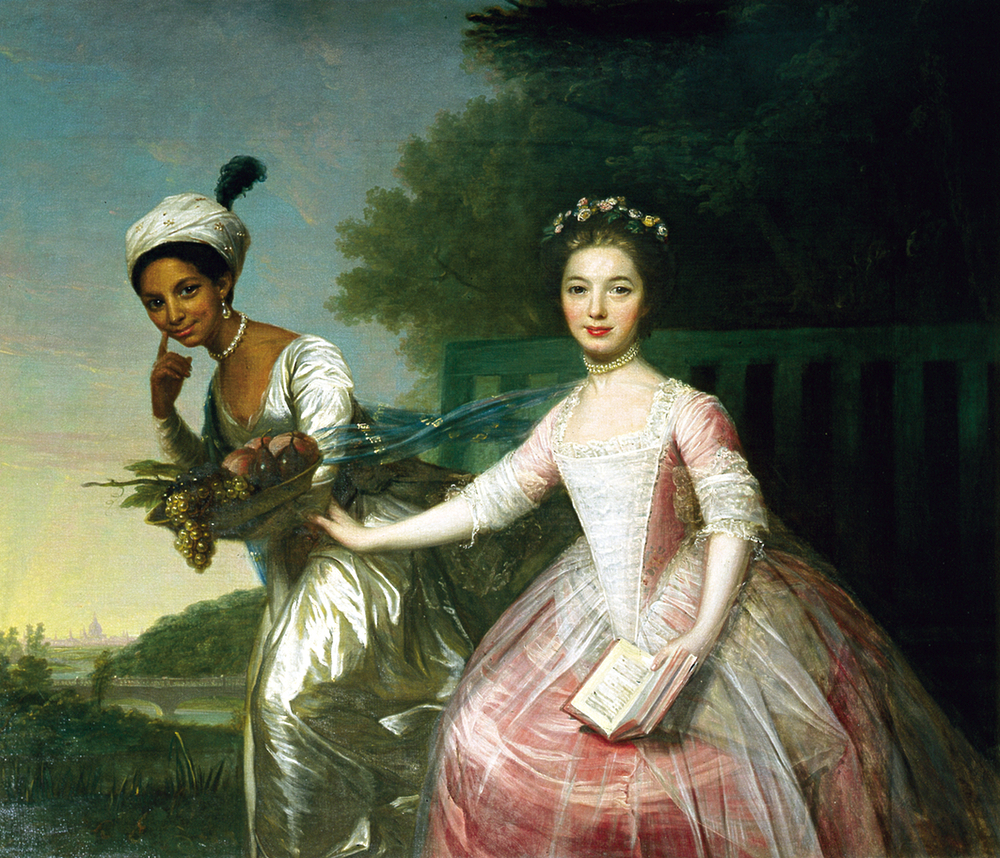
| Dido Elizabeth Belle and Lady Elizabeth Murray, 1779 |
 |
| Director Amma Asante |


 |
| Screenwriter Misan Sagay |
 |
| Actress Gugu Mbatha-Raw |
 |
| Asante on the set with Gugu Mbatha-Raw and James Norton |
BELLE A- Great Britain (103 mi) 2013 ‘Scope d: Amma Asante
I do not know that I find myself anywhere. —Dido Elizabeth Belle (Gugu Mbatha-Raw)
In honor of Letterboxd writer Nwoye, otherwise known as cleansing my soul of addiction, cleansing my soul of addiction 's profile • Letterboxd, a Chicagoan born in Ghana who passed away in September 2021 from cancer, having thoroughly trashed Barry Jenkins and his recent TV epic 2021 #2 Film of the Year The Undergound Railroad- made for TV, offering his own scathing comments, “beautifying and trivializing Black history and the suffering of Black people for a disingenuous, entitled audience of predatory revisionist (white) liberals,” Review by cleansing my soul of addiction ... - Letterboxd, curiously recommending this film instead, directed by Ghanaian-British director Amma Asante:
2013’s Belle is the only recent work I have seen in which (transatlantic) slavery is appropriately incorporated into narrative constructs, and it will continue to stand the test of time as an incredible modernist treatise that refrains from aggrandizing today’s Black struggle and equating the day-to-day injustices we face as Black Americans to those endured by our ancestors—actual chattel slaves given no rights to exist at all. If you really care and you want to watch something that pays respect to these scenarios and analyses slavery/liberation/Black life with some integrity and educated historical context, watch Belle.
A British costume drama with historical authenticity, an eloquent counterpoint to the graphically sadistic experience of 12 Years a Slave (2013), yet revealing what that film did not, as the history of slavery belongs to Britain as well as America. In the period this film takes place there were about 15,000 black people living in Britain, mainly in London, yet less than a third of that population was free. Written and directed by two black women, the work is directed by Amma Asante and written by Misan Sagay, a Nigerian-British screenwriter who was also a former emergency room doctor, but grew up during a time when the only blacks onscreen were either servants or gangsters, something she wanted to redress. The inspiration behind the film is a 1779 painting of Dido Elizabeth Belle alongside her white cousin Lady Elizabeth Murray (1,000 × 858 pixels), who grew up with her on the lavish estate at Kenwood House under the care of Lord and Lady Mansfield, commissioned at the time by Lord Mansfield, then Lord Chief Justice of England. Sagay happened to see the painting, attributed to Scottish artist David Martin, hanging at the Scone Palace in Perthshire, Scotland, and drew inspiration, as it’s one of the first European portrait paintings that subversively portrays a black subject on relatively equal terms with a white aristocrat, shown at the very end of the film, standing in stark contrast to J.M.W. Turner’s Slave Ship (2,152 × 1,616 pixels), a significant departure from the more prevalent historical images of horror, mourning, and despair. There is also an equally subversive 1650 Velázquez portrait of his enslaved black assistant, Juan de Pareja, who was a skilled artist in his own right, Reframing History: Juan de Pareja. One of the only reasons that we know about Dido Belle today is attributed to this painting. There are other British paintings from that time period depicting black subjects, but nearly always peripherally in subservient roles. Sagay’s comments when she first glimpsed the painting:
I was struck immediately when I saw the painting. It was this black woman staring directly out of the painting. She was vivacious. She was alive. She was painted in movement and yet the picture underneath the caption simply said, “The Lady Elizabeth Murray.” Nothing else. I was intrigued by who this black woman was. Years later, when I went back and the caption had been updated to, “Lady Elizabeth Murray and Dido, the Housekeeper’s Daughter,” I just didn’t buy it. I didn’t think that she was the housekeeper’s daughter. I felt that there was a story here and so that’s what captivated me. It was her herself and her presence and yet her silence. She didn’t even have a name.
Very little is actually known about the life of Dido Belle, who was born into slavery in the British West Indies and was the illegitimate mixed-race daughter of Sir John Lindsay, a white British naval officer, and Maria Belle, an enslaved African woman, found living in poverty by her father and entrusted to the care of his uncle, Lord Mansfield, originally William Murray, a crucial character in the story and in the history behind the film. As a Scotsman, Murray had to work hard to become the most powerful judge in Britain. Due to such scarce historical detail, Sagay was able to take artistic liberties in creating a fictionalized work that inserts Belle into a tumultuous discussion about the Zong massacre, Zong slave ship trial - HISTORY, where a central running thread of the film is an argument over the benefit or harm of the transatlantic slave trade, where an imminent ruling is expected by the court, specifically the Chief Justice, which could have historical ramifications, yet dressed in the romanticism and class system of a Jane Austen novel, where the primary family concern is marrying off young women to distinguished gentlemen who will maintain the prestigious family position of privilege. Economics is the primary concern, not happiness or love, viewing the coming-out of young women into society much as they would a financial transaction, as women in marriage were viewed at the time as the exclusive property of men. In the same way, the slave trade was viewed not only as the economic foundation of England, but as a means of expanding the British colonial empire, with little thought given to the heinous barbarity of the practice, as blacks were simply viewed as an inferior species. In a society where rank, wealth, and family honor are everything, an unanswered question lurking beneath the lush exteriors of the film is just how wealth was amassed to live in such luxurious surroundings, complete with ornate clothing and jewelry, implying British colonial wealth was largely obtained through plantation holdings in the territories that ran on slave labor, suggesting the transatlantic slave trade is at the heart of the aristocratic nobility (used ironically) and the entire British costume drama genre, as those are the underlying circumstances creating such colossal inequities in wealth. In 2006, The Church of England apologized for benefitting from the slave trade, Church apologises for benefiting from slave trade | UK news, following similar apologies by the late Pope John Paul II for the historic transgressions of the Roman Catholic church, including its anti-Semitism and the Inquisition, Pope says sorry for sins of church | World news - The Guardian. Something of an indictment of British imperialism, though funded by the British Film Institute, an early theme develops when Lindsay drops off Belle under the care of his uncle, informing him “What’s right can never be impossible.” Accordingly, Belle (Gugu Mbatha-Raw) has to find her place in the aristocratic world of white privilege, raised together with her cousin Lady Elizabeth Murray (Sara Gadon), who, after the death of her mother, was also entrusted into the care of her father’s uncle, Lord Mansfield (Tom Wilkinson) and Lady Mansfield (Emily Watson). While raised as equals, like sisters, outsiders held a more skeptical position, viewing Belle with racist derision and hostile contempt, seen more or less as a white charity case, but never one to take seriously. An intersection of contrasting identities, black and white, slave and lady, exotic and English, Belle, in her own words, seems to have “no place to claim,” suggesting an impossibility of belonging, becoming a personal study of class, race, and gender oppression juxtaposed into a fictionalized moment in history. This film was the coming-out party for British actress Gugu Mbatha-Raw, winning the British Independent Film Award (BIFA) in 2014 for Best Actress, seen a year later in Gina Prince-Bythewood’s Beyond the Lights (2014), winning an Emerging Artist Award during the Chicago Film Festival’s 18th Annual Black Perspectives Tribute in 2014, also seen in Peter Landesman’s Concussion (2015) and Edward Norton’s Motherless Brooklyn (2019), yet none of those others deal with the complexities of this film. However, perhaps due to the way the film was advertised, like a Masterpiece Theater presentation, it generated little research or academic study, overshadowed by the Academy Award winning acclaim for 12 Years a Slave and largely misunderstood at the time of release, as many critics just couldn’t fathom there could actually be depth in this format, yet it subversively generates sophisticated attitudes and ideas through a mainstream film, with a story that is a social critique, tackling controversial issues of slavery and rampant oppression through a historical costume drama.
British heritage is deeply intertwined with histories of colonization, slavery, and empire, yet there is a sense of amnesia when it comes to people of color, who are left out of any sense of belonging within an existing social fabric. There are efforts of revisionist history, casting black actors in roles traditionally given to whites in an attempt to tell missing narratives of blacks during colonial history, like Andrea Arnold’s Wuthering Heights (Arnold) (2011), where Heathcliff is played by a black actor, yet this feels more like a painterly essay, as so much is non-verbal. This film takes risks by utilizing a genre, the period costume drama, where black protagonists are nonexistent, offering a female perspective on being black in a white environment that elevates the feelings of the central character, placing viewers in her shoes, becoming a story about a voiceless character who develops a voice. It wasn’t until the 1990’s that research about the painting restored Belle’s rightful identity, while historical accounts reveal some idea of how Belle was provided for when living at the Kenwood House under the care of Lord and Lady Mansfield, as she received a quarterly allowance that was less than her white cousin Elizabeth, yet more than what the servants received, while also too high in rank to dine with the servants and too low to dine with her own family when they have visitors. These class customs are thoroughly confounding, with Belle reminding a visiting son of a clergyman that he is allowed to sit at the table before a lady of the house. Indignant that this is a curt reminder of “his place,” she quickly reassures him, “No, it is a reminder of mine,” leaving her emotionally flustered. Coming from a world that sees color before anything else, she finds herself living in a state of perpetually being in between, embodying living between two worlds, creating an endless psychological struggle. The extravagance of the Kenwood House (shot largely on the grounds of the West Wycombe Estate in Buckinghamshire) is beyond impressive, a palatial grand manor nestled into a picturesque pastoral landscape, sumptuously filmed in ‘Scope by cinematographer Ben Smithard, one of the first UK films using the new 4k digital cameras, where the image is immaculate, recalling the opulent décors of Kubrick’s BARRY LYNDON (1975), with refined production design by Simon Bowles and richly-colorful costumes by Anushia Nieradzik, while the sweeping musical score is written by British composer Rachel Portman, with Belle having her own leitmotif, Dido Elizabeth Belle - Belle Soundtrack - YouTube (1:53). As Belle arrives as a young girl, walking along the lush hallways lined with sculptures and paintings, she can’t help but notice the paintings depicting blacks as the property of white masters, such as Charles Stanhope, Third Earl of Harrington, and a Servant (1782) (4,246 × 6,967 pixels) or Lady Elizabeth Keppel and a Servant (1762) (476 × 700 pixels), both by Sir Joshua Reynolds, with growing questions about her own role, suggesting the power of art in helping shape one’s personal identity. These paintings have a way of reassuring whites of the benevolence of slavery, and help determine attitudes about the conditions of black lives, as they can be purchased, owned, or exchanged. “Just like in life, we are no better in paintings,” she acknowledges at one point, as the art collection as a whole implicates the creation and maintenance of British slavery. Yet somehow, Belle exists as a character conceived within a painting, much like Peter Webber’s GIRL WITH A PEARL EARRING (1999), when a Vermeer painting comes to life, yet throughout the history of artistic representation, black women are rarely depicted as symbols of beauty, particularly in European or British art. One need only recall the horrendous treatment of Sarah Baartman, paraded through the streets of Europe like a zoo animal, as depicted in Abdellatif Kechiche’s Black Venus (Vénus noire) (2010). While something of a coming-of age film where Belle slowly elevates her own consciousness, it is in direct conflict with the times, so much of her journey is conducted in secrecy, outside of prying eyes. What ignites her curiosity are the seemingly secret discussions surrounding the Zong affair, which is publicly written about, yet carefully concealed from Belle, supposedly protecting her from scandalous rumors and racist diatribe, yet in doing so it also hides her from the realities of people of color, so when a pastor’s son, John Davinier (Sam Reid), visits the home as an apprentice studying law under Lord Mansfield, his passionate abolitionist ideals and personal convictions draw the attention of Belle, who is herself curious and bright, yet woefully underinformed on the entire Zong affair, where she can’t help but sympathize with the mass killing of more than 140 enslaved Africans, thrown overboard supposedly to protect the ship’s crew, claiming a dwindling supply of water.
One of the curious aspects of the film is Belle’s reticence to have a portrait painting with Elizabeth, fearing she would appear like all the other paintings around the house in a subservient role, exhibiting a concern how she would be viewed in posterity. Nonetheless, it is arranged for both to sit for an artist, despite her growing reservations. Belle slowly learns that Lord Mansfield is the Chief Judge ruling on the Zong case, with the ship owners claiming insurance for damaged goods, or cargo lost in the form of slaves aboard a slave ship. There is some question about the health of the slaves, as they were diseased from living in such tight quarters, undercutting their potential value at auction, actually worth more dead than alive, with rumors swirling about regarding what actually happened, John Explains the Zong Ship Case to Dido YouTube (2:30). When it is discovered that Belle has been having open discussions with John, he is banished from the household and told never to see her again, but he is her only contact with news about the case, working tirelessly to provide evidence, so she continues to meet with him in secret. Meanwhile, Belle’s father dies overseas, leaving her the sum of £2,000 a year, making her an heiress. Elizabeth, by contrast, inherits nothing from her father, with a son from his new wife being named the sole heir. As females in English high society, traditionally they would have to marry a gentleman who would equal their status or elevate it in order to continue their privileged way of life. Sadly, with privilege and oppression intersecting, Lady Mansfield makes it clear that Belle is not to marry, believing no gentleman would marry her due to her race, while lower ranking men might only do so for her wealth, bringing ultimate shame and misfortune to the family, so she is asked to take the place of the perpetually despondent Aunt Mary (Penelope Wilton), a forlorn spinster whose mother prevented her from ever marrying, taking over the role of house manager, condemned to be hidden and shut away for the rest of her life, a fate she defiantly resists, another reminder of her low social and domestic position, continuing to be defined (or enslaved) by a patriarchal system that refuses to see her worth. So arrangements are made for only Elizabeth to have her coming-out to society, meeting two brothers, James and Oliver Ashford (Tom Felton, aka Draco Malfoy in the Harry Potter series, and James Norton), though Oliver immediately finds Belle intriguing, particularly after hearing her play a remarkable piano piece, Handel’s Suite No.9, Anatoly Vedernikov plays Handel Suite No 9 in G Minor YouTube (11:55), her talent towering over Elizabeth. Miranda Richardson plays the scheming Lady Ashford, who along with James, the firstborn, feel repulsed by Belle’s race, yet may be willing to sacrifice their bigotry if they can get their hands on her money, with James courting Elizabeth until he realizes she has no money, dropping her flat afterwards, a recurring syndrome with other suitors as well that continually perplexes her. It’s actually Belle that attracts attention, becoming engaged with Oliver, but she soon realizes the error of her ways, used only for money, becoming glaringly apparent when James brazenly makes racist and misogynistic insults before manhandling her in public at a picnic on the banks of a river, with Elizabeth, Lady Ashford, and many others present, showing no restraint or remorse, claiming she would only bring disgrace to the family, yet when she angrily cuts off the engagement, Lady Ashford haughtily declares she should be so lucky to marry into her family. This must be viewed as a time when female black slaves were routinely raped and defiled by white attackers, as there were very few white women in the West Indies, viewed by the men as perfectly acceptable behavior, while in Britain, white heritage gave them the right, believing blacks were naturally inferior and debauched. Belle even has a mirror scene where she begins to pinch and pull her skin with self-hatred, rubbing the heal of her palm across her face and forehead, certainly an uncommon experience in any movie genre, but very fitting here to reflect her own harrowing issues with identity, having to deal with one indignity after another. The history of violence against women is long and arduous, yet when Belle attempts to warn Elizabeth, she fumes with jealously, refusing to believe a gentleman like James would place his hands on her. Only afterwards does Elizabeth come to understand her lower social standing, as it’s all about monetary inheritance, and she has none. Belle is then openly surprised that she and Elizabeth are viewed on equal terms in the final portrait, giving her some claim to finally having a place, yet this sense continually eludes her.
At a key moment in the film, Lord Mansfield asks Belle what book she is reading, it turns out to be The Dying Negro: A Poetical Epistle, written by Thomas Day, a British abolitionist, that she says “speaks of a slave who agrees to marry an English lady; a voice for people, people like my mother, who do not have one.” Inquiring whether she finds herself in such writing, Belle can only answer, “I do not know that I find myself anywhere.” Reference to this poem published in 1773 adds weight and depth to the film. Living inside a gargantuan estate, a symbol of white, patriarchal power and authority, where it’s easy to see how easily one can be erased from history, one senses that Belle questions her own subjective existence within that overpowering dominion. Officially known as Gregson v. Gilbert (1783), while also mixing in rulings from Somerset v. Stewart (1772), everything that happens in the film points to a final resolution of the Zong case, much like Spencer Tracy in INHERIT THE WIND (1960) or Gregory Peck in To Kill a Mockingbird (1962), two films instilling generational values from historic court rulings, with bits and pieces of intensely private consultation between Belle and John that borders on romanticism, where an exchange of common ideas substitutes for matters of the heart. When Lord Mansfield finally renders his decision in open court, Belle is like a giddy little kid, running to the upper balcony, just like Scout peering out at her father in Mockingbird, watching the final verdict being rendered. One look around the courtroom reveals a noticeable lack of black presence. Belle stole the most damning evidence from her uncle’s office, incriminating evidence that may have changed the course of history, which could be viewed as an act of rebellious insurrection in support of those that lost their lives, a document in Mansfield’s own handwriting, revealing that the Zong slave ship sailed past eight ports where they could have taken on provisions before jettisoning their human cargo, suggesting their rationale of water deprivation was a fraudulent cover-up for their murderous crime. The lost lives she attempts to save recall the faint memory of her mother, as the details of her life are lost to Belle, becoming part of a collective consciousness of unnamed black lives, all viewed by a larger white society as humanly insignificant. The central question running through the entire film questions the morality of putting a monetary price on human life. While this is strictly a fictional version, as a woman of color, the verdict has enormous implications surrounding her growing self-awareness and her own idea of freedom, going through a transformative metamorphosis where she is finally in charge of her own life. And while her experience cannot be compared to that of a chained slave whose sole purpose, as viewed by a white majority, can be traced to an object sold in a market place, what it does instead is elevate Belle’s existential worth to an equal footing to that of a white man, John Davinier, whose moral convictions initially drew her to him, yet he’s idealized as a paragon of virtue, believing in a human cause that does not abandon the unempowered or voiceless, declaring “Laws that allow us to diminish the humanity of anybody are not laws. They are the frameworks for crime.” Unlike the Ashfords, their developing intimacy is always honest and respectful, much to the surprise of Lord Mansfield, who initially believed Davinier’s lower status would only disgrace his niece, where in this case the courtroom outcome helps prefigure the social conditions necessary for a happy marital union. The decision snowballed into the outlaw of the slave trade in England, which was abolished throughout the entire British empire in 1807. Coming from the most disadvantaged background imaginable, Belle had to overcome obstacles to leave her mark in the world, challenging us to rethink what we know about Britain’s past, perhaps drawing inspiration from women like her. Situated somewhere between the women’s filmmaking of Julie Dash’s Daughters of the Dust (1991) and Jane Campion’s The Piano (1993), this film reexamines national history and memory through race and colonialism, creating a place where the personal, the political, and the historical are inextricably linked, perhaps showing a way to review the past, literally cracking open a door in rewriting a greater and more inclusive examination of history, opening up new spaces to explore.
Postscript
Paula Byrne wrote a slim companion book to the film in 2014 entitled Belle: The Slave Daughter and the Lord Chief Justice, containing a slight yet factual account of Belle’s life, where so little is authoritatively known, providing more historical detail, while also focusing on other people of color from the time period, much more about Lord Mansfield, and the court cases that helped advance the British abolition movement.