 |
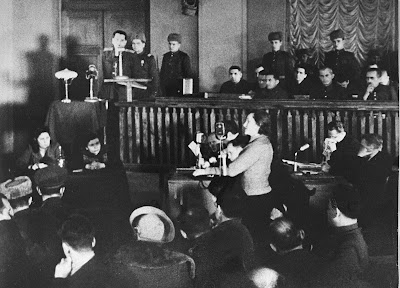
| Dina Pronicheva |
 |
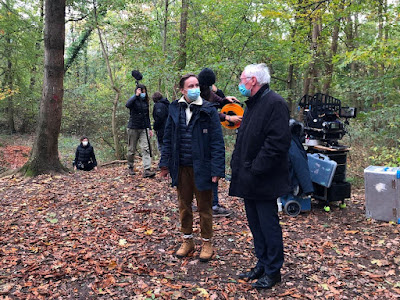
Director Sergei Loznitsa
|
Babi Yar. Context B Ukraine
Netherlands (121 mi) 2021
d: Sergei Loznitsa
In Ukraine there are
no Jews. Nowhere - not in Poltava, Kharkov, Kremenchug, Borispol, not in
Iagotin. You will not see the black,
tear-filled eyes of a little girl, you will not hear the sorrowful drawling
voice of an old woman, you will not glimpse the swarthy face of a hungry child
in a single city or a single one of hundreds of thousands of shtetls [small
towns].
Stillness. Silence. A
people has been murdered.
Murdered are elderly
artisans, well-known masters of trades: tailors, hatmakers, shoemakers,
tinsmiths, jewellers, housepainters, furriers, bookbinders; murdered are workers:
porters, mechanics, electricians, carpenters, furnace workers, locksmiths;
murdered are wagon drivers, tractor drivers, chauffeurs, cabinet makers;
murdered are millers, bakers, pastry chefs, cooks; murdered are doctors,
therapists, dentists, surgeons, gynecologists; murdered are experts in
bacte-riology and biochemistry, directors of university clinics, teachers of
history, algebra, trigonometry; murdered are lecturers, department assistants,
candidates and doctors of science; murdered are engineers, metallurgists,
bridge builders, architects, ship builders; murdered are pavers, agronomists,
field-crop growers, land surveyors; murdered are accountants, bookkeepers, store
merchants, suppliers, managers, secretaries, night guards; murdered are
teachers, dressmakers; murdered are grandmothers who could mend stockings and
bake delicious bread, who could cook chicken soup and make strudel with walnuts
and apples; and murdered are grandmothers who didn’t know how to do anything
except love their children and grandchildren; murdered are women who were
faithful to their husbands, and murdered are frivolous women; murdered are
beautiful young women, serious students and happy schoolgirls; murdered
are girls who were unattractive and foolish; murdered are hunchbacks; murdered
are singers; murdered are blind people; murdered are deaf and mute people;
murdered are violinists and pianists; murdered are three- year-old and
two-year-old children; murdered are eighty- year-old elders who had
cataracts in their dimmed eyes, cold transparent fingers and quiet, rustling
voices like parchment; murdered are crying newborns who were greedily sucking
at their mothers’ breasts until their final moments. All are murdered, many
hundreds of thousands, millions of people.
This is not the death of
armed people during the war… This is the murder of a people…of a people’s soul
and body. An entire people murdered.
—Ukraine without Jews,
by Vasily Grossman, 1943, (PDF)
Vasily Grossman - Ukraine without Jews (excerpt)
A unique exploration of history, where the director combines
the public and private archives in Russia, Germany, and Ukraine, working with
the Russian State Archive of Film and Photo documents in Krasnogorsk (RGAKFD),
with the Bundesarchiv in Berlin, with several regional archives in Germany,
with the Ukrainian State Archive in Kiev and with private archives, including
footage from soldiers on the front lines, reels from Die Deutsche Wochenschau, the Nazi propaganda news bulletin that
was produced in Germany and distributed throughout the territory occupied by
the Third Reich, as well as the help of the Babi
Yar Holocaust Memorial Center, the aim of this documentary is to “plunge
the viewer into the atmosphere of the time.”
Yet the origins feel more personal, as Ukrainian director Sergei
Loznitsa grew up in Kiev and went to school there, not far from the Babi Yar
ravine, but had no knowledge of what happened there, declaring “Even though I
grew up close to Babyn Yar and to the old Jewish cemetery, which was completely
destroyed, and as a child I stumbled across the Jewish tombstones many times
during my walks, my parents were very reluctant to answer my questions on the
subject.” We now know that on September
29–30, 1941, in a large ravine in Kiev known as Babi Yar, the Nazis slaughtered
more Jews in two days than in any other single German massacre, killing 33,771
Jews. In total, from September 29, 1941,
until October 1943, the Nazi forces, with no interference from local residents,
killed nearly 100,000 people at Babi Yar.
Nazi authorities banned photo and film cameras from the places of mass
executions, however through the use of archival footage, it is possible to
reconstruct the surrounding circumstances of what happened. With the troubling rise of xenophobic
far-right groups in Europe, the unlearned lessons of history and the growing
seeds of hate and resentment make this time we’re living in dangerous and
extremely precarious times. For
instance, less known even to practiced historians is that fact that as many as
500,000 to a million former Soviet citizens were living in Ukraine and actually
joined the Third Reich in fighting against the Red Army, as they were hoping
the Germans would deliver them from Stalin.
With that in mind, the assembled footage is presented with no narration
or talking heads, instead there is frequent use of introductory intertitles
that place each historical setting in context, opening with “June 1941. Soviet
Ukraine” as bomb blasts are dropped on the city of Lviv, the largest of the
westernmost cities of the Ukraine, demolishing a bridge while targeting supply
dumps and airfields, as Nazi troops are seen riding in diesel-powered Panzer
tanks, rumbling motorcycles, and even horse-drawn vehicles as they move their
artillery units in and begin to occupy the town, where a mass square is filled
with POW soldiers, the first attack in Operation
Barbarossa, a German plan to destroy the Soviet Union. The city is surrounded by plumes of smoke, while
dead bodies are strewn everywhere. The
Soviets left behind murdered prisoners, as corpses lay on the ground swarmed by
flies, with bystanders, including many children, stopping to stare, yet Jews
are blamed with collaborating with the enemy, ordered to line up by the prison
and carry out the bodies, with Nazi soldiers going house to house setting them
ablaze, with some seen in the foreground drinking in a celebratory mode, exacly
as depicted in Elem Klimov’s Come
and See (Idi i smotri) (1985), while citizens are seen bringing flowers to
the tanks, openly welcoming them while destroying the posters of Stalin,
replacing them with posters of “Hitler, the Liberator,” as children are seen
fighting for hand-sized Swastika flags on sticks.
Using only found and restored archival footage, mostly black
and white, the film images were restored by Jonas Zagorskas, a colorist and VFX
artist, who colorized some of the images, with Vladimir Golovnitski adding an
innovative sound design, adding aural effects and even dubbing voices to what
is otherwise silent footage. Throughout,
people inevitably stare at the camera as they walk by, as there are endless
scenes of troop movements lugging heavy equipment across muddy terrain, including
lines of captured POW Soviet troops walking along in single file, yet there are
also lines and lines of soldiers marching, so massive that one wonders where
they all sleep, as there couldn’t possibly be adequate accommodations for
either group. Even for prisoners, where
could you possibly hold them all? As it
turns out, what we see is unfathomable, a giant expanse of people packed
together like sardines for as far as the eye can see, where the number of Red
Army POW’s was actually 600,000, most dying of starvation as the Nazis never
made provisions to feed them. A small
number of about 10,000 were released if a family member came present and they
signed a document swearing to never fight against Germany again, as the films
shows scenes of recently freed Ukrainian POW’s being processed, greeted briefly
by their smiling wives who take them home.
Yet it’s scenes not normally seen that stand out, like women trying the
clean the bodies of the dead with branches and brooms, or hideous footage of
people being pulled from their homes and beaten with sticks, stripped naked and
paraded through the streets by their neighbors, some dragged by their hair,
long lines of trenches are dug, mostly by women, apparently to bury the
dead. By the time the Nazis get to Kiev,
there are more explosions, as several days after the Germans took control of the
city remote-controlled explosives were detonated by the Soviets, who mined the
central streets and planted the bombs, causing mass destruction and many
civilian casualties, as buildings burned for days, leaving 25,000 people
homeless, drawing the ire of the Nazis who again accused Jews of collaborating
with the enemy, posting an ominous public order in Russian, Ukrainian, and
German language:
All Yids of the city of Kiev and
its vicinity must appear on Monday, 29 September, by 8 o’clock in the morning
at the corner of Mel’nikova and Dokterivskaya streets (near the Jewish
Viis’kove cemetery). Bring documents,
money and valuables, and also warm clothing, linen, etc. Any Yids who do not follow this order and are
found elsewhere will be shot. Any
civilians who enter the dwellings left by Yids and appropriate the things in
them will be shot.
Expecting 5 or 6,000, nearly 34,000 reported under the false
belief they would be resettled, and were taken to the Babi Yar ravine on the
outskirts of town where one by one they were systematically stripped, giving up
their luggage, then their coats, shoes, clothing and underwear, leaving their valuables
in a designated place, before being led into the ravine in groups of ten where
they were gunned down by SS police battalions and units of the Ukrainian
auxiliary police, who actually walked among the corpses shooting anyone still
breathing. According to testimony
afterwards, they were made to lie down on top of Jews who had already been
shot, with bodies placed atop bodies, covering them with a layer of dirt at the
end of the night before commencing again the next day. According to some reports, many were still
alive after the shootings, but were in a state of shock, where as many as 10%
may have died from suffocation under all the other dead bodies. As there is no existing footage, still shots are
shown of half-buried bodies, discarded coats and a pile of boots and shoes, and
a prosthetic leg left behind while an extensive passage of Vasily Grossman’s
eloquent memorium Ukraine without Jews is read, (PDF)
Vasily Grossman - Ukraine without Jews.
While there may have been some who risked their lives by helping the
Jews, thousands of others remained indifferent to their fate, becoming
preoccupied with dividing the remaining Jewish property amongst themselves. What’s truly appalling is the widespread
infestation of anti-Semitism, as neighbors reported on their neighbors, acted
as informants, and provided lists of residents to the Nazis. Even after the massacre, a few remaining
invalids and elderly Jews who were too frail to walk to Babi Yar were hunted down
by the local residents, dragged out of their homes and stoned to death. Incredibly the locals did this on their own
initiative, without any German involvement.
Afterwards local newspapers celebrated, printing the bold headline “Kiev
is liberated from oriental barbarians, finally a new life begins,” while the
following month they held a big parade, a chillingly indifferent response to
the extermination of tens of thousands of people, as life, for all practical
purposes, went on as normal. Despite
centuries of Ukrainians and Jews living peacefully together, the extermination
of Jews in Lubny, Poltava, Kharkov, Kremchug, Borispol and Lugotin among
others, continued shortly afterwards with no public interference. There is some question about Ukrainian
complicity, as Ukrainian nationalists at the time were looking for an
independent state protected by the German army, unaware that the Germans
planned to kill them as well, but the Nazi priority was to exterminate all the
Jews first, Poles and Ukrainians would come afterwards.
The war on the Eastern Front began to take a turn in 1943
when Soviet troops reclaimed Kiev, with Hitler posters once again replaced by
Stalin, though by this time the war-weary citizens were too overwhelmed by the
exhaustion of war to present flowers to the returning Red Army soldiers, instead
they were met with a tired resignation, yet a massive public celebration was
held in the town square to promote a united Poland, Ukraine, and Russia behind
the Soviet banner. International journalists,
including Americans, traveled to the site of the Babi Yar massacre where
details of the atrocity were presented, including an attempted cover-up, as Nazis
forced Russian war prisoners to dig up the bodies and burn them in an attempt
to conceal the evidence, building two-storied funeral pyres, cremating 1500
bodies with each operation, taking nearly 3 days to burn completely, a process
that went on for 40 days. Afterwards the
Nazis turned on those prisoners, spraying them with machine gunfire, yet a
dozen out of more than 200 managed to escape.
Actual court testimony is presented in the war crimes tribunals that
followed the war, including one woman witness Osmachko who escaped execution in
Kharkov by lying in a pile of corpses for eight long hours without moving while
the massacre continued all around her, even as soldiers walked around the pit with
machine guns searching to shoot anyone showing signs of life, yet none was more
riveting than Dina Pronicheva, Testimony
of Dina Pronicheva about the Annihilation of the Jews in Babi Yar on September
29-30, 1941, a Soviet Jewish actress from the Kiev Puppet Theatre, who tore
up her identity card and claimed she was not Jewish, that she was only there to
accompany someone else to the site, but Nazis ordered her death anyway, wanting
to eliminate all witnesses, marching her to the ravine, stripping her naked, then
as she was about to be shot she jumped onto the pile of corpses and played
dead, remaining completely still as the shooting continued all day, with bodies
falling all around her, finally covered by a layer of dirt, when she became
more afraid of being buried alive than being shot, so she climbed her way out
of the massive pit of corpses and a layer of earth, up the side of the ravine
and crawled to safety under cover of darkness.
She is among 29 known survivors of Babi Yar, and related her story to
Soviet author Anatoly Kuznetsov whose novel Babi
Yar was published in 1966, where hardcover copies have been out of print
for decades. Additional court testimony
was provided by one of the Nazi sharpshooters, SS Officer Hans Isenmann, whose testimony
is brutal, exposing the methodical nonchalance in revealing just how mechanical
the entire process is to organize a massacre, expressing no emotion, simply
repeating established procedures, exhibiting no regard for human life. After hearing various testimonies, the
director provides rare and macabre footage of the public execution by hanging
of 13 Nazi officers in Kiev’s Kalinin Square for “atrocities against the Soviet
people,” among them Hans Isenmann. The
square is completely packed by a massive outpouring of 200,000 people
completely filling the screen, with Jeeps pulling them into their designated
spaces with nooses placed around their necks, and then the Jeeps move away,
leaving them dangling in the breeze.
It’s a horrific sight any way you want to look at it, primitive and
grotesque, as if that barbaric act can actually eradicate evil from our
midst. About 1.4 million Jews were
murdered just in the Ukraine alone, so the execution of a handful of men hardly
suffices, but wartime is an entirely different mindset, where this massive
extermination of Jews is unprecedented in human history.
Stalin discouraged placing any emphasis on the Jewish aspect
of the Babi Yar tragedy and instead presented these atrocities as crimes
committed against the Soviet people, so under the Soviet occupation there was
no mention of Jewish genocide at Babi Yar.
Even more astonishing, in 1952 the city council voted to turn the Babi
Yar ravine into a reservoir for liquid industrial waste from a nearby brick
factory, erecting box-like multistoried apartment buildings nearby, with
workers seen wearing no protective covering, standing knee-deep in the
industrial waste, and can be seen spreading the waters into the ravine. The film ends without revealing that after
years of filling the ravine with sewage and waste, it eventually ruptured and
flooded the city, killing over a thousand people. Also not mentioned, several attempts were
made to erect a memorial commemorating the fate of the Jewish victims, but all
attempts were overruled until after Stalin died and was finally denounced by
the Party in 1961, when Russian poet Yevgeny Yevtushenko wrote a poem after
visiting the site, searching for a sign, a tombstone, some kind of historical
marker, but found nothing, so his poem begins with the line, “No monument
stands over Babi Yar,” Babi Yar
By Yevgeni Yevtushenko - The Holocaust History, a line repeated in
Shostakovich’s commemorative 13th Symphony entitled Babi Yar, Shostakovich - Symphony n°13
- Moscow PO / Kondrashin 1962 YouTube (56:35), which is structured around
the narrative of the poem. An official
memorial to Soviet citizens shot at Babi Yar was erected in 1976, but it wasn’t
until after the dissolution of the Soviet Union in 1991 that the Ukrainian
government finally allowed a separate memorial specifically identifying the
Jewish victims. It took until the 75th
anniversary before a broad international coalition gathered to announce the 5-year
plan to construct the Babi
Yar Holocaust Memorial Center in Kiev, which proposes to build a $100
million complex of museums, research centers, works of art, and open-air audio
and visual exhibits on more than 320 acres of land. Yet for all the publicity surrounding the
event, there is still ample evidence of anti-Semitism in Ukraine, as anti-Semitic
literature is regularly sold on Independence Square in Kiev, the symbolic
center of the Orange Revolution, while a pro-Nazi group handed out anti-Semitic
fliers at the Babi Yar event, and even Swastika graffiti could be seen entering
the walkway to the Jewish Babi Yar memorial, as the filled-in ravine is now a
park surrounded by urban sprawl. Loznitsa
attended the Russian State Institute of Cinematography (VGIK, the celebrated
Russian film school) at the same time as Ilya Khrzhanovskiy, the director of
the epic and ever evolving DAU (2019) series of films and art installations
about life in the Soviet Union.
Khrzhanovskiy is an associate producer of the film, also one of the
people that urged Loznitsa to make this film, while also serving as the
artistic director of the Babi
Yar Holocaust Memorial Center. While
this is a unique understanding of history, it’s also difficult viewing, with
the director relying upon intertitles much more than usual, which still leaves
viewers on their own, swamped with historical content, often unaware of just
what it is we’re seeing, as the mixed archival content often changes and
confuses the narrative. For instance,
multiple early sequences show massive lines of soldiers, yet it’s hard to tell who
they are, which side they are on, or whether they are advancing or retreating, a
sequence of Ukrainian women digging a ditch is unclear if they are being forced
to do this, or why, also in the trial testimony they edited war crimes at Babi
Yar with atrocities occurring in other areas, which was not immediately
apparent. Overall this can feel a bit
overwhelming. It’s a bit ironic that the
word context is in the title, as without any explanation, context is often precisely
what’s missing, despite elaborate measures to assemble footage in a
comprehensible fashion. Much in the same
vein as Romanian Radu Jude’s I
Don't Care if We Go Down in History as Barbarians (Îmi este indiferent daca în
istorie vom intra ca barbari) (2018), these filmmakers are holding their
own countrymen accountable for what happened during the war, yet they’re viewed
as elitists among the intelligentsia, as the majority of the modern era populace
would prefer to overlook the incriminating details, opening the door for more
far-right nationalists to push hate speech among their xenophobic rhetoric, as
neo-Nazi organizations are now considered commonplace. While this film is like an anguishing cry in
the dark, one has to wonder whether anyone is listening.